Hi-Fi Audio
LA Harmony DAC Review: A Discrete R-2R Ladder Converter Worth a Closer Look
A precision-machined, fully balanced R-2R ladder DAC with a modular interior, a remote control and a clear OLED display, plus a few input-related caveats to weigh first.
Introduction
New converters arrive at a steady pace, and the LA Harmony DAC is one of the more distinctive releases in its price bracket. It comes from an independent company with its own engineering team based in Singapore, and it is sold direct rather than through a traditional dealer network. Pricing sits at $2,700, with shipping, taxes, duties and VAT included for residents of the 33 countries currently on the list, which removes a lot of the usual guesswork from importing. Two finishes are offered: black and silver.
What makes it interesting is not a single headline specification but the combination. This is a fully balanced discrete R-2R ladder converter, built into a chassis machined from a single billet of aluminium, with a modular interior and a supplied remote control. For listeners who have been comparing ladder designs and want something that behaves like a finished product rather than a project, it deserves a careful look.
Who the LA Harmony DAC Is For
The Harmony makes most sense for listeners whose digital source is a computer, streamer or transport connected over USB, or for those who can feed it an I2S signal. Those two inputs are where the converter performs at its best, and they are the reason to choose it over similarly priced rivals.
It also suits anyone who has grown tired of squinting at tiny indicator LEDs on the back of a converter. The Harmony has a large monochrome display, a menu system you can actually navigate, and a machined aluminium remote control. If your current DAC requires you to walk over and peer at it every time you change a setting, that difference alone is meaningful.
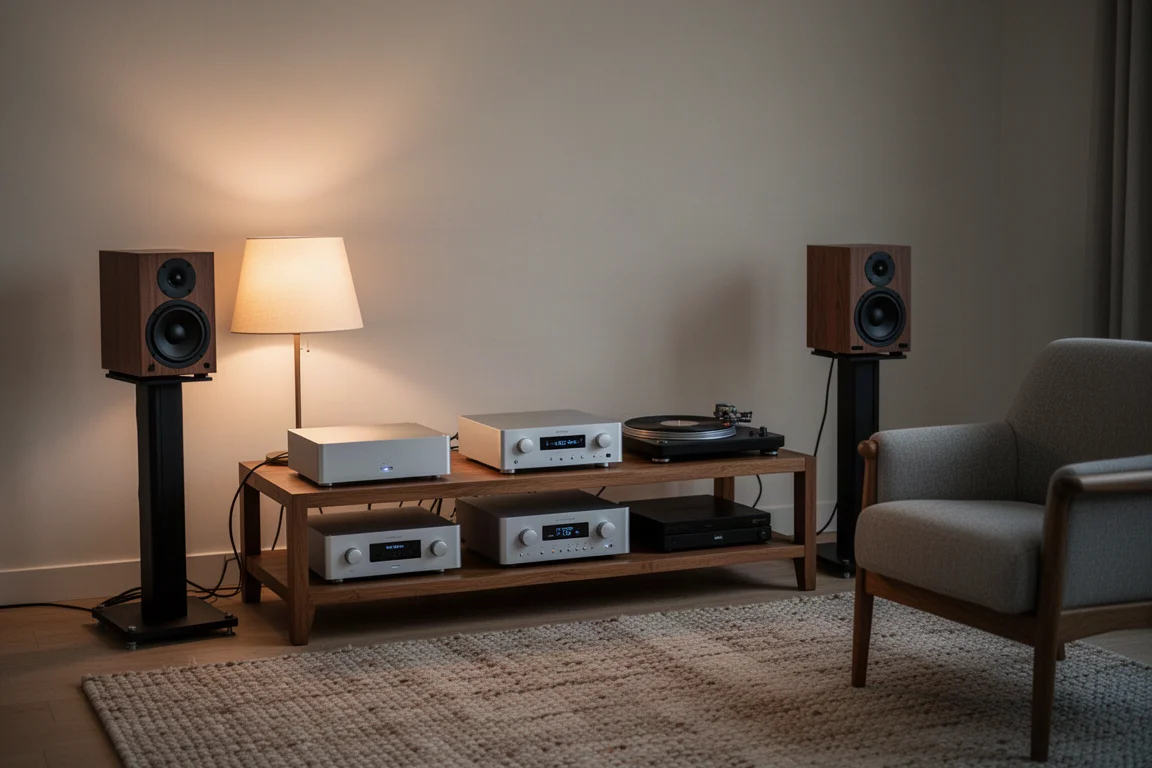
It is less suited to listeners who depend on coaxial or optical sources, since those inputs do not reach the same level as USB and I2S. It is also not the right choice for anyone who wants a DAC with preamp functionality or volume control, because the Harmony has neither. A separate preamplifier or integrated amplifier is required.
Build Quality and Industrial Design
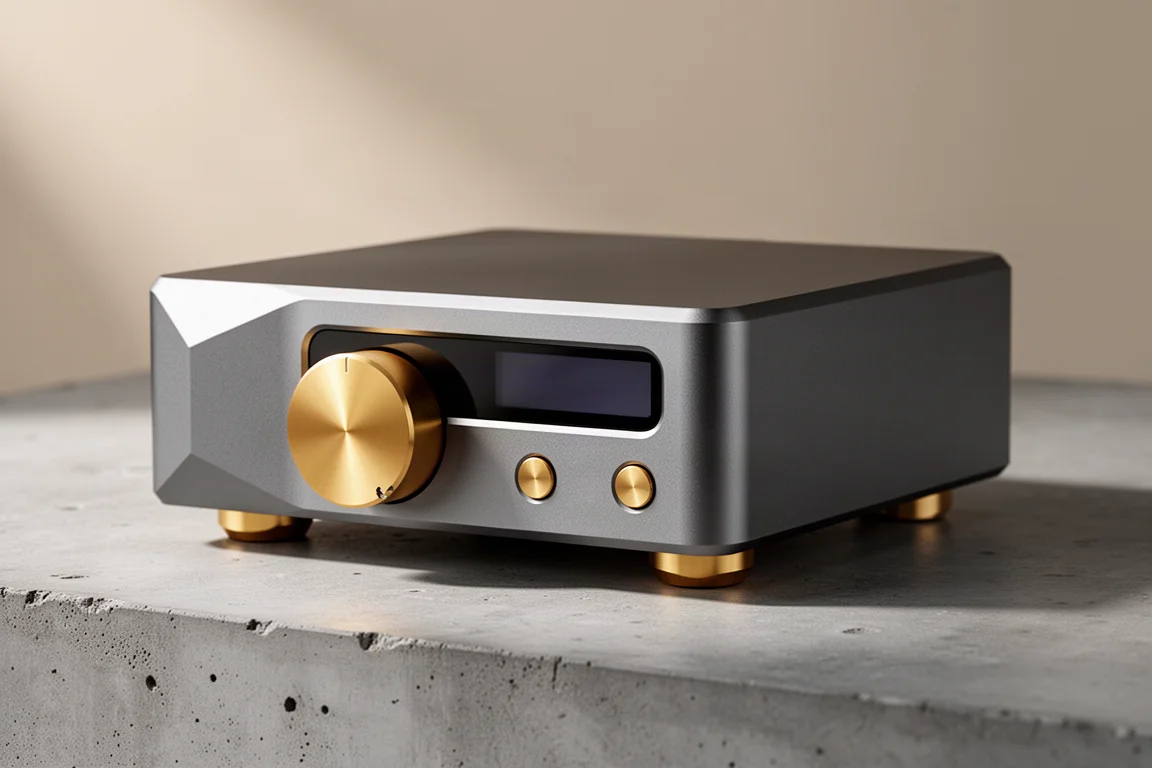
The chassis measures 255 mm wide, 75 mm high including the feet, and 250 mm deep, or roughly 10 by 3 by 9.8 inches. It weighs a reassuring 4.3 kg, or 9.5 lb. Rather than assembling the case from aluminium panels, the body is precision machined from a single billet, a construction normally reserved for considerably more expensive products. The aim is to keep vibration to a minimum.
The styling is anything but anonymous. Rounded edges, a chamfered front-left corner, and a rotary dial, buttons and sculpted feet finished in anodized gold aluminium give it a look that is hard to ignore, even in the more discreet black finish.
The button on the left powers the unit up, and a quick press toggles the OLED display on and off. That 97 mm, or 3.8 inch, monochrome screen presents information boldly and clearly. The button on the right opens the menus, which are scrolled with the rotary dial. The dial is not a volume control. The supplied remote is sculpted from a single billet of aluminium as well.
Inside the Chassis: Modular Design and Premium Parts
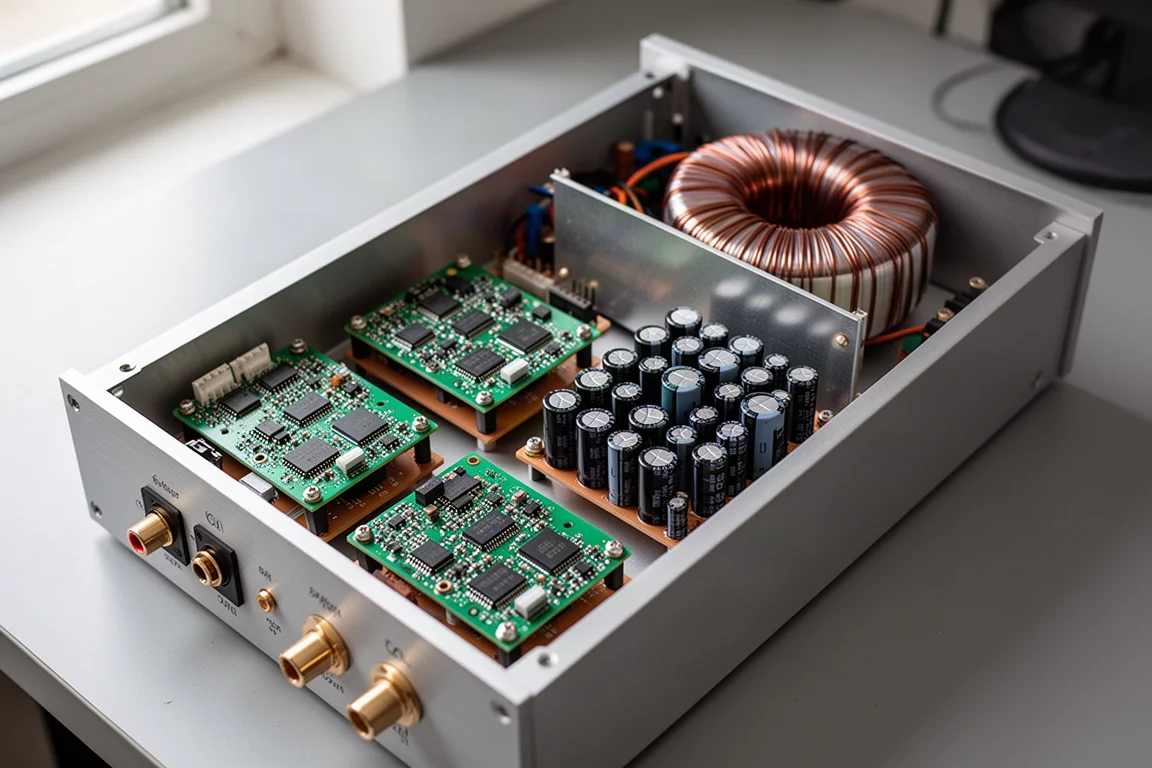
Removing the bottom panel reveals a modular layout. The display module, input module and output module each sit on their own board, and the digital and analog sections have separate power supplies, both fed from the same toroidal transformer. That approach makes the unit easier to service and leaves room for future upgrades.
The conversion stage itself is a fully balanced discrete R-2R ladder. The resistor ladders are housed in an anodized gold aluminium shell, which appears to be less about hiding the design and more about making the ladder networks straightforward to replace when upgrades become available. The tiny surface-mount resistors that form those ladders are selected to a tolerance of 0.05 percent, and that precision is central to how accurately an R-2R ladder performs its conversion.
Component quality is high throughout. Two ultra-low-noise femtosecond crystal oscillators, developed specifically for high-definition audio, form the clocking heart of the design, while an Intel Altera Cyclone FPGA handles signal processing. A generous bank of ZLH capacitors supplies power-supply capacitance, and the capacitors sitting directly in the signal path are of a standard rarely seen at this price, including four Audio Note capacitors in the output stage.
Around the back you will find single-ended RCA and balanced XLR analog outputs alongside four digital inputs: I2S, coaxial, optical and USB. AES/EBU is the obvious omission.
Digital Inputs and Why They Matter
Not all digital inputs behave the same way, and the circuitry a signal passes through before reaching the conversion stage differs from one connection type to the next.
Coaxial and optical are the oldest options, both routed through the S/PDIF interface. USB was developed later and works asynchronously, with a handshake between transport and converter that reduces jitter, the digital distortion that affects many S/PDIF connections. AES/EBU is also a decades-old format, a serial data stream over balanced connections, which allows long cable runs without added noise.
I2S is the format used natively inside most digital audio products, and it is how a converter communicates with other modules. The master clock, word clock and audio data travel separately rather than being multiplexed together, which makes it the purest form of external digital input a DAC can receive, since the clocking and audio signals never have to be unpicked from one another.
The practical consequence is that I2S, coaxial and AES/EBU are not asynchronous. Only USB is. With the synchronous connections, the transport, not the converter, is responsible for timing, which makes the quality of the source far more critical.
Sound Quality: What Each Input Reveals
Through the optical and coaxial inputs, the Harmony presents a warm side of neutral balance with a three-dimensional soundstage, a little bloom in the bass, richness through the midrange and a slight softening of transients at the leading edge of notes. The character is close to a Denafrips Ares 12th-1, with a touch more instrument separation and detail, though not enough to justify the price gap between them through these inputs.
Switching to USB brings clear gains. The tonal balance stays on the warm side, but the bass tightens, the midrange gains resolution, the top end opens up, and vocals and instruments come into sharper focus. The soundstage grows noticeably in width, and front-to-back layering remains strong. Through USB, the Harmony edges ahead of a Gustard R26, which costs around $500 less. Both retrieve detail well, with crisp note attacks, texture through the middle of notes and well-preserved decay. The difference is tone and space: the Gustard is neutral without being sterile, while the Harmony is fuller in the bass and lower midrange and throws a wider stage.
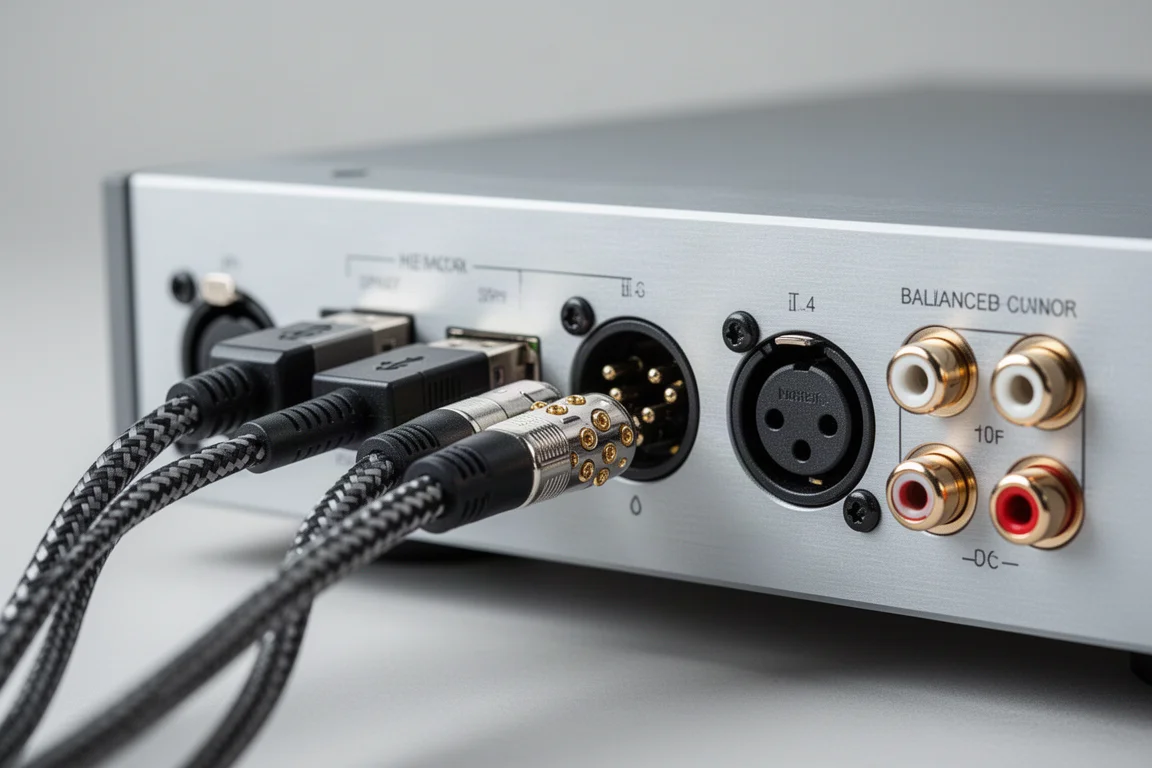
Feeding the I2S input, via a digital-to-digital converter, brings a further step up in clarity and focus. Detail retrieval is very close to the Gustard R26, but the Harmony paints on a larger canvas and gives performers greater acoustic mass. It does not match a Denafrips Venus 2, which sounds bigger, with more tangibility to where performers sit, more space between them, and more of the micro-detail that shapes natural timbre and harmonic finesse. The Venus 2 is also considerably more expensive.
Against the similarly priced Denafrips Pontus, the Harmony is a serious contender through its I2S and USB inputs. These differences remained audible when the converter was moved between different speakers and amplifiers, which suggests the character of the unit carries across systems rather than belonging to one particular setup.
Living With the LA Harmony DAC
The menu system is refreshingly short. There is an I2S pin layout setting, display brightness and illumination interval, a couple of remote control options, a choice of positive or negative signal phase, and the option to oversample or not.
That last setting matters. With oversampling switched off, the presentation sounded more natural, and there was no discernible loss in fidelity, which is a common finding with R-2R ladder designs. The Harmony also lacks preamp functionality, so it needs to be paired with a preamplifier or integrated amplifier. Analog output is available over both RCA and XLR, so balanced connection is straightforward if the rest of the chain supports it.
Buying Advice
The Harmony is easiest to recommend to listeners who can commit to USB or I2S as their primary input. In that configuration it delivers a large soundstage, good imaging and detail, and the harmonically rich presentation that draws many people to ladder converters in the first place. Add the remote control, the readable display and the single-billet construction, and the package is unusually complete for the money.
If your system relies on coaxial or optical, temper expectations. Those inputs work, but they do not show the converter at its best, and the gap between them and USB is wider here than on some rivals. Buyers who need AES/EBU, or who want volume control built in, should look elsewhere.
One practical point in the Harmony’s favour is the direct-sale model. The $2,700 price includes shipping, taxes, duties and VAT for residents of the 33 countries on the current list, which means the figure you see is close to the figure you pay, with no separate import bill arriving later. Two finishes are available, so the choice is mostly about whether you want the black version to blend in or the silver to stand out.
Conclusion
The LA Harmony DAC is a well-executed first impression from a relatively new brand. Its build is faultless, its styling is memorable, and its modular interior suggests the design was planned with long-term ownership in mind. Through USB and I2S it gets close to the class leaders, and it competes directly with the Denafrips Pontus on price and character. The main caveats are the weaker optical and coaxial inputs, the absence of AES/EBU, and the lack of any preamp function. For listeners with a USB or I2S front end who want a warm, richly layered R-2R presentation, plus a remote and a proper display, it is a genuinely compelling option.
Product link
View more details for LA Harmony DAC
This product is mentioned in the review. Check the specifications, options, and compatibility before buying.
View more details for LA Harmony DACFurther reading
Related Reviews
Hi-Fi Audio
Accuphase C-57 vs Allnic H-7000V: Two High-End Phono Stages Compared
A fully balanced solid-state phono stage with a pitch-black noise floor meets a tube design built for well-loved records. Here is how to choose between them.
Hi-Fi Audio
Active vs Passive Hi-Fi: Five Components for a Modern System
Five components that define modern active and passive hi-fi systems, with the strengths, trade-offs and setup details worth weighing before you buy.
Hi-Fi Audio
Advance Paris A10 Apex Review: A Hybrid Integrated Amplifier That Covers a Lot of Ground
A French hybrid integrated amplifier with a class A tube preamp stage, analogue power meters, and an internal DAC and phono stage good enough to make extra boxes unnecessary.