Hi-Fi Speakers
Klipsch Rebellion Review: A Heritage Stand-Mount With Live-Music Energy
The Klipsch Rebellion brings the Heritage line back to the bookshelf. Here is how its horn-loaded design, 95 dB sensitivity and 60 Hz bass limit shape what it does well.
Introduction
The Klipsch Rebellion is the newest member of the Klipsch Heritage line, a family of speakers that reaches back to 1946, when founder Paul Klipsch introduced the Klipschorn. The story goes that in 1958 he designed a bookshelf speaker called the H8, built a handful of prototypes and even a small production run, and then, for reasons that were never fully explained, the design never stuck. In 2026 the Heritage line finally has a stand-mount bookshelf model again, and like the rest of the range it is designed and manufactured in Hope, Arkansas.
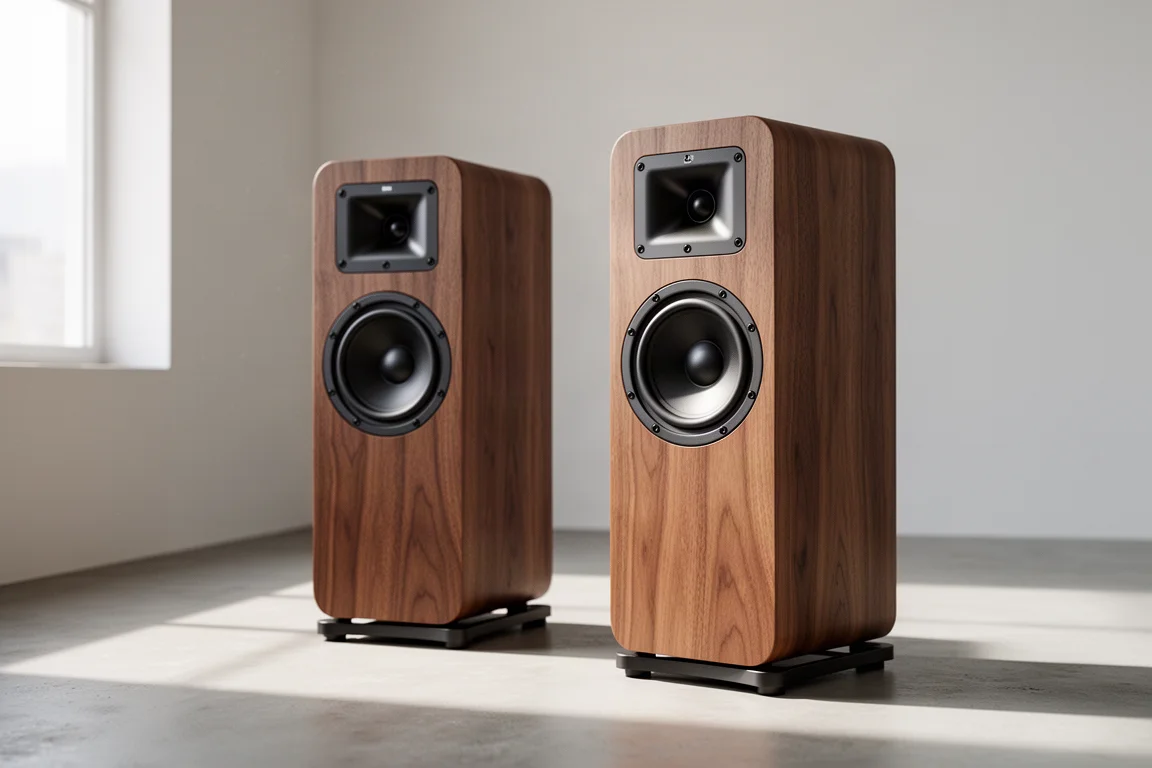
The Rebellion is a horn-loaded design assembled from familiar Heritage parts. A 1.75-inch compression driver feeds a Tractrix horn, the same combination used in the Klipsch Forte 4, where those parts handle midrange duty. Below it sits an 8-inch midwoofer.
Two standard finishes are available: American walnut, a real wood veneer, and black. Both are priced at $2,600 per pair. A special 80th Anniversary edition in a different wood finish is offered at $3,200 per pair.
Who This Product Is For
The Rebellion makes the most sense in a small to medium room, roughly 10 by 13 feet, where its limited deep bass output works in its favour rather than against it. Because the speaker does not push a large amount of low-frequency energy into the space, it can be used without overwhelming the room.
A sensitivity rating of 95 dB is well above average for a passive stand-mount, which means the Rebellion can be driven by amplifiers that would struggle with less efficient designs. Owners of low power tube amplifiers can use them here, provided they listen at moderate levels in a modest room.
It is also a strong match for listeners who care most about voices, piano, acoustic instruments and rock. Anyone who wants genuinely deep bass should either look at a larger speaker or plan to add a subwoofer.
Design and Build Quality
At 19 inches tall, the Rebellion is on the large side for a stand-mount, and at 32 pounds each it is solidly built. The walnut version uses real wood veneer, and the included woven grille attaches magnetically with no visible hardware.
The rear of the cabinet is a ported design, and the port tube follows Tractrix geometry in the same way the horn does. Connections are bi-wire capable, with all-metal binding post nuts rather than plastic. Rubber bumpers on the underside keep the speaker stable on a shelf or sideboard, and they should be removed when the speaker is placed on stands. Klipsch covers the Rebellion with a 10-year warranty, where five years is the more usual figure for a passive speaker.
Main Strengths
The Rebellion sounds like a Heritage speaker: lively, immediate and closer to live music than to a polite studio monitor. It is not laid-back, but it is also not bright, aggressive or shouty, which is where older horn designs earned their reputation. Small dynamic shifts and large ones both come through clearly, and brass and horn instruments sound like themselves.
The overall balance sits on the warm side of neutral, and the speaker is easy to listen to for long stretches without fatigue. It also holds up at very low volumes, so late-night listening does not feel like a compromise.
Bass is where the design surprises in a different way. There is not a lot of it in absolute terms, but what is there is quick and nimble, with good pitch definition and none of the thickness that can blur low notes. Clarity stays consistent from bass through the midrange and into the treble, and the midrange is the standout: vocals are handled especially well, and piano recordings come across with unusual realism.
The soundstage is wide, though focus and specificity within it are about average for a horn-loaded design. The Rebellion is also revealing enough to make differences between amplifiers obvious, which is useful when you are matching electronics.
Things to Consider Before Buying
The figure worth knowing before you buy is the low-frequency limit. Klipsch rates the Rebellion’s -3 dB point at 60 Hz. It does not fall off a cliff there, but a stand-mount with an 8-inch woofer would more typically reach down to around 50 Hz. The result is a speaker that is not bass challenged exactly, and certainly not lean, but also not especially full sounding. Listeners who want weight and depth in the bottom octaves should add a subwoofer or choose a larger speaker.
The 8-ohm nominal impedance also deserves attention. The load dips to 3.3 ohms, so a modest amplifier that is comfortable with an easy 8-ohm load may not be the best partner.
Finally, consider the footprint. Nineteen inches of cabinet and 32 pounds per speaker is a lot for a stand-mount, so plan the room and the stands accordingly.
Auditioning in your own room is worthwhile here, because the balance between limited bass extension and room size is exactly what determines whether the Rebellion feels at home.
How the Rebellion Compares
Listeners who know the Klipsch RP-600M will hear a strong family resemblance in the Rebellion. The two share a recognisable sound signature, but the Rebellion is the clearer and lower-distortion design of the pair, with a refinement that the far more affordable RP-600M, which sells for roughly $500 a pair, does not reach. Against the Buchardt S400 Mark III, a slightly smaller Danish speaker, the Rebellion gives up some fullness and room-filling weight, while keeping the advantage in clarity, dynamics and the sense of jump that makes recorded music feel immediate.
Buying Advice
The Rebellion is a considered purchase at $2,600 per pair, or $3,200 per pair for the 80th Anniversary finish, so the decision should start with your room and your amplifier rather than with the spec sheet. If your listening space is on the small side, if you value dynamics and vocal realism over deep bass, and if you own an amplifier that can cope with a load dipping to 3.3 ohms, the Rebellion is a coherent and rewarding choice.
The walnut veneer and the black finish are priced the same, so that decision is purely visual. If you plan to use the speakers on a shelf or sideboard, leave the rubber bumpers in place; if you use stands, take them off. A subwoofer is the sensible upgrade path if you later want more low-frequency weight, and the 10-year warranty means the speaker is intended to stay in a system for a long time.
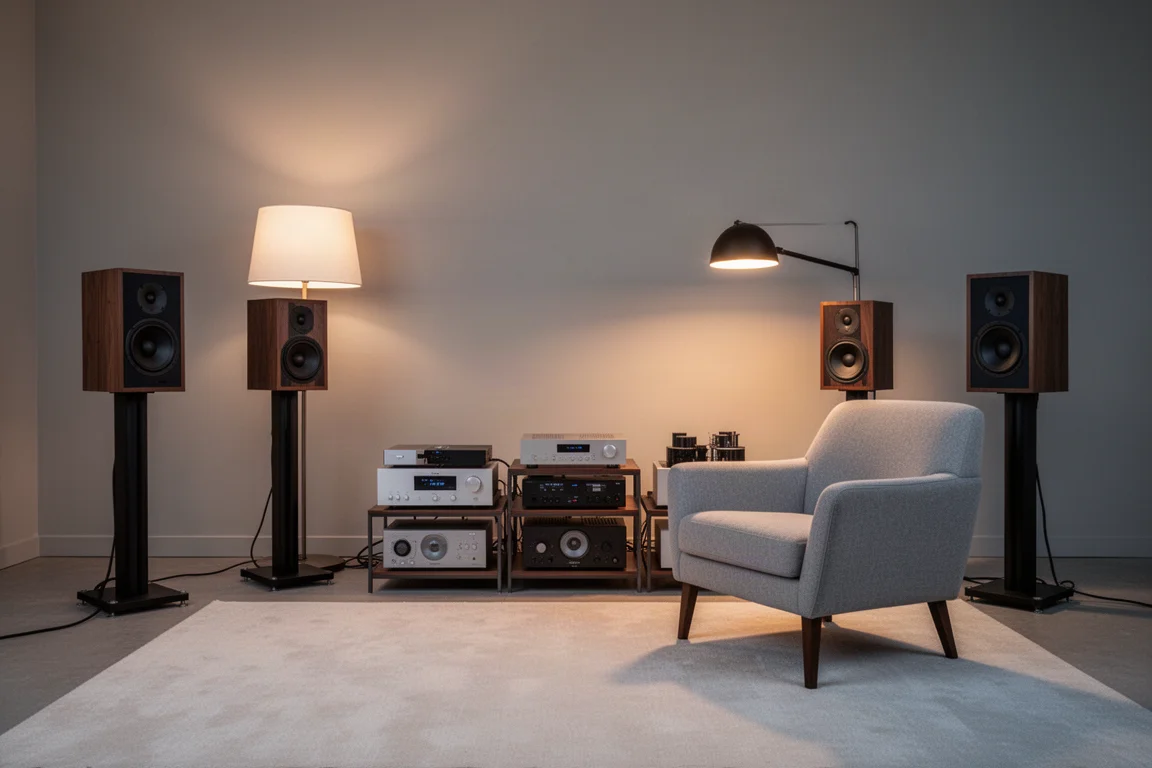
Because the speaker is easy to drive and honest about amplifier differences, it is worth pairing it with electronics you already trust rather than rebuilding an entire system around it.
Conclusion
The Klipsch Rebellion fills a gap that has been open since 1958: a Heritage bookshelf speaker. It brings horn-loaded dynamics, high sensitivity and a genuinely engaging midrange to a stand-mount that can live comfortably in a smaller room. Its 60 Hz bass limit and 3.3-ohm impedance dip are the two details to weigh before buying, and listeners who want deep, full-range bass will need a subwoofer or a bigger speaker. For everyone else, this is a lively, unfatiguing speaker that makes the most of the music it is given.
Product link
View more details for Klipsch Rebellion
This product is mentioned in the review. Check the specifications, options, and compatibility before buying.
View more details for Klipsch RebellionFurther reading
Related Reviews
Hi-Fi Speakers
1723 THX Tower vs 1528 Bookshelf: Which Speaker Fits Your Room?
Two speakers at roughly the same price, built very differently. How the 1723 THX tower and the 1528 bookshelf compare on construction, bass, power needs, and sound.
Hi-Fi Speakers
Acoustic Energy AE 300 Review: Deep Bass From a Compact Standmount
A two-way standmount with real wood veneer, surprising low-end weight, and a warm, easygoing character. Here is what to know before buying.
Hi-Fi Speakers
Acoustic Energy AE1 40th Anniversary Review: A Modern Take on a British Classic
A compact standmount that revives a 1980s favorite with all-new parts, a warm mid-centric balance, and a price of £1,499 per pair.