Hi-Fi Speakers
Klipsch Ojas KOR1 Review: A Limited-Edition Horn Speaker With Live-Music Immediacy
A two-way stand-mount horn speaker built by Klipsch and Ojas, with 97.5 dB sensitivity, a 12-inch Heresy IV woofer and a directness that rewards careful setup.
Introduction
The Klipsch Ojas KOR1 is the product of an unlikely but entirely logical partnership. Klipsch has been building horn loudspeakers in Hope, Arkansas since 1946. Ojas is a far younger studio based in Brooklyn, New York, founded by Devon Turnbull. What the two share is a commitment to horn-loaded design, and the KOR1 is what emerged when Roy Delgado of Klipsch and Turnbull decided to build a loudspeaker together.
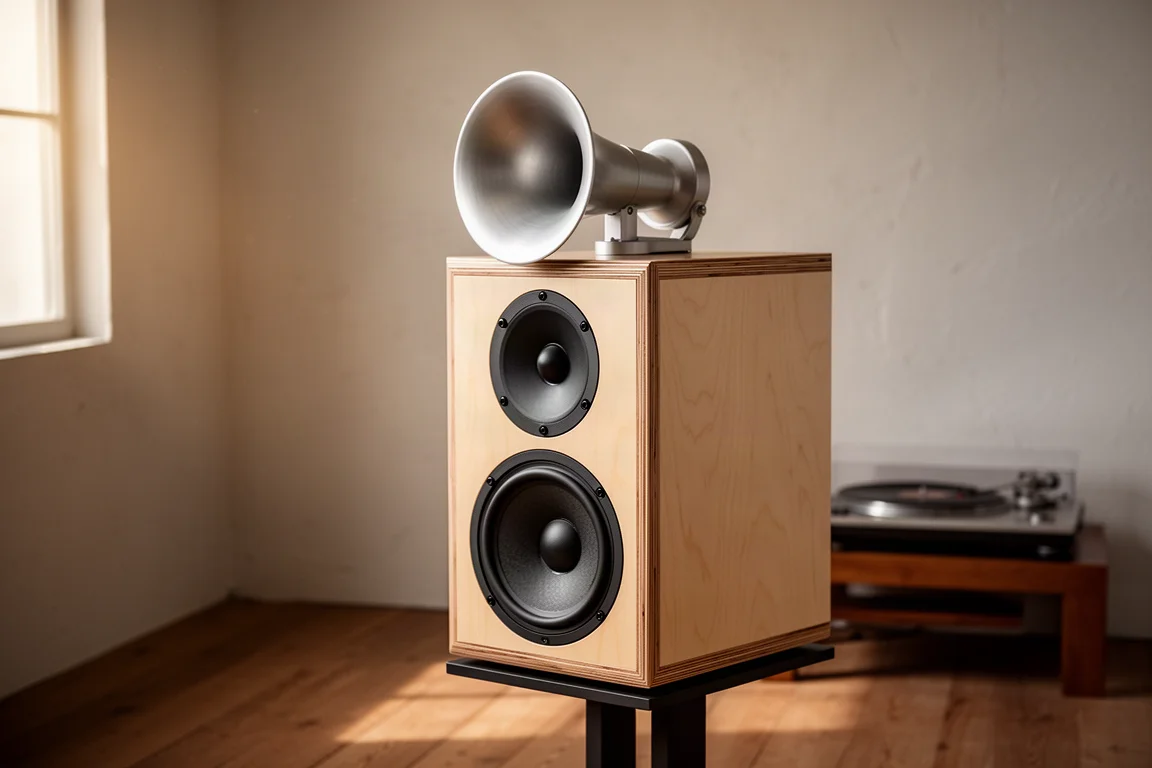
The result is a two-way stand-mount speaker that blends Klipsch engineering with an Ojas sensibility: a birch plywood cabinet, a cast aluminium horn, and a 12-inch woofer taken directly from the Klipsch Heresy IV. It is a limited edition offered in red oak and a gray finish, priced at $8,498 per pair with the 12-inch stands included.
For now the KOR1 is sold in the United States through three brick-and-mortar dealers: Common Wave Hi-Fi in Los Angeles, IQ Home Entertainment in Fairfax, Virginia, and the Ojas showroom in New York City. Broader worldwide distribution is planned for a later stage.
Design and Build: A Klipsch and Ojas Collaboration
The cabinet is the first clue that this is not a typical Klipsch loudspeaker. It is built from 13-ply birch plywood, a construction approach that reads as Ojas, while assembly itself takes place at the Klipsch factory in Hope, Arkansas.
Above the cabinet sits a cast aluminium horn, another Turnbull signature, loaded with a K76 compression driver. The 12-inch woofer below is carried over directly from the Klipsch Heresy IV, so the speaker genuinely cross-pollinates the two design languages rather than dressing one company’s hardware in another’s styling.
Roy Delgado designed the crossover network, which hands over at 970 Hz, as well as the six-inch-deep rectangular port. A high-frequency control on the right-hand side of the cabinet, visible when looking down at the speaker, provides five positions spanning minus 3 dB to plus 3 dB in 1.5 dB steps, giving owners a useful range of tonal adjustment.
The stands are 12 inches tall and ship with the speaker, along with two different kinds of feet. Two-way designs sometimes attract skepticism, but Klipsch’s own flagship Jubilee, a far larger speaker priced at $36,000 per pair, is also a two-way. The appeal is a simpler crossover network, and a simpler crossover tends to make the transitions through bass, midrange and treble smoother.
Sound Quality: Immediacy, Dynamics, and Detail
Horn loudspeakers are usually discussed in terms of dynamics, and the KOR1 certainly delivers those. The quality that stands out most, though, is immediacy. There is a directness to the way it reproduces a piano key being struck, the attack of a trumpet, or a voice entering a room. It is the kind of shading and presence that recreates the feeling of live music rather than a facsimile of it.
Bass is tight, fast and leading-edge, and its integration with the horn is excellent. That integration is what makes the midrange so strong for voice, guitar and acoustic instruments. Electric guitar in particular has the bite and edge that great recordings depend on. On electric-period Miles Davis, both the instruments and the trumpet’s attack arrive with the energy the music demands.
The speaker is equally convincing at low levels. At roughly 40 dB there is no urge to turn it up, and as the volume rises the presentation simply scales. Even at mid-90 dB peaks there is no sense of strain or distortion creeping in, and the top end stays extended, clear and pure. Well-made recordings sound delicate and clean; harsh, brittle recordings will be exposed for exactly what they are.
Amplifier Matching and Setup
With a rated sensitivity of 97.5 dB, the KOR1 can be driven by very low-powered amplifiers, and it has no trouble with high-powered ones either. Nominal impedance is 8 ohms with a dip to 4.4 ohms, so a wide range of designs will work.
In practice the speaker has performed beautifully with a 20-watt-per-channel output-transformerless tube amplifier, with a Class A solid-state amplifier, and with a roughly 60-year-old EL34 tube amplifier delivering 35 watts per channel. Each brought a different character to the music, and each was satisfying in its own way.
The high-frequency trim control is the main setup tool. Its five positions cover a 6 dB window, which is enough to fine-tune the balance to a room, a recording or a personal preference without altering the fundamental character of the speaker.
How It Compares With Larger Reference Speakers
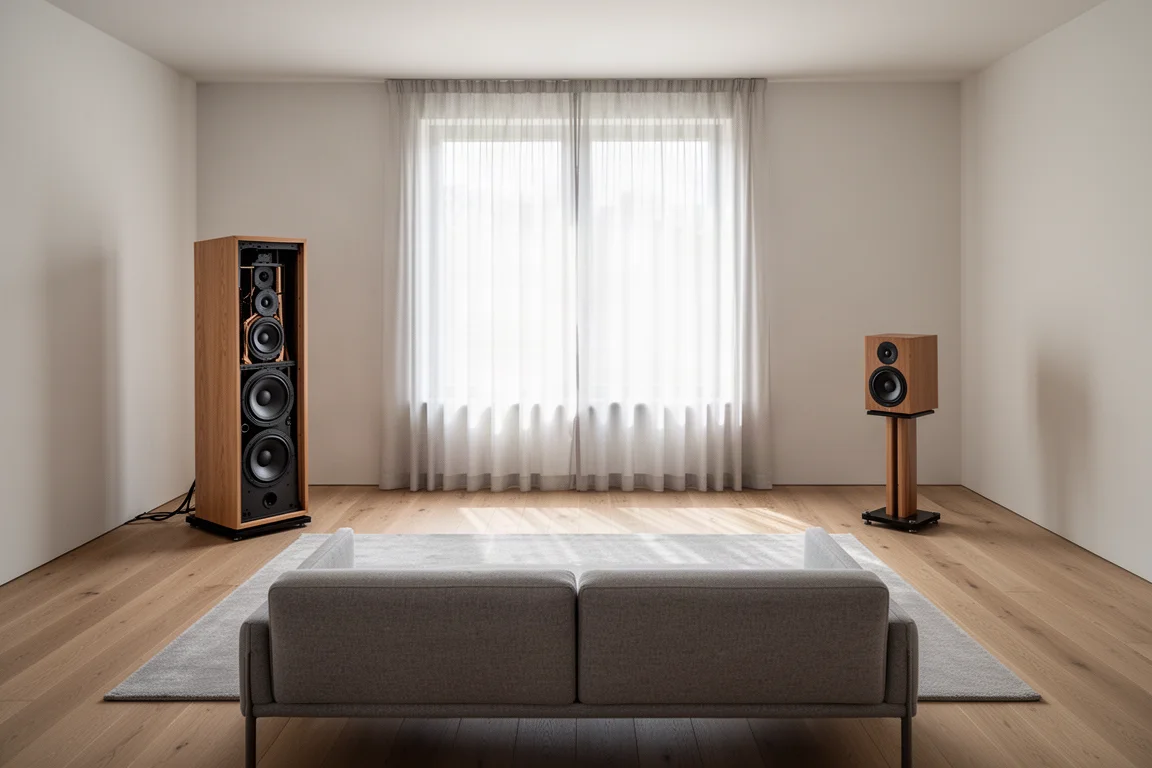
The KOR1 is a relatively small speaker with a 12-inch woofer, and it does not pretend to sound like a large one. Against an open-baffle reference pair that uses 15-inch woofers and full-range drivers, it gives up scale and low-end weight, and its output below roughly 50 Hz is limited. The open-baffle speakers also place the performance further back, with a deeper and more recessed soundstage.
Where the KOR1 pulls ahead is presence. It sounds more forward, more immediate and more alive, with a center image that locks in with a focus that is genuinely rare. Listeners who want the deepest bass and the physical weight of a big cabinet should plan on adding a subwoofer, or consider a larger three-way design such as the Klipsch Cornwall IV, which uses a 15-inch woofer in a much bigger enclosure and moves noticeably more air. Listeners who prioritize liveness, dynamic shading and midrange purity will find the KOR1 gives more of what matters to them.
Things to Consider Before Buying
- The KOR1 is a limited edition, and no production number has been published.
- Availability is currently restricted to three dealers in the United States, with worldwide distribution planned for a later stage.
- Bass below roughly 50 Hz is limited, so a subwoofer is worth budgeting for if deep low-frequency weight matters.
- The two-way approach will not suit every listener, even though the flagship Jubilee shows how far it can be taken.
- The speaker is revealing, and poor recordings will not be flattered.
Buying Advice
The KOR1 makes the most sense for listeners who value immediacy, dynamic shading and midrange purity above all else, and who either own a low-powered amplifier or are curious about one. The 97.5 dB sensitivity means a modest tube amplifier is a realistic pairing rather than a compromise, and the included stands plus the five-position high-frequency trim make the speaker easy to live with once it is in the room.
A subwoofer is the sensible companion if deep bass matters. Buyers who want a single pair of speakers to deliver full-range weight on their own should look at a larger three-way design instead. Those who simply want to explore horn character before committing at this level can do so at a fraction of the cost with an affordable horn model such as the Klipsch RP-600M.
Conclusion
The Klipsch Ojas KOR1 is a reminder of what well-executed horn design does better than almost anything else. It brings immediacy, presence and dynamic shading to recordings in a way that makes music feel live, and it does so from a compact stand-mount cabinet that works with amplifiers of almost any power output.
Its limits are honest ones. Bass below roughly 50 Hz is modest, and a larger three-way will always move more air. Within its range, though, the KOR1 delivers a level of engagement that is rare, and the collaboration behind it has produced something genuinely distinctive rather than a badge exercise.
Product link
View more details for Klipsch Ojas KOR1
This product is mentioned in the review. Check the specifications, options, and compatibility before buying.
View more details for Klipsch Ojas KOR1Further reading
Related Reviews
Hi-Fi Speakers
1723 THX Tower vs 1528 Bookshelf: Which Speaker Fits Your Room?
Two speakers at roughly the same price, built very differently. How the 1723 THX tower and the 1528 bookshelf compare on construction, bass, power needs, and sound.
Hi-Fi Speakers
Acoustic Energy AE 300 Review: Deep Bass From a Compact Standmount
A two-way standmount with real wood veneer, surprising low-end weight, and a warm, easygoing character. Here is what to know before buying.
Hi-Fi Speakers
Acoustic Energy AE1 40th Anniversary Review: A Modern Take on a British Classic
A compact standmount that revives a 1980s favorite with all-new parts, a warm mid-centric balance, and a price of £1,499 per pair.