Home Audio
KEF Reference 2 Meta Review: A Center Channel Built for Every Seat
A three-way sealed center channel with coaxial drivers, excellent directivity, and very low distortion, plus the small tonal trade-offs worth knowing before you buy.
Introduction
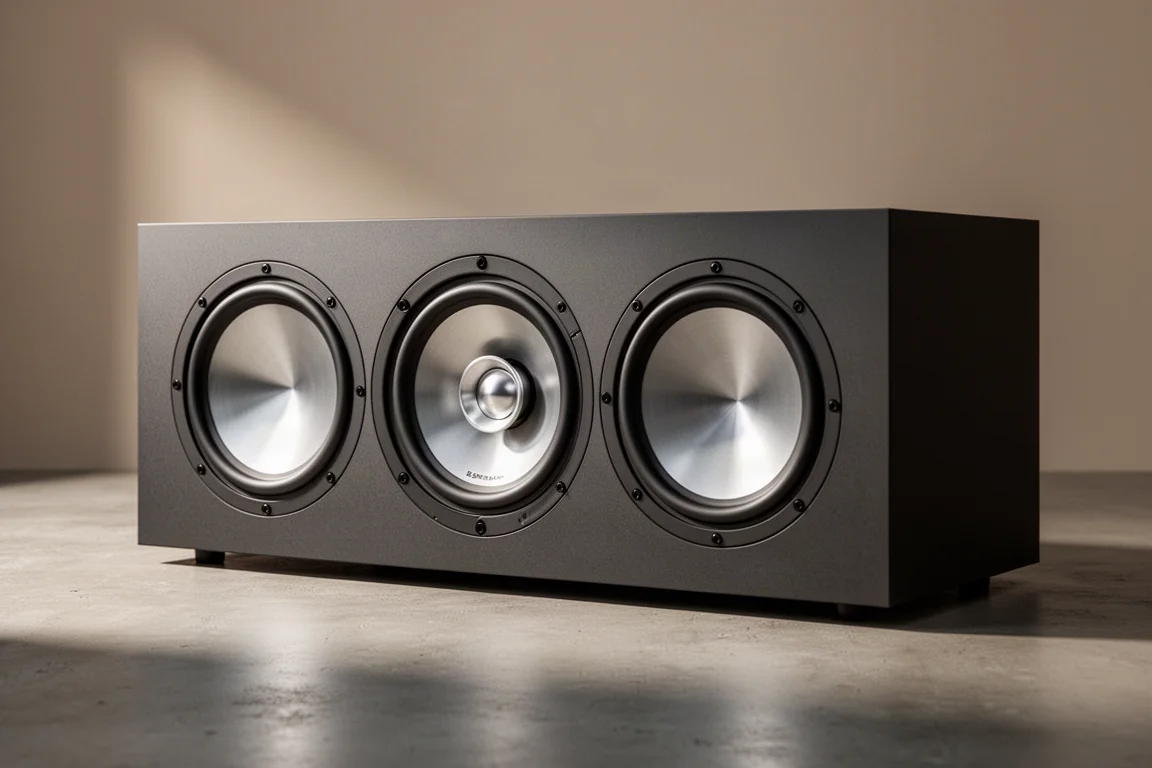
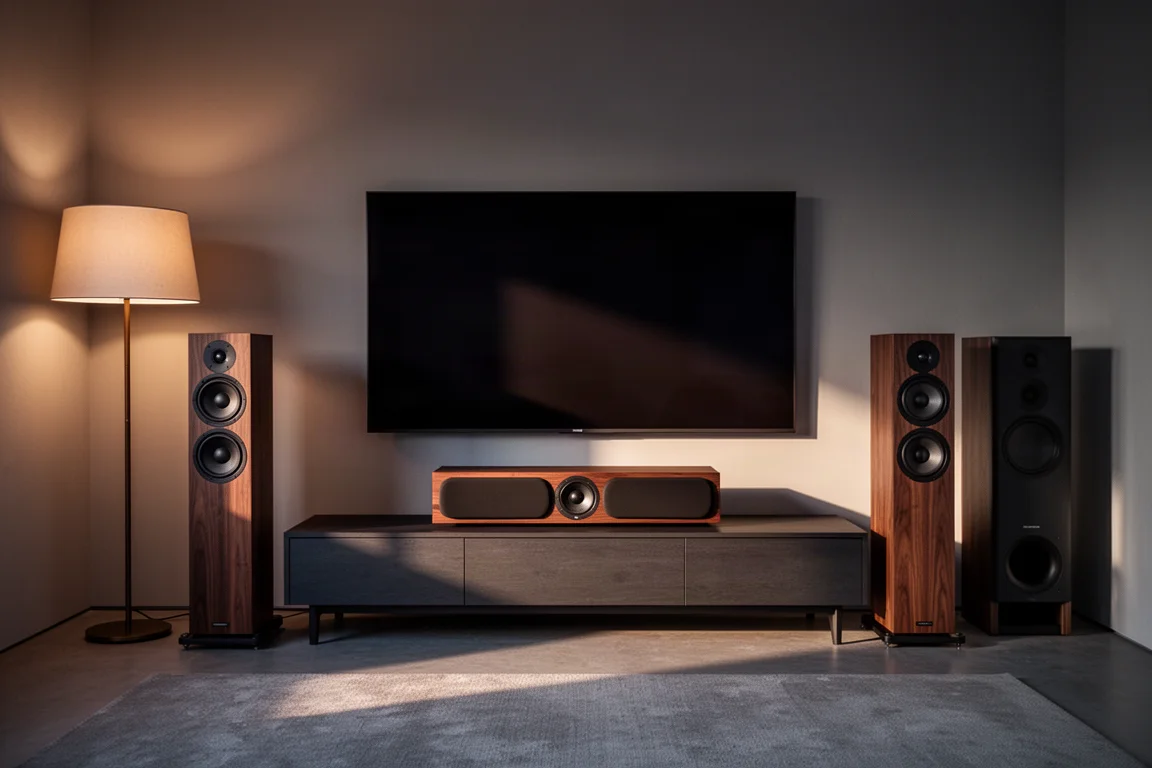
The KEF Reference 2 Meta is a three-way sealed center channel loudspeaker that can also be positioned upright and used in a monitor-style orientation. It sits at the top end of what most people would budget for a center channel, and the design decisions behind it aim squarely at one problem: keeping dialogue anchored and tonally consistent for every listener in the room, not just the person in the sweet spot.
That focus shows up in the driver layout. Instead of a conventional dome tweeter mounted on a flat baffle, the Reference 2 Meta builds its midrange and treble around a coaxial assembly, which is the main reason its measured behavior stays so even across listening angles. The result is a center channel that behaves more like a well-sorted monitor than a typical horizontal box.
Who the KEF Reference 2 Meta Is For
This speaker is aimed at listeners running multi-seat, multi-row home theater systems where off-axis performance matters as much as on-axis performance. If people are sitting to the sides of the room, or in a second row behind the first, the Reference 2 Meta is designed to give them a very similar tonal picture to what the primary seat hears.
It also makes sense as a tonal match for larger speakers in the same family. Owners of the Reference 3 or Reference 5 Meta floorstanders can pair it directly, and it can serve as a center channel alongside a pair of Blade speakers even if the cabinet aesthetics differ. The speaker is offered in a range of colors, which makes it easier to blend into an existing setup.
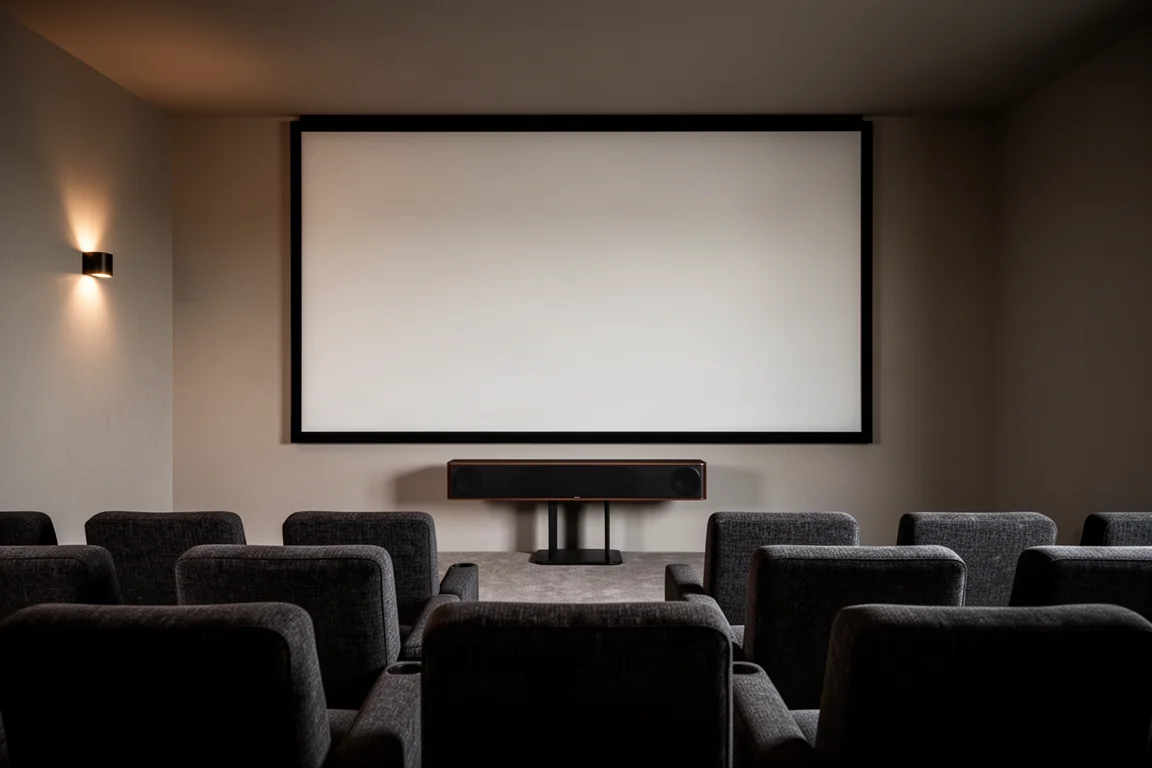
Because it can be stood upright, the Reference 2 Meta is not limited to a shelf under a screen. It can be used vertically where space or cabinet design allows, which broadens the range of rooms it can work in.
Design and Driver Configuration
The Reference 2 Meta is a three-way sealed enclosure. At its center is a coaxial driver that places a 1-inch aluminum dome tweeter in the middle of a 5-inch aluminum cone midrange driver. Two 6.5-inch aluminum cone drivers handle the bass.
KEF specifies a frequency range of 65 Hz to 45 kHz, well beyond what anyone can hear at the top end. Crossover points are set at 450 Hz between the midrange and the bass drivers, and 2.1 kHz between the midrange and the tweeter. Recommended amplifier power is 50 to 300 watts.
Directivity and Seat-to-Seat Consistency
This is where the speaker separates itself from most center channels. Measured on-axis and 30 degrees off-axis responses track each other closely, staying within roughly 2 dB across the range. Horizontal coverage holds out to about 40 degrees up to around 13 kHz, and vertical coverage extends well past plus or minus 40 degrees, which matters when a second row is sitting above the tweeter axis.
The benefit of the coaxial layout is that there is no crossover-related suckout through the upper midrange, and the tweeter does not narrow abruptly above 8 kHz. Radiation stays consistent to roughly 50 degrees in both the horizontal and vertical planes.
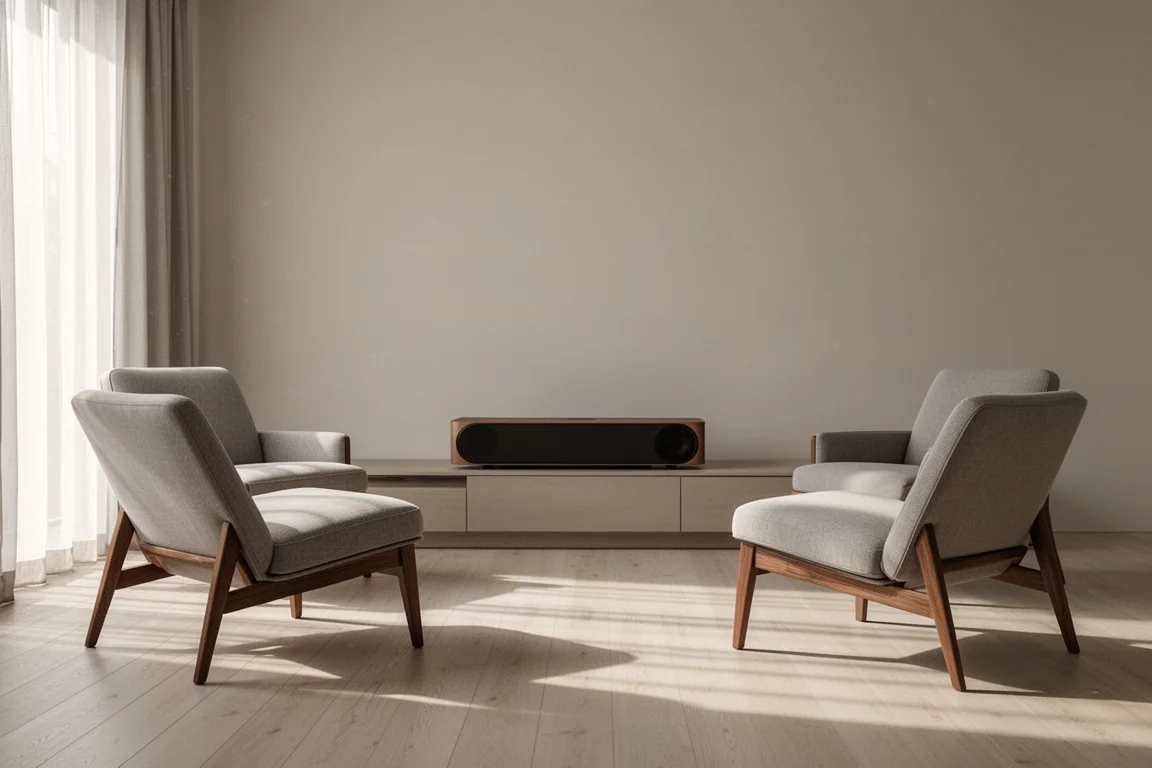
In practice, that means seat-to-seat variation is minimal. Listeners to the side or behind the primary seat get the same dialogue anchoring rather than a shifted tonal balance, which is the entire point of a center channel in a multi-seat room.
Distortion, Compression, and Measured Linearity
Distortion is very low at both 86 dB and 96 dB, and multi-tone distortion is equally well controlled. Long-term compression stays within about half a dB at the highest test level, near 100 Hz. Average sensitivity measures around 88 dB, a reasonable figure for a speaker of this type.
On-axis frequency response sits in a tight window of roughly 2 to 2.5 dB. F3 lands at 76 Hz and F10 at 46 Hz, so although the rolloff begins early, it is gradual rather than abrupt, which is typical of a sealed cabinet. There is a mild upper midrange scoop, and some low-level ringing appears around 3 to 4 kHz and near 1.5 kHz. Those decay artifacts are low in level, and similar behavior shows up in plenty of non-aluminum drivers as well.
Bass Extension, Placement, and Amplification
Because the enclosure is sealed, the low-frequency rolloff is gentle. In-room extension down to about 60 Hz is realistic, which gives enough overlap to blend cleanly with a subwoofer. A crossover around 80 Hz is comfortable, and the minimum recommended crossover point is 50 Hz, leaving useful flexibility if a subwoofer has a dip in the region where it hands over.
Placement matters a little. The measured response suggests the speaker works well within about two feet of a wall. Pulling it further into the room introduces a small dip, though only on the order of 1.5 dB, so this is a refinement rather than a dealbreaker.
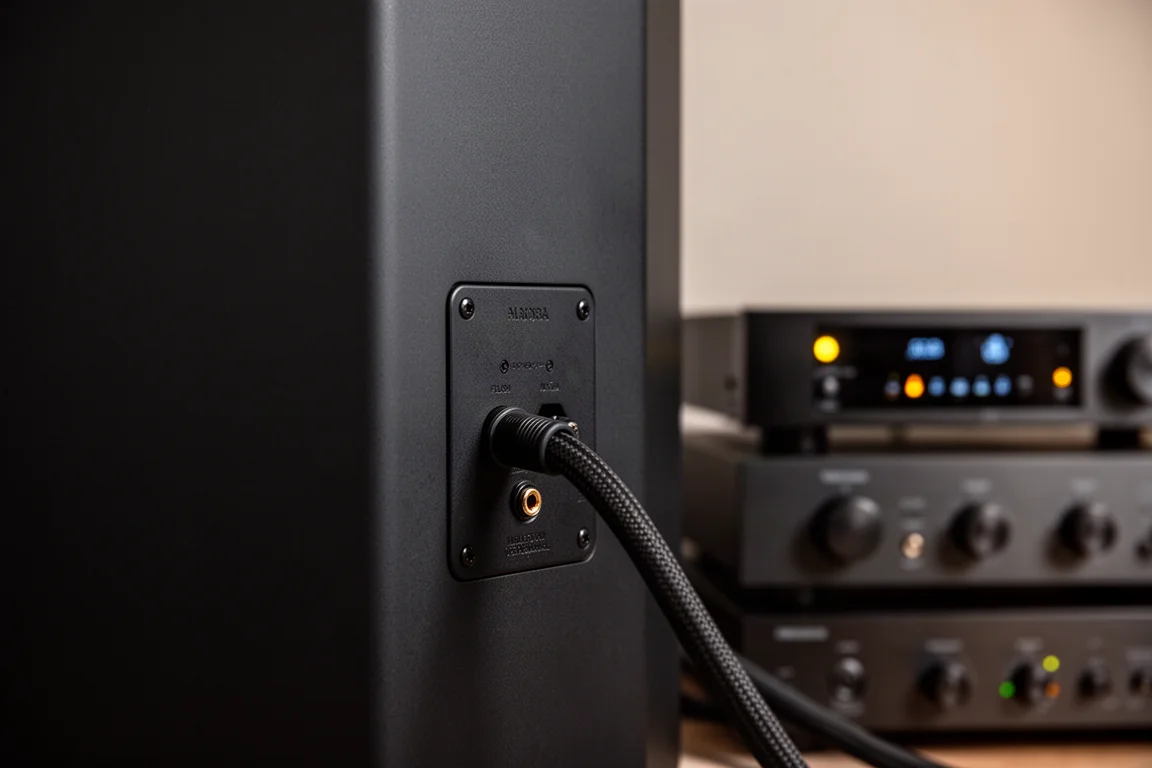
Amplification deserves attention. Impedance drops to a minimum of about 3.2 ohms, and EPDR reaches roughly 2.1 ohms at 200 Hz. That makes the Reference 2 Meta a demanding load for class AB amplifiers, so a solid 4-ohm-capable amplifier is the sensible choice.
For most rooms, that combination of gradual rolloff, flexible crossover range, and stable directivity makes the speaker easy to integrate into an existing system without heroic tuning.
Things to Consider Before Buying
The top end rolls off gradually above about 8 kHz. Depending on taste, that can read as a lack of air or fine detail, though it is worth noting that the low distortion, low compression, and consistent directivity mean this region takes EQ well if you want more sparkle.
There is also a mild dip around 1 kHz. It can make the speaker sound slightly recessed or a touch warm, and it takes out some attack. Because the on-axis and off-axis responses track closely through that area, it can be equalized without creating a tonal mismatch between direct and reflected sound.
Short-term compression data suggests crossing the speaker over no lower than 50 Hz, and the impedance profile means it is not the easiest load to drive. Budget for a capable amplifier alongside the speaker itself.
Buying Advice
If you are building a multi-seat home theater and want the center channel to hold its tonality across the room, the Reference 2 Meta delivers on that brief. Pair it with Reference 3 or Reference 5 Meta floorstanders, or with Blade speakers, and set the crossover somewhere between 50 Hz and 80 Hz depending on your subwoofer.
Give it a 4-ohm-capable amplifier, and place it within about two feet of the wall if you want to avoid the small measured dip. If you prefer a brighter top end, EQ is a realistic option here rather than a compromise.
The speaker is expensive, but the measured performance and the consistency from seat to seat are what you are paying for. If your room has more than one row of seats, that consistency is the feature that matters most.
Conclusion
The KEF Reference 2 Meta is a three-way sealed center channel with a coaxial midrange and tweeter, very low distortion, excellent directivity, and a gradual low-frequency rolloff that integrates easily with a subwoofer. Its weaknesses are minor and largely addressable: a gentle top-end rolloff, a small dip near 1 kHz, and an impedance curve that asks for a capable amplifier. For a multi-seat home theater where dialogue clarity has to hold up across every chair, it is a straightforward recommendation.
Product link
View more details for KEF Reference 2 Meta
This product is mentioned in the review. Check the specifications, options, and compatibility before buying.
View more details for KEF Reference 2 MetaFurther reading
Related Reviews
Home Audio
Aperion Novus Tower and Center Review: Punchy Home Theater Sound With Real Refinement
A close look at the Aperion Novus tower and center speakers, from their layered paint finish and punchy bass to the 4-ohm load and what the price actually buys.
Home Audio
Arendal 1610 Tower Review: Flagship Dynamics in a Room-Friendly Tower
A compact floorstanding tower with three 8-inch aluminium woofers, a 5-inch carbon midrange, and the kind of bass heft usually reserved for much larger speakers.
Home Audio
Arendal 1723 S THX Review: A Reference Speaker Built Like a Tank
A practical look at the Arendal 1723 S THX, a sealed, THX-certified speaker with exceptional build quality, a very flat top end, and a midrange that responds beautifully to EQ.