Bookshelf Speakers
KEF Q150 Review: A Coaxial Bookshelf Speaker With Real Soundstage Depth
A close look at the KEF Q150 bookshelf speaker, covering its coaxial driver design, soundstage depth, bass limits, and the price points where it makes sense.
Introduction
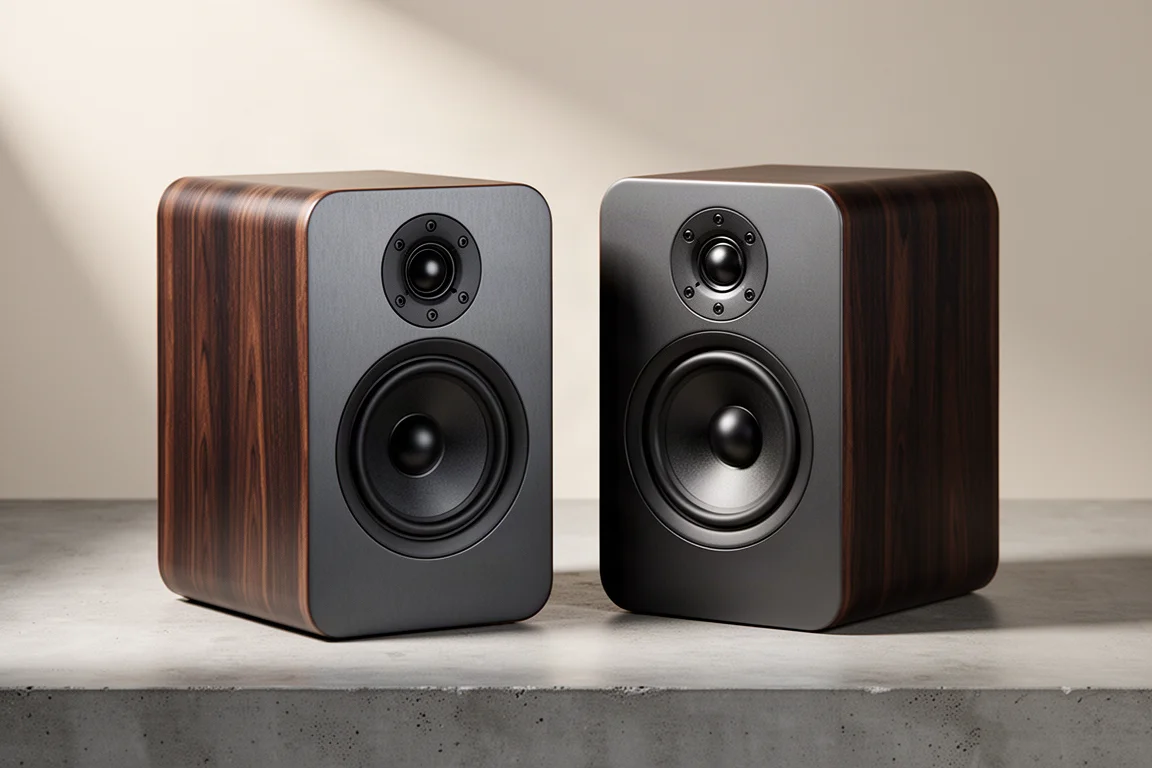
The KEF Q150 is a compact two-way bookshelf speaker built around a single coaxial driver array: a one inch dome tweeter and a five and a quarter inch midrange that operate together as one concentric unit. It can be run in either a ported or a sealed configuration, and that coaxial arrangement shapes almost everything the speaker does well.
Pricing is the other half of the story. The Q150 carries a stated regular price near $600 per pair, and it has been selling at roughly $299 per pair. That gap matters, because the value calculation changes a great deal depending on which number a buyer is looking at.
Who This Speaker Is For
The Q150 suits listeners who want a compact speaker with a wide, deep soundstage rather than maximum output. Sensitivity averages around 84 dB, so it rewards a capable amplifier rather than a low-powered one. In practice it held up well with about 230 watts available at a listening distance of roughly four meters.
Distance also changes the character of the speaker. At three to four meters in a treated room, the tonal balance reads as reasonably even. In the near field, at about a meter or less, the top end becomes noticeably more forward, which is worth knowing if the speakers are headed for a desk rather than a dedicated listening room.
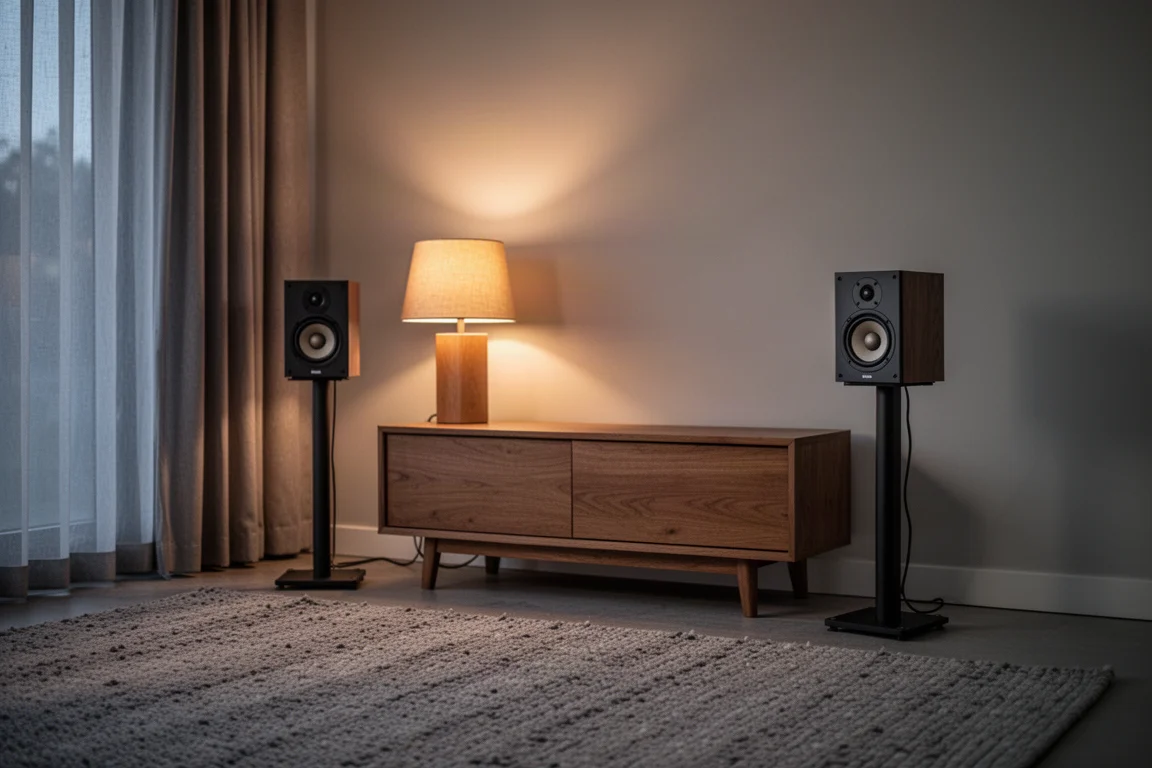
Room treatment plays into this as well. A space with acoustic paneling smooths the upper frequencies, while a typical living room with limited soft furnishings lets more of that energy through. Neither outcome is wrong, but the room is a genuine variable with this speaker.
Main Strengths: Coaxial Design and Soundstage Depth
The standout quality of the Q150 is soundstage depth. Because the tweeter and midrange are coaxially aligned and effectively time aligned, their output arrives at the listening position at nearly the same moment, and the speaker spreads a convincing sense of depth that most conventional two-way designs in this class struggle to match.
That depth is not only a horizontal effect. The vertical and horizontal presentation stay close to each other, so the image holds together as a listener moves around the room. Listeners who value a three dimensional, holographic presentation tend to notice this quality immediately.
Bass extension is also respectable for a cabinet this size. The Q150 reaches down into the kick drum region, which is enough for many listeners to enjoy it without a subwoofer at moderate levels.
Ported and Sealed Configurations
The Q150 can be run in either a ported or a sealed configuration, and that choice changes the low-frequency behaviour more than it changes anything else. In the ported configuration the speaker extends lower and rolls off more gradually, which is the setup most buyers will want for music without a subwoofer.
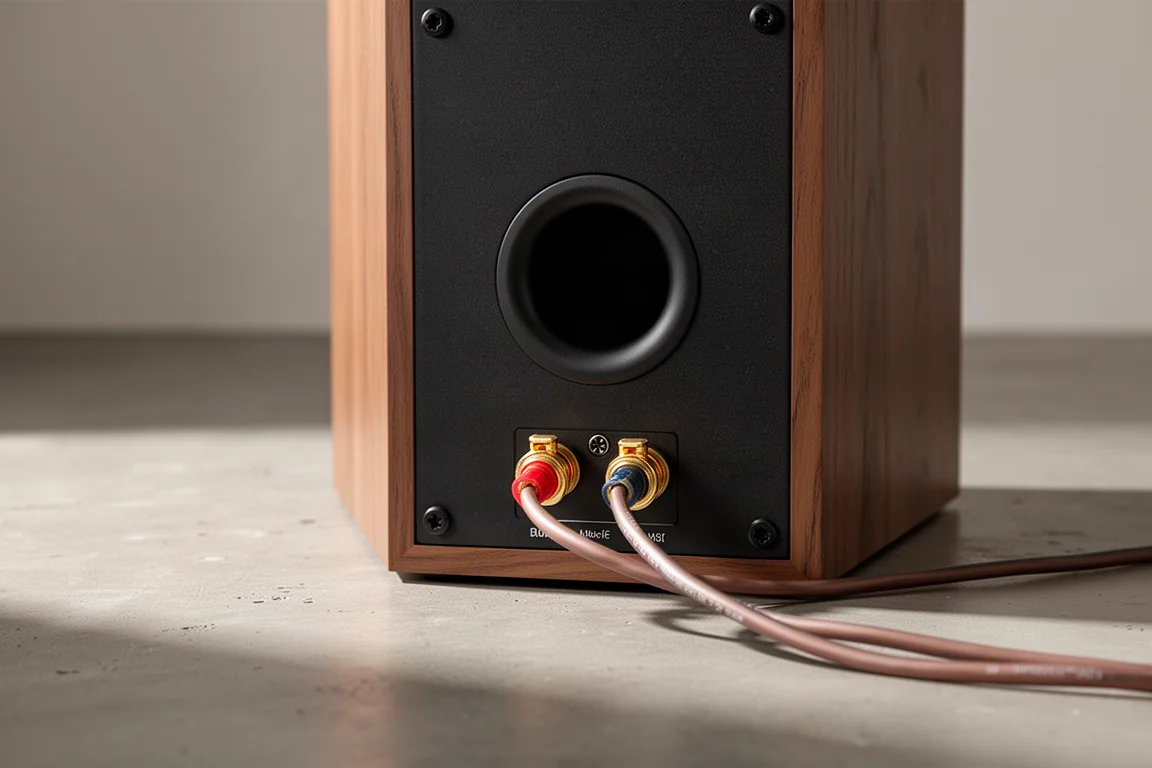
Sealing the cabinet shifts the roll-off to a steeper 12 dB per octave slope and starts that roll-off higher in frequency, so sealed operation trades bass extension for a more controlled low end. Distortion behaviour is essentially the same in both configurations, and because the speaker is likely to be crossed over well above the point where distortion rises, the choice comes down to preference and room rather than measured purity.
One consistent finding across both configurations is a set of resonances in the midrange that remain present whether the cabinet is ported or sealed. Their persistence points to cabinet panel vibration rather than the port as the source, which means they can be addressed with equalization rather than a physical modification.
Things to Consider Before Buying
There are two tonal characteristics to weigh before buying. The first is a directivity index mismatch in the one and a half to two kilohertz region, which appears to come from the vertical response rather than the horizontal. The horizontal off-axis behaviour through that range stays clean, so the issue is narrower than a broad directivity problem.
The second is a rise in the estimated in-room response at the top end. Around eight kilohertz the radiation pattern widens, sending more energy into the room, and that is the region that reads as bright in untreated spaces and at short listening distances.
Both characteristics are manageable. Listeners who prefer a linear top end can adjust toe-in, add absorption, or apply a single band of equalization to bring that region down. The midrange resonances are similarly linear across the measurements, which means they respond predictably to equalization as well.
Sensitivity, Power, and Subwoofer Needs
With an average sensitivity around 84 dB, the Q150 is not an efficient speaker, and it will ask for real amplifier power. A high-pass filter is worth using, because without one the woofer can over-exert itself at higher volumes.
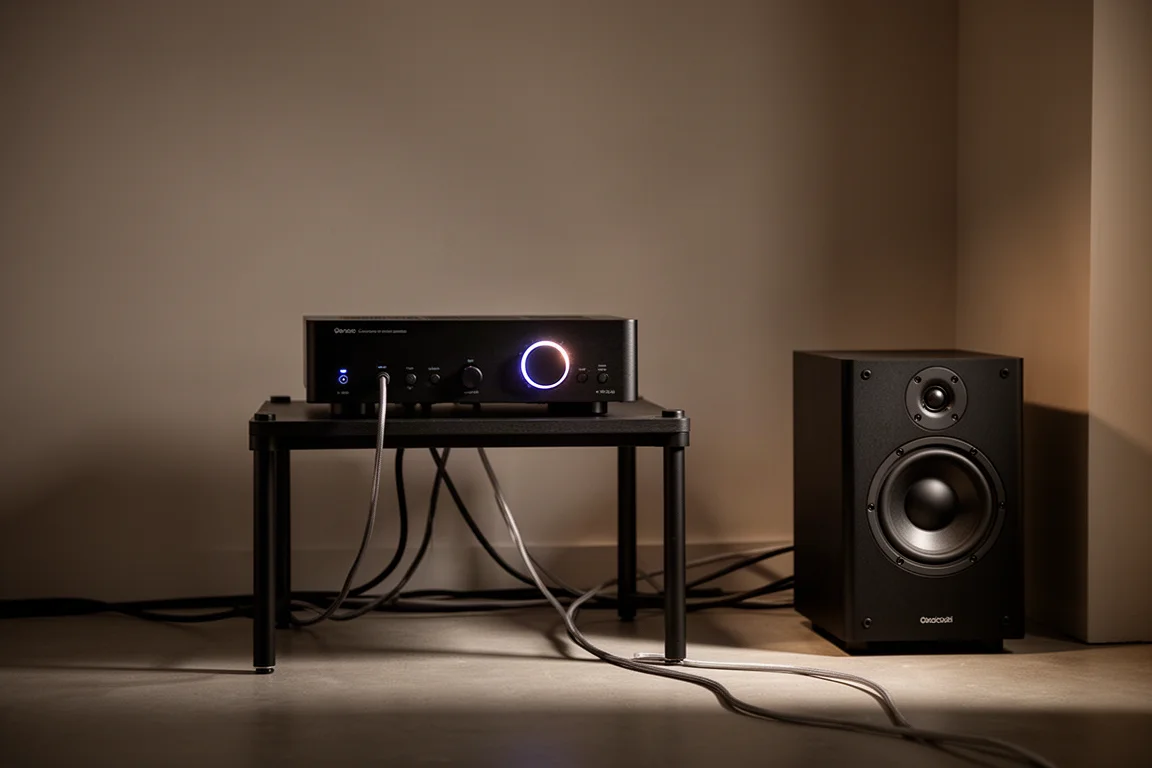
The practical recommendation is straightforward: pair the Q150 with a subwoofer and cross it over higher than usual. A crossover of at least 80 Hz works, and 100 Hz or even 120 Hz tends to give better results. Compression and linearity stay orderly until extreme levels, where output at 102 dB becomes uneven, especially at lower frequencies. The subwoofer is therefore doing more than adding bass. It is protecting the midrange driver from the workload that causes that unevenness.
If no subwoofer is part of the plan, the speaker’s natural extension still reaches down toward the 50 Hz region, which is enough to make it usable on its own at moderate levels in a smaller room.
Placement, Toe-In, and Room Treatment
Placement is the cheapest tool available with this speaker. Angling the cabinets slightly in or out changes how much of that upper-frequency energy reaches the listening position, and small adjustments are often enough to shift the balance from bright to neutral.
Acoustic treatment is effective here too, with one important limitation. Most panels of a few inches thick stop being useful below roughly one kilohertz, which happens to sit near the region where the Q150 already behaves well. That makes the upper-frequency bump a good candidate for treatment, since the problem and the effective range of typical panels overlap.
In a room with drapes on one wall and bare surfaces on the other, expect the imbalance to be audible. Rooms with more soft furnishings tend to even things out, so a few ordinary changes to the space can be as useful as any purchase.
Buying Advice
At the sale price of roughly $300 per pair, the Q150 is an easy recommendation. The soundstage depth it delivers is difficult to find elsewhere at that figure, and the tonal issues are correctable with placement, treatment, or a single band of equalization.
At around $400 per pair the recommendation still holds. Above that, the calculation becomes less clear, and at the stated regular price near $600 per pair the speaker faces much stiffer competition. Buyers comparing it against alternatives such as the Emotiva B1+ should weigh what they value most: the Q150’s depth and imaging, or a more conventionally balanced top end.
A subwoofer should be treated as part of the budget rather than an optional extra, especially for anyone planning to listen at higher volumes.
Conclusion
The KEF Q150 is a compact coaxial bookshelf speaker that does one thing exceptionally well. Its sense of soundstage depth is the reason to buy it, and the coaxial driver arrangement is the reason it can. The trade-offs, a bright top end in untreated rooms and limited output without a subwoofer, are real but manageable.
For listeners building a modest two-channel system around a small speaker and a subwoofer, the Q150 makes a strong case, particularly at the sale price. Buyers who want a speaker that plays loudly on its own, or who prefer a relaxed top end out of the box, should plan for the extra steps or look elsewhere.
Product link
View more details for KEF Q150
This product is mentioned in the review. Check the specifications, options, and compatibility before buying.
View more details for KEF Q150Further reading
Related Reviews
Bookshelf Speakers
Acoustic Energy A100 Mark II Review: A Compact Standmount With an Expansive Soundstage
The Acoustic Energy A100 Mark II brings clarity, natural tonality and a wide soundstage to an entry-level standmount, with a few setup details worth knowing first.
Bookshelf Speakers
Acoustic Energy AE-100 Mark II Review: Compact Bookshelf Speakers With Standout Imaging
A compact British two-way bookshelf speaker with deep, layered imaging, fast bass, and a slight treble lift to weigh against a crowded $500 field.
Bookshelf Speakers
Acoustic Energy AE100 MK2 Review: Measured Performance and Four Alternatives
A close look at the Acoustic Energy AE100 MK2 bookshelf speaker, what its measured performance reveals, and four alternatives with different trade-offs.