Bookshelf Speakers
KEF LS50 Meta Review: Refined Imaging, Real Trade-Offs
The KEF LS50 Meta delivers superb imaging and a rock-solid cabinet, but bass depth, amplifier demands, and price deserve careful thought before buying.
Introduction
The KEF LS50 Meta is a compact passive bookshelf speaker built around a concentric driver array, and it carries a retail price of $1,600. That combination puts it in a busy part of the market, where it lines up against several well-regarded alternatives at similar and considerably lower prices.
The Meta sits on an 8-ohm nominal rating, which on paper suggests it can be driven by a wide range of amplifiers. In practice, the picture is more nuanced, and that nuance shapes almost everything worth knowing about this speaker. It is a refined, beautifully made design with genuine strengths, and it also asks more of a system than its specification sheet first suggests.
This review covers what the LS50 Meta does well, where it holds back, and who should feel confident buying it.
Who This Speaker Is For
The LS50 Meta is aimed at listeners who care most about imaging and soundstage. The concentric driver layout places the woofer around the tweeter, which produces a tightly focused image and widens the usable listening area so the sweet spot is less of a single precise seat.
That makes it a natural fit for a small to medium room where the speakers sit a reasonable distance apart and the listener is not pinned to one exact spot on the sofa. It suits people building a two-channel system around a dedicated integrated amplifier, and it rewards owners who are willing to spend time on placement and on integrating a subwoofer.
It is not the simplest path into good sound. Anyone hoping for a speaker that flatters whatever amplifier happens to be on hand, or that delivers full-range bass on its own, will find the LS50 Meta pushes back.
Equally, this is a speaker for listeners who value clean, uncoloured presentation over drama and punch. If excitement and scale sit at the top of your priorities, the LS50 Meta is unlikely to be the most satisfying choice at this price.
Design and Build Quality
Physically, the LS50 Meta is exceptionally solid. The cabinet has a substantial, weighty feel, with mass concentrated low in the enclosure. That construction leaves very little opportunity for the cabinet itself to add resonance to the sound, and it is one of the clearest reasons the speaker sounds as clean as it does.
The finish is genuinely attractive. The paint has a fine, slightly rough texture, the front baffle is curved, and the trim rings around the drivers are neatly executed. The copper tone of the driver surround is a distinctive detail that gives the speaker a character of its own without tipping into showiness.
Around the back you get five-way binding posts, which accept the usual connection types and make cabling straightforward. The enclosure is ported, and foam port plugs are included in the box for listeners who want to tame the low end in a room that needs it.
Sound Characteristics
The published frequency response runs from 79 Hz to 28,000 Hz, and that lower figure is the single most important number here. It tells you plainly that the LS50 Meta is not a full-range speaker and that a subwoofer is part of the intended system rather than an optional extra.
With low frequencies handled elsewhere, the speaker’s bass is clean and controlled. It is not especially textured, and it shares some of that character with aluminium-driver designs that trade warmth for definition. Around 100 Hz to 125 Hz the speaker is punchy enough to give drums real presence, and bass drum hits land with a satisfying thump followed by a crisp, snappy snare.
Where the LS50 Meta excels is focus. The concentric driver arrangement produces an image with clear placement, and vocals and instruments sit in well-defined positions across the stage. Detail retrieval is strong. On sparse, heavily reverberant acoustic material you can follow the vibration of individual strings and hear the room around the performance.
Two tonal traits are worth flagging. First, the midrange sits slightly back compared to the original LS50, which pushes some lead vocals a little further into the mix than expected. Second, the treble is composed rather than forward. Even on notoriously bright, sibilant recordings, the LS50 Meta stays restrained, and cymbals and metallic instruments carry a bit of bite without becoming fatiguing over a long session.
Main Strengths
The imaging and soundstage are the headline. Few compact speakers at this price place instruments with this much precision, and the concentric design makes that focus hold up across a wider listening area than a conventional two-way layout.
The cabinet is another clear strength. The heavy, rigid enclosure keeps resonance out of the equation, so what you hear is the driver behaviour rather than the box. Combined with the attractive finish and the curved baffle, it is a speaker that looks and feels like a considered piece of engineering.
Tonally, the LS50 Meta is easy to live with. The slightly recessed midrange and composed treble mean long listening sessions stay comfortable, and the clean bass, once a subwoofer is in place, integrates smoothly with the rest of the range.
Compared with the original LS50, the Meta is the better speaker overall. It offers a little more bass punch and a touch more dynamic range, even if the difference is incremental rather than transformative.
Things to Consider Before Buying
The first consideration is bass. With a 79 Hz lower limit, the LS50 Meta needs a subwoofer to feel complete. Budget for one, and budget for the space to place it properly, or accept that large portions of your music will arrive without their foundation.
The second is amplification. Sensitivity is rated at 85 dB, and recommended amplifier power is 40 to 100 watts. That is not a punishing load on paper, but this speaker does ask for quality rather than quantity. It has been run successfully on a Cambridge Audio Evo 105 DeLorean Edition, a Teac AI-303, and a WiiM Amp, and it has also been driven by Emotiva A1 monoblocks with a Cambridge Audio unit acting as preamp. Getting the most from it tends to mean bringing real current and control to the partnership.
The third consideration is price. At $1,600 the LS50 Meta competes directly with the Sonus Faber Lumina II Amator, a speaker with noticeably more dynamic energy and excitement on top. It also sits well above the Q Acoustics 5020, which lands around $900, and far above the ELAC Uni-Fi 2.0, which costs roughly a third as much while using a comparable concentric driver arrangement and a three-way design. That ELAC in particular sounds strikingly similar in character.
Finally, be honest about what you want from a speaker. The LS50 Meta is more dynamic than the first-generation model, but not enough to change its fundamental personality. Listeners who prioritise drive and immediacy may find it polite to a fault.
How the LS50 Meta Compares to the Original LS50
The generational differences are smaller than the marketing might suggest. The Meta version shifts the midrange slightly further back, adds a little more bass punch, and improves dynamics modestly. It is the more complete speaker of the two, and the one worth choosing if you are buying new.
Within the brand’s own range, the more affordable KEF Q150 is worth auditioning before you commit. It is a strong performer in its own right, and some listeners will find its presentation more immediately engaging than the LS50 Meta’s more restrained balance.
Buying Advice
Buy the LS50 Meta if imaging, build quality, and a clean, unfatiguing tonal balance are what you value most, and if you are prepared to build the rest of the system around it. A capable integrated amplifier and a competent subwoofer are effectively part of the purchase, so factor both into the total cost before you decide.
Placement matters more than usual here. Give the speakers room to breathe, keep them away from rear walls where the port interacts with the room, and use the supplied foam plugs if the low end becomes unruly. If you can audition the speaker alongside the Q Acoustics 5020 and the ELAC Uni-Fi 2.0, do so. The differences in price are significant, and the differences in sound are smaller than those numbers imply.
If you already own the LS50 Meta and enjoy it, there is no reason to second-guess that. It is a genuinely good speaker that does several things very well. The point is simply that at this price, “good” has a lot of company.
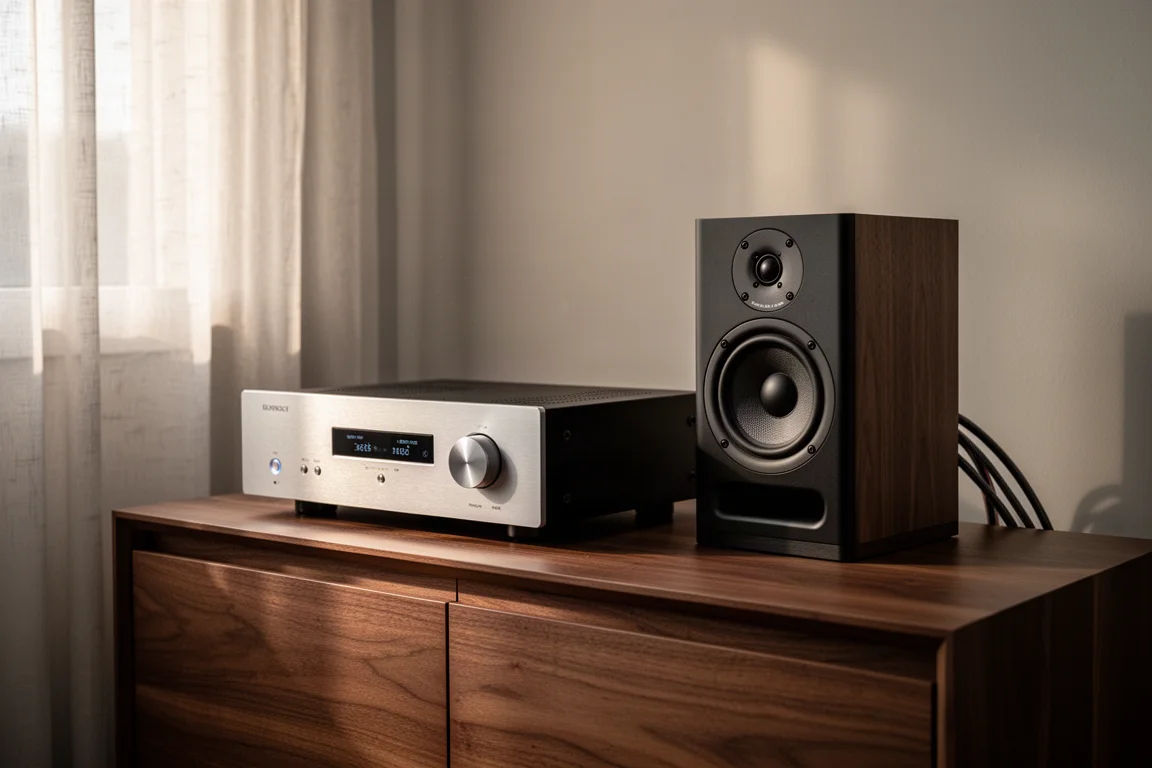
The practical test is straightforward. If you sit down, hear the image lock into place, and stop thinking about the equipment, the LS50 Meta has done its job. If you keep waiting for a song to hit harder, a different speaker will serve you better.
Conclusion
The KEF LS50 Meta is a beautifully built compact speaker with excellent imaging, a remarkably inert cabinet, and a composed, comfortable tonal balance. It is clearly better than the model it replaces, and it will satisfy listeners who prioritise precision and refinement.
It is also a speaker with real conditions attached. It needs a subwoofer, it benefits from a capable amplifier, and at $1,600 it faces competition that is both more dynamic and, in some cases, far cheaper while sounding remarkably close.
For the right listener, in the right system, it is a confident purchase. For everyone else, it is a good speaker rather than a great one, and the alternatives deserve a serious listen before you decide.
Product link
View more details for KEF LS50 Meta
This product is mentioned in the review. Check the specifications, options, and compatibility before buying.
View more details for KEF LS50 MetaFurther reading
Related Reviews
Bookshelf Speakers
Acoustic Energy A100 Mark II Review: A Compact Standmount With an Expansive Soundstage
The Acoustic Energy A100 Mark II brings clarity, natural tonality and a wide soundstage to an entry-level standmount, with a few setup details worth knowing first.
Bookshelf Speakers
Acoustic Energy AE-100 Mark II Review: Compact Bookshelf Speakers With Standout Imaging
A compact British two-way bookshelf speaker with deep, layered imaging, fast bass, and a slight treble lift to weigh against a crowded $500 field.
Bookshelf Speakers
Acoustic Energy AE100 MK2 Review: Measured Performance and Four Alternatives
A close look at the Acoustic Energy AE100 MK2 bookshelf speaker, what its measured performance reveals, and four alternatives with different trade-offs.