Subwoofers
KEF KF92 vs KEF KC62: Which Compact Subwoofer Suits Your Room?
Two compact KEF subwoofers compared on size, features, measured output, distortion and group delay, with clear guidance on which room and listening level each one suits.
Introduction
KEF builds two compact subwoofers that sit at very different points on the size and output scale: the KF92 and the KC62. They share the same control philosophy, but they behave very differently once the volume goes up. This comparison covers physical size, features, measured output at low, medium and maximum levels, total harmonic distortion, group delay and CEA-2010A results, so you can decide which one fits your room and the way you actually listen.
Size and Feature Differences
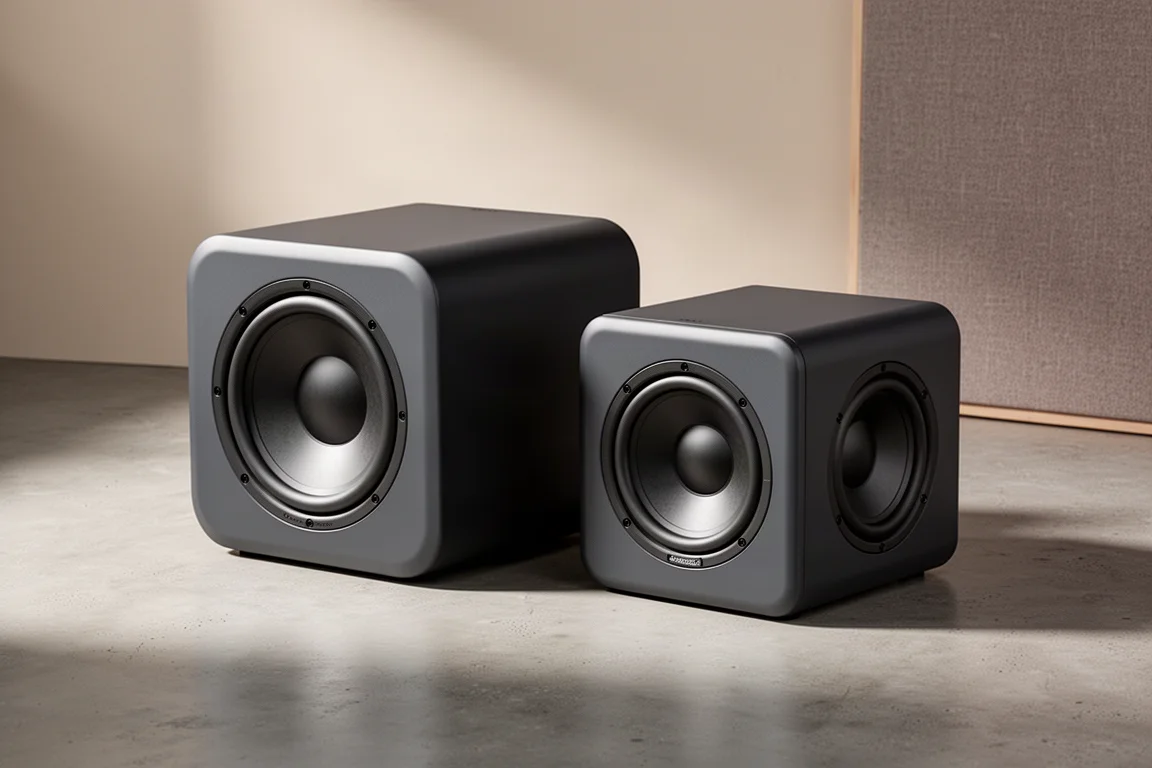
The most obvious difference is physical. The KC62 is roughly one third of the overall volume of the KF92, which makes it far easier to place in a small room, an apartment layout or a tight corner. The KF92 needs noticeably more floor space and reads as a substantial piece of furniture once it is in the room.
The feature sets are close enough that the decision comes down to size and output rather than connectivity. Both offer an LFE mode and manual switches for room mode, corner mode and apartment mode, so the same placement and tuning options are available on either cabinet.
KEF KC62: Compact Punch With a Firm Limit
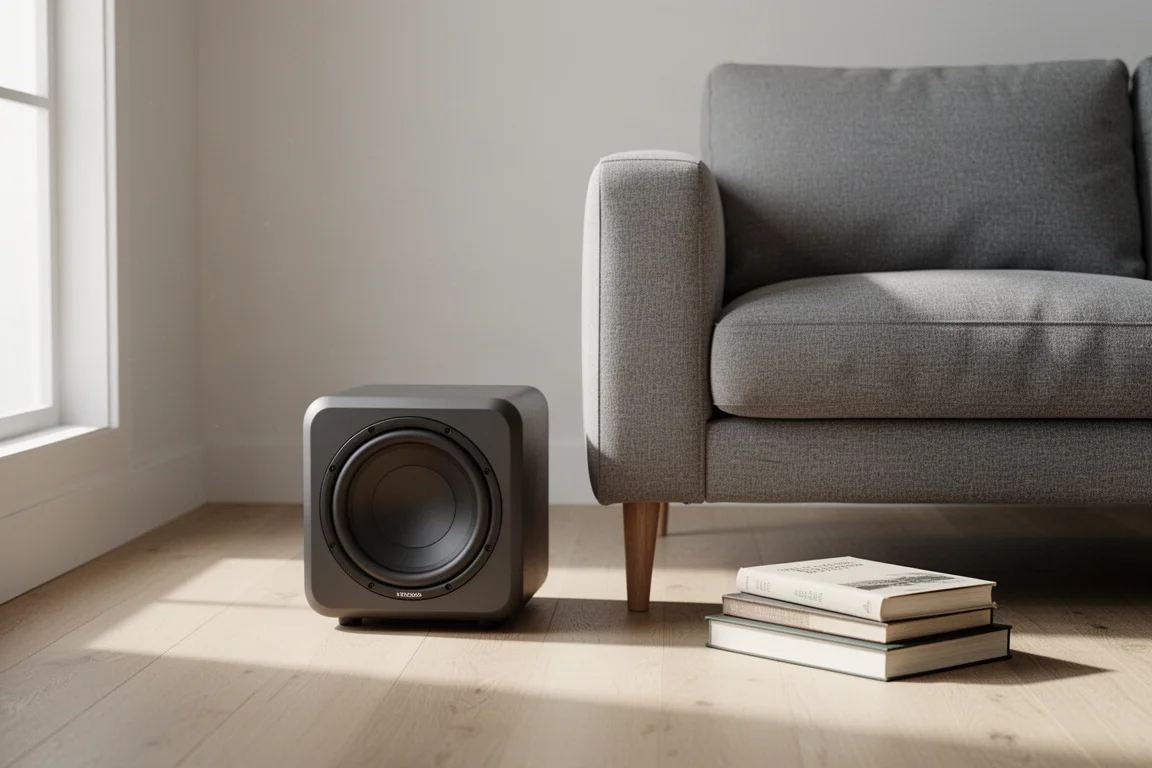
At lower listening levels the KC62 extends reasonably well, and its strongest asset is mid-bass punch. In the 60 Hz to 80 Hz region, and even up past 100 Hz, it can produce more output than the KF92. That is the area that gives drums and bass lines their impact.
Push the volume up and the picture changes. The KC62 is limited firmly, and its output below 30 Hz, and in some cases below 40 Hz, falls well short of what it delivers in the mid-bass. The deep rumble region is where it gives ground.
That does not rule it out for music. If your listening material has little content below 40 Hz, or if you run two of them to add low-end output, the KC62 remains a sensible choice. At moderate levels, roughly below 80 dB at a couple of metres, it still produces adequate low-end output down to about 30 Hz. Below that, results depend on boundary loading, volume level and the content itself.
KEF KF92: Deeper Extension and More Output
The KF92 simply gets louder, and it holds its low end better as the volume rises. It also appears to carry something like a loudness contour, which may be intentional or may be a side effect of its limiter behaviour. At low levels the two subwoofers are closer than you might expect.
The gap opens up at realistic listening levels. Around 85 to 90 dB, at 20 Hz the KC62 measured roughly 74 dB against roughly 80 dB for the KF92, a difference of about 6 dB that reads as close to twice as loud. Down at 10 Hz the two were roughly 15 dB apart. The KC62 does retain about 5 dB more output in the lower and mid mid-bass region, even above 100 Hz, so this is not a one-sided result.
Distortion Performance and What It Means
At 20 Hz the KC62 measured about 12 percent total harmonic distortion, against about 18 percent for the KF92. Below 20 Hz the KC62 is third-order dominated, and the KF92 is third-order dominated as well, but across most of the range the distortion is made up mainly of second-order components.
That distinction matters because lower-order distortion products sit closer to the original tone. A second-order product from a 10 Hz fundamental lands at 20 Hz, a third-order product at 30 Hz and a fourth-order product at 40 Hz. The further a distortion product sits from the fundamental, the more likely it is to be audible. A distortion figure built mostly from second-order content tends to sound closer to the original tone than the raw number suggests.
KEF’s white paper describes a Smart Distortion Control Technology approach. It states that many subwoofers use an electromechanical sensor to monitor driver position against the input waveform and limit excursion to reduce distortion, while the UniCore low voice coil inductance in the KC62 allows an analog current sensor to measure voice coil current directly and instantaneously. KEF states that this can reduce total harmonic distortion by up to 75 percent.
Group Delay and Crossover Alignment
Group delay is most useful when you are looking at the crossover region, where the subwoofer hands over to the main speakers. Crossovers introduce their own delay and phase shift, so the final alignment is a sum of parts rather than a single measurement. It is also possible to be perfectly aligned in time and completely out of phase, which is exactly why deliberate null testing is used when setting up subwoofer and main speaker alignment.
Looking at group delay on its own, the KC62 shows a smoother shape between roughly 70 Hz and 50 Hz, without the jump of about 5 ms seen on the KF92 in that region. That suggests phase alignment with the main speakers may be a little easier to get right on the KC62. Below 40 Hz the KC62 shows higher group delay, though the audible consequence of that is not clear-cut.
CEA-2010A Maximum Output Results
CEA-2010A is an industry standard for maximum output capability measured against harmonic distortion thresholds. In practice, each harmonic has to stay below a set level relative to the fundamental. With a 100 Hz fundamental, for example, the second harmonic must stay below negative 10 dB relative to that fundamental, and the third harmonic below negative 20 dB.
At 12.5 Hz and 16 Hz no reliable reading was possible, because ambient noise overrode the output from the subwoofer and the signal-to-noise threshold could not be met. Across the results that could be captured, the KF92 delivers roughly 6 dB more output than the KC62 on average.
Looking at the maximum output figures in detail, the KC62 averages around 95 to 96 dB at one metre in free space, while the KF92 sits at roughly 97 dB. These are free-space measurements, so a ground-plane setup would add about 6 dB to both. At 100 Hz the two are about 2 dB apart, at 50 Hz about 5 dB, at 20 Hz about 5 to 6 dB, and at 40 Hz roughly 7 to 8 dB. The response of the KF92 also tapers off less as frequency drops.
Matching a Subwoofer to Your Room
If you are listening in a small room, need a small cabinet and are not planning to play loudly, the KC62 makes sense, provided you are not expecting meaningful output much below 20 Hz. It is also the better fit for music that rarely reaches below 40 Hz, and running a pair adds low-end output.
If you want lower frequency extension, or you listen at medium to high levels, the KF92 is the stronger choice between these two. Its advantage shows up mainly at higher output volumes, so it rewards listeners who actually use that headroom.
Conclusion
The KC62 is the compact option: small, punchy in the mid-bass and easier to align, but limited hard as the volume rises. The KF92 is the larger, more capable option, with more low-end extension and about 6 dB more output on average. Match the subwoofer to your room size and the levels you genuinely listen at, and either one can be the right purchase.
Further reading
Related Reviews
Subwoofers
Arendal 1961 Subwoofer 1S Review: Beautiful Build, Modest Punch at $1,000
A sealed $1,000 subwoofer with a gorgeous cabinet, plus three lower-priced alternatives that deliver more impact for movie nights.
Subwoofers
Arendal Sound 1723 2V Subwoofer Review: Dual 13.8-Inch Drivers Under $3,000
A flagship ported subwoofer with dual opposing 13.8-inch drivers, a 1,200W RMS amplifier, app-based DSP, and a 10-year warranty.
Subwoofers
Ascendo 16 Sub Active Sealed Review: Sealed Bass Built on Real Engineering
A close look at the Ascendo 16 Sub Active Sealed, a 16-inch sealed home theater subwoofer with independently verified measurements, a purpose-built driver, and genuinely controlled output.