Desktop Speakers
Kanto Aura Review: Compact Active Desktop Speakers With Serious Engineering
A close look at the Kanto Aura, a fully active desktop speaker pair with a DSP crossover, wide dispersion, and genuine bass down to 50 Hz.
Introduction
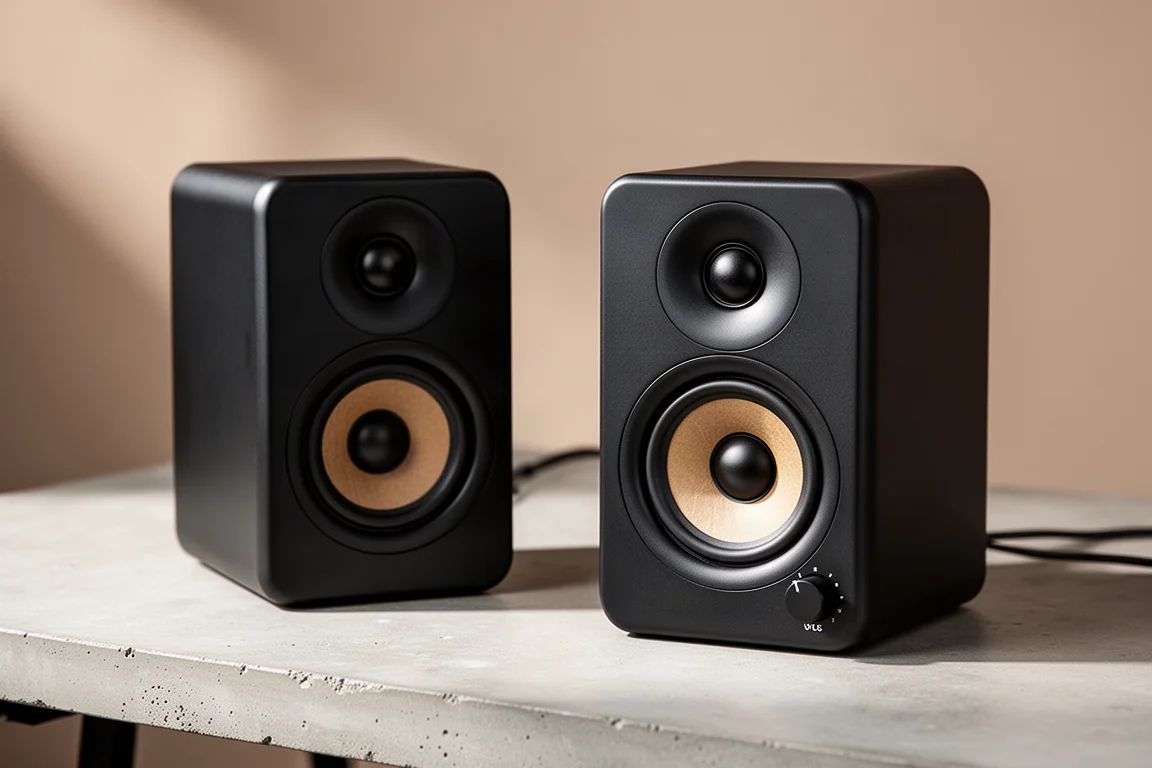
The Kanto Aura is a pair of fully active desktop speakers built for listeners who want genuine sound quality without surrendering their workspace. At $350 per pair, they cost more than most computer speakers, and the engineering explains why: there are no analog crossovers inside, and every driver is powered and shaped digitally.
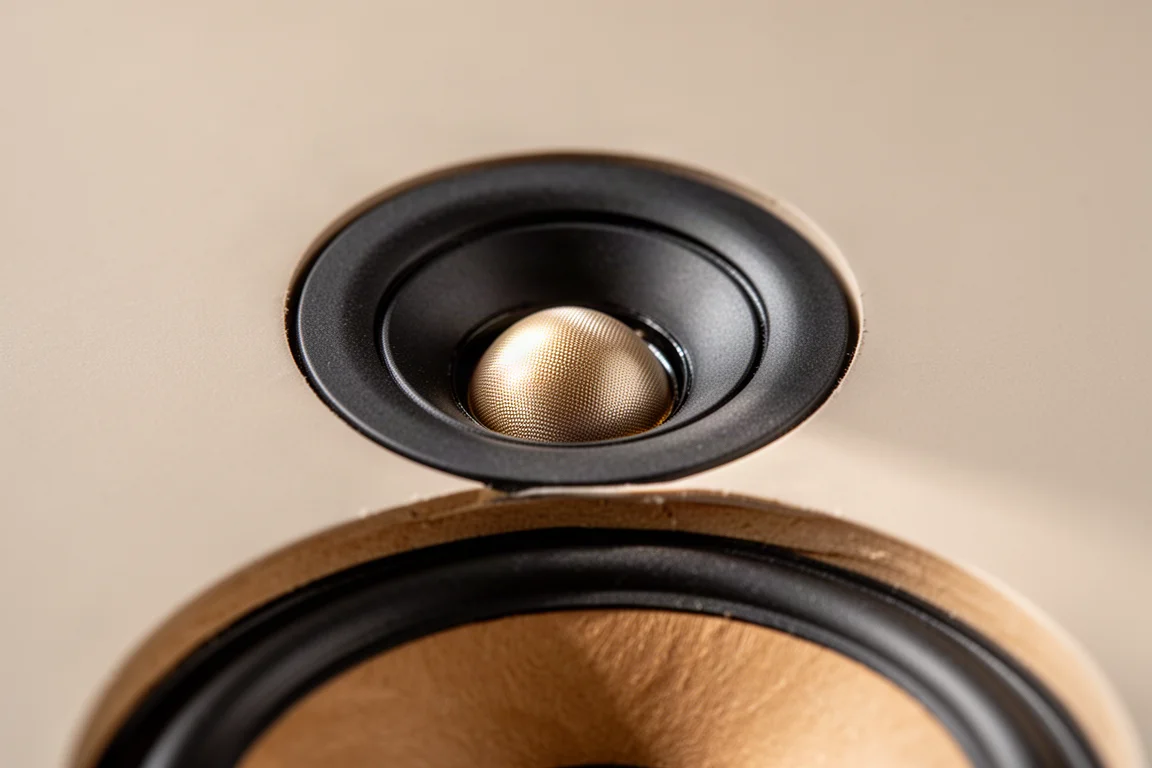
Each cabinet is small enough to lift with one hand and weighs only around two pounds. Inside, a 3 inch paper cone woofer and a soft dome tweeter sit behind a waveguide, and a 50 watt amplifier system drives them: 16 watts to each woofer and 9 watts to each tweeter. That is a substantial amount of technology packed into a very small box.
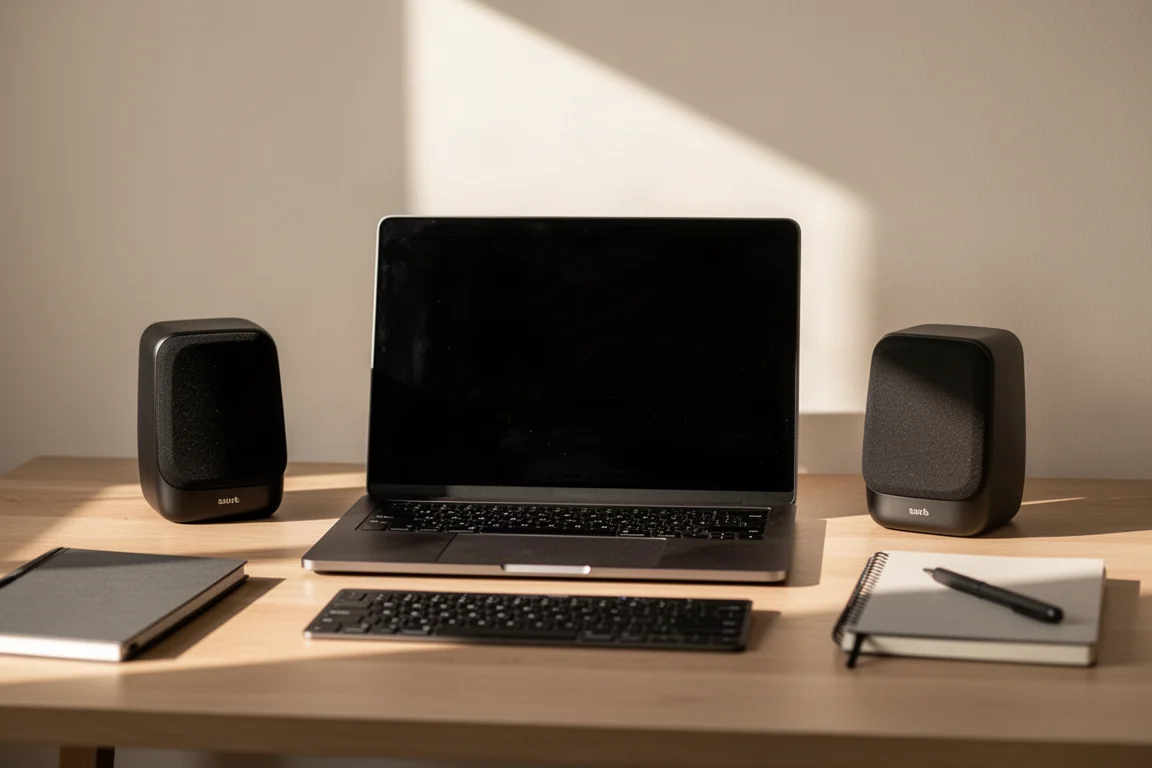
The payoff is a speaker that stays remarkably neutral across the audible range and reaches genuinely useful bass down to 50 Hz. For anyone who wants accurate desktop sound but cannot spare the footprint of a conventional bookshelf speaker, the Aura deserves a serious look.
Who This Product Is For
The Aura is built for nearfield listening at a desk or in a small room. It suits people who spend long hours at a computer and prefer speakers over headphones, whether for music, games, or film.
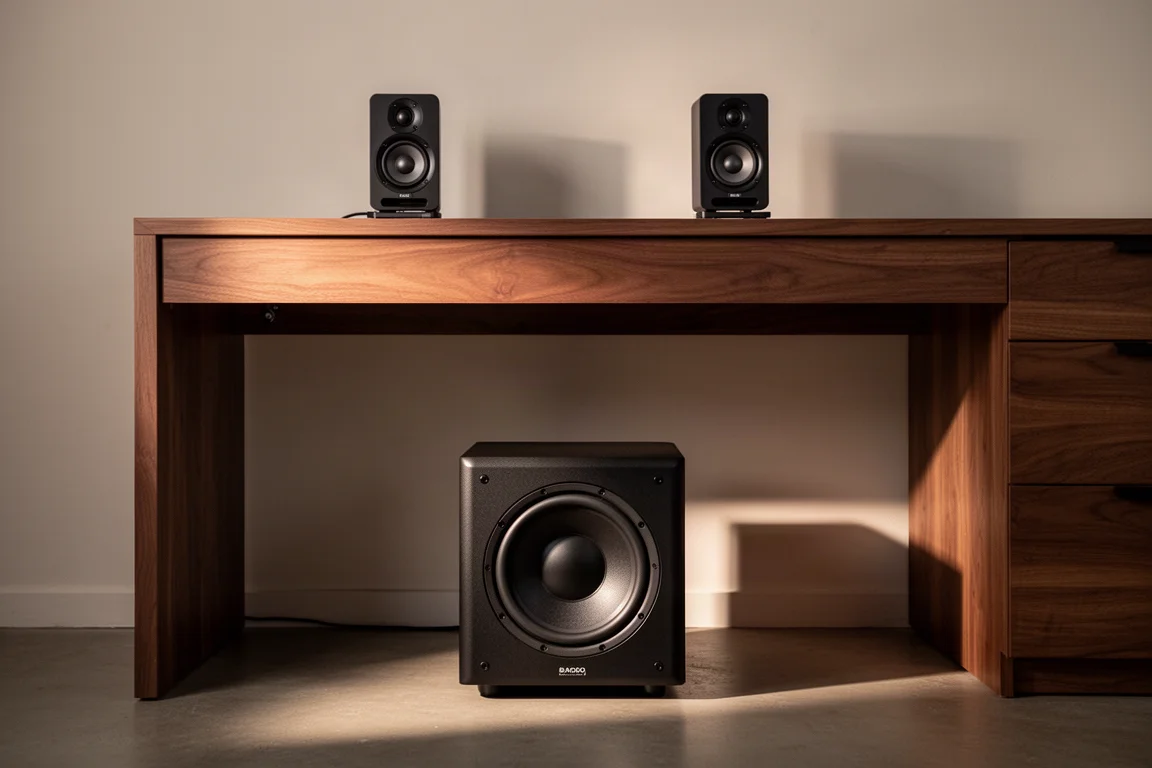
Gamers are a natural fit. Paired with a subwoofer, the Aura becomes a compact 2.1 system that adds weight and headroom to the low end without crowding an ultrawide monitor. The same logic applies to anyone running a 35 inch or 40 inch display, where full size speakers simply will not fit.
Because the response is so linear and balanced, the Aura can also handle light production work at moderate levels. It does not offer the dynamic range of a dedicated studio monitor, but its tonality is better than many monitors in its price range. Treat it as a desktop speaker first and a casual monitoring tool second.
Main Strengths: Tonality, Imaging, and Small-Room Flexibility
Tonality is where the Aura separates itself. The active DSP crossover keeps the response within roughly a plus or minus 2 dB window from 20 kHz down to about 200 Hz, which is unusually flat for a speaker this small. It sounds balanced and accurate rather than bright or thin.
Imaging is excellent. Instruments and voices hold their positions, and the stereo picture stays stable across a wide listening area. Horizontal dispersion holds up well out to around 60 degrees, and the off-axis response tracks the on-axis response closely, so the sound does not change dramatically as you move.
Vertical dispersion is the quiet advantage. Many two-way speakers demand that your ears stay level with the tweeter, which is unrealistic over a long work session. The Aura stays consistent across roughly 20 degrees above and below the reference axis, so sitting up or slouching down does not change its tonal character.
Add the practical side: the cabinets are small, light, and unobtrusive. On a crowded desk, that combination is worth as much as any measurement.
Connectivity and Everyday Setup
The Aura covers the connections most desktop users actually need: stereo RCA analog inputs, a USB-C input, and Bluetooth. There is also a subwoofer output, which is a rare and welcome feature at this size.
That subwoofer output is smarter than it first appears. When a subwoofer is connected, the Aura senses it and automatically highpasses the speakers at 100 Hz. The little 3 inch woofers are relieved of the deepest work, which helps them stay composed as volume rises.
One cabinet houses the amplification and powers the other through a speaker out and speaker in connection. The supplied cable runs roughly five to six feet, enough to span a typical monitor setup without tension. Setup is straightforward, and the system behaves predictably once connected.
Kanto also offers matching desktop stands. They use a rubber mat to hold each cabinet in place rather than a threaded insert, a sensible choice given how light these speakers are. The grip is secure enough that knocking them off takes real effort.
Measurements and Dispersion: Why the Aura Stays Balanced
Measured at half a meter, the Aura performs well above its price and size. The on-axis response is neutral, the off-axis family of curves correlates closely with it, and dispersion remains controlled and even well past 60 degrees. A color map of the same data shows a smooth, linear spread rather than the abrupt transitions small cabinets often produce.
The vertical picture is equally reassuring. A waterfall plot shows wide vertical dispersion for this type of speaker, with usable consistency from about 20 degrees below the axis to nearly 20 degrees above it.
Low frequency output is the surprise. The 3 inch woofer delivers legitimate bass down to 50 Hz, which is remarkable for a cabinet this size. It will not pressurize a large room, and the bass compresses when the volume climbs, but for nearfield listening at sensible levels it holds together far better than its dimensions suggest.
That consistency across both axes is why the Aura sounds the same from a range of seating positions, an important quality when the listener is not locked into one posture all day.
Things to Consider Before Buying
Dynamic range is the main limitation. The Aura is linear and balanced, but it cannot play loudly the way a larger monitor with a 5 inch or 8 inch woofer can. Push the volume and the bass begins to compress, which becomes obvious on bass heavy material.
A subwoofer solves most of that. Adding one does more than extend the low end: the extra amplifier headroom below 100 Hz changes the character of the whole system. If you listen to a lot of bass driven music, plan for a subwoofer or accept the trade-off.
There is no threaded insert on the bottom of the cabinet, so the desktop stands rely on a rubber interface instead of a bolted connection. That is fine for a speaker this light, but it is worth knowing if you prefer a mechanically fixed setup.
Finally, the price. The Aura costs more than the inexpensive desktop speakers sold by large online retailers. What you get for the money is an active DSP design with no analog crossover, which is genuinely uncommon at this price point.
Buying Advice
If you want the best sound you can fit into a small desktop footprint, the Aura is one of the strongest options available. The combination of an active DSP crossover, a waveguided soft dome tweeter, wide dispersion, and 50 watts of distributed amplification delivers accuracy that small passive speakers rarely approach.
Buy it if your priority is tonal balance and imaging at close range, and if your desk will not accommodate a larger cabinet. Buy it as a 2.1 system if you want bass depth and headroom, since the subwoofer output and automatic 100 Hz highpass make that upgrade painless.
Shoppers comparing options will also encounter the AudioEngine HD3, which occupies similar territory, and the Monoprice MM3, which offers comparable specifications for considerably less money. Whether those alternatives match the Aura’s measured neutrality is an open question, but the Aura’s own performance is not.
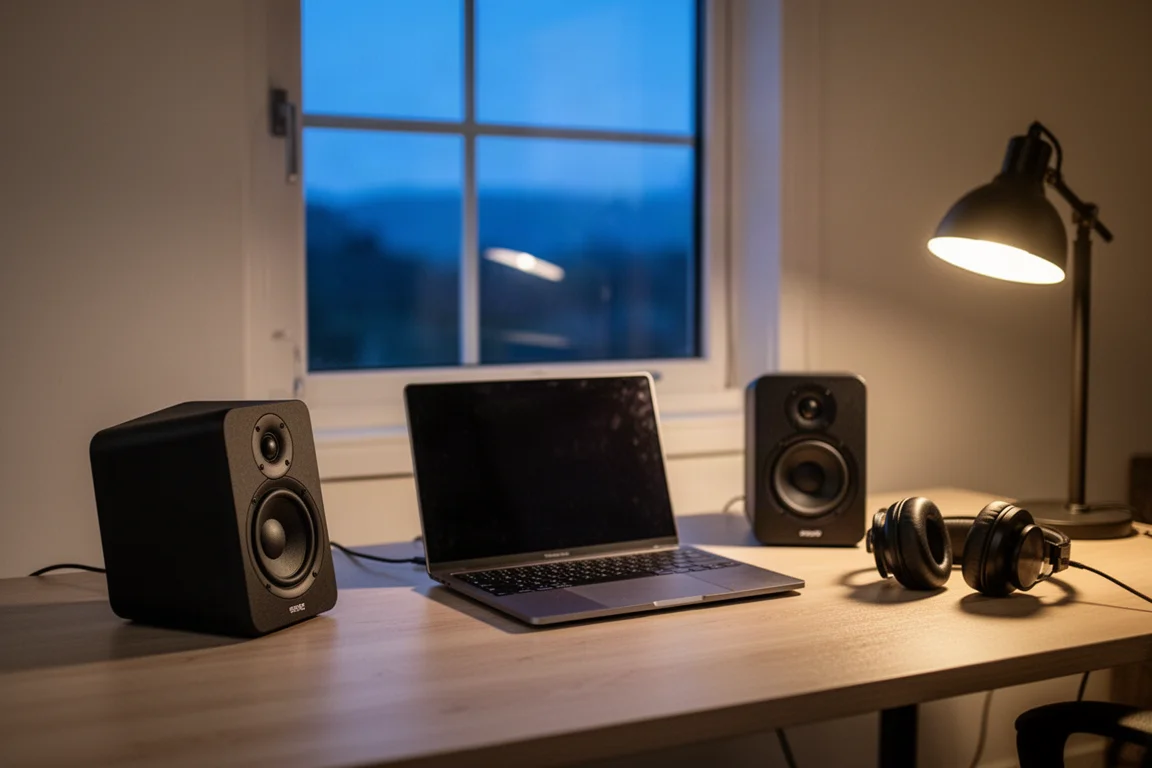
At $350 per pair, you are paying for engineering rather than size. For a listener who values accuracy and space, that trade is easy to justify.
Conclusion
The Kanto Aura proves that a desktop speaker does not need to be large to be serious. A 3 inch woofer and a soft dome tweeter, driven by 50 watts and managed entirely in the digital domain, produce a neutral, well dispersed sound with real bass down to 50 Hz.
Its limits are honest ones: dynamic range is modest, and the deepest bass benefits from an added subwoofer. Within those limits, and within the space it occupies, it is hard to do much better.
Product link
View more details for Kanto Aura
This product is mentioned in the review. Check the specifications, options, and compatibility before buying.
View more details for Kanto AuraFurther reading
Related Reviews
Desktop Speakers
Audio Smile Little British Monitor Review: A Compact Desktop Speaker With Measured Neutrality
A small European powered desktop speaker with a waveguide tweeter, an aluminum cone woofer, and an unusually flat measured response for its size.
Desktop Speakers
Audioengine A2+ Review: A Small Desktop Speaker That Knows Its Place
The Audioengine A2+ is a compact powered desktop speaker pair with Bluetooth, a tidy footprint, and a sound profile tuned for life on a desk rather than a listening room.
Desktop Speakers
Five Desktop Speakers Compared: Edifier, Kanto, Adam Audio, and Kali
Five compact desktop speakers from roughly $170 to $349 per pair, compared on accuracy, listening window stability, output capability, and desk footprint.