In-Wall Speakers
JBL Synthesis SCL Review: A Compact In-Wall Speaker Tuned for Home Theater
A close look at the JBL Synthesis SCL in-wall speaker, from its compression driver and four 5.25-inch woofers to its EQ-friendly directivity and the installation details that shape its sound.
Introduction
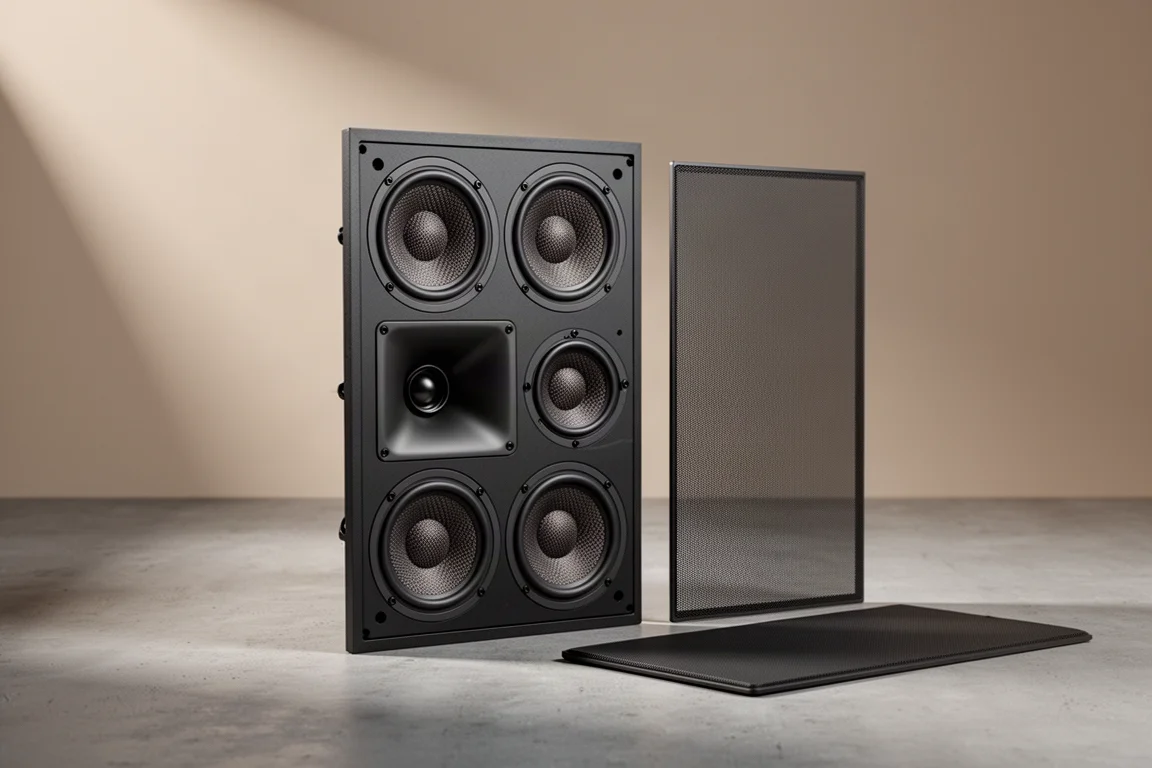
The JBL Synthesis SCL is an in-wall loudspeaker that fits a one-inch compression driver with High Definition Imaging waveguide technology and four 5.25-inch woofers into a chassis that is more compact than its specification list suggests. It is a two and a half way, fully passive design, which means all of the crossover work happens inside the cabinet rather than in a rack of external electronics. The midrange to tweeter crossover is specified at around 1.8 kHz.
What makes the SCL interesting for a home theater build is not raw size but how it behaves once the wall becomes part of the speaker. Because the baffle is effectively infinite, the wall itself reinforces low frequencies, so a slim driver complement does not translate into thin sound. The trade-off is that this speaker is designed to be installed, calibrated and equalized rather than dropped into a room and forgotten.
Who This Speaker Is For
This is a speaker for anyone building a dedicated or semi-dedicated home theater where the front stage, and possibly the surrounds, need to disappear into the architecture. It suits installations where a calibrator or installer can apply equalization, because the design prioritizes linearity, dynamic range and headroom for correction rather than a fixed voicing straight out of the box.
Average sensitivity is about 91 dB, which matters in a home theater context where clean dynamic range is more useful than amplifier strain. The speaker still needs a subwoofer. Its four 5.25-inch woofers deliver output and fidelity well above their size class, but the design assumes the lowest octaves are handled separately.
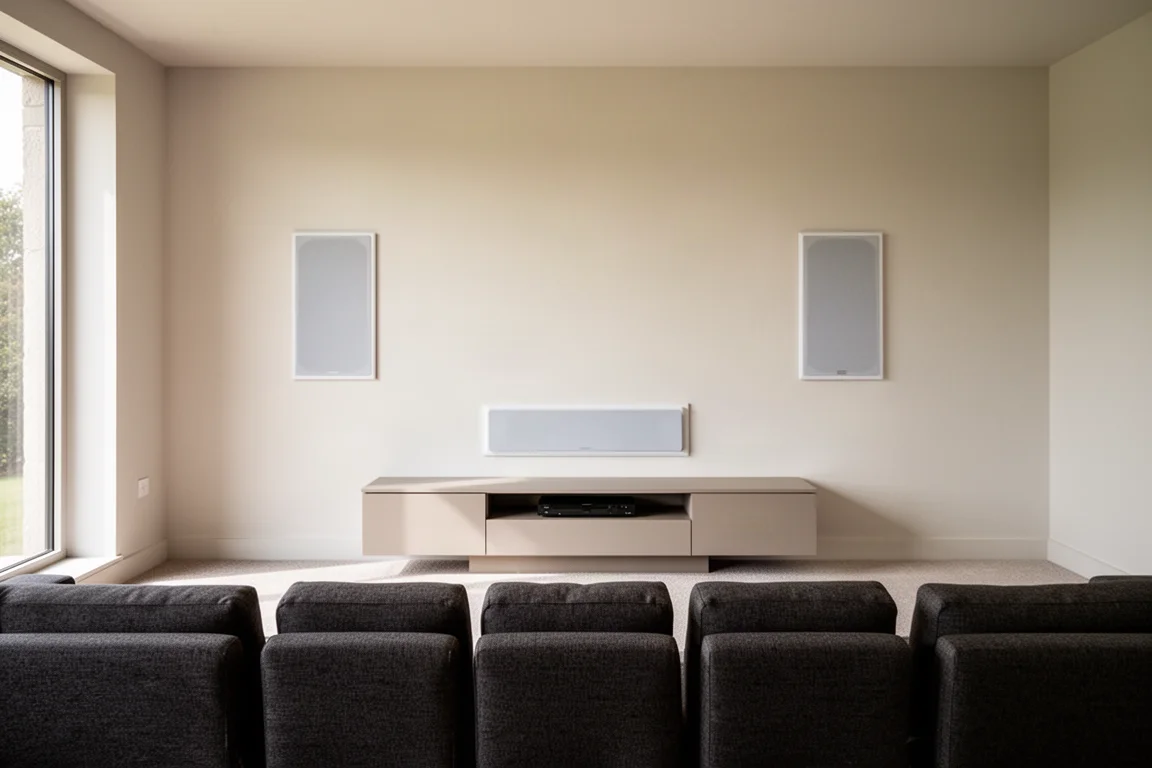
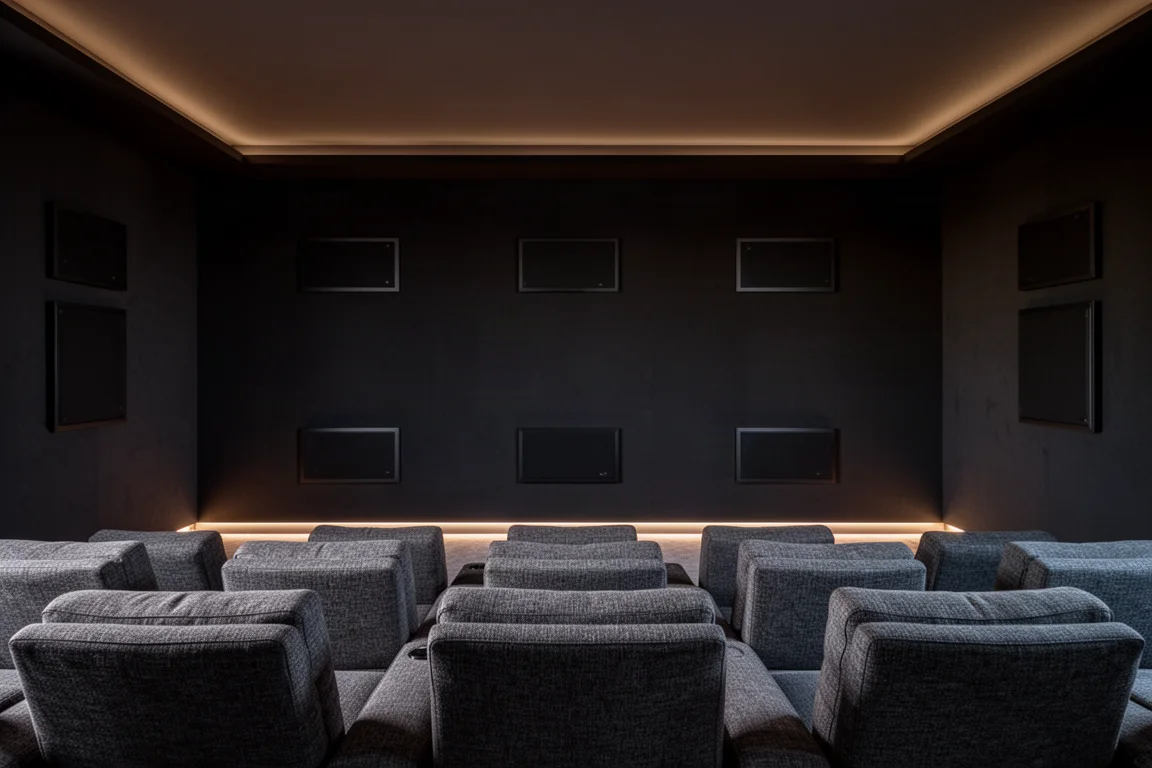
It also suits listeners who care about consistent off-axis behavior. In a multi-row room, a speaker that sounds right in the front row should not fall apart in the second, and the SCL’s controlled directivity is aimed squarely at that problem.
Main Strengths: Directivity, Linearity and EQ Flexibility
Measured under infinite baffle conditions that mimic a real wall installation, the midrange sits within roughly plus or minus 1.5 dB, and most of the response stays within plus or minus 3 dB. There is a dip near 10 kHz and a bass rise of about 2 to 3 dB, but the overall shape is orderly enough to be corrected with a few well-placed parametric filters.
The more impressive part is what happens off axis. Peaks and dips track as you move away from the on-axis position, which is unusual. Many speakers that look uneven on axis only flatten out at 10 to 15 degrees off axis, effectively forcing a listening angle to sound right. Here, the correction you apply on axis continues to work off axis.
Beaming does not begin until about 1500 Hz, so the radiation pattern stays broad and consistent from the low end up to that point. Above the midrange the pattern narrows to roughly plus or minus 40 degrees. Early reflections and sound power directivity indices stay smooth well into the high frequencies, which is the kind of foundation that makes equalization effective instead of a patch job.
Output, Distortion, and Bass Reinforcement
Distortion at 86 dB and at 96 dB is low across the board with one exception: a second order harmonic spike near 1.7 kHz, most likely originating at the compression driver. It is measurable, and it did not stand out during listening. Compression testing is similarly reassuring. There is no meaningful compression until roughly 80 Hz, and because the speaker is intended to run with a subwoofer, everything below that point is largely irrelevant to how it will actually be used.
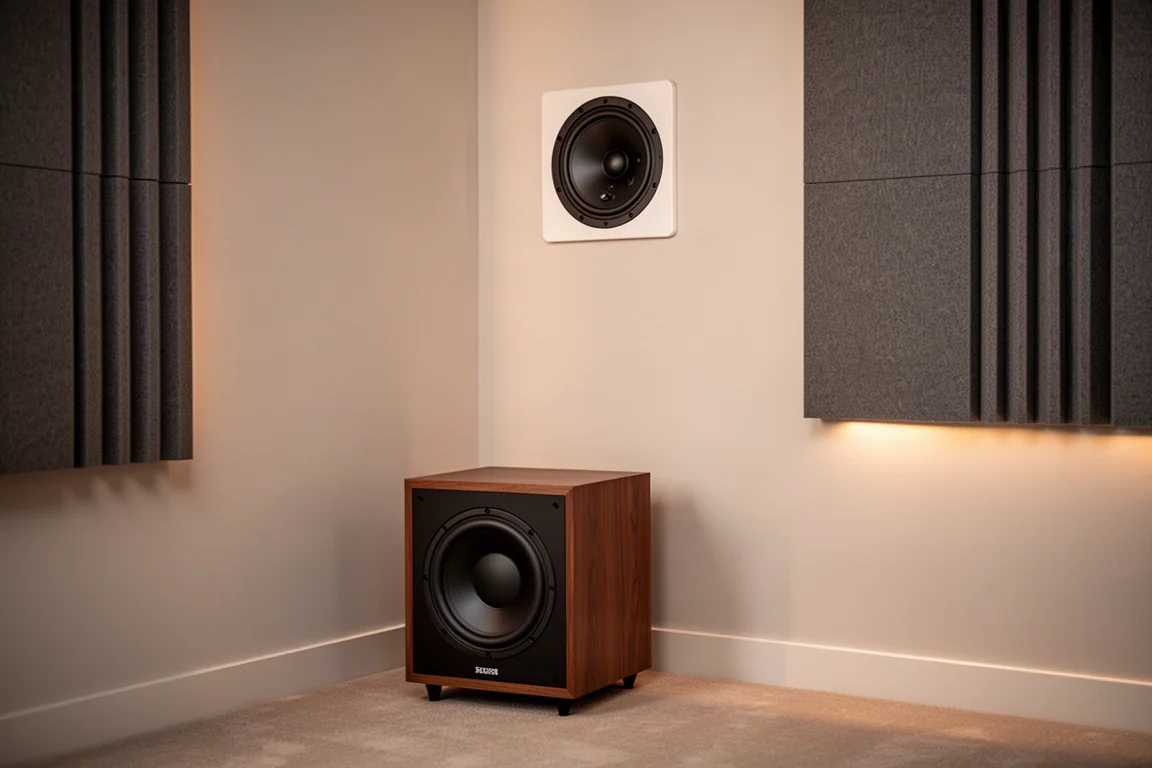
Bass reinforcement comes from the installation itself. Mounting a speaker into a wall makes the wall part of the baffle, and that boundary loading adds low frequency energy in much the same way that corner loading a subwoofer does. The result is a compact in-wall that behaves like something with larger drivers than it actually has.
The Boundary Switch and the Grille
Two practical details affect the final result. The first is a boundary switch with near and far settings. The default is far, while near is intended for installations where a sidewall sits within about two feet of the speaker, trimming the bass so that a natural mid-bass bump does not become bloated.
The second is the grille. It is magnetically attached and can be painted to match the wall, and it holds securely in place. Response is better with the grille removed. With the grille on, the upper response becomes more erratic and the directivity indices bounce around, which reduces how effectively you can equalize the top end. That is worth knowing before committing to a fully covered installation.
Things to Consider Before Buying
The driver complement is compact. Four 5.25-inch woofers are capable, but anyone hoping for a large-format in-wall with a bigger woofer will need to look at other options in the line. A subwoofer is required here, not optional.
Vertical placement matters more than it does with a typical box speaker. Radiation holds at roughly plus or minus 15 degrees above and below the axis until around 1.3 to 1.5 kHz, after which the pattern broadens. In practice, the tweeter should sit at or very near ear height, and the speaker should be no more than about 10 degrees above or below the primary listening position. Additional seating rows and surround placements need to respect that limit.
This speaker is also designed around equalization. If the plan is to install it and never measure or correct the room, a good part of its potential goes unused.
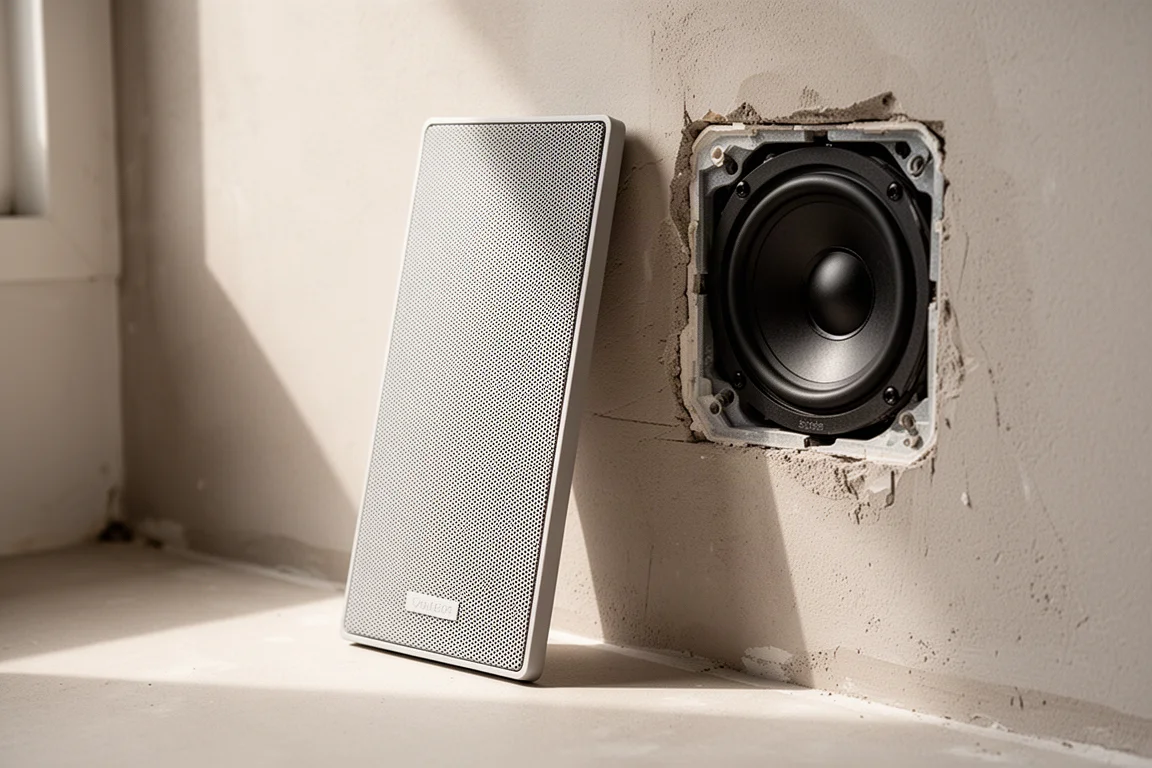
Construction quality is a genuine plus. The passive crossover is neatly assembled with no rattling components or loose wiring, which is exactly the kind of flaw that ruins an in-wall installation once the wall is closed up.
Installation Notes That Affect Performance
Installation follows a standard cutout. The speaker slides into the opening, and tightening the Phillips head bolts draws a flange outward until it clamps the wall. The clamping force is strong enough that the speaker stays firmly seated in the opening without shifting.
Spring-loaded terminals keep wiring simple: press the terminal down, insert the wire, release. Because the wall becomes the baffle, the low frequency behavior you get in the room depends on this mounting being solid and properly seated.
Buying Advice
The JBL Synthesis SCL makes the most sense for a planned home theater build with in-wall front channels, a subwoofer and a calibration step built into the process. Buyers who want a speaker that measures well, stays consistent off axis and responds predictably to equalization will find a lot to like.
Plan the installation height carefully, budget for the subwoofer, and decide early whether you can live with the grille in place or want the cleaner upper response without it. Handle those three things and the speaker is easy to recommend for its intended role.
If you are weighing it against other architectural options, the deciding factors are usually the same ones this speaker is built around: how much correction your room can support, and how much dynamic range you need at the seating positions you actually use.
Conclusion
The JBL Synthesis SCL is a thoughtfully engineered in-wall loudspeaker rather than a brute-force one. Its four 5.25-inch woofers and compression driver deliver low distortion and strong output, its directivity stays consistent well off axis, and its response responds predictably to equalization. It asks for a subwoofer, a sensible mounting height and a calibration step in return. For a home theater build where those are already part of the plan, it belongs on the shortlist.
Product link
View more details for JBL Synthesis SCL
This product is mentioned in the review. Check the specifications, options, and compatibility before buying.
View more details for JBL Synthesis SCLFurther reading
Related Reviews
Room Correction
Anthem ARC Genesis Beta Review: Smarter Speaker and Subwoofer Integration
A practical look at Anthem's ARC Genesis beta, including phase-aware speaker calibration, all-pass subwoofer blending, and the settings worth adjusting.
AV Processors
Anthem AVM 90 8K Review: A Reference-Grade AV Processor for Music and Movies
A close look at the Anthem AVM 90 8K AV processor: measured performance, two-channel and immersive listening notes, bass control, and what to weigh before buying.
Home Theater
Anthem AVM 90 Review: A 15.4-Channel Flagship Preamp Processor
A close look at Anthem's flagship preamp processor, covering its dual ESS DAC architecture, 15.4-channel layout, ARC Genesis calibration and four independent subwoofer outputs.