Bookshelf Speakers
JBL Stage A120 vs Stage A130 vs Emotiva Airmotiv B1+: Three Budget Bookshelf Speakers Compared
A measured comparison of the JBL Stage A120, JBL Stage A130, and Emotiva Airmotiv B1+ bookshelf speakers, covering tonal balance, cabinet behaviour, output limits, and which one is worth buying.
Introduction
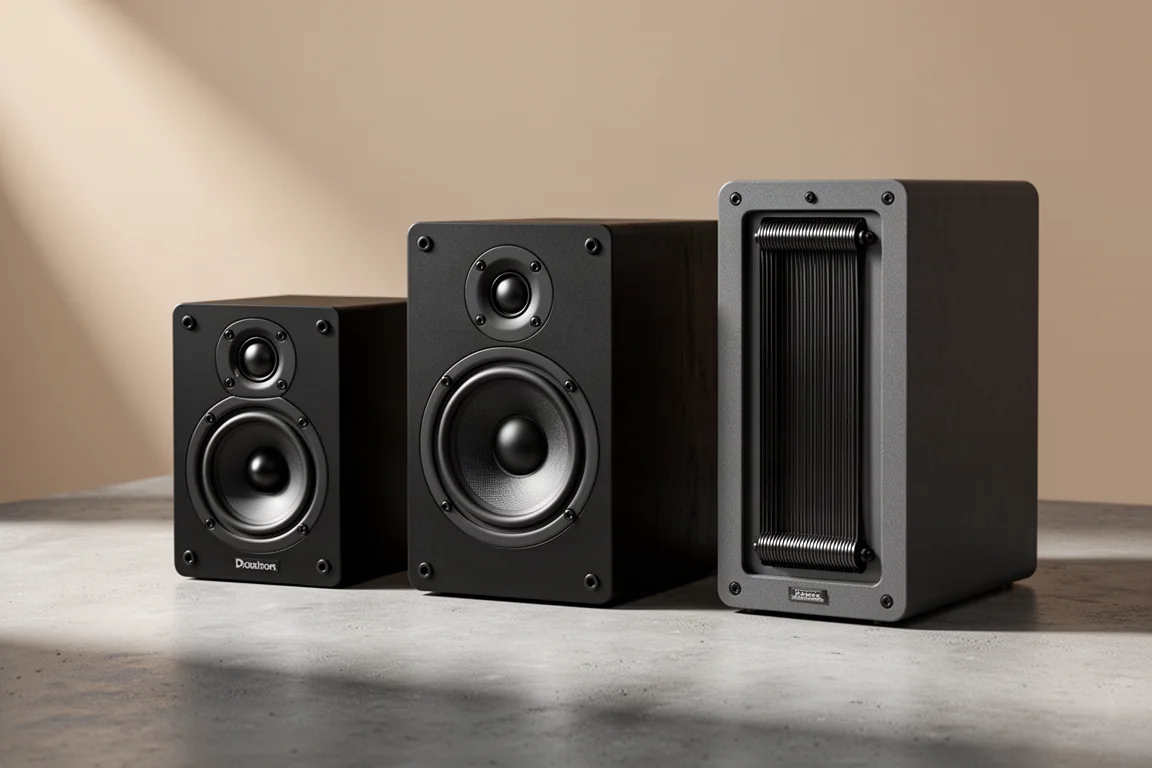
Bookshelf speakers in the $200 to $300 bracket are where most people start building a serious two-channel system, and three models come up repeatedly in that range: the JBL Stage A120, the JBL Stage A130, and the Emotiva Airmotiv B1+. They sit close together on price, but they do not behave alike, and the differences show up clearly in measurement.
The Stage A120 is the smallest of the three, built around a roughly four-inch midwoofer, with a manufacturer’s suggested price near $200. The Stage A130 scales the same formula up with a five-and-a-quarter-inch midwoofer and a list price around $300. The Airmotiv B1+ lands between them at roughly $250, also with a five-and-a-quarter-inch driver, and it uses a folded ribbon tweeter rather than the waveguide-loaded dome found on the JBL pair.
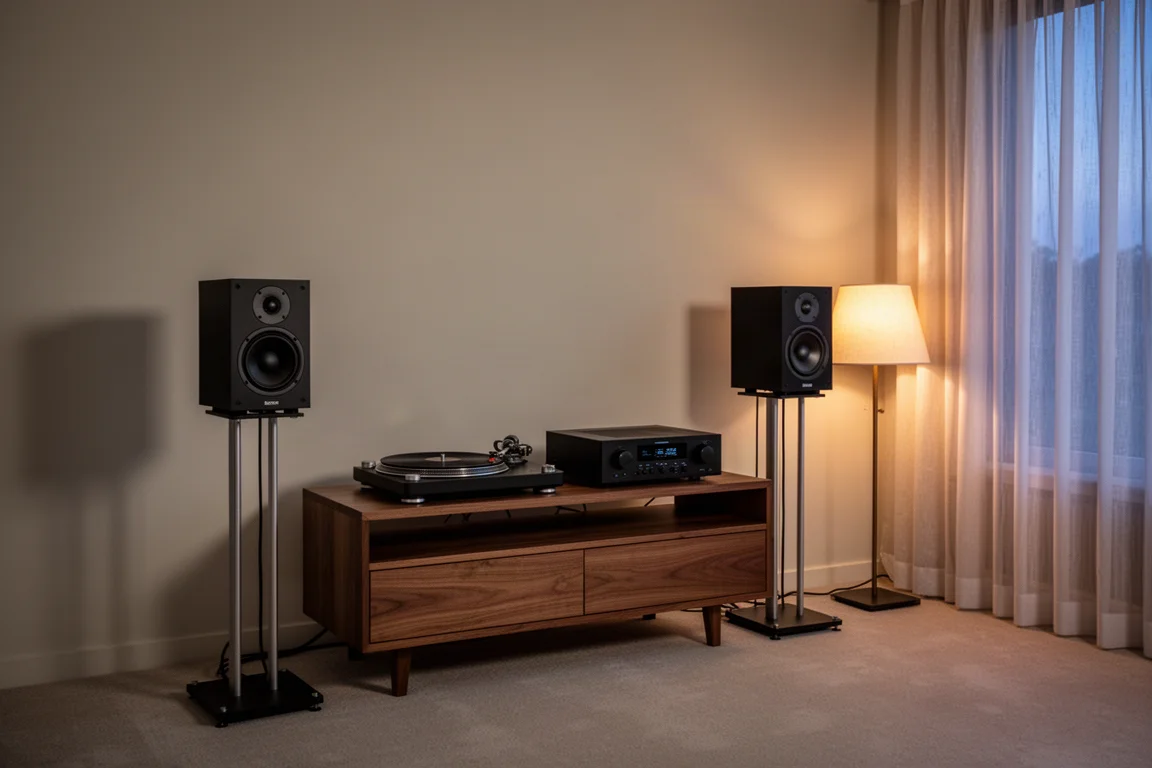
That overlap makes a direct comparison genuinely useful. If you are choosing between them, the deciding factors are tonal balance, cabinet behaviour, and how much clean output you actually need in your room.
How These Speakers Were Evaluated
Each speaker was measured as a complete system rather than in isolation. The data set covers on-axis frequency response, listening-window and sound-power averages, the directivity index, horizontal radiation patterns, distortion at 96 dB measured at one metre, and dynamic-range tests at 76, 86, 96, and 102 dB. Cabinet resonance was checked separately with an accelerometer placed on the side and top panels.
All three units were new and played in before testing. Measurements are useful for predicting behaviour, but the practical takeaway is what the data suggests about how each speaker will behave in a normal room, at normal listening distances.
JBL Stage A120: The Compact Option
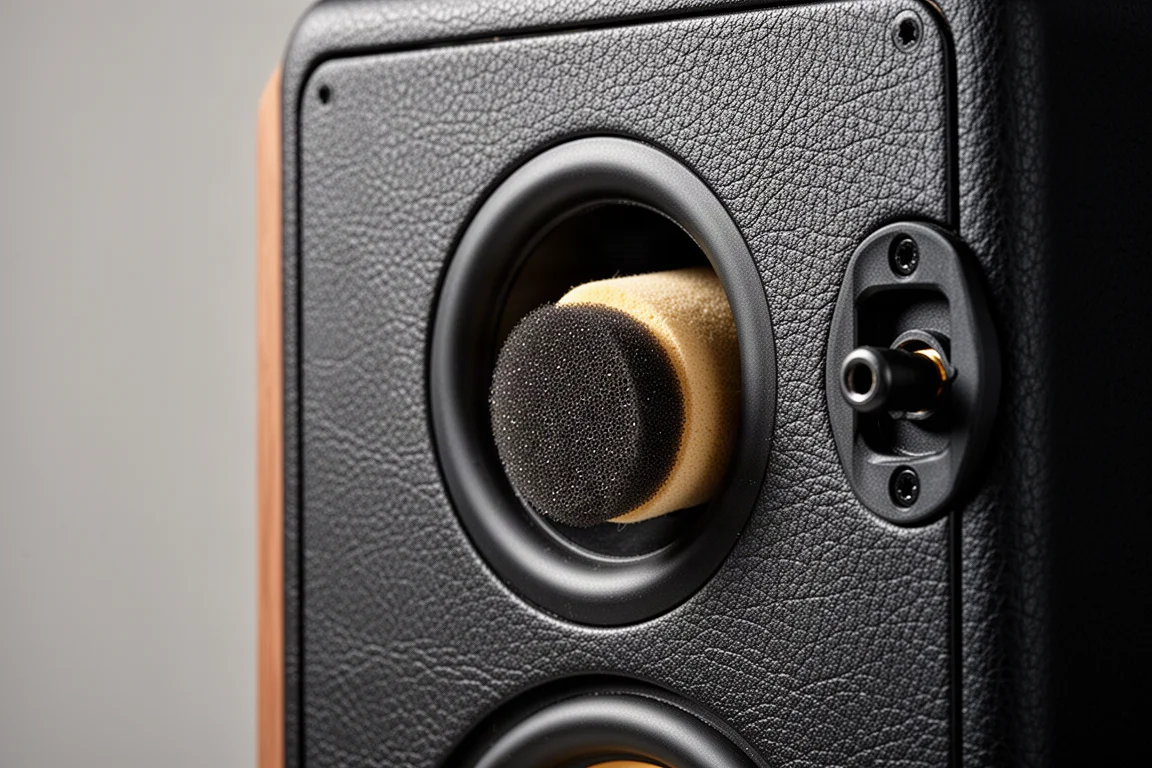
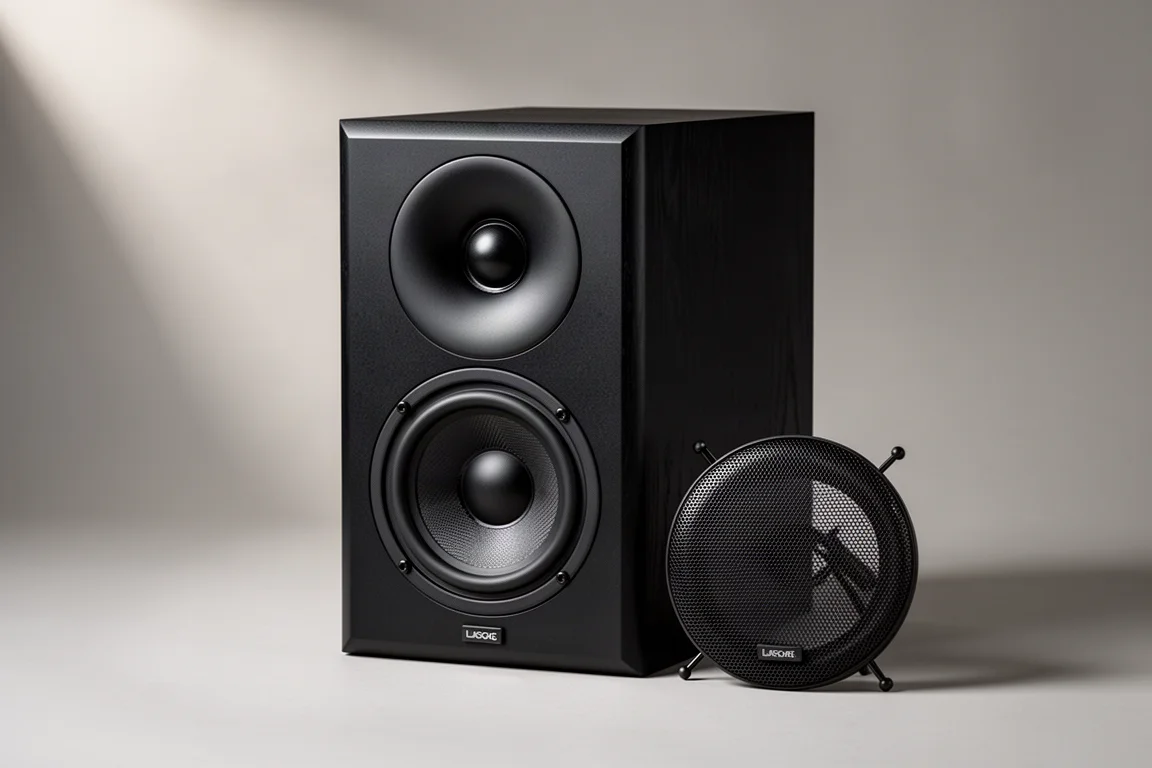
The Stage A120 is the entry point of the JBL pair. Its roughly four-inch midwoofer keeps the cabinet small, and the rear panel includes a port bung, so the speaker can be run in a sealed configuration if you prefer. That flexibility matters more than it might appear, because the A120 genuinely improved with the port sealed: blocking the port smoothed out a peaky region in the response and produced a noticeably better balance.
On axis, the A120 shows a broad lift in the mid-bass between roughly 100 Hz and 150 Hz, about two to three dB above the average level of the 300 Hz to 3 kHz band. From there the midrange drops into a trough, and the upper midrange and treble climb back up by roughly three to four dB relative to that scoop. Cabinet resonance appears in the side and top panels and leaves a peak around 1 kHz. The result is a forward, bass-heavy presentation with a lot of high-frequency energy.
Directivity is uneven, with peaks and dips that make equalisation harder to apply cleanly, because the direct sound and the off-axis sound do not track each other. Distortion at 96 dB sits a little above three percent at the low end. At very high levels, around 102 dB, low-frequency output drops off sharply, which limits how hard the speaker can be pushed.
JBL Stage A130: The Larger Sibling
The Stage A130 is essentially the A120 scaled up, with a five-and-a-quarter-inch midwoofer and a correspondingly larger cabinet. It does not ship with a port bung, so sealing the cabinet requires your own solution if you want to try that configuration.
Measured response follows a similar shape to the smaller model: a lift in the low bass, a dip through the midrange, and a broad peak between roughly 800 Hz and 1.7 kHz that lines up with cabinet resonance. Accelerometer measurements on the top and side panels produced different results, which is consistent with the way internal modes excite each panel differently. Above that, the treble recesses relative to the midrange peak, and there is a rise of roughly five dB over the mean around 10 kHz.
A130 Directivity and Output Behaviour
Directivity on the A130 is better controlled than on the A120. The pattern narrows as frequency rises toward the tweeter crossover, then widens and stays fairly constant, so the directivity index line flattens rather than continuing to climb. An estimated in-room response taken at about two metres shows a mild downward slope, with the peaky behaviour around 1 to 2 kHz still visible.
Distortion is lower than the A120 at the low end and slightly better than the Airmotiv B1+ in that region, though it rises in the higher frequencies. Output is limited at the top of the dynamic-range tests: at 102 dB the low end gives up. That matters if these are used as surround speakers or placed far from the listening position.
Emotiva Airmotiv B1+: The Neutral Alternative
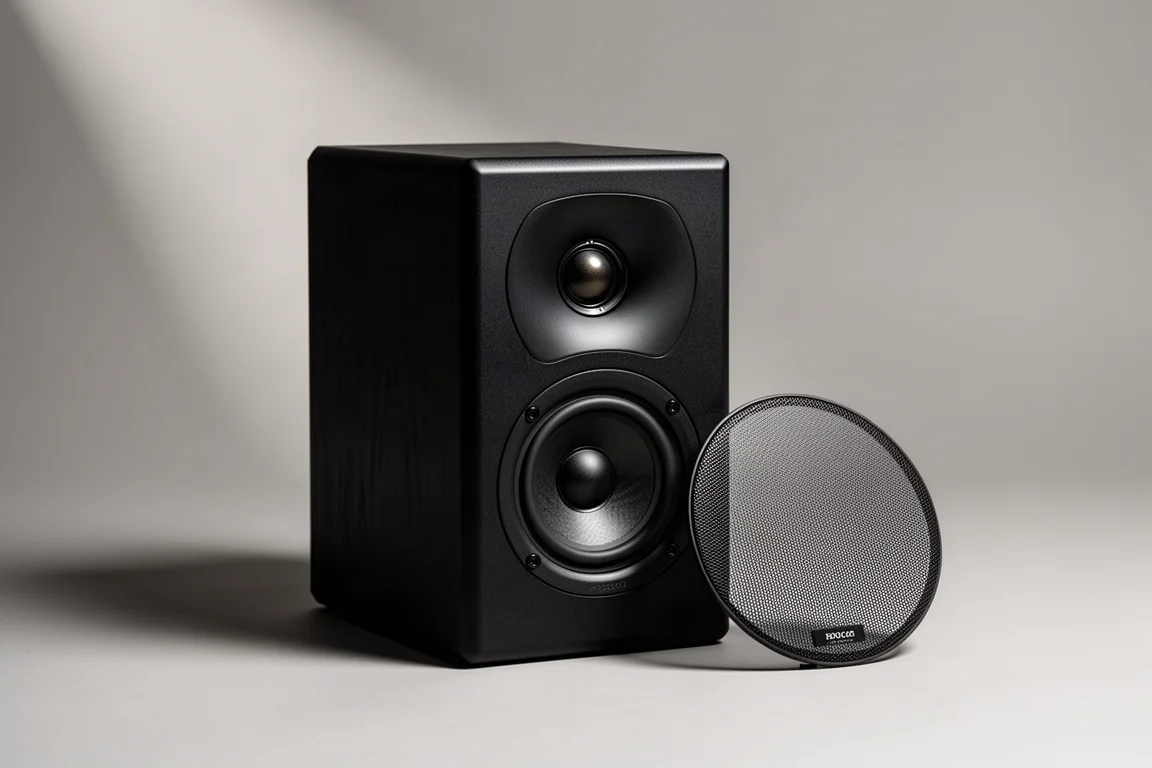
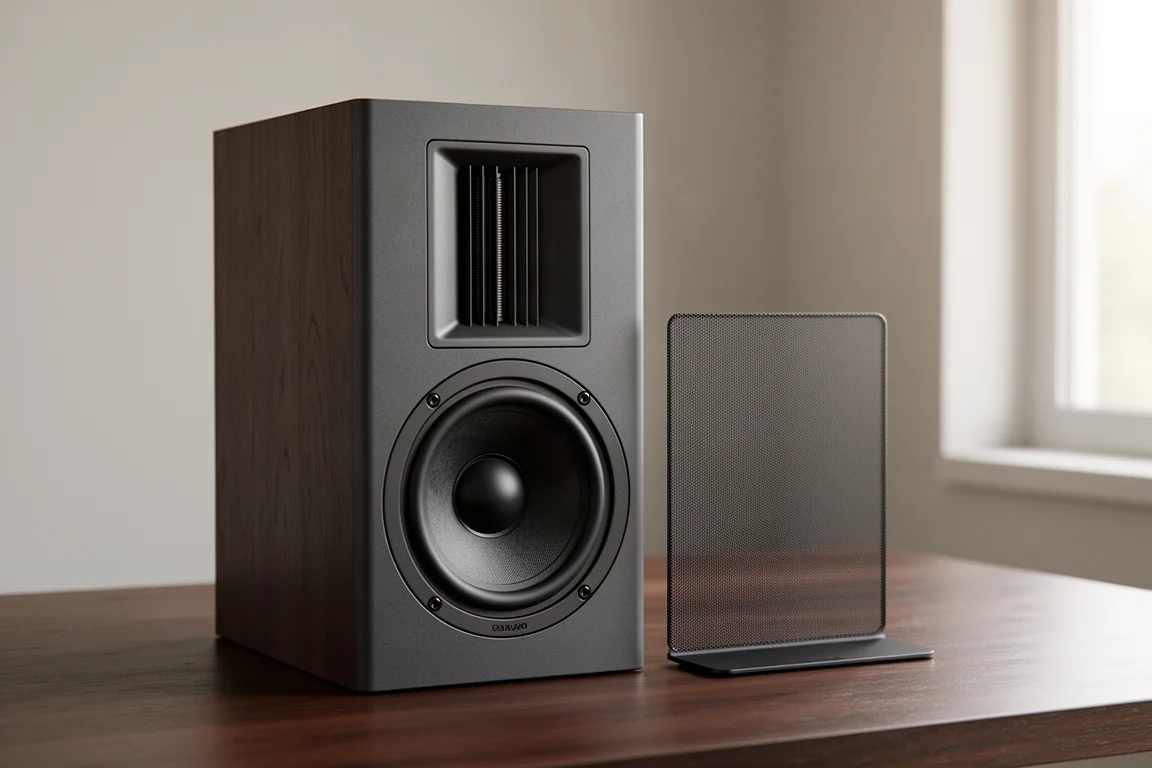
The Airmotiv B1+ sits between the two JBL models on price and on driver size, with a five-and-a-quarter-inch midwoofer and a folded ribbon tweeter. Its grilles attach magnetically, a simpler arrangement than the pinned grilles on the JBL pair.
Tonally it is the more neutral of the three. The midrange is slightly recessed, perhaps a decibel or so below the high frequencies, and there is a cabinet resonance between roughly 1 and 2 kHz that accelerometer sweeps confirmed on the side and top panels. A single parametric filter centred near 1.3 kHz, with a moderate Q and about two dB of cut, would reduce it. Some listeners describe that region as slightly shouty. It is audible when you compare the speaker with and without correction, though it is low in amplitude and spread across a wide range.
The important advantage is in the directivity index. Both early reflections and sound power stay smooth, which means the resonance can be equalised efficiently, and the handoff from midwoofer to tweeter is well managed. High frequencies run a little above the midrange, but the deviation is modest. At high output the B1+ compresses more than the JBL pair across the board, so it is not the choice for very loud playback, but at normal levels it delivers strong neutrality for the money.
Overall Buying Advice
If neutrality and easy correction matter most, the Airmotiv B1+ is the strongest of the three at its price. Its midrange is a touch recessed and its cabinet adds a small resonance in the 1 to 2 kHz region, but both issues are mild, and the smooth directivity means a single equalisation filter can address the peak without upsetting the off-axis response. The trade-off is output: it compresses earlier than the JBL models when pushed hard.
The Stage A130 is the better of the two JBL speakers. It has lower low-frequency distortion than the A120, a more controlled directivity pattern, and a more usable balance overall, though the low-bass lift, midrange dip, and 10 kHz rise are still present, and the 800 Hz to 1.7 kHz cabinet resonance colours the lower midrange. If you own one, sealing the cabinet or applying corrective EQ helps, and keeping expectations realistic about maximum output is sensible.
The Stage A120 is the hardest to recommend. Its response is the least linear of the three, its directivity is the least consistent, and it needs the most work to sound balanced. It does improve noticeably with the port sealed, and it offers the lowest entry price, but the money is better spent elsewhere unless you find it heavily discounted.
One caveat worth knowing: measured results for the A130 have varied between setups, which may point to a running design change or to sample variation. Whichever model you buy, judge it in your own room rather than relying on any single set of numbers.
Conclusion
Across these three, the ranking holds up: the Emotiva Airmotiv B1+ offers the most neutral balance and the most equalisable response near $250, the JBL Stage A130 is a step up from the A120 and the better of the two JBL options near $300, and the JBL Stage A120 is the least linear of the group near $200.
None of them is perfect. The B1+ gives up output at high levels, both JBL models carry a low-bass lift, a midrange dip, and cabinet resonances that colour the lower midrange, and the A120 needs the most correction to sound balanced. Matched to the right room and sensible listening levels, though, each can serve a purpose: the A120 as a budget starting point, the A130 as a larger-room option with better distortion performance, and the B1+ as the pick for anyone who values tonal accuracy first.
Further reading
Related Reviews
Bookshelf Speakers
Acoustic Energy A100 Mark II Review: A Compact Standmount With an Expansive Soundstage
The Acoustic Energy A100 Mark II brings clarity, natural tonality and a wide soundstage to an entry-level standmount, with a few setup details worth knowing first.
Bookshelf Speakers
Acoustic Energy AE-100 Mark II Review: Compact Bookshelf Speakers With Standout Imaging
A compact British two-way bookshelf speaker with deep, layered imaging, fast bass, and a slight treble lift to weigh against a crowded $500 field.
Bookshelf Speakers
Acoustic Energy AE100 MK2 Review: Measured Performance and Four Alternatives
A close look at the Acoustic Energy AE100 MK2 bookshelf speaker, what its measured performance reveals, and four alternatives with different trade-offs.