Bookshelf Speakers
JBL L52 Classic Review: Retro Looks, Lively Sound
A compact two-way bookshelf speaker with real walnut veneer, an adjustable treble control and an engaging, forward presentation that rewards careful placement.
Introduction
Retro-styled hi-fi has moved from niche curiosity to a genuine market segment, and few brands have as much right to revisit their own past as JBL. The L100 is the icon of the Classic line, the L82 sits just below it, and the L52 Classic is the smallest member of the family. It arrives with the same 1970s-inspired visual language and a price of £999 in the UK.
The styling is nostalgic. The engineering is not. Behind the walnut veneer sits a modern driver complement, a waveguide-loaded dome tweeter and an adjustable high-frequency control. What follows is a practical look at how the L52 Classic performs, what it asks of a room and which listeners will get the most from it.
Who This Speaker Is For
The L52 Classic is aimed at listeners who value character over clinical accuracy. Its presentation is lively and forward, with a presence-region lift that adds energy to guitars, brass and vocals. If your reference point is a studio monitor or a speaker tuned for strict neutrality, this is a different philosophy, and it is worth being honest about which one you want before you buy.
It also suits systems that need a little waking up. Because the speaker is full rather than lean through the lower midrange, it can balance out electronics that sound thin or overly polite, while the adjustable treble gives you a way to fine-tune the top end to your room.
Where the L52 Classic is less convincing is for listeners who chase the last word in refinement, ultimate detail retrieval or a perfectly locked centre image. It earns a recommendation here, but not because it wins those particular arguments.
Design and Build: Real Walnut and Retro Details
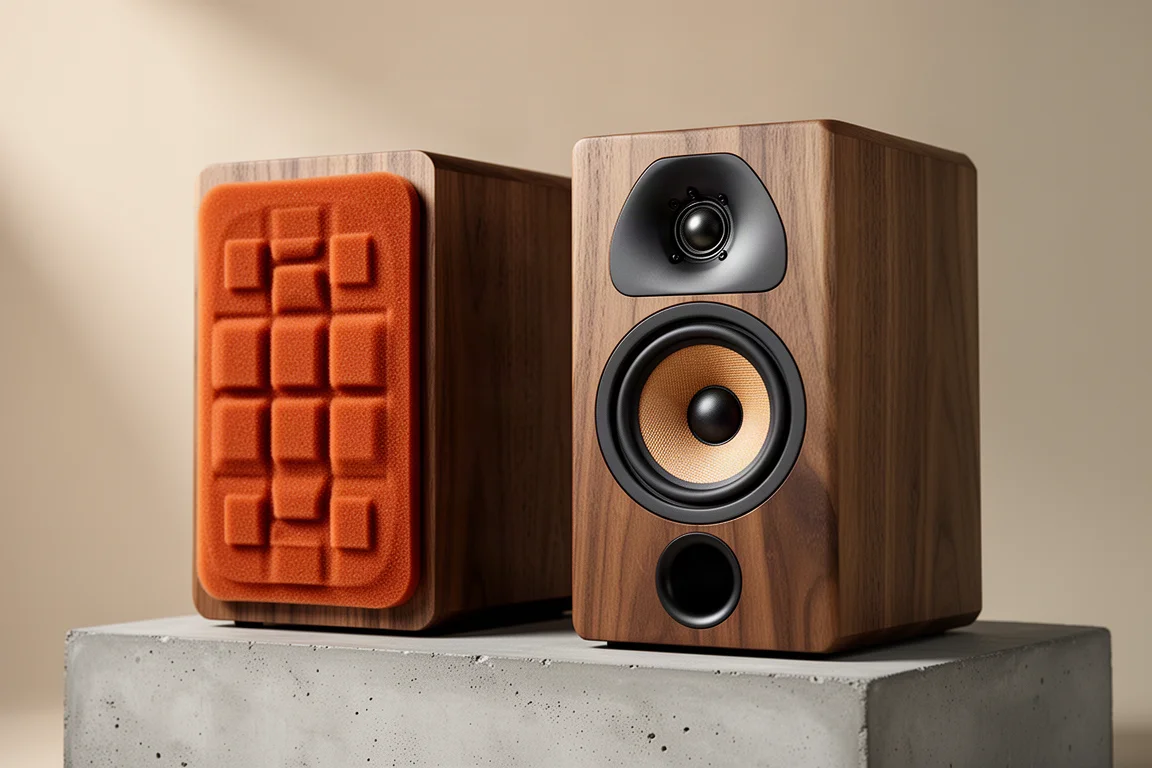
The cabinet measures 330 by 197 by 216 millimetres and each speaker weighs 5 kilograms, so this is a genuinely compact standmount rather than a shrunken floorstander. The finish is real walnut wood veneer, which gives the speaker a warmth that vinyl wrap rarely matches.
The quadrex grille, the same pattern used on the larger models in the range, is available in dark blue, black or burnt orange. There are no concealed magnets holding it in place, just conventional mounts, so removing the grilles takes a little effort.
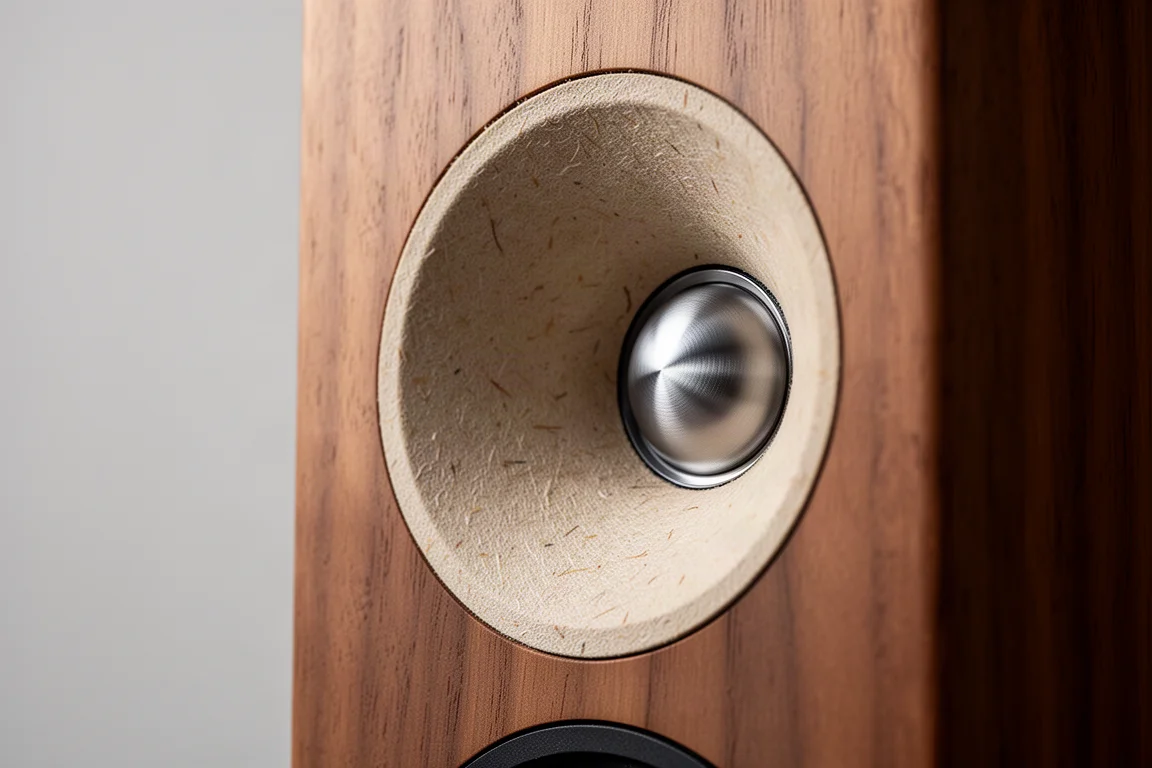
Behind the grille the layout is straightforward. A 133 mm mid-woofer cone made from pure paper pulp handles the lower registers, handing over to a 20 mm titanium dome tweeter at 2800 Hz. The tweeter sits in a shallow waveguide to improve integration with the mid-woofer, and the front-firing port keeps the design easier to live with near a wall than a rear-ported alternative.
The specification is confirmed on the rear label: 85 dB sensitivity and a 4 ohm impedance, with a single set of binding posts. There is also a high-frequency adjustment on the front baffle, a feature borrowed from the era the speaker references.
The tweeter is deliberately offset rather than centred. Sound radiating across the baffle reflects at the cabinet edges, where the change in impedance between wood and air effectively creates a secondary source. That secondary source arrives slightly late, smearing timing and blurring stereo imaging and transients. Offset geometry avoids a simple mathematical relationship between the tweeter centre and the surrounding baffle edges, which spreads the diffraction effect. Wide baffles, common in the 1970s, made that effect more prominent, so the offset was a considered solution then and remains one here.
How the JBL L52 Classic Sounds
The overall impression is of a small speaker with a big personality. It is dynamic, immediate and enjoyable, and it leans on engagement rather than neutrality.
Bass output is strong and punchy for the cabinet size. Rated extension reaches down to 47 Hz, so anyone wanting subterranean low frequencies or floor-shaking output will still need a subwoofer, but the L52 Classic sounds considerably larger than its dimensions suggest. It is not the last word in articulation and definition, yet it holds together well when a drummer is working hard, avoiding the homogenised blur that smaller speakers can fall into.
The midrange is where the speaker’s character lives. There is a slight uplift in the presence region between 2 and 4 kHz, which gives the sound a forward nature and a sense of energy. It stops short of harshness, so even bright recordings remain listenable, but it is enough to make you sit up and pay attention. The lower midrange is full, which lends authority to male vocals in particular. Occasionally that fullness tips into a hint of stored energy or boxy resonance, which can thicken a voice and cost some clarity, though it does not appear on every track.
The high frequencies are well judged in the standard setting, with a sensible balance between extension and detail. Sibilance and aggression are kept in check, and the front-panel adjustment gives you room to move in either direction if your room or your electronics ask for it.
Beyond tonal balance, the L52 Classic separates instruments decently even in busier passages. Leading edges are nicely defined and decays are rendered with care. The soundstage extends well beyond the speakers to the left and right, and there is a touch of depth. The centre image is the least precise part of the picture and can drift slightly, which is a minor caveat rather than a deal-breaker at this price.
Things to Consider Before Buying
The most important consideration is tonal preference. This is not a neutral speaker, and the presence lift that makes it so engaging will divide opinion. Listeners who want a flat, analytical presentation will find more suitable options.
Placement matters more than the front port might suggest. Bass output, particularly in the mid-bass, is strong enough that definition suffers if the speaker sits too close to the wall behind it. Around 90 centimetres, or three feet, measured from the front of the cabinet, is a sensible starting point. If you must place it close to a wall, blocking the front port helps to control and attenuate the low frequencies; no port bungs were supplied with the speaker, so that is a DIY solution.
The offset tweeter means you have a decision to make about orientation. Angled outwards, the presentation opens up and a slight graininess in the upper midrange smooths out as you move off the listening axis. Directly on axis, the colouration can be reminiscent of a horn speaker, which some listeners enjoy and others do not.
Finally, this is not the last word in refinement or overall detail retrieval. A very revealing high-end pre and power combination exposed those limits rather than flattering the speaker, so it makes more sense with amplification priced in a similar bracket.
Placement and Room Setup
The high-frequency adjustment is one of the most useful features here, and where you end up setting it depends on the acoustics of your room, your partnering equipment and your own taste. In a lively space with plenty of hard reflective surfaces, or with electronics that lean bright, turning the control down helps. In a heavily furnished room with lots of soft surfaces, or with equipment that needs lightening, turning it up is the better move. Adjustments like this were common on speakers of the 1970s and are rare on modern designs, which makes the L52 Classic more adaptable than most.
Tweeter orientation is worth experimenting with over a few sessions rather than a few minutes. Facing the tweeters outwards was the more satisfying arrangement in practice, with off-axis listening tempering the upper midrange colouration. If you sit directly on axis, expect a more forward, horn-like character.
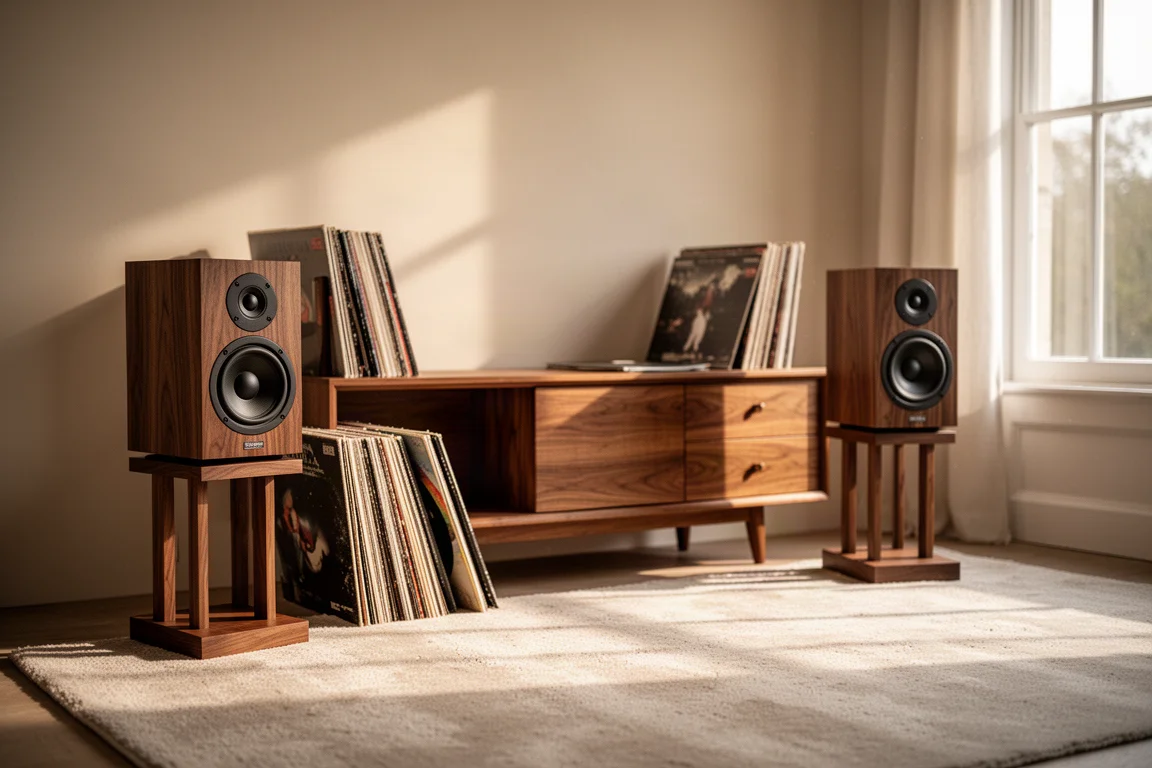
Give the speakers room to breathe. Placing them clear of the wall behind them, with a modest amount of toe-in and a listening position that is not perfectly on axis, gets the best balance of punch and control.
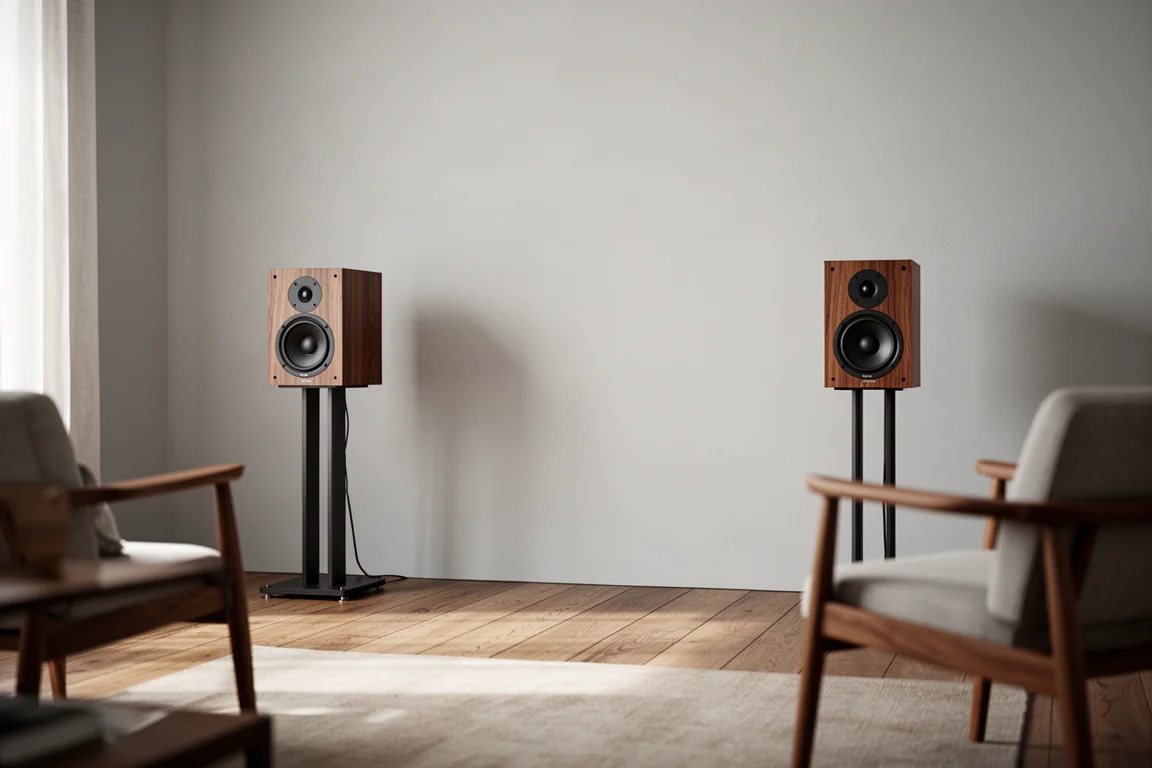
If space is tight, port blocking plus a little distance from the wall is the compromise that keeps the bass from overwhelming the rest of the presentation.
Amplifier Matching and System Synergy
The L52 Classic is not a fussy speaker, but it does respond clearly to what feeds it. A warm, dynamically rich integrated amplifier at a similar price to the speaker proved an excellent match, pulling the upper midrange back towards neutral while playing to the speaker’s sense of drive and scale.
A more expensive neutral amplifier also worked well. Because the L52 Classic is full rather than lean through the lower midrange, it balances out electronics with a lighter tonal balance instead of pushing them into brightness.
Where it struggled was with a far more revealing pre and power setup built around micro-detail and timbral information. Those amplifiers highlighted the speaker’s limits in refinement rather than its strengths. Neutral or warm-leaning amplification, priced sensibly relative to the speaker, is the sensible target.
Buying Advice
At £999 in the UK, the L52 Classic competes in a crowded part of the market, and the decision comes down to priorities. If you want a speaker that injects life into recordings, looks the part in a living room and is forgiving of modest electronics, it makes a strong case. If you want class-leading detail retrieval and control, with faster and tighter bass and a leaner midrange, a more analytical design such as the Amphion Argon 1 is the alternative to audition. If a natural, open midrange matters more to you than bass weight and dynamics, a compact LS3/5A interpretation such as the Sound Artist model is worth hearing, though it plays smaller and with less low-end extension.
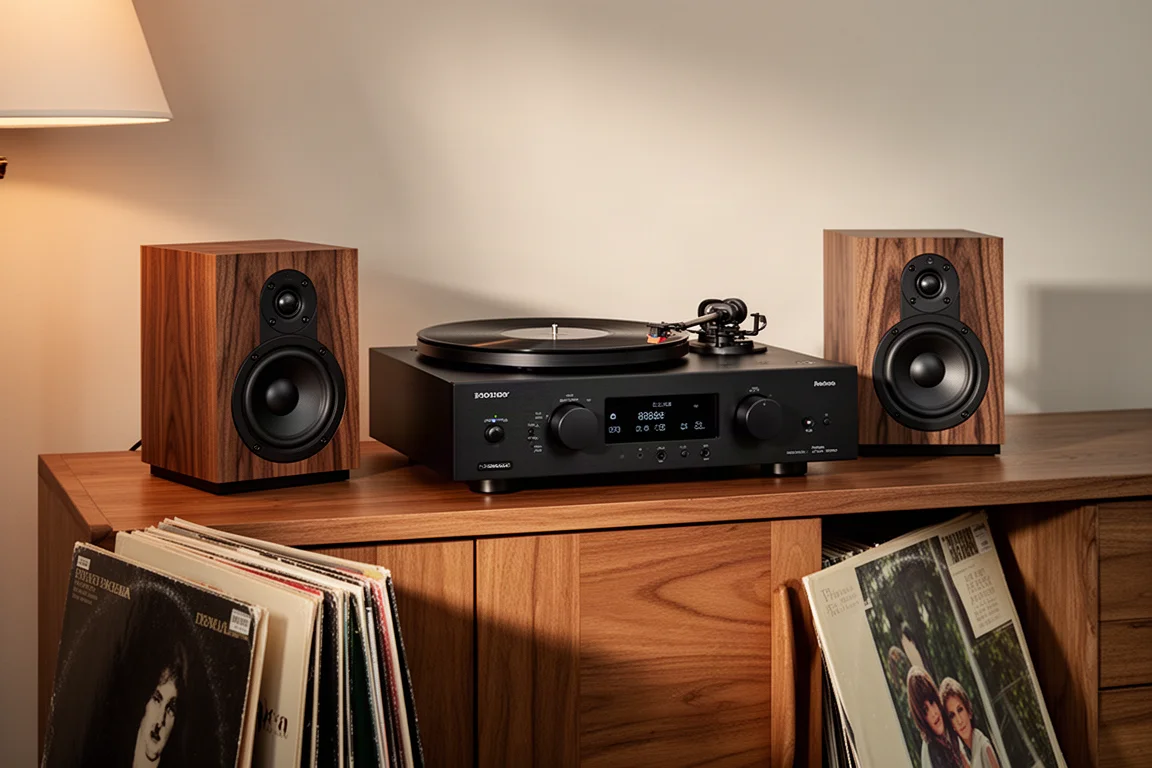
Budget for placement as well as for the speaker itself. The L52 Classic rewards being pulled clear of the wall and paired with amplification that is either neutral or on the warm side of neutral, which is a straightforward requirement rather than an exotic one.
Conclusion
The JBL L52 Classic is a small speaker with a big personality, and it earns a recommendation on those terms. Its retro styling is convincing, the walnut veneer and quadrex grille are the real thing, and the tuning deliberately echoes the dynamic, engaging character of the brand’s earlier designs rather than chasing neutrality.
The trade-offs are equally clear. The presence lift and full lower midrange will not suit everyone, the occasional boxiness is audible on some material, and the speaker is not the last word in refinement or detail retrieval. Give it a room to breathe in, match it with sensible amplification and it delivers an enjoyable, characterful performance that is hard to find at this price.
Product link
View more details for JBL L52 Classic
This product is mentioned in the review. Check the specifications, options, and compatibility before buying.
View more details for JBL L52 ClassicFurther reading
Related Reviews
Bookshelf Speakers
Acoustic Energy A100 Mark II Review: A Compact Standmount With an Expansive Soundstage
The Acoustic Energy A100 Mark II brings clarity, natural tonality and a wide soundstage to an entry-level standmount, with a few setup details worth knowing first.
Bookshelf Speakers
Acoustic Energy AE-100 Mark II Review: Compact Bookshelf Speakers With Standout Imaging
A compact British two-way bookshelf speaker with deep, layered imaging, fast bass, and a slight treble lift to weigh against a crowded $500 field.
Bookshelf Speakers
Acoustic Energy AE100 MK2 Review: Measured Performance and Four Alternatives
A close look at the Acoustic Energy AE100 MK2 bookshelf speaker, what its measured performance reveals, and four alternatives with different trade-offs.