Streaming Active Loudspeakers
JBL 4329P Review: A Streaming Active Loudspeaker Built Around Dynamics
A two-way active streaming loudspeaker with a horn-loaded tweeter, an 8-inch woofer and a complete streaming platform. Here is what it does well and what to weigh first.
Introduction
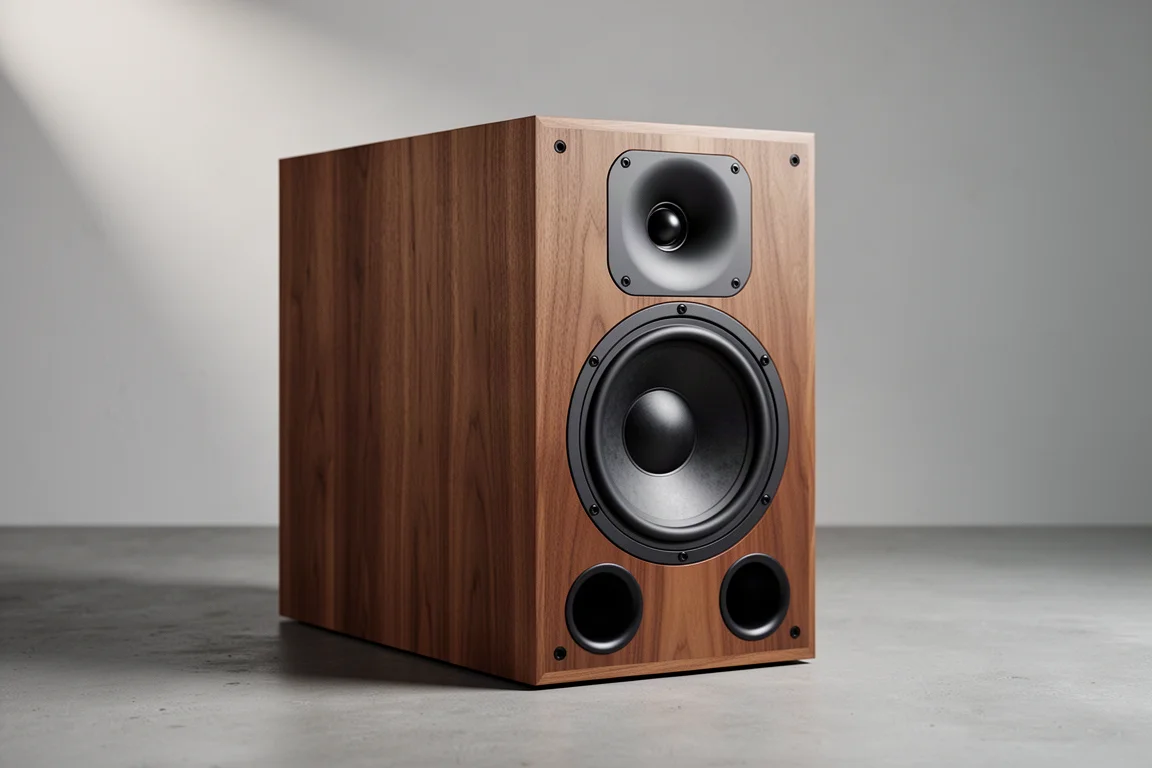
The JBL 4329P is an active streaming loudspeaker that arrives as a complete system in a box. Amplification, crossover, streaming and physical inputs are all built into the cabinets, so the only thing left to add is mains power. That combination is still uncommon among large stand-mount speakers, and it is the main reason this model deserves attention from anyone trying to simplify a two-channel setup without dropping down to small desktop speakers.
Priced at around €4,000 a pair, the 4329P sits in premium territory. What matters is whether its particular blend of driver technology, streaming convenience and physical scale suits the room you actually listen in. Here is what stands out, and what to weigh before buying.
Who the JBL 4329P Is For
This speaker suits listeners who want one pair of boxes to handle everything: network streaming, a turntable, a computer and a digital source, without a rack of separate components. Because the primary cabinet carries left and right XLR sockets that also accept phono plugs, a vinyl front end can be connected directly to the speaker rather than to a separate preamplifier. That is a meaningful convenience for anyone who wants to keep the signal chain short.
It also suits listeners with a mid-sized room who have found that small two-way stand-mounts sound thin, while large floorstanders deliver more bass energy than the space can absorb. A substantial stand-mount tends to land in the sweet spot between those two extremes.
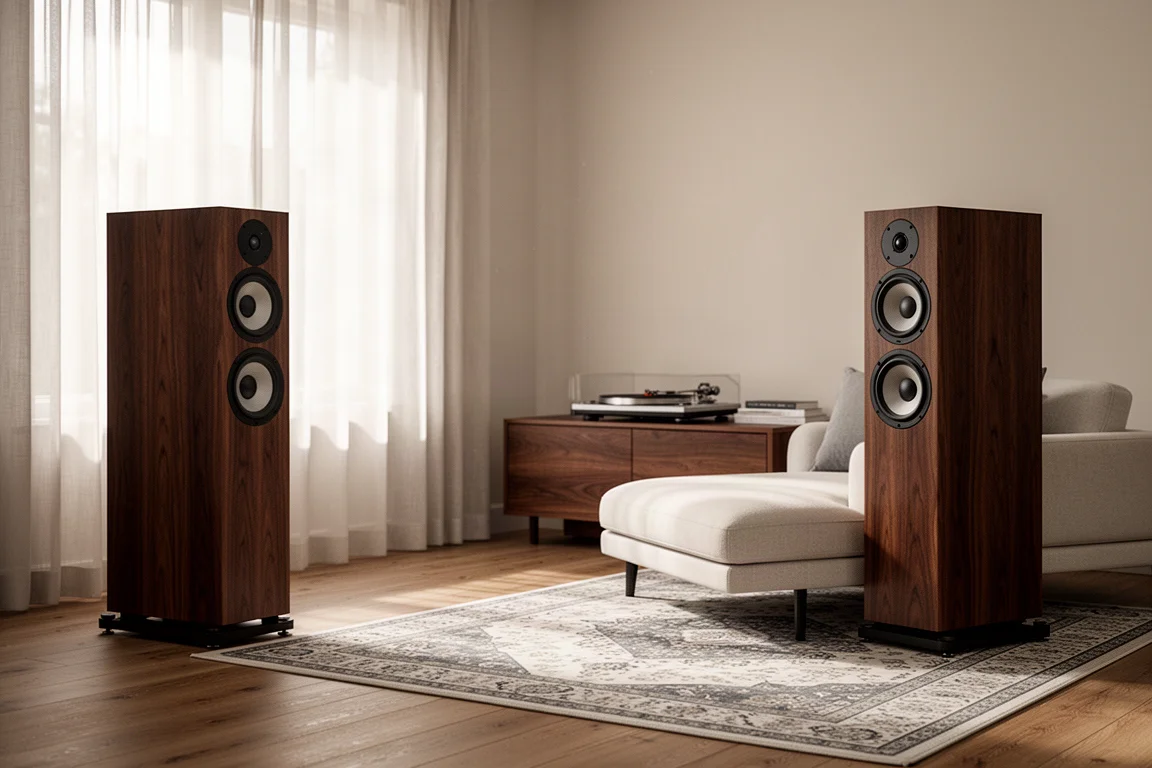
At 16 kg per cabinet, the 4329P is not a speaker you will casually move between rooms, and it is heavy enough that desk use is unlikely despite the USB input on the back. Treat it as a room-defining purchase rather than an accessory.
Streaming Without Extra Boxes
Everything needed for network playback is built in. The 4329P supports Bluetooth, Apple AirPlay 2, Tidal Connect, Spotify Connect, Google Chromecast and Roon Ready operation out of the box. In practice that covers most of the ways people listen today: casting from a phone, connecting a laptop over Bluetooth, or running a full library through Roon.
Where It Fits in a Room
How a loudspeaker interfaces with a room shapes the sound you actually get more than any single specification. In a 6 by 5 metre room with a listening chair roughly 2 metres from the speaker plane, the 4329P proved to be a good match. The size of the cabinet and its low-frequency output filled the space without overwhelming it, which is exactly the balance a large stand-mount is meant to strike.
Main Strengths
The 4329P’s strongest arguments are its dynamic character, its unusually deep bass for a cabinet of this size, and the fact that it needs nothing else to play music. Each of those deserves a closer look.
Dynamics and Driver Architecture
The 4329P is a two-way design. The tweeter is a horn-loaded 1-inch compression driver rather than a dome, and it is driven directly by a 50 watt amplifier. The mid-bass driver is an 8-inch paper cone mounted in an aluminium cast frame, driven by a 250 watt amplifier. JBL confirms that the amplifiers in each cabinet are direct digital designs, meaning the signal path stays digital all the way to the switching output with no interceding DAC stage. A DSP-based crossover feeds the four amplifiers, two per channel.
That hardware translates into the speaker’s defining quality: dynamics, top to bottom. It puts clear daylight between quiet and loud passages and pushes sound forward into the room with real drive. The top end is smoother and better extended than the Buchardt A500, and the mid-range lets you see further into a dense mix, including the phantom centre image drawn between the two cabinets.
Connectivity and Everyday Use
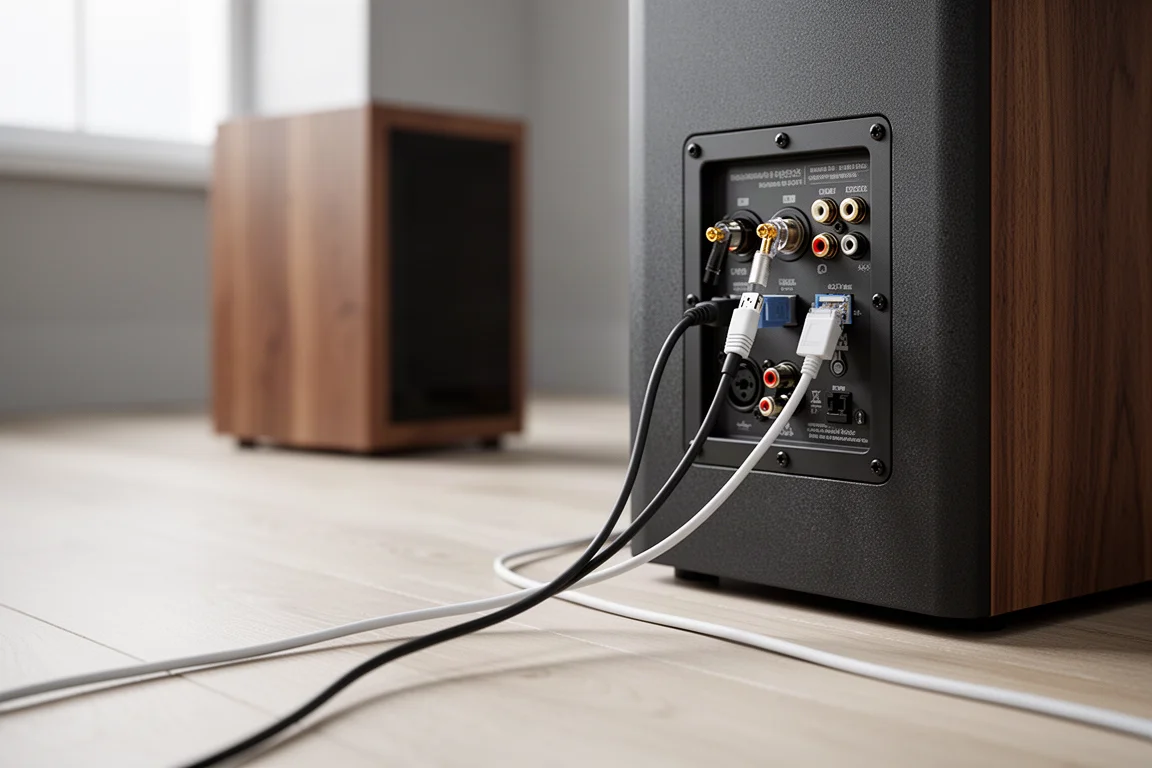
The primary speaker carries the connections. Left and right XLR sockets accept either XLR or phono connectors, there is a USB-B socket that will appeal to anyone running a computer as a source, and a Toslink optical input handles digital components. That primary cabinet then hands the signal to the secondary speaker over a digital interlink, either by Ethernet cable for 24-bit/192 kHz or wirelessly at 24-bit/96 kHz. The supplied 3 metre Ethernet cable is shorter than ideal if you want to separate the speakers properly, so the wireless link is often the more practical choice.
Two details are worth noting. Analog signals are digitised on entry, which vinyl listeners should factor in, though the drivers and their amplifiers will shape the sound far more than the conversion stage does. The subwoofer output is auto-sensing, with the signal sent to the sub low-pass filtered at 80 Hz while the speakers are high-pass filtered at the same point.
Bass Depth for a Stand-Mount
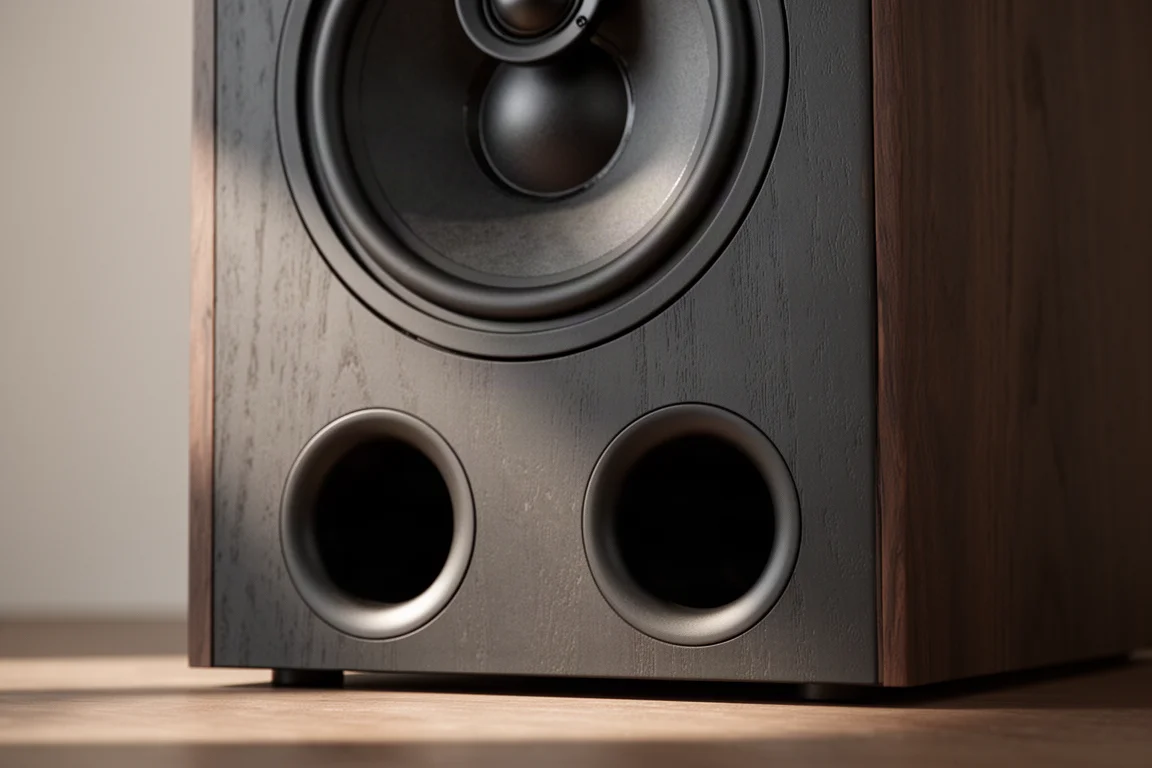
Two bass reflex ports fire forwards from behind detachable grilles, and JBL quotes low-frequency extension down to 60 Hz. That is impressively low for a cabinet this size and puts the speaker in the same conversation as other active models known for going deep from modest volumes. In a 6 by 5 metre room, a subwoofer is genuinely unnecessary, although one would almost certainly add something.
A bass contour toggle is provided, and it earns its place. In one room the neutral setting made the low end sound overcooked and bloated, and dropping the contour to minus 3 dB brought it back under control. Your room may behave differently, but the switch is a useful tool rather than a gimmick.
Things to Consider Before Buying
The 4329P gets the fundamentals right, but a few accessories and omissions are worth planning around before you order.
Stands, Remote and Inputs
JBL’s JS8 stands add around €220 per pair. They serve several purposes: they raise the tweeter to ear height, lift low-frequency energy away from the floor, and tilt the speaker upward by 7 degrees for what JBL describes as superior dispersion, particularly at close listening distances. The effect is audible. On the JBL stands the speaker sounded more open and expansive than on a shorter third-party stand.
The trade-offs are aesthetic. The skeletal frame leaves speaker cable on full display because there is no cable routing, which is a strange omission at this price. The supplied Bluetooth remote also feels like an afterthought next to the quality of the cabinet, yet it remains genuinely useful, since the front panel controls on the primary speaker are more awkward to reach from a listening chair. On inputs, the absence of HDMI ARC stands out for a speaker aimed partly at home listeners.
How It Compares With Other Speakers
Against the passive Zu Audio DWX, which needs an outboard amplifier and streamer, the 4329P gives up a little dynamic robustness and some of the mid-range focus, but it reaches deeper into the sub-bass and removes an entire chain of components from the equation.
The Buchardt A500 streams over a wireless link from an outboard hub and offers room correction and alternate tunings, along with impressively deep bass for a stand-mount. The 4329P counters with greater overall clarity and a smoother, better extended top end. The Genelec 8341 does not stream at all and is aimed at studio users, and while it is transparent, the 4329P adds a layer of excitement on top of that transparency while keeping some of the same composure on complex material.
One honest caveat: with dense recordings played loudly, above roughly 85 dB at the listening seat, the lower treble can start to sound a little strident. That is a loud-listening characteristic rather than a day-to-day one.
Buying Advice
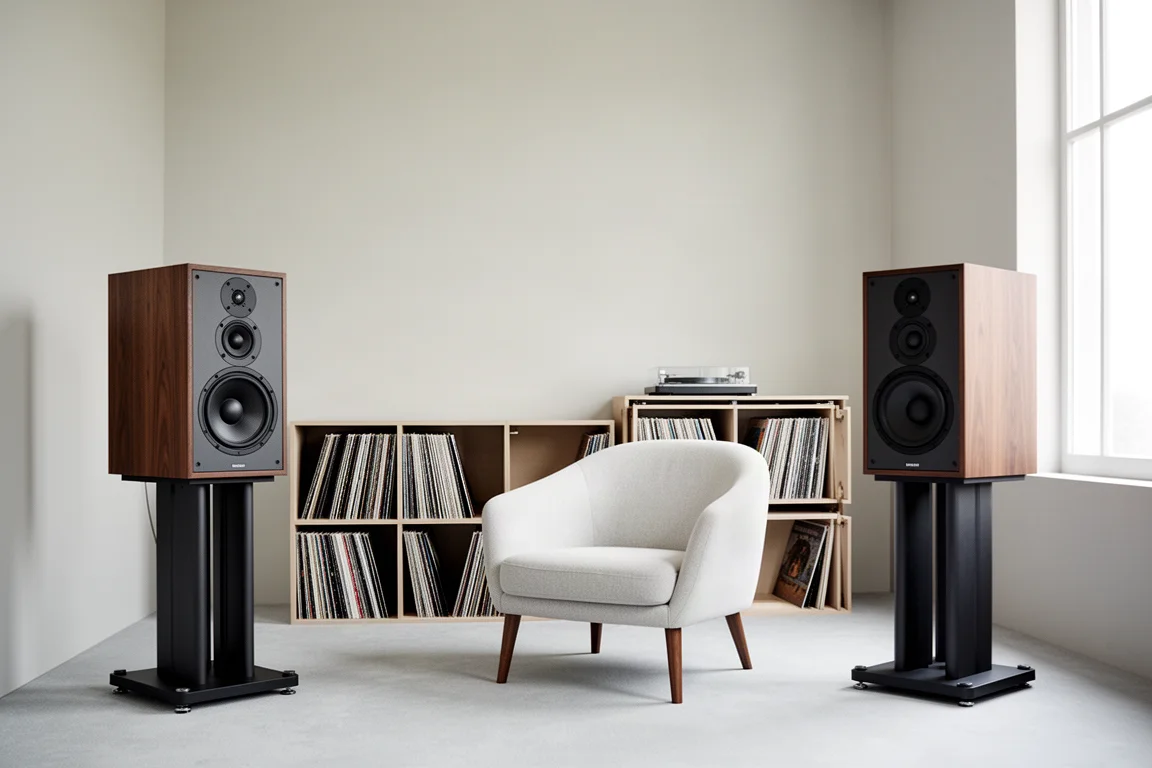
The 4329P makes the most sense if you want a single purchase that covers streaming, vinyl and digital sources without extra boxes, and if your room is large enough to let a substantial stand-mount breathe. Budget for the stands as well, since the 7 degree tilt is part of the design intent, and accept that the remote and the cable management are the weakest parts of the package.
If you already own a high-quality amplifier and streamer and enjoy swapping components, a passive design may give you more flexibility. If you want the shortest possible path from a phone, a turntable or a laptop to music in the room, this speaker is built for exactly that.
Conclusion
The JBL 4329P earns its place on dynamics, bass depth and convenience. Its streaming platform is comprehensive, its driver package is serious, and its ability to fill a mid-sized room from a stand-mount cabinet is the quality that stays with you. The stands, the remote and the missing HDMI ARC are real compromises, but none of them change the fact that this is a complete, capable system that asks only for a power socket.
Product link
View more details for JBL 4329P
This product is mentioned in the review. Check the specifications, options, and compatibility before buying.
View more details for JBL 4329PFurther reading
Related Reviews
Hi-Fi Audio
Accuphase C-57 vs Allnic H-7000V: Two High-End Phono Stages Compared
A fully balanced solid-state phono stage with a pitch-black noise floor meets a tube design built for well-loved records. Here is how to choose between them.
Hi-Fi Amplifiers
Accuphase E-280 Review: Entry-Level Accuphase With Flagship Attention to Detail
A close look at the Accuphase E-280 integrated amplifier, covering its champagne build, AAVA volume control, sound quality, and the speakers and sources that suit it best.
High-End Audio
Accuphase E-3000 Review: A Class AB Integrated Amplifier Built to Last
The Accuphase E-3000 is the entry point into a legendary Japanese high-end line. Here is how it sounds, how it is built, and who should consider it.