Home Audio
HSU Research CCB8 Review: Big Bass and High Sensitivity, With Real Trade-Offs
A close look at the HSU Research CCB8 coaxial bookshelf speaker, covering its strong midrange and bass, its high sensitivity, and the tonal balance issues to weigh before buying.
Introduction
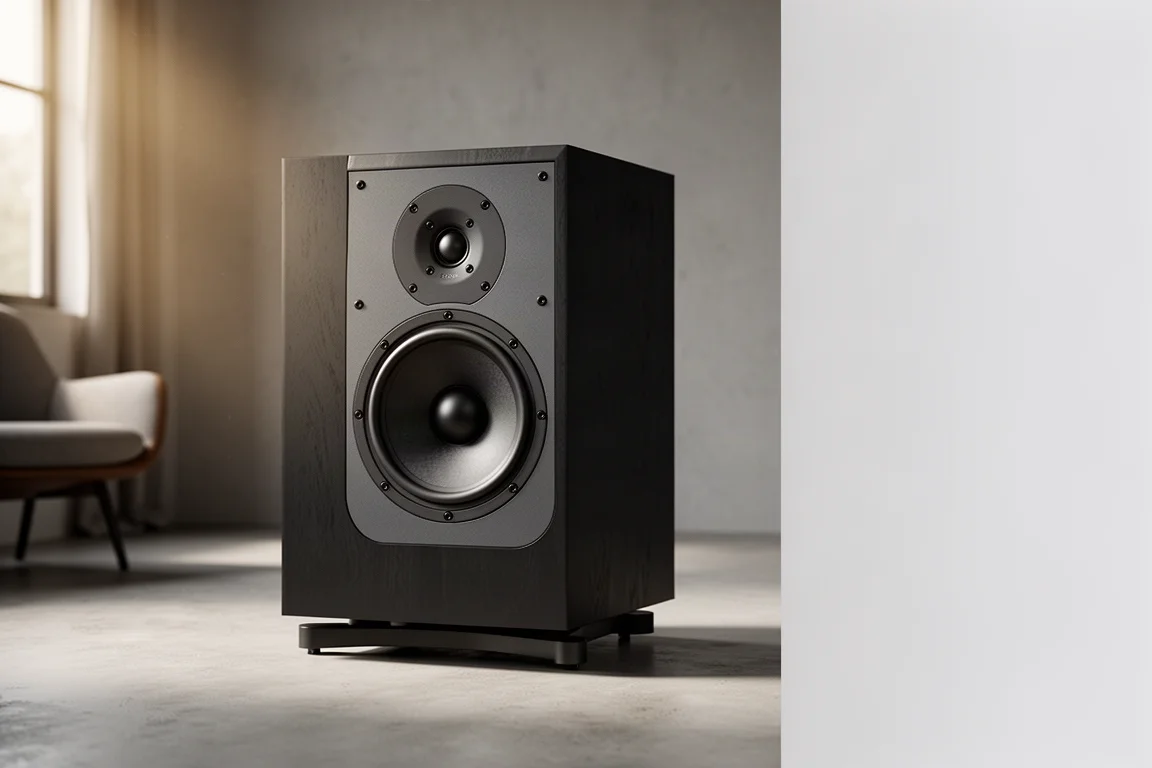
The HSU Research CCB8 is an eight-inch coaxial bookshelf speaker in a vented cabinet, built around a circular constant directivity horn. Retail pricing is around $390 each in the United States, which puts a pair close to $780. The design brief is appealing: a single coaxial driver places the tweeter and the woofer on the same acoustic center, so a listener stays the same distance from both, and the manufacturer specifies a frequency response of 50 Hz to 20 kHz, plus or minus 2 dB at 15 degrees off axis, with 94 dB sensitivity in half space and a recommended amplifier range of 10 to 400 watts.
In practice, the CCB8 behaves like two different speakers. Everything below roughly 1 kHz is genuinely good: a full, punchy mid-bass, a clean midrange, and enough sensitivity and bass extension to embarrass many larger cabinets. Above that region, it becomes difficult to live with, and the problems are not the kind a quick turn of a tone control can hide.
Who This Speaker Is For
This is a speaker for listeners who want high sensitivity, high output capability, and wide horizontal coverage from a coaxial design, and who are willing to place it carefully and treat the room around it. It makes the most sense in a dedicated listening room or a home theater system where absorption can go on the side walls and equalization is available.
It is not a speaker for a bare living room with hard floors and untreated side walls. Set up that way, it works against the room instead of with it.
The coaxial layout is the main draw. A point source design avoids lobing between drivers because the woofer and tweeter share one acoustic center, and the circular horn is intended to keep off-axis response consistent whether a listener moves vertically, horizontally, or diagonally. That is a real engineering advantage in principle, and the measured horizontal coverage, roughly plus or minus 55 degrees before the treble narrows, supports the claim.
Main Strengths: Midrange, Bass, and Efficiency
Below about 1 kHz the CCB8 is excellent. Mid-bass has proper punch, the midrange stays clean, and the handoff into the lower registers is handled well. In-room extension lands around 60 to 70 Hz, and the measured F3 of 65 Hz with F10 at 52 Hz is a strong result for a cabinet this size.
Sensitivity is the other headline. The rated figure is 94 dB in half space, and the average measured sensitivity of about 90.4 dB is still high for a bookshelf speaker. High sensitivity usually means giving up bass, and the reasonable assumption would be that an eight-inch driver rated this efficient rolls off well above 100 Hz. It does not. Pairing roughly 90 dB of efficiency with useful output down to 60 Hz or so is a genuine achievement, and it is the strongest argument in the speaker’s favor.
The CCB8 also plays loudly without drama across most of its range. With a minimum impedance of 4 ohms and a minimum EPDR of 2 ohms, a standard 4-ohm-capable amplifier will drive it without trouble, and the recommended 10 to 400 watt window leaves plenty of headroom for a home theater system.
Things to Consider Before Buying
The upper midrange is where the design comes apart. There is a resonance around 600 Hz and another around 1.2 kHz, both visible in the burst decay and in the frequency response, and the crossover region contains a peak and dip combination spanning roughly 7 dB. A swing that large is audible as coloration rather than as a subtle voicing choice, and the practical result is an aggressive upper midrange that keeps drawing attention to itself.
Two further dips, one near 2 kHz that looks like cabinet diffraction and one in the crossover region, cannot be corrected with equalization because they are built into the design. To get anywhere near a flat response, a room correction pass produced nine separate EQ bands, and both dips survived it. Nine bands is a lot of correction to ask of a passive speaker, and it is a strong signal that the underlying balance is off.
Imaging suffers as well. With the cabinets pointed straight ahead and no treatment in place, the presentation was unstable. Adding two-inch rock wool absorption at the first reflection point tightened the imaging and took some edge off the upper midrange. That fix works, but it is also a warning sign: speakers with well-controlled, even dispersion do not require side wall treatment, and treatment can reduce the sense of envelopment that side wall reflections contribute.
Port or enclosure resonances also appear in the impedance curve and in the frequency response, which points to the cabinet itself adding to the uneven character of the sound.
It is worth setting the CCB8 against two similarly priced alternatives. The KEF Q1 Meta, at $699 per pair, is also a coaxial design but far more linear and more tonally balanced, with bass that reaches roughly 10 Hz lower. It gives up about 6 dB of sensitivity and shows higher distortion overall with less output capability, so the trade is efficiency and headroom for accuracy. The Klipsch RP-600M II, also $699 per pair, is more linear than the CCB8 with an F3 of 70 Hz and an F10 of 41 Hz, and its radiation is narrower at roughly plus or minus 40 degrees but better controlled. Both alternatives respond well to a small amount of equalization. The CCB8 does not.
How the Measurements Read
Frequency response measurements put average sensitivity at about 90.4 dB, with F3 at 65 Hz and F10 at 52 Hz. The CEA-2034 data set shows the resonances near 600 Hz and 1.2 kHz along with a busy high frequency region. The horizontal contour plot is wide, roughly plus or minus 55 degrees, before narrowing quickly in the treble.
Because the driver is coaxial, the vertical and horizontal contour plots behave similarly, with small differences that come from the cabinet being slightly taller than it is wide. Multitone distortion is acceptable at moderate levels but peaks at higher output levels and again around 8 to 9 kHz. Crossing the speaker over to a subwoofer at 80 Hz brings those distortion peaks down only slightly, so the behavior is not simply a matter of bass load on the driver.
Placement, Room Treatment, and EQ
Placement changes this speaker a great deal. Facing the listener directly produced the worst result by a clear margin. Angling the cabinets away by roughly 15 degrees softened the top end without solving the tonal problems, and turning them further out, to around 30 degrees off axis and parallel with the wall behind them, did not help either. This matches how coaxial designs typically behave: because the driver sits dead center in the cabinet, diffraction from the cabinet edges and from the drive unit itself creates peaks and dips directly on axis, and the symmetry of the layout concentrates those artifacts exactly where a listener normally sits.
The practical fixes are absorption and equalization. Two-inch absorptive panels at the first reflection, around 50 degrees off axis, catch some of the extra energy the speaker sends into the room and calm the aggressive upper midrange. Equalization can flatten the overall response, but it will not repair the diffraction dip near 2 kHz or the crossover dip. If you already own a pair, treat the side walls first, then apply correction, and keep the filter count modest.
Adding a subwoofer does not change the picture much. Crossing the CCB8 over at 80 Hz reduced the distortion peaks a little but not significantly, which confirms that the uneven upper range is a design characteristic rather than a limitation of driver excursion.
Buying Advice
For most buyers, the CCB8 is hard to recommend. The lower half of its range is genuinely impressive, and the combination of high sensitivity, real bass extension, and high output capability is uncommon at this price. But a speaker has to reproduce the full range, and the aggressive upper midrange, the resonances, and the roughly 7 dB peak-to-dip swing in the crossover region are not details that fade after a few hours of listening. They shape everything you hear.
If you are weighing a purchase, ask two questions first: can you place absorption at the first reflection points, and do you have room correction available? If the answer to both is yes, the CCB8 can be made listenable, and its dynamics and mid-bass punch are worth experiencing. If either answer is no, the similarly priced KEF Q1 Meta and Klipsch RP-600M II are easier speakers to live with and respond to a small number of EQ filters rather than nine.
One more cost to keep in mind: the retail price of about $390 each does not include stands, and the acoustic panels that made the biggest difference in listening were not really optional in practice. Budget for both as part of the purchase rather than as an afterthought.
Conclusion
The HSU Research CCB8 gets the hard part of speaker design right and the critical part wrong. Its coaxial driver, high sensitivity, and bass extension down to roughly 60 Hz in room are real strengths that few bookshelf speakers at this price can match, and listeners who value dynamics and output capability will find a lot to like in the lower registers.
The tonal imbalance above 1 kHz is the reason to hesitate. Between the resonances, the roughly 7 dB peak-to-dip swing, the two dips that equalization cannot fix, and the reliance on side wall absorption to sort out imaging, this is a speaker that demands a treated room and correction tools before it becomes enjoyable. Buy it with that setup in place, or choose one of the more linear alternatives at the same price.
Product link
View more details for HSU Research CCB8
This product is mentioned in the review. Check the specifications, options, and compatibility before buying.
View more details for HSU Research CCB8Further reading
Related Reviews
Home Audio
Aperion Novus Tower and Center Review: Punchy Home Theater Sound With Real Refinement
A close look at the Aperion Novus tower and center speakers, from their layered paint finish and punchy bass to the 4-ohm load and what the price actually buys.
Home Audio
Arendal 1610 Tower Review: Flagship Dynamics in a Room-Friendly Tower
A compact floorstanding tower with three 8-inch aluminium woofers, a 5-inch carbon midrange, and the kind of bass heft usually reserved for much larger speakers.
Home Audio
Arendal 1723 S THX Review: A Reference Speaker Built Like a Tank
A practical look at the Arendal 1723 S THX, a sealed, THX-certified speaker with exceptional build quality, a very flat top end, and a midrange that responds beautifully to EQ.