Bookshelf Speakers
HECO Aurora 300 Review: A Compact Bookshelf Speaker With Serious Value
A German two-way bookshelf speaker with a linear midrange, wide off-axis coverage, and usable bass down to about 50 Hz for $419 a pair.
Introduction
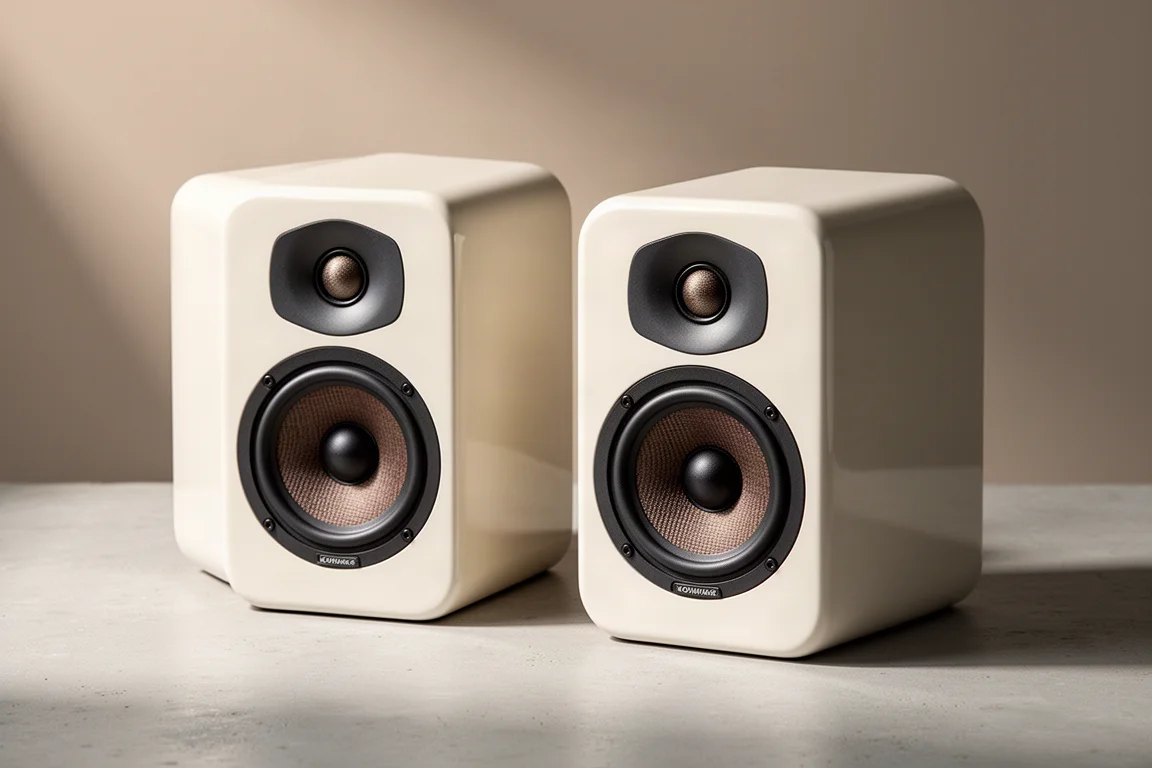
HECO is a German loudspeaker company that has stayed under the radar in many markets, even as its Aurora series has built a reputation for measured performance that exceeds its price. The Aurora 300 is the compact two-way bookshelf model in that family. It pairs a paper cone woofer of roughly 6.7 inches with a 1-inch fabric dome tweeter in a rear-ported cabinet, and it carries a $600 per pair list price that in practice almost never applies. Most buyers see it at $419 per pair. Finishes are black ash or white, and the review sample is black, with a satin front baffle and a wood-grain finish on the side panels.
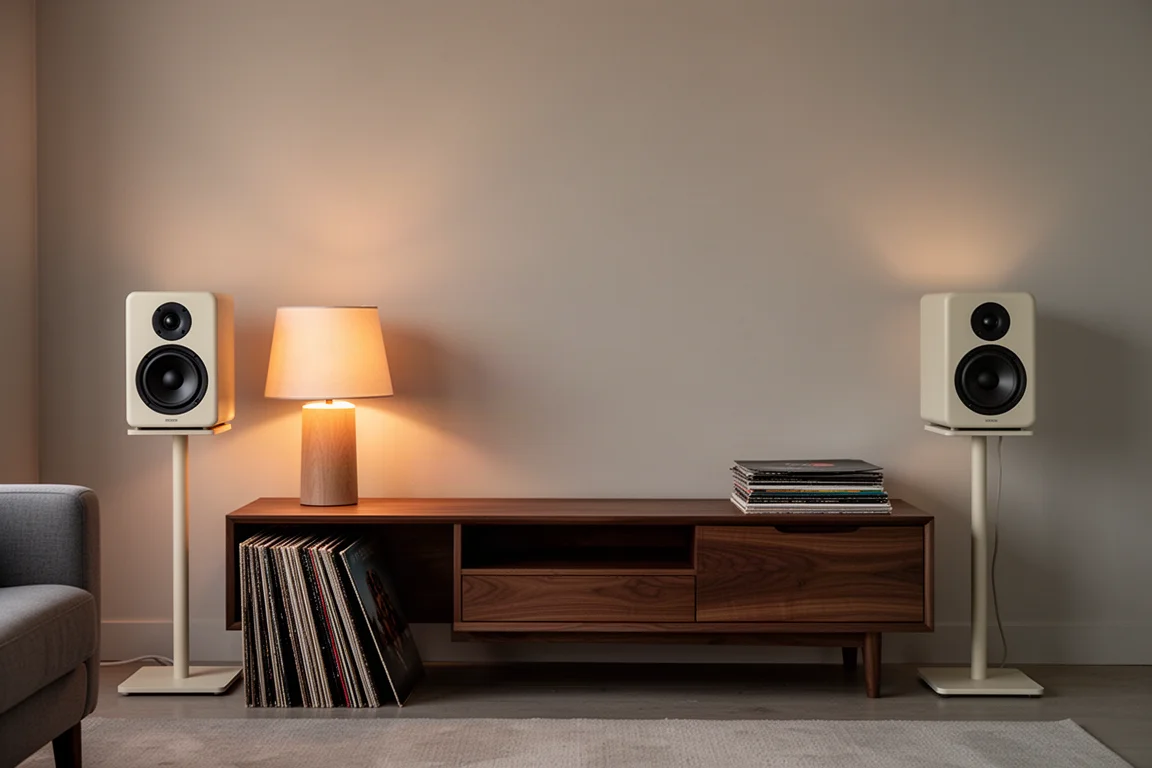
That price lands in one of the most competitive corners of the speaker market, where several well-known bookshelf models trade places on discount every few months. The Aurora 300 does not separate itself with a long feature list. It separates itself with behavior: a linear midrange, even coverage well off axis, and genuine low-frequency output for a cabinet this size.
One design detail is worth noting up front. The tweeter sits behind a plate with a pattern of concentric ripples rather than a flat baffle. At a glance it can look like a coaxial driver, but it is not. The rippled plate acts as a waveguide, shaping how sound leaves the front baffle. It is the only visibly unusual element on an otherwise conventional two-way speaker, and the measured results suggest it is doing something useful.
Who the HECO Aurora 300 Is For
This is a speaker for listeners who want a neutral, uncolored presentation rather than a forward or heavily voiced one. Its measured response is remarkably flat through the region where human hearing is most sensitive, which makes it a sensible choice for two-channel music in a small to medium room and for the front stage of a modest home theater system.
It is also an easy speaker to drive. The cabinet presents a nominal 4-ohm load, but the impedance never drops below about 4.1 ohms, which makes it a benign load for a mid-priced AV receiver. Sensitivity is rated at 90 dB, and measured output at 2.83 volts came in slightly lower but close to that figure. For a bookshelf speaker with this much bass extension, that combination is unusual and welcome.
Buyers who want a compact speaker that looks more expensive than it is will also find plenty to like. The Aurora 300 avoids the flat, textured vinyl look common at budget prices, and the magnetic grilles mean the front baffle stays clean whether or not you use them.
Main Strengths
The most impressive part of the Aurora 300 is its listening-window response. Averaged across a realistic listening area, roughly plus or minus 30 degrees horizontally and plus or minus 10 degrees vertically, the response is very flat, with a notably linear midrange. The horizontal measurements stay smooth out to 90 degrees, with no serious peaks or dips. The result is a large area of the room where the speaker sounds tonally even, which is exactly what you want from a compact two-way.
There are two minor deviations worth mentioning for completeness. The on-axis curve shows a small lift around 5 kHz, likely tied to the tweeter waveguide, and a slight elevation in the midrange on the order of a couple of decibels. Neither is dramatic, and both fade as you move off axis. A small rise near 15 kHz is far above the range most listeners can hear.
Low-frequency performance is the other headline. The response stays flat from around 500 Hz down to roughly 90 Hz before rolling off gradually, with the rear port tuned just below 50 Hz. In practice that means usable bass down to about 50 Hz in a normal room, which is a lot of low-end reach for a cabinet of this size. The rolloff below the port tuning frequency is gentle rather than abrupt.
Sensitivity and dynamics follow from the driver choices. The larger paper cone is efficient, and bucking magnets on the back of the woofer add a small amount of motor force that nudges sensitivity upward. Combined with the roughly 90 dB rating, that gives the Aurora 300 a dynamic ease that most compact bookshelf speakers at this price cannot match. Paired with its wide dispersion, the result is a broad, enveloping presentation that fills a typical room without sounding strained.
Build quality is solid for the money. The top and bottom panels use MDF close to an inch thick, there is a generous amount of internal stuffing, and the flared rear port and terminal plate look like brushed aluminium even though both are plastic. Dual binding posts allow bi-wiring, though splitting the signal to a tweeter at this price and power level offers little practical benefit. The cabinet’s side panels measure about 5/8 inch thick, which brings us to the trade-offs.
Things to Consider Before Buying
The most consistent complaint concerns packaging rather than sound. Each speaker weighs around 15 to 16 pounds, and the foam blocks used in the carton are not really substantial enough for that weight. Units can arrive with minor cosmetic scuffs on the cabinet as a result, even when the drivers and structure are undamaged. It is a cost-saving decision that buyers should simply be aware of.
Inside the cabinet, there is no bracing between the side panels. An impedance sweep shows a very small blip around 280 Hz that may be a side panel or port resonance, though it is minor and did not produce any audible coloration. Listeners who care about cabinet rigidity at this price point should note the omission, but it does not undermine the overall result.
The vertical listening window is the other practical consideration, and it is common to nearly every non-coaxial two-way design. If you sit well above or below the tweeter axis, the woofer and tweeter fall out of phase through the crossover region and you lose a chunk of the midrange. Staying within roughly plus or minus 10 degrees of tweeter height avoids the problem entirely.
Finally, if the speakers are aimed directly at your ears, the small on-axis lift around 5 kHz may add a touch of brightness to sibilant sounds. Angling them differently, as described below, removes that concern for most listeners.
Setup and Placement Notes
The measurements point to a setup that happens to match how most people arrange a room anyway. For the most neutral result in the sweet spot, place the speakers firing straight ahead in parallel lines rather than toed in toward the listening position. Because the response is exceptionally flat at around 15 to 20 degrees off axis, a listener seated in the middle of two forward-facing speakers is already sitting in the speaker’s most linear window. That is unusual, and it makes the Aurora 300 unusually forgiving of ordinary room layouts.
A mild toe-in is still perfectly workable, and some listeners may prefer the slightly more present treble that comes with aiming the speakers more directly at the seat. Aggressive toe-in is the one approach worth avoiding. If you do experiment, keep the changes small and give each position a proper listen before moving on.
Height matters more than angle here. Get the tweeters as close as you can to seated ear level, whether the speakers sit on stands or on a shelf. Keep the rear port in mind as well, since it does the work below 50 Hz and sits on the back of the cabinet. The rest is straightforward: a clean 4-ohm load that never dips below 4.1 ohms and roughly 90 dB of sensitivity means almost any competent receiver will drive them without complaint.
Where the Aurora 300 Fits Among Other Bookshelf Speakers
This is a crowded price bracket, and several familiar names occupy it. Klipsch’s CF Q50 carries a $600 per pair list price but frequently sells near $400, and Polk’s Signature Elite ES20, the Wharfedale Diamond series, and JBL’s Studio 620 all compete in the same territory. The JBL model in particular tends to offer higher power handling and greater dynamic headroom for listeners who push levels hard. The Hsu Research HB-1 Mk2 is another strong performer with a bit more punch for home theater, though it is fussier about placement.
The Aurora 300’s advantage is balance. It does not appear to give up much in any single area. Its bass extension, off-axis linearity, and sensitivity are all strong for the money, and its finish looks better than the price suggests. Listeners who want the most well-rounded compact speaker of the group, rather than the loudest or the punchiest, will find the HECO the easiest of the set to live with.
It is also worth noting the family context. The Aurora 1000 floorstanding model earned a strong reception for punching above its class at around $800 each, sometimes less on sale. The Aurora 300 carries that same character into a smaller cabinet and a much lower price.
Buying Advice
At $419 per pair, the Aurora 300 is straightforward to recommend. It measures better than most speakers at this price, reaches down to about 50 Hz in a real room, and pairs easily with modest amplification. The list price of $600 is largely theoretical, since the speaker is discounted so consistently that $419 is effectively the going rate. Buyers should treat that number as the real cost.
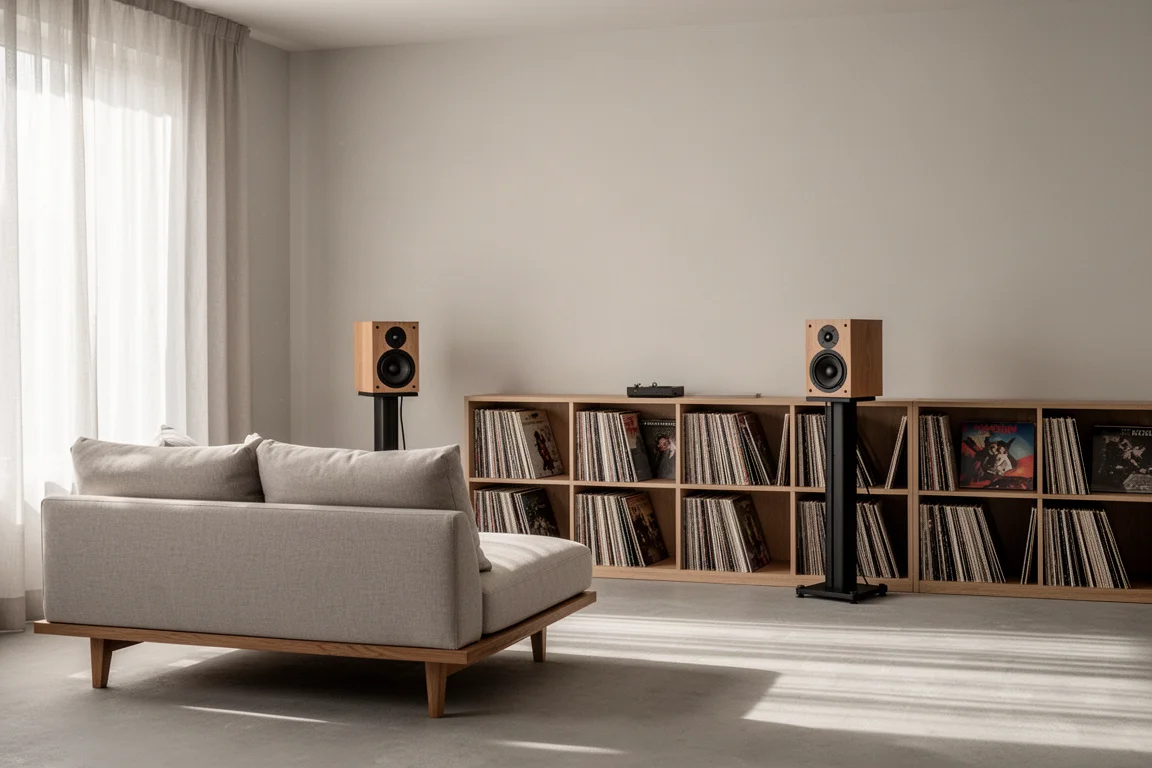
There are cases where a different choice makes sense. If you are building a dedicated home theater room and need maximum output and headroom, a higher-sensitivity design such as the JBL Studio 620 may serve you better. If you want the last word in midrange refinement regardless of price, there are more expensive options. But for a small to medium stereo system, a desk-adjacent nearfield setup, or the front channels of a living-room theater, the Aurora 300 delivers the kind of measured performance that usually costs noticeably more.
One practical note before ordering: distribution for this brand in the United States runs through a single retail partner, which makes it easy to overlook and harder to audition in person. That is worth knowing, because the speaker deserves more attention than its availability suggests.
Conclusion
The HECO Aurora 300 is a rare thing in an overcrowded category: an affordable bookshelf speaker with no obvious weak point. Its listening-window response is very flat, its horizontal coverage is smooth and wide, its bass reaches about 50 Hz in-room, and its roughly 90 dB sensitivity gives it dynamic freedom that compact rivals struggle to match. The trade-offs are real but minor, limited to light packaging, unbraced side panels, and a vertical window that is standard for the design type.
For listeners who want neutral sound, easy amplification, and a finish that looks better than the price tag, this is one of the stronger values in compact speakers right now. Set them up with the tweeters at ear level, keep the toe-in gentle, and the Aurora 300 will reward the purchase for years.
Product link
View more details for HECO Aurora 300
This product is mentioned in the review. Check the specifications, options, and compatibility before buying.
View more details for HECO Aurora 300Further reading
Related Reviews
Bookshelf Speakers
Acoustic Energy A100 Mark II Review: A Compact Standmount With an Expansive Soundstage
The Acoustic Energy A100 Mark II brings clarity, natural tonality and a wide soundstage to an entry-level standmount, with a few setup details worth knowing first.
Bookshelf Speakers
Acoustic Energy AE-100 Mark II Review: Compact Bookshelf Speakers With Standout Imaging
A compact British two-way bookshelf speaker with deep, layered imaging, fast bass, and a slight treble lift to weigh against a crowded $500 field.
Bookshelf Speakers
Acoustic Energy AE100 MK2 Review: Measured Performance and Four Alternatives
A close look at the Acoustic Energy AE100 MK2 bookshelf speaker, what its measured performance reveals, and four alternatives with different trade-offs.