Camping Tents
Gazelle T4 Review: A Tall, Spacious Instant Cabin Tent With One Rain Caveat
The Gazelle T4 pitches fast, stands tall enough to walk around inside, and packs away with a clever removable floor. Its short rainfly is the main thing to weigh up.
Introduction
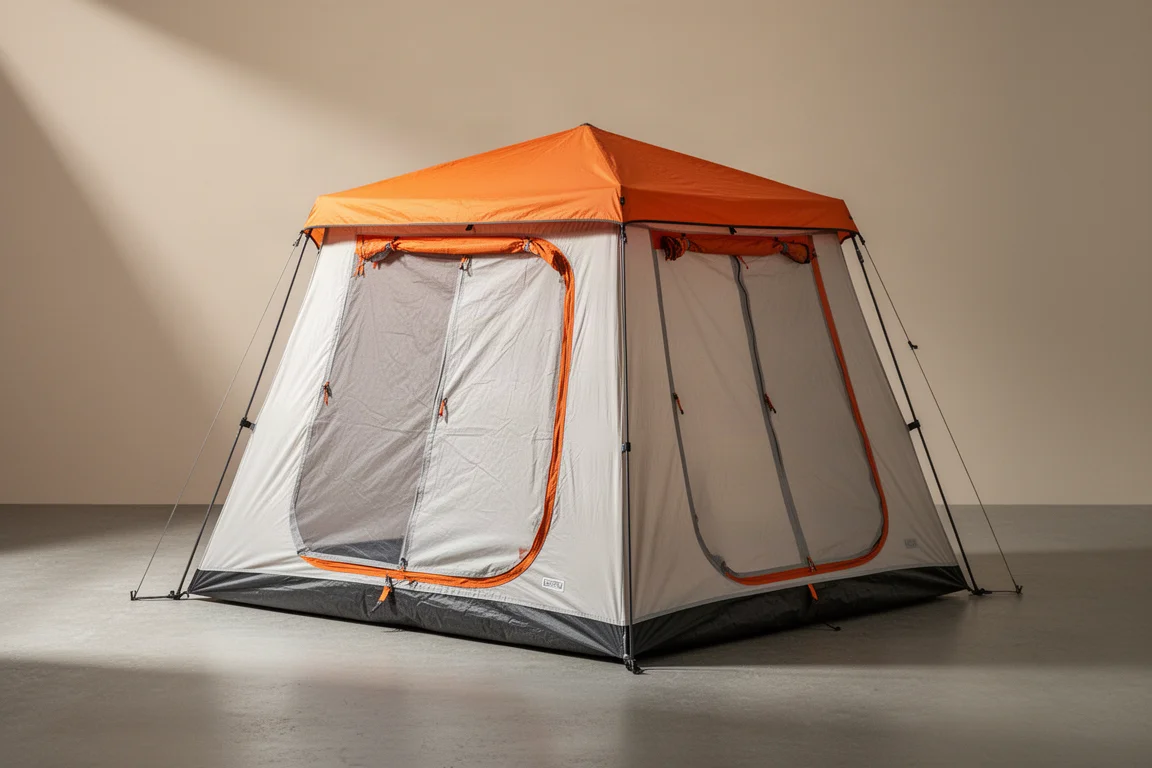
The Gazelle T4 is a four-person instant cabin tent built around a hub-and-pole frame rather than a set of separate poles you thread through sleeves. It sets up in minutes, stands tall enough for most adults to walk around inside, and includes a removable floor that makes packing it away unusually quick. It is also a large, heavy tent with a short rainfly, and that combination shapes who will get the most from it.
This review covers how it pitches and packs, how much usable room it really offers, how it handles weather, and the practical trade-offs to check before buying.
Who This Tent Is For
The T4 suits car campers who want a basecamp tent that feels more like a small room than a sleeping pod. Four adults fit at its maximum capacity, and the near-vertical side walls and generous corner height make that capacity feel realistic rather than optimistic. Campers who are tall, or who simply dislike crouching, will notice the difference immediately.
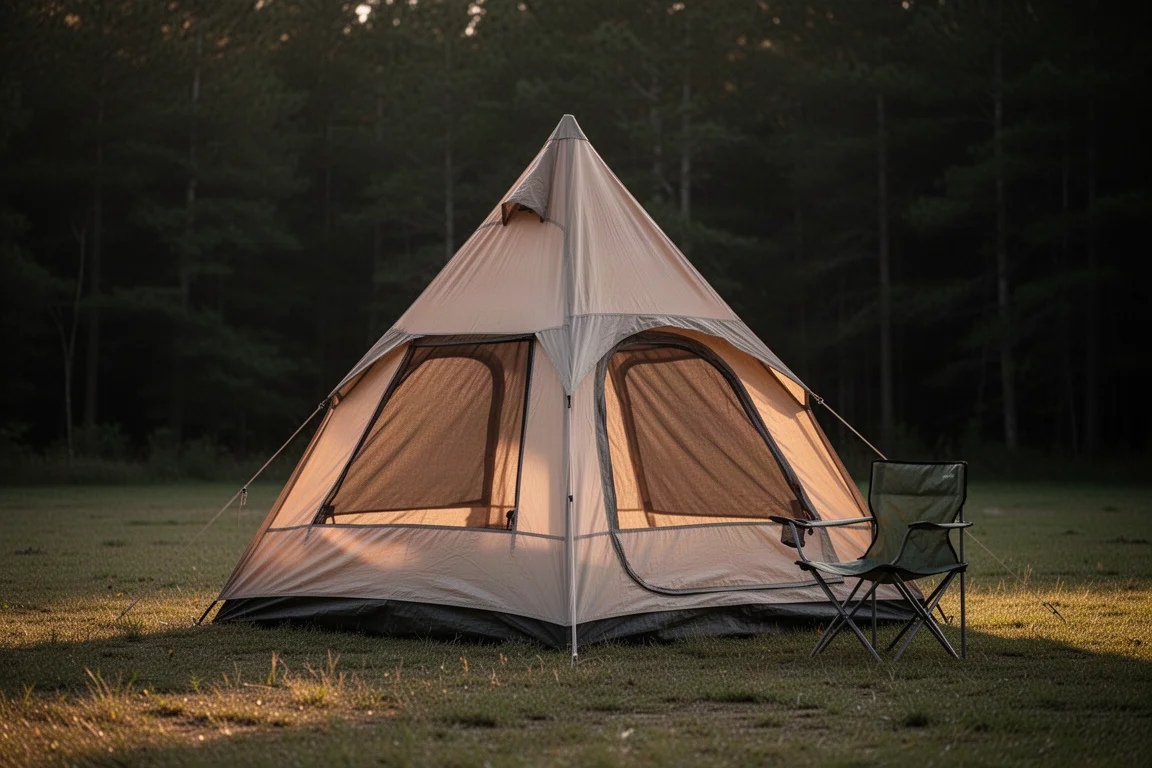
It is also a good match for anyone who camps mostly in warm weather and values fast setup and teardown at the start and end of a trip. Buyers who expect to camp through sustained heavy rain, or who need a compact pack size, should weigh the limitations carefully.
Setup and Pack-Away
Setup follows a simple sequence: unfold the tent flat on the ground, then pull on the four wall hubs. That first stage takes roughly a minute and a half. Adding the rainfly takes about another minute and a half, and staking out the base plus the four guylines takes around two minutes, for a total of about five minutes with everything in place. Skip the rainfly and the tent goes up in roughly one minute and 45 seconds to two minutes, which puts the 90-second pop-open claim within reach for fair-weather pitching.
The supplied instructions are clear enough to work from on a first attempt, and there are enough stakes and guylines to cover the whole tent. The one quirk worth knowing is that the final wall can take noticeably more effort to pop open the first few times, before the fabric relaxes.
Packing away is easier than expected. Unstaking the tent, removing the rainfly, folding everything down and returning it to the carry bag takes around six minutes. The carry bag is sized well rather than being a struggle to close, and air escapes the folded tent readily.
Living Space and Interior Height
The floor measures about 94 inches by 93.5 inches, giving a near-square base of almost exactly 61 square feet. Peak height at the centre is around 77.5 inches, and the lowest point in the corners is about 67 inches, which is high enough for many adults to stand upright even at the edges. That corner height is the standout figure, because most cabin tents lose a great deal of headroom toward the walls.
The frame helps here. Each of the four walls has a hub at its centre, and the hub-to-hub span measures about 102 inches, wider than the floor itself. Those hubs pull the fabric outward, so the walls bow slightly and the usable space extends past the staked footprint. Standing in a corner and reaching forward leaves a clear gap to the wall, and sitting up does not bring a head into contact with the fabric.
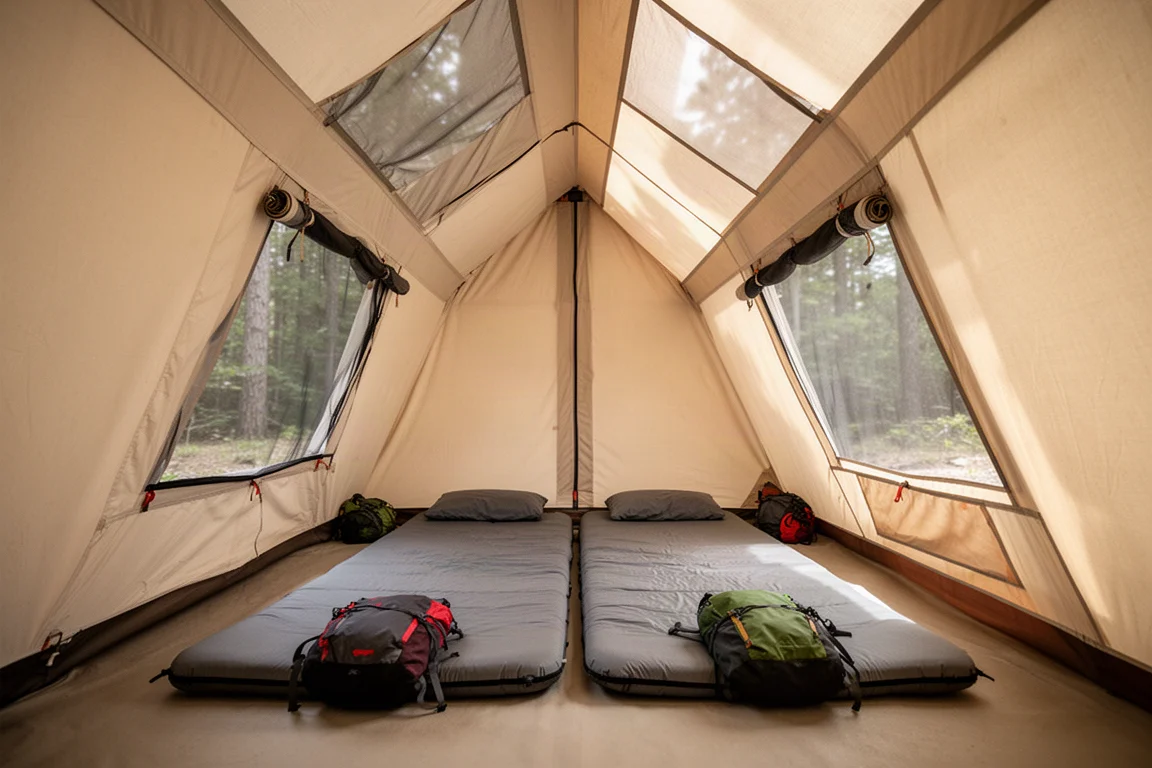
For sleeping, two double pads, equivalent to four single pads, fit side by side without looking compressed, even when those pads are wider than the standard 20-inch width. There is still room for gear at the foot of each pad. A single queen mattress fits, oriented either across the width or down the length of the tent, but there is not enough space left for a second one. Thick nine-inch mattresses still leave standing room under the peak.
Doors, Windows, and Storage
There are eight windows in total, two on each wall, with two of them being the larger door windows. The smaller windows measure about 19 by 21 inches, while a door window measures about 28 by 53 inches. Zipping is smooth, with no snags on the smaller windows, and the smaller windows have a useful pocket at the bottom that the fabric tucks into, so they can be closed again without pulling the panel fully out.
The two D-shaped doors sit at opposite corners. They are the main compromise of the frame design: each is about 26 inches at its widest point and about 50 inches long, tapering sharply at the top and bottom, with roughly 56 inches of clearance from the ground to the top of the opening. Most adults will duck on the way in and out, and the tapered shape takes some getting used to. A queen mattress has to be brought in deflated and inflated inside the tent.
The door zippers are YKK and behave well from both sides, even with the large storm flaps outside, which is where zippers on many tents tend to catch. The door windows use two layers, one for the window and one for the door, so opening them involves unzipping both, tying the door layer back, and closing the window layer again. Keeping the window layer tied up when it is not needed saves that routine.
Storage is generous. Six pockets are spread across the walls: two walls carry two pockets each, and the other two walls carry one each. The lower pockets measure about 18 by 15 inches, while the largest upper pocket is a triangle roughly 59 by 26 inches, big enough to put an arm into. A 20 by 20 inch gear loft is included and hooks onto four loops at the top of the tent with toggles. A strap hangs from the top hub for a lightweight lantern, though heavy items should be avoided there, and there is no power port.
Weather Protection and Ventilation
The tent body and rainfly are made from polyester with a 2,000 mm hydrostatic head rating, and the floor steps up to 5,000 mm. The rainfly can be removed entirely on hot days to expose the ceiling mesh, which, combined with the windows and doors, gives decent airflow in warm weather. Because of that ceiling mesh, this is a three-season summer tent rather than a cold-weather shelter.
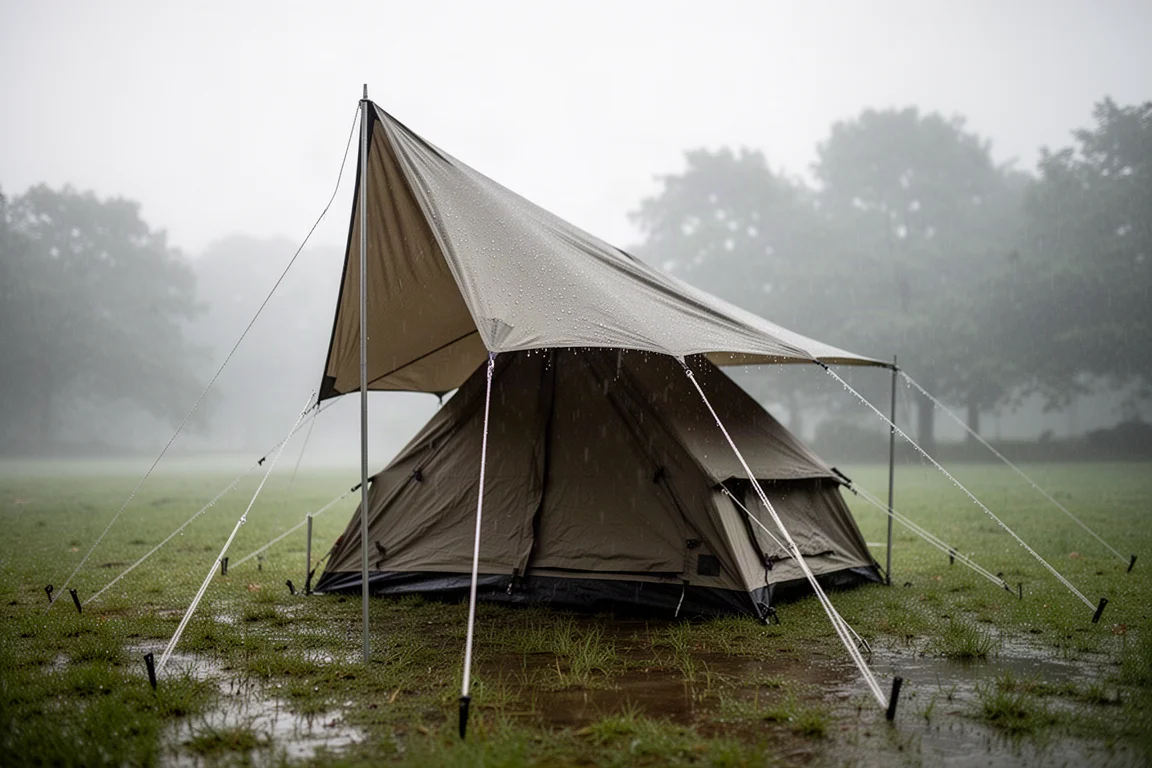
In a one-hour heavy rain simulation, the results were mixed. Parts of the top mesh panels became damp, a few droplets reached the floor after dripping through the mesh, the seam of one wall pocket soaked through, and the interior side of the wall hubs felt slightly damp. The cause is the rainfly length: it overlaps the top mesh panels by only a small margin, so heavy rain driven at the right angle can reach beneath it. The estimate is roughly five to ten hours of sustained heavy rain before those weak points begin leaking properly. Seams that sit under the rainfly are fully taped, but the pocket seams are only taped along the top, and hubs cannot be taped at all.
Rainy-day ventilation is limited as well. There are no roof, rainfly, or floor vents, and the windows cannot be opened in the rain because the rainfly covers them poorly. In light winds the tent held up well, and in moderate to strong winds it should be guyed out fully, since wind pressing on a wall hub can fold the wall inward. The four guylines are not reflective, and the hub loops on the outside allow the tent to be guyed out without the rainfly attached.
Materials, Build Quality, and the Removable Floor
The tent body uses 210-denier oxford weave polyester, the rainfly uses standard polyester, and both carry a UPF 50+ rating. The mesh is tight-weave in principle but feels closer to standard mosquito netting than the micro mesh found on some premium tents. The poles are fiberglass, and although they feel sturdy in use, aluminum or steel would be a welcome upgrade at this price point. Stakes are the V-style type, and the stuff sack fabric feels durable.
The frame uses five hubs in total, four on the walls and one at the top, with interconnected poles running hub to hub and up to the top of the tent. That density of poles is what gives the tent its rigidity and its roomy interior, and it is also why the doors and windows end up on the smaller side. Each wall hub carries foam padding held on with Velcro, which protects the fabric and should be left in place. Stitching is double-stitched throughout, with no loose threads or inconsistent areas.
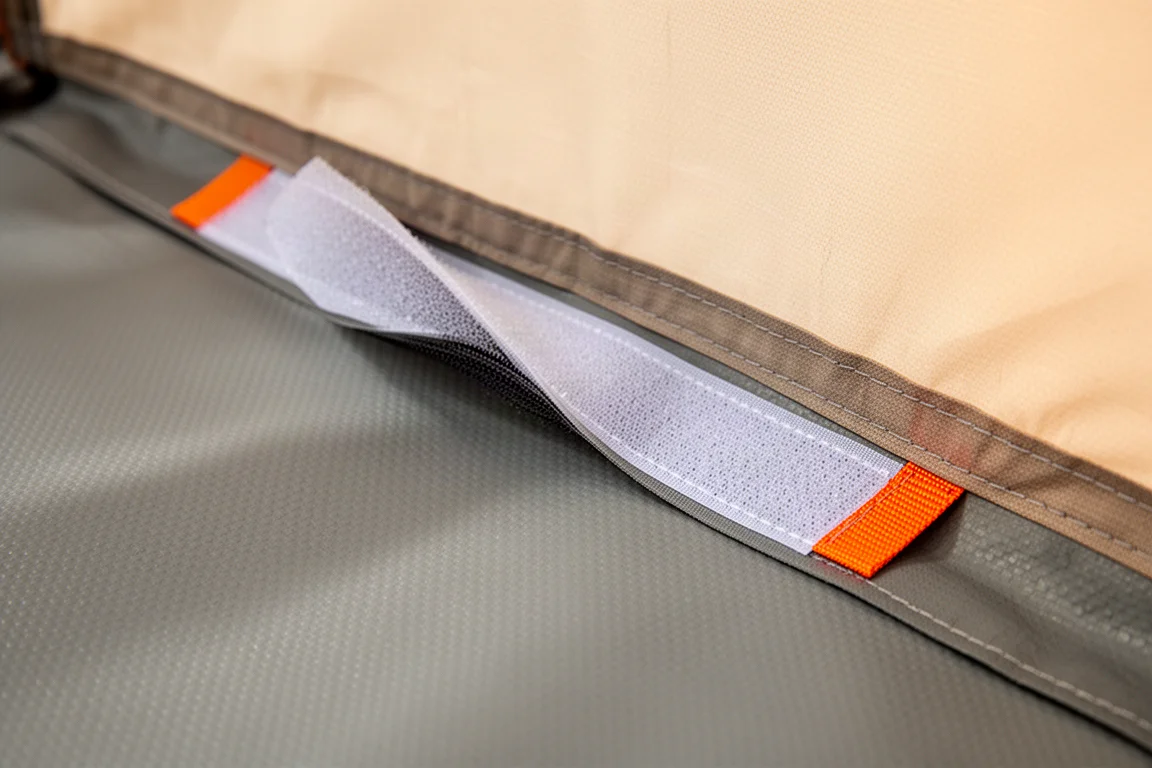
The floor deserves separate attention. It is a thick 300-denier oxford weave polyester with a 5,000 mm hydrostatic head rating, and it comes out of the tent completely. Four corner toggles release first, then the rest of the floor separates from the body along a long Velcro strip around the perimeter. Removal takes very little effort, which makes cleaning simple, and partially releasing the floor also lets air escape quickly during pack-down, compressing the tent in under 20 seconds. Refitting it is slightly more involved: the orange tabs on the floor need to line up with the orange tabs on the body, and excess fabric is best spread toward the corners. The tent body overlaps the tub floor at the corners, and that overlap kept the corners dry even after heavy rain.
Portability and Packed Size
Packed, the T4 measures about 68 by 13 by 10 inches and weighs around 34 pounds for everything. That is long: noticeably longer than some six-person instant tents and roughly double the packed size of a typical four-person cabin tent, so it will not suit every boot or small hatchback. The carry bag helps, with handles at both ends and a padded main handle in the middle for carrying.
Things to Consider Before Buying
The rainfly coverage is the biggest consideration. Light and moderate rain are handled comfortably, but sustained heavy rain exposes the top mesh panels, the pocket seams, and the wall hubs, with an estimated five to ten hours before real leaking begins. Rainy-day ventilation is restricted too, since the windows cannot be opened and there are no vents.
The doors are narrow and tapered, which means ducking and a little care when carrying gear in. The packed length is substantial, the poles are fiberglass rather than aluminum, the guylines are not reflective, and there is no power port. The warranty runs for one year, which is shorter than the price point might suggest. On cost, the T4 sits at the higher end among instant tents, though retailers do run sales from time to time, so it is worth checking before buying.
Buying Advice
The T4 makes the most sense for car campers who pitch in one spot for a few days, want to stand up and move around freely, and camp mainly in fair weather. The fast hub-based setup, the tall corner height, the outward-bowed walls, the six pockets plus gear loft, and the removable floor are the reasons to choose it over a conventional cabin tent. Treated well and set up as intended, it should serve for several seasons.
Buyers whose trips regularly involve hours of heavy rain, or who need a compact packed size, are better served by a tent with a longer rainfly and a smaller footprint. If the T4 does fit your plans, guy it out in any real wind, keep the door window layer tied up when it is not needed, bring inflatable mattresses in deflated, and take a moment to align the floor tabs when refitting the floor.
Conclusion
The Gazelle T4 delivers on the things that matter most in a car camping tent: it goes up in about five minutes, it packs away quickly, and it offers genuinely walk-around space with headroom even in the corners. The removable floor is a standout feature, and the storage provision is well above average. Its limits are just as clear. The short rainfly, restricted wet-weather ventilation, narrow doors, and very long packed size define who should buy it and who should look elsewhere.
Product link
View more details for Gazelle T4
This product is mentioned in the review. Check the specifications, options, and compatibility before buying.
View more details for Gazelle T4Further reading
Related Reviews
Camping Tents
3F UL Gear Taiji Two-Person Tent Review: Field Waterproofing Results and Buying Advice
The Taiji pairs an attached fly with a removable inner, but sustained rain exposed untaped vent seams that need sealing before this shelter can be trusted.
Camping Tents
3FUL Gear Lanshan 2 Pro 4-Season Review: A Sub-$200 Single-Wall Trekking Pole Tent
An early look at the 3FUL Gear Lanshan 2 Pro 4-Season, covering its straightforward pitch, generous interior space, and the condensation and seam-sealing questions that come with any single-wall shelter.
Camping Tents
Alps Mountaineering Lynx 1-Person Tent Review: Big Value in a Small Budget Tent
A close look at the Alps Mountaineering Lynx 1-Person Tent, covering real interior dimensions, materials, setup time, ventilation limits, and who should buy it.