Outdoor Watches
Garmin Instinct 3 Solar Review: Solar Endurance for Long-Distance Hikers
A rugged, button-operated GPS watch with solar charging, multi-day GPS battery life, and course navigation for hikers who would rather keep their phone in the pack.
Introduction
On long-distance trails, most hikers navigate with a phone running an offline map app. It works well, and there is a good reason it has become the default. The catch is battery life. A phone is also handling podcasts, music, photos, and sometimes satellite messaging, and every one of those tasks pulls the battery down. Pulling the phone out of a pocket or hip belt just to check mileage gets old quickly, and in heavy rain a touchscreen becomes unreliable.
A watch does not replace the phone, but it can take over the small, frequent jobs: distance, time, elevation, sleep, and a basic sense of whether you are still on the trail. The Garmin Instinct 3 Solar is built for exactly that role. It is not a necessity. It is, however, genuinely useful.
Who This Watch Is For
This watch makes the most sense for thru-hikers and long-distance backpackers who already navigate with a phone and want a low-maintenance companion on the wrist. It also suits hikers who want a rugged watch that can go weeks between charges while still tracking training, sleep, and daily distance.
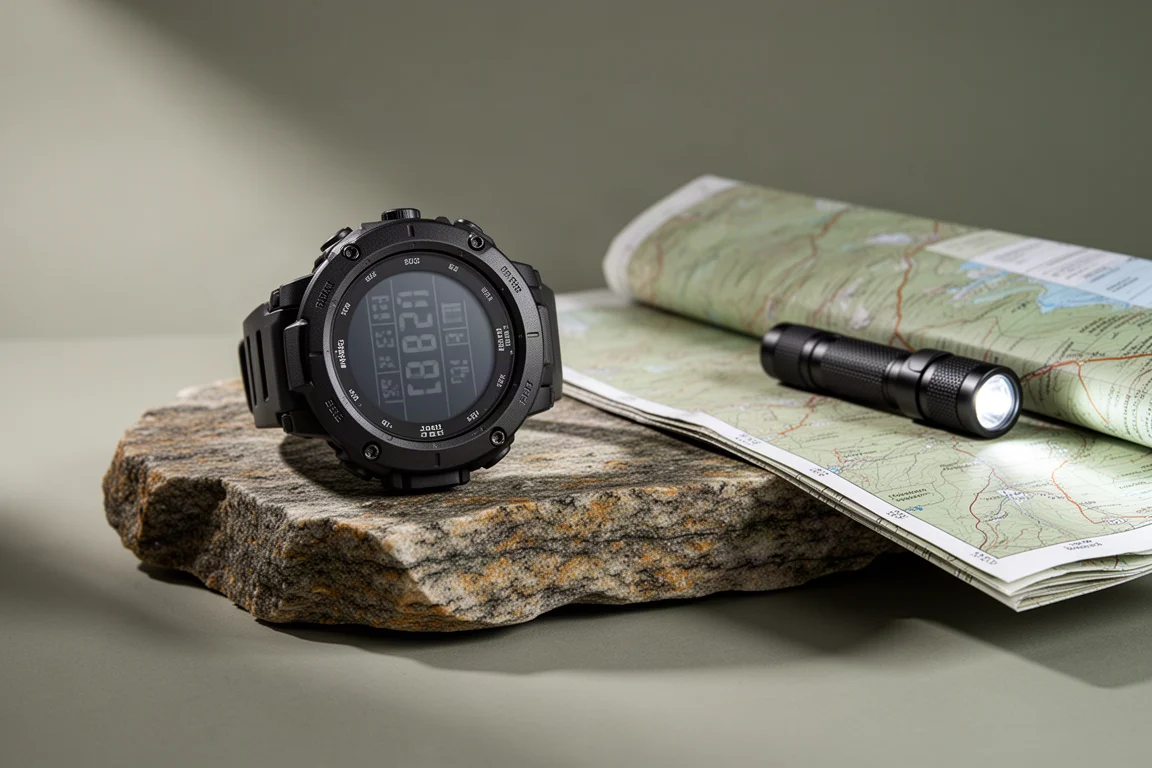
Garmin offers the Instinct 3 Solar in two sizes, a 50 mm version and a 45 mm version. The 50 mm model carries a slightly better battery rating and a distinctly retro look, with a large plastic bezel that reads a little like an older outdoor digital watch. It is big on the wrist, though not quite as large as a 51 mm Garmin Fenix 8. The 45 mm version is the option for smaller wrists.

The case is built to take abuse, which matters more than looks on a trail that lasts for months.
Solar Battery Life and Real-World Endurance
The solar panel is the main reason this watch stands out. Tracking a hike with GPS only while also navigating through mixed tree canopy produced roughly 75 hours of battery life. On a sunny day above the tree line, the same setup stretched to around 150 hours of GPS tracking. Results vary with sunlight, wrist position, and how much of the panel is actually exposed.
Garmin also provides a battery saver mode that can be toggled on and off and shuts down features such as heart rate monitoring. When sunlight is limited, battery saver mode charges the watch fastest, and it can be customized to keep the functions you still want. Charging from a wall outlet takes about two hours from empty to full.
Away from GPS tracking, the watch behaves like a normal smartwatch. It runs about 40 days without solar assistance, and roughly two to three months with it. Garmin states that solar charging can extend runtime indefinitely depending on how much sunlight the watch receives.
Navigation and On-Trail Confidence
There are no maps on this model, and that is the clearest trade-off. What you get instead are breadcrumb trails, which are enough to follow your route back if you lose the path, plus the ability to zoom out far enough to see town names for orientation.
Courses are where the navigation really works. A route can be built in Garmin Connect on the web or on mobile, snapping to the trail as you click along it. Course points can be added as waypoints for shelters and water sources, which is a practical way to see how many miles remain to the next reliable water. Once a course is synced to the watch, you start it through the activity options, and the watch provides turn-by-turn directions, upcoming landmarks, and alerts when you drift off course and when you return to it.
If you want more map context, Garmin Explore is a free app that offers free offline map layers, including topographic and satellite views, and shows your position on the phone while the watch is connected. Routes from AllTrails can be sent to Garmin Connect and then synced to the watch, though very long trails are too large for the device and will return an error; sending a section of a long trail instead usually works. CalTopo is another free option: export a route as a GPX file, import it into Garmin Connect, and it behaves like any other course. Courses can also be handed to other hikers with Garmin Share, which transfers watch to watch without Wi-Fi.
Everyday Tracking, Health Metrics, and the Built-In Flashlight
Between hikes, the watch keeps working as a daily wearable. The default watch face shows elevation, steps, and sunrise and sunset times, and the health features include a morning report that offers a second opinion on whether you are rested enough for a long day, plus pulse oximeter readings and sleep tracking. All of this runs on normal smartwatch battery life rather than GPS battery life.
The heart rate monitor is not the newest sensor Garmin makes, but it performs well in most conditions. Very cold or very dry skin can affect contact, and moistening the wrist helps.
The built-in LED flashlight sits on the edge of the case and throws a surprisingly wide pool of light. It works well as a backup to a headlamp, or on its own for a quick trip out of the tent at night.
Two hardware details are worth knowing. The display is transflective, which saves battery but depends on ambient light reflecting off it to be readable, so in low light you press the backlight button, and the backlight can be set to turn off automatically after a few seconds. There is no touchscreen at all. Every interaction uses the side buttons: up and down to move through screens, one button to select, and one to go back. The buttons are firmer than on some other models, but the menu logic becomes second nature quickly.
The watch also pairs with a Garmin inReach satellite communicator, letting you read messages, reply with presets or quick text, and trigger an alert or an SOS from the watch itself. That is meaningful if the communicator is buried in a pack after a fall. Standard phone notifications for text messages work as well.
Things to Consider Before Buying
The lack of on-device maps is the biggest one. If you want trail names and surrounding context on your wrist, this is not the model for that. The breadcrumb and course system covers basic route following well, but it is a different experience from a full map screen.
Screen readability is a related consideration. A transflective display is excellent in bright sun and needs the backlight in shade, inside a tent, or at night. If you prefer an always-bright screen, this will feel like a compromise.
Solar performance is variable by nature. Canopy cover, cloud, sleeve position, and how you wear the watch all change how much charge you collect, so the headline battery numbers are best read as a range rather than a guarantee.

Size is the other factor. The 50 mm case is large, and the 45 mm version exists for that reason. The absence of a touchscreen is a deliberate choice that suits wet, cold, gloved hands, but it is still an adjustment if you are used to swiping.
Finally, firmware matters with any modern GPS watch. Early software on this model had reported issues, and recent use has been stable, but it is worth checking for updates before a long trip.
Alternatives Worth Knowing
If on-device maps matter more than price, the Garmin Enduro 3 offers maps, a longer solar runtime, and preloaded mapping detail including trail names, at roughly twice the cost. The Garmin Fenix 7 Pro is an older model that is currently discounted and includes maps and routing, with weaker solar performance than the Instinct 3 Solar as the trade-off. The Suunto Vertical is another solar option with strong performance and maps, but those maps are not preloaded, need to be synced, and do not include trail names, which places it between the Instinct 3 Solar and the Enduro 3 in mapping usefulness.
Buying Advice
Choose the Instinct 3 Solar if you want a rugged, button-operated watch with strong solar-assisted GPS battery life, dependable course navigation, and everyday health tracking, and if you are comfortable keeping maps on your phone. It pairs especially well with phone-based navigation, where the watch handles mileage checks, tracking, and route alerts while the phone stays in your pack.
Look elsewhere if on-device maps, trail names, or a bright touchscreen are priorities. Those needs point toward the Enduro 3 or another mapping-focused model, and the higher price is the honest cost of that feature set.
Size is the one decision to make before ordering. If your wrist is small or you prefer a lower profile, the 45 mm version is the sensible pick. If you want the best battery figures and do not mind a large case, the 50 mm version is the one to choose.
Conclusion
The Garmin Instinct 3 Solar is not a required piece of kit for a long hike. It is a helpful one. Solar charging, multi-day GPS runtime, reliable course navigation, and a genuinely useful flashlight make it a strong companion for hikers who navigate with a phone and want to stop draining it for every small check. If maps on the wrist are non-negotiable, the alternatives above are worth the extra spend. If they are not, this watch covers the essentials without asking for much attention.
Product link
View more details for Garmin Instinct 3 Solar
This product is mentioned in the review. Check the specifications, options, and compatibility before buying.
View more details for Garmin Instinct 3 SolarFurther reading
Related Reviews
Outdoor Watches
Garmin Fenix 7 Solar vs Garmin Epix: Which Outdoor Watch Fits Your Adventures?
Two top-end Garmin watches share the same build and feature set. The screen technology decides battery life, daylight readability, and how much detail you can pull from a map.
Outdoor Watches
Apple Watch Ultra for Hiking: How It Compares to the Garmin Epix and Fenix
Six months of trail use show what the Apple Watch Ultra does well on hikes, where navigation falls short, and when a Garmin Epix or Fenix is the better fit.
Outdoor Watches
Apple Watch vs Garmin: Which Outdoor Watch Should You Buy?
A practical comparison of Apple Watch Ultra, Apple Watch SE, the Garmin Fenix and Epix lines, and the two apps that add offline trail maps to an Apple Watch.