Hi-Fi Amplifiers
Gallion TS A20 Review: A 20 W Class A Amplifier Tuned for Detail
A close look at the Gallion TS A20, a Canadian 20 W Class A power amplifier built with North American parts and voiced for resolution, clarity, and air.
Introduction
Class A power amplifiers occupy a small corner of the hi-fi market. They run warm, they are rarely powerful, and they tend to be built in modest numbers by small companies. The Gallion TS A20 fits that description closely: it is a Class A design rated at 20 W per channel into 8 ohms and 35 W per channel into 4 ohms, it is made in Canada, and almost every part inside it comes from North American suppliers.
The company behind it is Gallion, founded by Thomas Tan, who spent years evaluating high-end audio equipment before deciding to build amplifiers of his own. The TS A20 is described as a passion project, two years in the making, and it sells for $3,750 US with a two-year warranty.
Who This Product Is For
Tan is not an engineer by trade. The design work on the TS A20 is credited to an engineer named Fabian, whose name appears on the front of the amplifier, while Tan handles voicing: the deliberate shaping of the sound through repeated capacitor swaps in key parts of the circuit. It is slow work, and some of the capacitors involved, made in the US by Jupiter, are very expensive parts.
That approach gives the TS A20 a distinct character rather than a neutral, committee-designed one. It is an amplifier for listeners who prize resolution, quietness, and the ability to hear into a recording, and who are willing to build a system around those priorities.
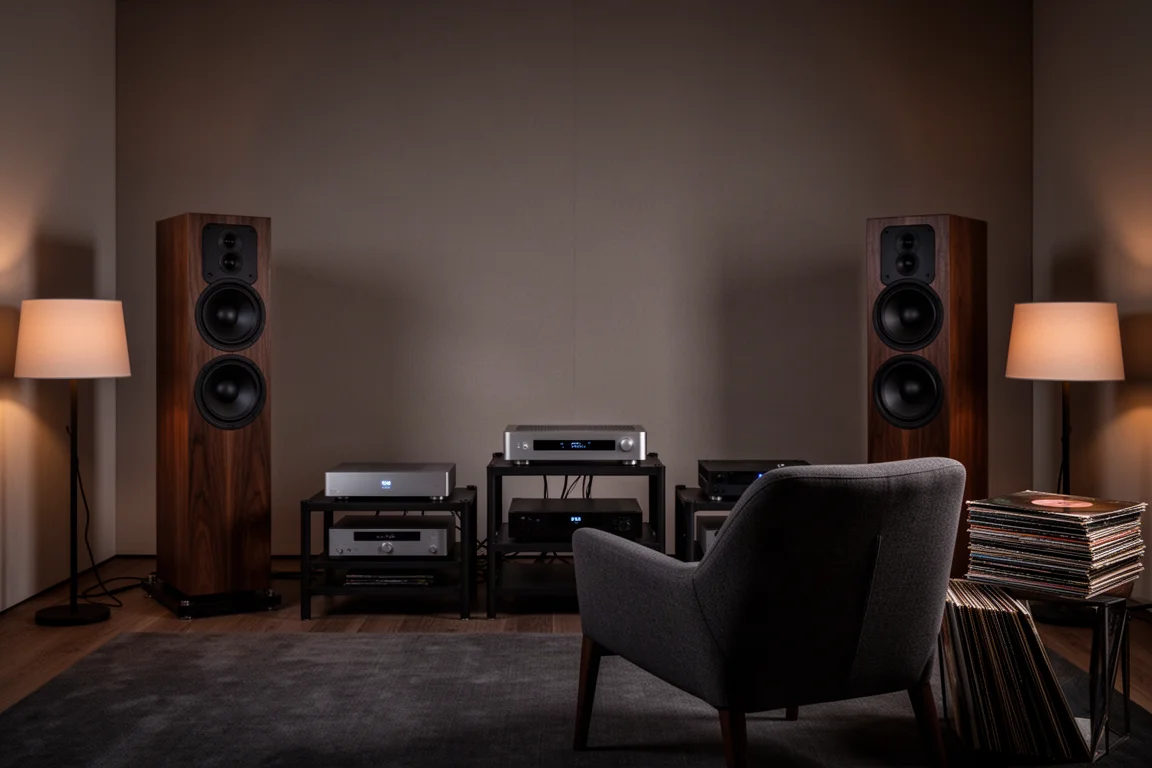
Because output is limited to 20 W into 8 ohms, the TS A20 also asks for sensible speaker matching. Both speakers used during testing were high-sensitivity designs, and that is the kind of system where this amplifier makes the most sense.
Design, Build, and What Is Inside
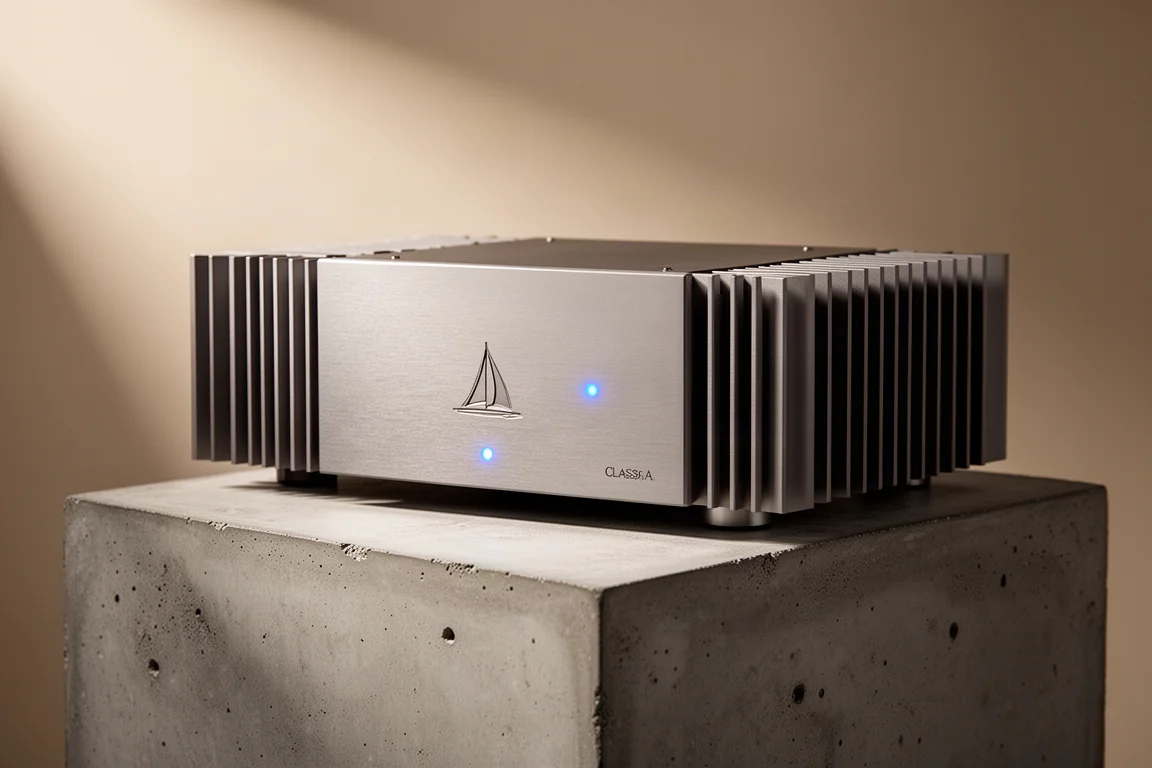
The front panel is deliberately simple: the Gallion emblem, which resembles the sails of a boat and is on the large side, plus a single bright blue indicator light that stayed unobtrusive in a darkened room. The rear panel is equally spare, with one pair of RCA inputs and a set of well-made binding posts.
Inside, the amplifier is densely populated with capacitors and parts sourced largely from North American suppliers, a deliberate choice that raises the cost of production. Class A operation means the chassis and heat sinks run warm to the touch, and the amplifier adds some warmth to the room over a long session.
Main Strengths: Detail, Dynamics, and Clarity
The TS A20’s strongest quality is how much of a recording’s internal structure it reveals. On a 1959 live album, each performer on the stage held a clearly separate position, and the sense of the hall around them came through intact. The same recording’s wide dynamic swings, from very quiet passages to loud ones, were tracked without any sense of strain.

That clarity extended to quieter material as well. On a 1968 studio album built from layered vocals, reverb, and spacious production, low-level details deep in the mix surfaced more readily than expected, and on a 1969 percussion recording the transient attack and harmonics of the instruments were especially vivid. Twenty watts per channel proved sufficient for the speakers on hand.
Listening Notes: Two Speaker Systems
Listening covered two high-sensitivity designs, the Pure Audio Project Duet 15 and the Zu Dirty Weekend 6. On a 1994 live recording played through the Zu speakers at roughly the low 90 dB range, the energy and drive of the performance came through clearly, even though that recording is more compressed and processed than the 1959 live album. Through these speakers the two amplifiers sounded far more alike than through the more revealing pair.
How It Compares to a Reference Amplifier
The natural comparison point is the Pass Labs XA25, a Class A design rated at 25 W into 8 ohms and 50 W into 4 ohms. Tonally the two amplifiers differ. The XA25 is darker and warmer, with a fuller, deeper vocal sound, while giving up some of the room sound, spatial clarity, and pinpoint separation between instruments that the TS A20 provides.
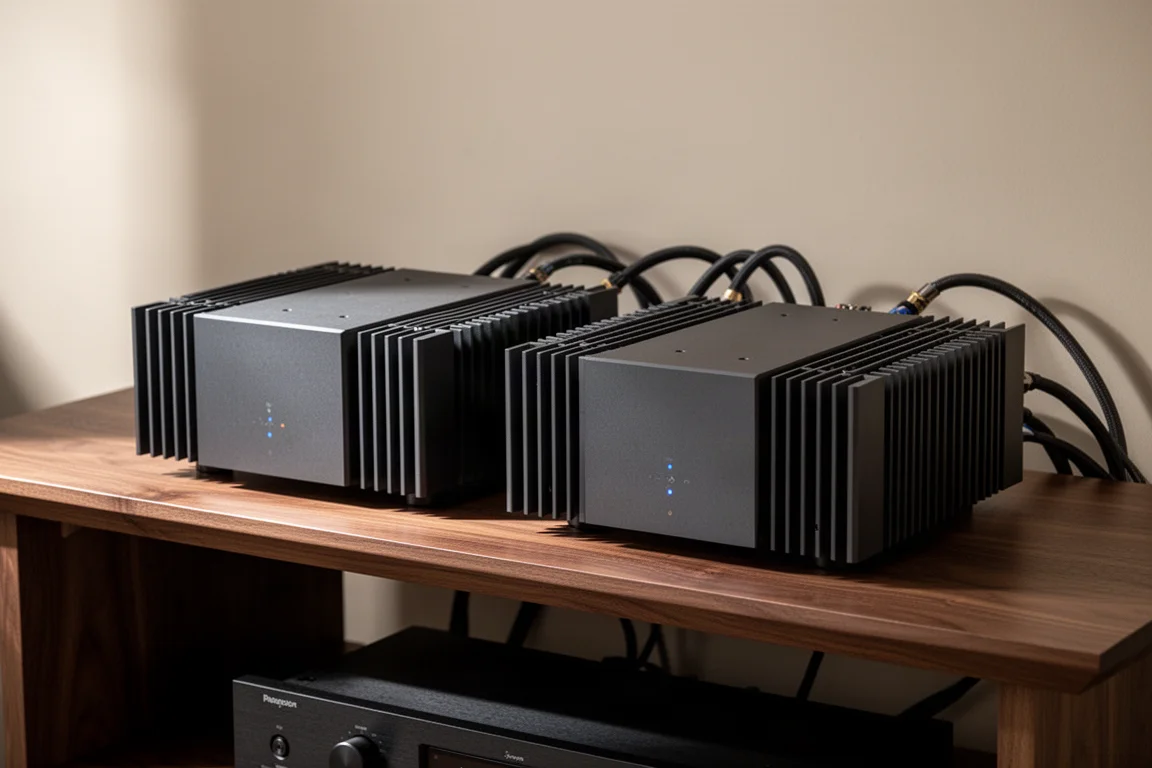
Through the more forgiving speakers, that gap narrowed considerably, to roughly half its previous size, and both amplifiers handled dynamic contrast equally well. The distinction is one of emphasis rather than quality: the TS A20 leans toward fine detail, clarity, and air, while the reference leans toward warmth and body.
Things to Consider Before Buying
- Twenty watts per channel into 8 ohms is a modest rating. Both speakers used here were high-sensitivity designs, so matching the amplifier to efficient speakers is the safest path.
- Class A operation runs warm. The chassis and heat sinks are hot to the touch, and the amplifier contributes some heat to the room.
- The warranty runs two years.
- At $3,750 US, the price reflects Canadian assembly and North American parts rather than raw output.
- The voicing is a specific choice. Listeners who prefer a warmer, lusher presentation may find a different amplifier more to their taste.
- The front emblem is large and the blue indicator light is bright, though neither proved distracting in use.
Buying Advice
The TS A20 makes its strongest case for listeners running efficient speakers who want to hear the smallest details in a recording, along with a clear sense of the space it was captured in. If that describes your priorities, the amplifier delivers a level of resolution that is hard to overlook.
If your system leans toward warm, full-bodied sound, or if your speakers need more power than 20 W into 8 ohms comfortably provides, it is worth hearing the amplifier in your own room before deciding.
Conclusion
The Gallion TS A20 is a 20 W Class A amplifier with a clear personality, and it earns its place on the strength of its resolution, its sense of air, and the care that went into voicing it. It is made in Canada, built with North American parts, priced at $3,750 US, and covered by a two-year warranty. Listeners with high-sensitivity speakers who value detail and clarity will find a great deal to like here.
Product link
View more details for Gallion TS A20
This product is mentioned in the review. Check the specifications, options, and compatibility before buying.
View more details for Gallion TS A20Further reading
Related Reviews
Hi-Fi Amplifiers
Accuphase E-280 Review: Entry-Level Accuphase With Flagship Attention to Detail
A close look at the Accuphase E-280 integrated amplifier, covering its champagne build, AAVA volume control, sound quality, and the speakers and sources that suit it best.
Hi-Fi Amplifiers
Advance Paris A10 Classic vs Yamaha A-S301: Two Integrated Amplifiers Compared
A practical comparison of a $350 integrated amplifier and a $2,500 reference model, covering the differences that matter and the ones that do not.
Hi-Fi Amplifiers
Affordable Chinese Amplifiers Worth Buying: Five Budget Hi-Fi Amps Compared
A practical look at five affordable amplifiers, what each one does well, and the trade-offs to weigh before you buy.