Power Amplifiers
Galion TSA-75 Review: A $1,500 Power Amplifier With Giant-Killing Ambitions
A dual mono, fully balanced power amplifier with 200,000 microfarads of capacitance, a bold V-shaped presentation, and a few ownership quirks worth knowing.
Introduction
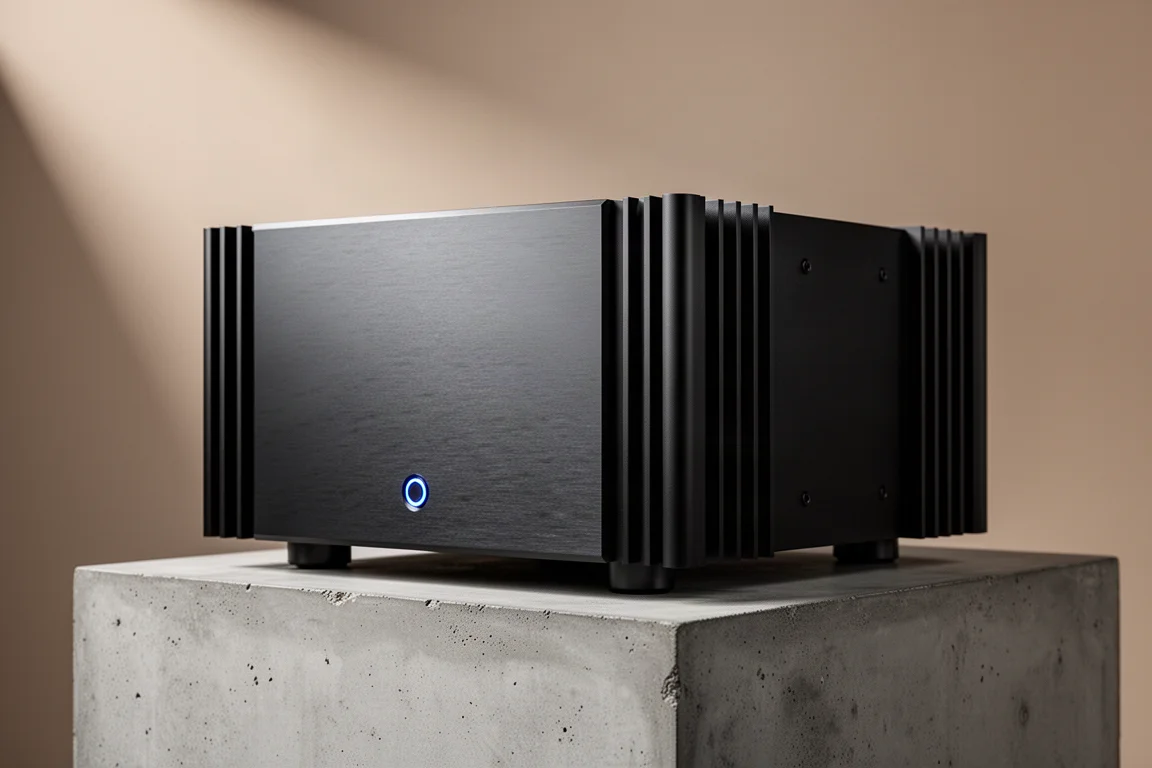
The Galion TSA-75 is a stereo power amplifier priced at $1,500 and marketed as a giant killer. That claim rests on a genuinely unusual set of internals: a dual mono, fully balanced design with a dedicated toroidal transformer for each channel and a total of 200,000 microfarads of filter capacitance. For the money, that is a lot of energy storage in a chassis that looks fairly ordinary from the outside.
Rated output is 75 W into 8 ohms and 100 W into 4 ohms, which is modest next to what the internals suggest. The amplifier has been in continuous use for several months, which makes it possible to judge it as an ownership proposition rather than a specification sheet, including the small details that only become noticeable over time.
Who the Galion TSA-75 Is For
This is a straightforward power amplifier, so it is aimed at listeners who already have a source with volume control, most likely a streaming DAC or a preamplifier. It offers both balanced XLR and single-ended RCA inputs, and the balanced connection is the better of the two here, sounding cleaner and more dynamic, though the difference is small rather than dramatic.
It suits someone who wants a simple, powerful-feeling amplifier without tone controls, headphone outputs, or app features. If your priority is a clean signal path, balanced connectivity, and a presentation with weight and depth, this is the kind of component that makes sense.
It is less suited to listeners who mostly play music quietly in the background. The TSA-75 performs at its best at normal to slightly elevated listening levels, where its bass authority and soundstage depth come fully into focus. Those who want a single box that handles streaming, switching, and room correction should look elsewhere.
Main Strengths: Dual Mono Design and 200,000 Microfarads
The interior is the reason this amplifier is interesting. Two toroidal transformers are stacked inside, one dedicated to each channel, which is the foundation of the dual mono, fully balanced layout. The filter capacitors are stacked and arranged along the sides of the chassis, adding up to 200,000 microfarads in total.
For context, a legendary 50 W class A amplifier from decades ago used 160,000 microfarads, and clean used examples of that amplifier now trade above their original list price. Reaching 200,000 microfarads at this price point is rare, and the chassis is properly designed to match, with substantial heat sinks and a solid outer shell.
The gap between the specification sheet and the rated output is the one genuinely puzzling part. With dedicated transformers per channel and that much capacitance, the internals suggest a powerhouse, yet the amplifier is rated at 75 W into 8 ohms and 100 W into 4 ohms, and it does not double its output as impedance halves. A more expensive rival selling for around $2,150 is rated at 120 W into 8 ohms and 220 W into 4 ohms.
Sound Signature: A Refined V-Shape
The presentation is V-shaped, and it is one of the more convincing examples of that tuning. Bass is elevated, bold, rich, and muscular, giving the impression that the amplifier can drive almost any speaker connected to it. That low-end weight is textured and dynamic rather than loose.
The mid-range is the most interesting part. It is not reduced in level so much as pulled back into the soundstage, which creates a deep sense of space. The practical consequence is that raising the volume brings both bass and treble up along with the mid-range, and the result is a full, smooth, and non-fatiguing mid-range with appealing tone on vocals and strings.

Treble is airy, spacious, and nuanced rather than bright or shrill. On some speakers it takes on a soft, blooming quality where fine details are spotlit without becoming aggressive, and the overall effect is sweet and refined for the price. In direct comparisons, the TSA-75 was preferred over a tube amplifier priced near $6,500, and it holds its own against a rival around $2,150 that leans toward a more balanced, snappier presentation. Which one you prefer will come down to taste: more depth and weight here, more clean-cut attack there.
Speaker Pairings That Work Well
The amplifier’s tendency to pull the mid-range back into the soundstage makes it a useful partner for speakers that can sound forward in the upper mid-range. A $650 horn-loaded bookshelf model is a good example. It is not the ideal match in absolute terms, but the TSA-75 smooths its upper mid-range and adds body to the bass, making it considerably more listenable than it is with more neutral amplifiers.
A $1,000 standmount was an excellent match for listeners who want speed and excitement, producing quick, tactile bass and punchy dynamics once the volume was raised enough to balance the slightly recessed vocal.
The brand’s own Galion Voyager TL, a transmission line tower at around $1,200, is a natural pairing with deep, extended, well-controlled bass. Its mid-range is thicker and more rounded, which makes strings and vocals sound weightier and less incisive. That is an acquired taste rather than an accurate one, but it is musical and easy to live with for long sessions.
A DIY kit speaker finished in bird’s-eye maple was the strongest match in the $1,000 to $1,500 bracket. Its mid-range sits just right, neither too far back nor too forward, and the amplifier adds a slightly fuller, more muscular bass that makes the whole presentation feel richer.
The best pairing overall came from a $2,000 THX-certified monitor. It delivered the most forceful mid-bass punch and dynamics heard from any speaker tried, with deep, textured bass, an airy top end, and a wide, deep, holographic soundstage. A tower with a passive radiator at a similar price ran it close, with phenomenal bass extension, refined and liquid mids, and an unusually fast yet smooth treble.
Pairings to Approach With Care
Some speakers fight the amplifier’s character rather than complement it. A $500 bookshelf pair that is normally well liked sounded too bright and too forward in the treble, and the combination became tiring quickly.
A very small desktop monitor with an already deep soundstage was the extreme case. The amplifier pushed the mid-range back even further, so the bass and treble were superb while the mids needed constant volume increases to feel present. If you actively enjoy an extremely deep soundstage, this is exactly what you want; otherwise it is too much of a good thing.
A $2,000 reference standmount was a strong match with impressive bass weight, but its mid-range sat further back than ideal, and vocals gained an added thickness in the lower register, including on female voices, which some listeners will find less clean than they expect.
A tower with a passive radiator at around $1,500 offered the most textured bass of the group and a spacious presentation, though it gave up some impact and imaging precision compared with the top picks. A $650 horn-loaded bookshelf also remains a compromise match, excellent if you already own it and worth checking with a neutral amplifier if you do not.
Things to Consider Before Buying
Two cosmetic details are worth knowing before you commit. The front panel logo is slightly off center, which is a small thing that becomes hard to unsee once noticed. The blue indicator light is also very bright, and since it cannot be dimmed, it is intrusive in a dark room at night.
Functionally, this is a minimal amplifier. There is no remote, no tone control, and no headphone output, and the low-level listening experience is noticeably less engaging than the medium to loud experience. The modest rated output relative to the internals is also worth weighing if you own speakers with difficult impedance loads.
For placement, the substantial heat sinks and the stacked transformer and capacitor arrangement mean the amplifier benefits from open space and reasonable ventilation.
Buying Advice
At $1,500, the Galion TSA-75 is a compelling proposition for a specific kind of buyer: someone with a streaming DAC or preamplifier who wants balanced inputs, real current delivery, and a bold, spacious presentation without paying for features they will never use. The capacitance figure alone is difficult to match at this price, and the amplifier sounds subjectively more powerful than its ratings imply.
The most important decision is the speaker pairing. Choose speakers that already sound smooth in the upper mid-range, or ones you feel could use a little more bass weight and soundstage depth, and the amplifier will flatter them. If you listen mostly at low volumes, or you want a more neutral, snappier presentation, this may not be the right fit.
Using the balanced XLR input is worthwhile if your source supports it, since it sounded consistently cleaner than the RCA connection. Buyers who want a fuss-free, high-value power amplifier with a distinct voicing should feel confident about this one, provided they can live with the cosmetic details and the simple feature set.
Conclusion
The Galion TSA-75 earns its giant-killing reputation in the areas that matter most: current delivery, bass authority, and an open, deep soundstage. Its dual mono architecture and 200,000 microfarads of capacitance are genuinely unusual at $1,500, and the sound quality holds up against amplifiers costing considerably more. The trade-offs are honest ones: a bright indicator light, an off-center logo, and a presentation that rewards medium to loud listening with the right speakers. Match it carefully, connect it over XLR, and it delivers far more than its price suggests.
Product link
View more details for Galion TSA-75
This product is mentioned in the review. Check the specifications, options, and compatibility before buying.
View more details for Galion TSA-75Further reading
Related Reviews
Power Amplifiers
Advance Paris X-A160 EVO Review: A Focused Power Amplifier Built to Last
A $1,999 stereo power amplifier with selectable class A bias, 160 watts per channel, blue VU meters, and a build designed to be serviced for decades.
Power Amplifiers
Benchmark AHB2 Review: A Compact Power Amplifier Built Around Transparency
A compact reference-oriented power amplifier with THX-patented feed-forward error correction, balanced-only inputs, and the current to drive low-impedance speakers.
Power Amplifiers
Burson Timekeeper 3X GT Review: Class A Character in a Compact Monoblock
A compact flagship monoblock with the first 30 watts in Class A, 110W into 8 ohms, pinpoint imaging, and an unusually large soundstage.