Integrated Amplifiers
Fosi Audio MC351 Review: A 2.1 Integrated Amplifier With Clear Trade-Offs
The Fosi Audio MC351 bundles a DAC, Bluetooth, tone controls and a VU meter into a compact 2.1 integrated amplifier, but power delivery, the internal DAC and the subwoofer channel each come with caveats worth knowing before you buy.
Introduction
The Fosi Audio MC351 is a compact integrated amplifier aimed at desktop and small-room listeners. It folds a built-in DAC, Bluetooth, tone controls, a front-panel VU meter and a 2.1 channel layout into an aluminium chassis for around $189. That is a lot of functionality for the money, and the brand’s track record with affordable analogue amplifiers raises expectations further.
In practice the MC351 is a mixed proposition. The chassis, the input selection and the overall concept are genuinely appealing, while the internal DAC, the Bluetooth implementation and the real-world power output are the areas that need honest scrutiny. This review walks through what the amplifier does well, where it falls short, and who should consider it anyway.
Who this product is for
The MC351 makes the most sense for a listener running efficient, easy-to-drive speakers in a nearfield or small-room setup. If you want a single compact box with tone controls, several digital inputs and a VU meter, and you are open to adding an external DAC later, the feature list covers a lot of ground.
It is a harder recommendation for anyone with demanding speakers, for anyone whose main source is Bluetooth, and for anyone who expects a properly adjustable subwoofer output. Those three groups will run into the amplifier’s main limitations quickly.
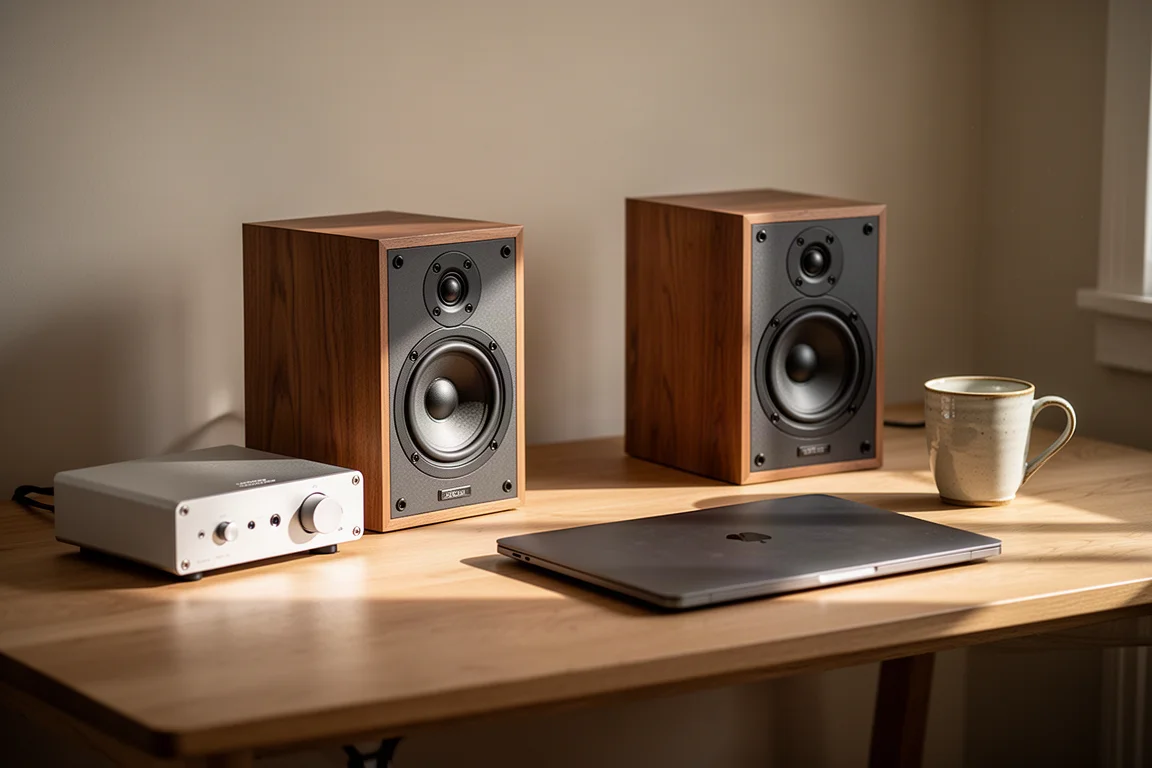
The rotary volume knob doubles as the power switch, which is a small detail that works well: you turn it to switch the amplifier on rather than pressing it, so the state of the unit is always obvious at a glance.
Design and build quality
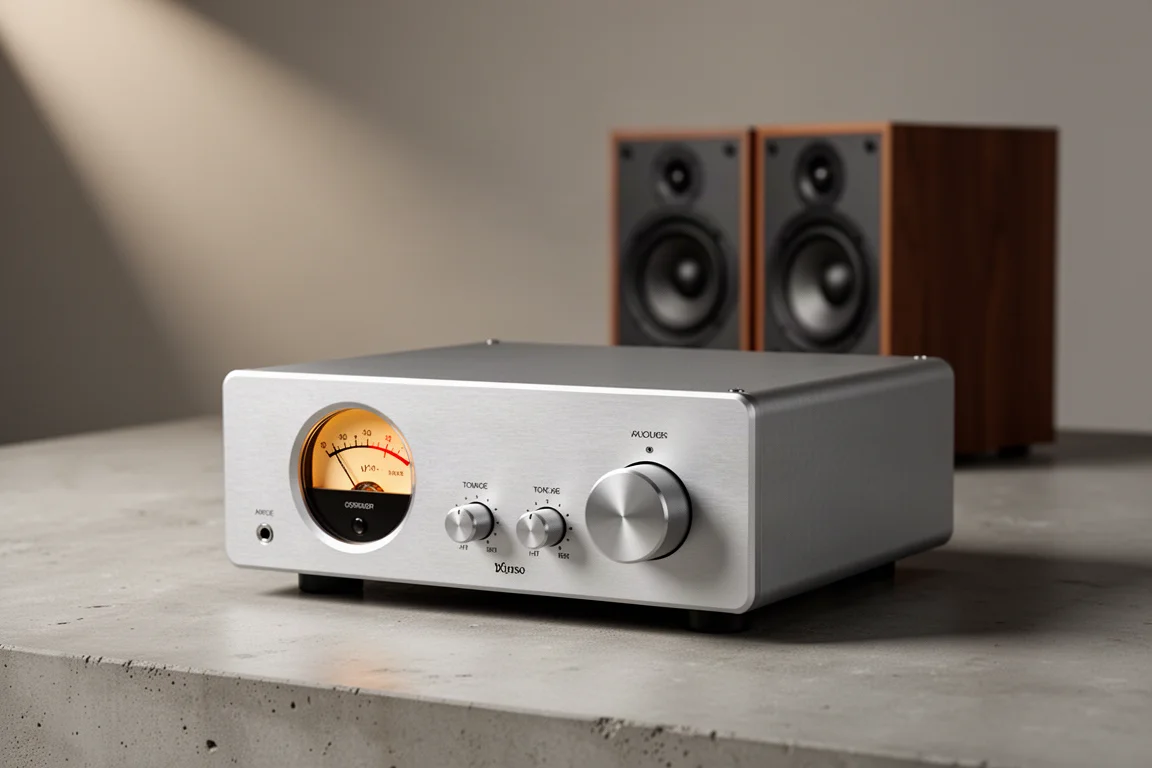
The chassis is aluminium and, for a compact desktop amplifier, it is one of the better-looking options available. The front panel carries the VU meter, a pair of tone controls and the single rotary volume knob, and the whole unit feels solid rather than hollow.
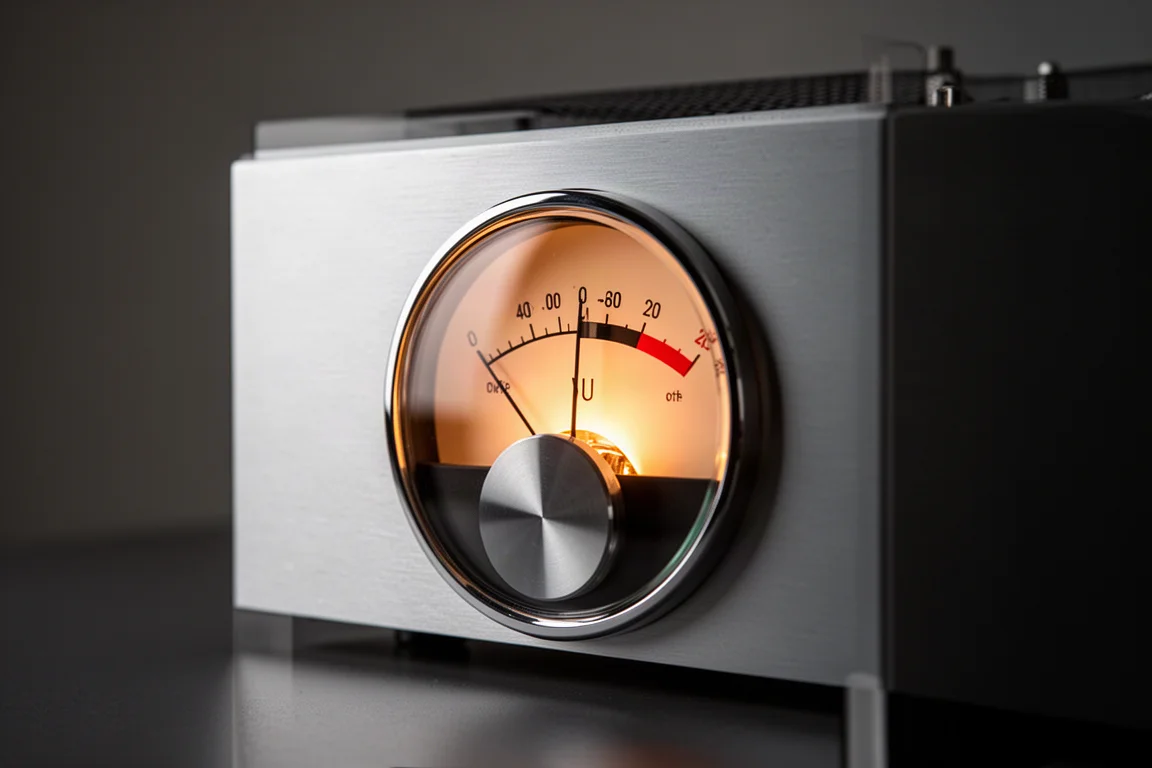
The VU meter is an appealing touch, though it reads high. It spends most of its time sitting in the top quarter of its range, so it behaves more like a design feature than a useful indication of how much power is actually being delivered.
Connectivity and inputs
The rear panel is where the MC351 earns much of its price. There is an RCA analogue input, a coaxial input, an optical input and a USB-C input, all feeding the internal DAC, plus a Bluetooth antenna for wireless playback.
There is also a preamp output that varies with the volume setting, so the unit can serve as a preamp feeding a separate power amplifier. Speaker connections are split across three pairs of binding posts: two pairs for the front channels and one pair for a passive subwoofer. The supplied power supply is a 32V 5A unit, while the Texas Instruments 3255 amplifier chip is designed to accept up to a 48V 10A supply, so there is an upgrade path if you want more headroom.
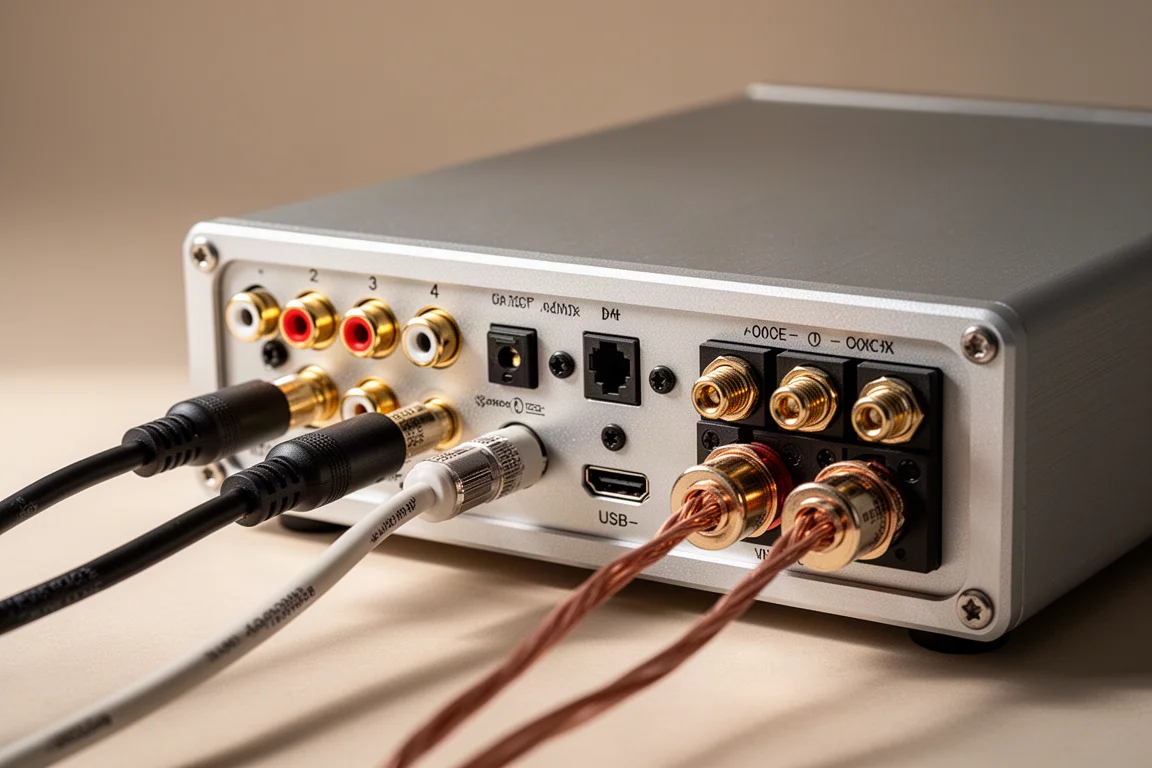
For a desktop system, that spread of inputs is the strongest argument in the amplifier’s favour. Most competing boxes at this price cover fewer source types out of the box.
Sound quality and the internal DAC
The internal DAC is the weakest part of the package. Fed from a streamer over the optical input, it comes across as bright at the top end, with a forward character that gets tiring rather than engaging. Bluetooth is weaker still, with sibilance that makes vocals sound harsh.
Switching between the optical and Bluetooth inputs also produced audible pops and cracks. It is a behaviour that turns up on a number of amplifiers in this category, but it is not ideal when you are changing sources mid-session.
Adding an external DAC transforms the equation. A compact outboard DAC in the region of $80 delivered a clearly better result than the built-in stage, which is a useful workaround but also an admission that the internal conversion is not the reason to buy this amplifier.
Power output and real-world performance
The claimed power ratings are far above what the amplifier actually delivers, and even a 48V 10A supply does not bring it close to those numbers. With the included 32V 5A power supply driving efficient speakers, peaks reached roughly 85 dB at three feet before distortion set in, and the woofer began to bottom out at around three o’clock on the volume dial.
A hard-to-drive speaker rated at 83 dB sensitivity proved a poor match, even though the same speaker had handled considerably more power on a different amplifier. The pattern here is consistent: the amplifier runs out of usable output earlier than the headline figures suggest, and pushing past that point risks distortion rather than louder music.
The practical takeaway is simple. If your speakers are efficient and your listening distance is short, the MC351 can play at comfortable levels. If your speakers are demanding, this is not the amplifier that will unlock them.
The passive subwoofer channel explained
The 2.1 designation refers to a genuinely active third channel, which is an unusual inclusion at this price. It is designed to drive a passive subwoofer, so you can connect a raw driver or a passive subwoofer cabinet without adding a separate plate amplifier.
The problem is control. There is no separate level adjustment for that subwoofer output, so the bass level simply follows the main volume knob. A DIY build with a passive subwoofer still leaves you without a way to balance the subwoofer against the main speakers, and combined with the limited power on tap, the channel is difficult to use well in practice.
Buying advice
At $189, the MC351 is priced against some strong alternatives, including options from the same brand. If you like the concept but want better sound, pairing a separate DAC with one of the brand’s analogue amplifiers, or with the BT20A Pro, lands at roughly the same total cost and avoids the weak internal conversion. A 48V power supply will add headroom, but it will not deliver the claimed figures.
The MC351 remains a reasonable buy for a very specific listener: someone with efficient speakers, a short listening distance, a preference for tone controls and a VU meter, and a willingness to add an external DAC. If you want a streamer, HDMI connectivity and a mains-powered design with more usable output, a streaming amplifier costs more but covers those needs more convincingly.

Weigh the feature list against what you actually need. The inputs, the build and the subwoofer channel concept are real strengths, but the DAC, the Bluetooth quality and the power delivery are the parts that decide whether this amplifier suits your system.
Conclusion
The Fosi Audio MC351 is an attractive, well-built compact amplifier with a generous input selection and a genuinely distinctive front panel. It is also the least convincing product in the brand’s current line-up for anyone who cares about sound quality first.
Buy it if efficient speakers, a small room and a feature-rich desktop box are your priorities, and budget for an external DAC alongside it. Look elsewhere if your speakers need current, if Bluetooth is your main source, or if you want real control over a subwoofer channel. The MC351 is a reasonable product for a narrow set of setups, not a universal upgrade.
Product link
View more details for Fosi Audio MC351
This product is mentioned in the review. Check the specifications, options, and compatibility before buying.
View more details for Fosi Audio MC351Further reading
Related Reviews
Integrated Amplifiers
Advance Paris A10 Classic Review: Vintage Looks and a Lively, Punchy Sound
The Advance Paris A10 Classic pairs glowing blue VU meters and a tube stage with one of the widest input sets on any integrated amplifier. Here is what it does well and what to weigh before spending $2,500.
Integrated Amplifiers
Advance Paris A12 Apex Review: A Modern Integrated Amplifier With Vintage Character
A dual mono integrated amplifier with 180 watts per channel, a tube front end, VU meters, and a connectivity list that covers turntables, televisions, computers, and headphones.
Integrated Amplifiers
Advance Paris Nova Range Review: AI130, AI190 and Modular Upgrades
A practical look at the Advance Paris Nova range, including the AI130 and AI190 integrated amplifiers and the modular streaming, Bluetooth and remote accessories that expand them.