Audio Amplifiers
Fosi Audio BT20A Pro Review: A Compact Class D Amplifier With Upgradable Op Amps
The Fosi Audio BT20A Pro moves to the TPA3255 amplifier chip, adds socketed op amps and a subwoofer output, and keeps the price near $100.
Introduction
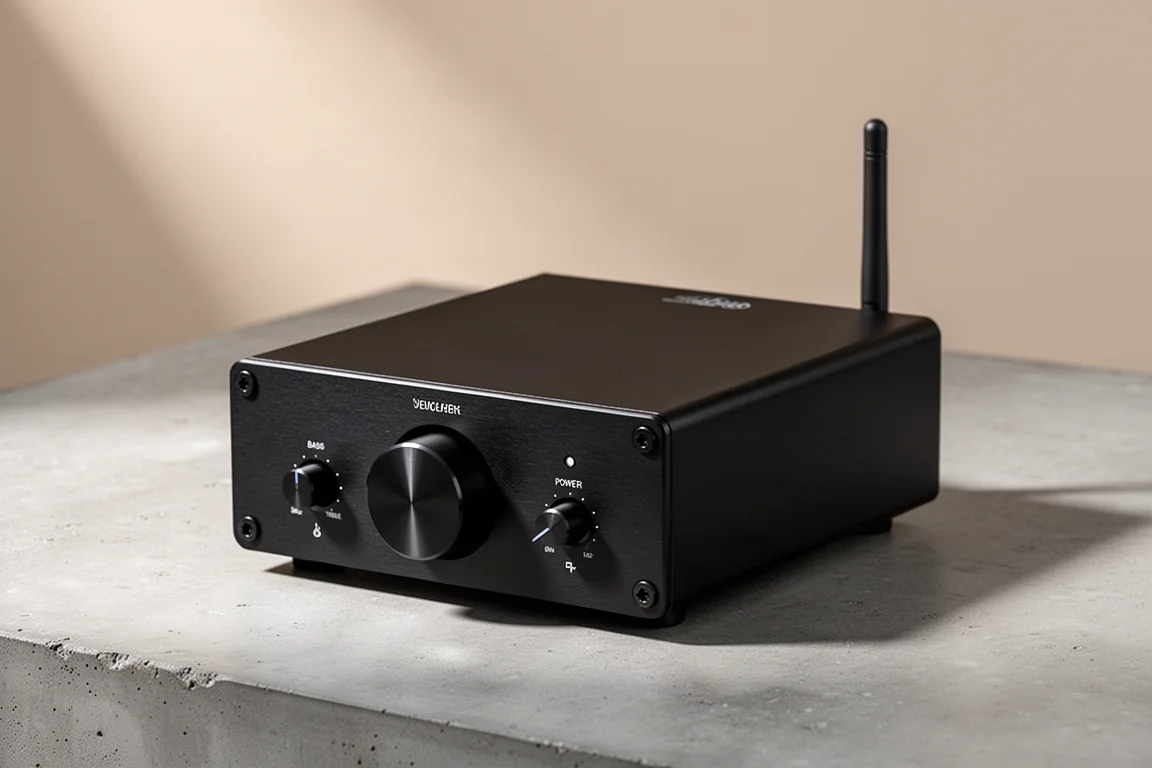
The Fosi Audio BT20A Pro is the updated version of the BT20A, a compact desktop stereo amplifier that has become a common starting point for small hi-fi systems. The most important change sits under the lid: the older Texas Instruments TPA3116 chipset is gone, replaced by the TPA3255, an amplifier chip that can take considerably more power and that sits at the core of far more expensive Class D designs.
That shift matters for two reasons. The BT20A Pro can be paired with a power supply up to 48V 10A if you want more headroom later, and it now includes removable socketed op amps, so the amplifier can be tuned over time rather than simply replaced. It costs about $100, and coupons are often available.
Who the BT20A Pro Is For
This is an amplifier for listeners who want a small, simple stereo system that sounds better than its price suggests. It suits a desktop setup, a nearfield listening position, or a second system in a study or bedroom where a full-size integrated amplifier would be overkill.
It is also a natural fit for a 2.1 channel system. The rear panel includes a 3.5mm auxiliary output for a powered subwoofer, and the subwoofer level follows the main volume control, so the whole system can be raised or lowered with one knob. Pair a phone over Bluetooth, connect a pair of passive speakers, wire in a powered sub, and the system is complete.
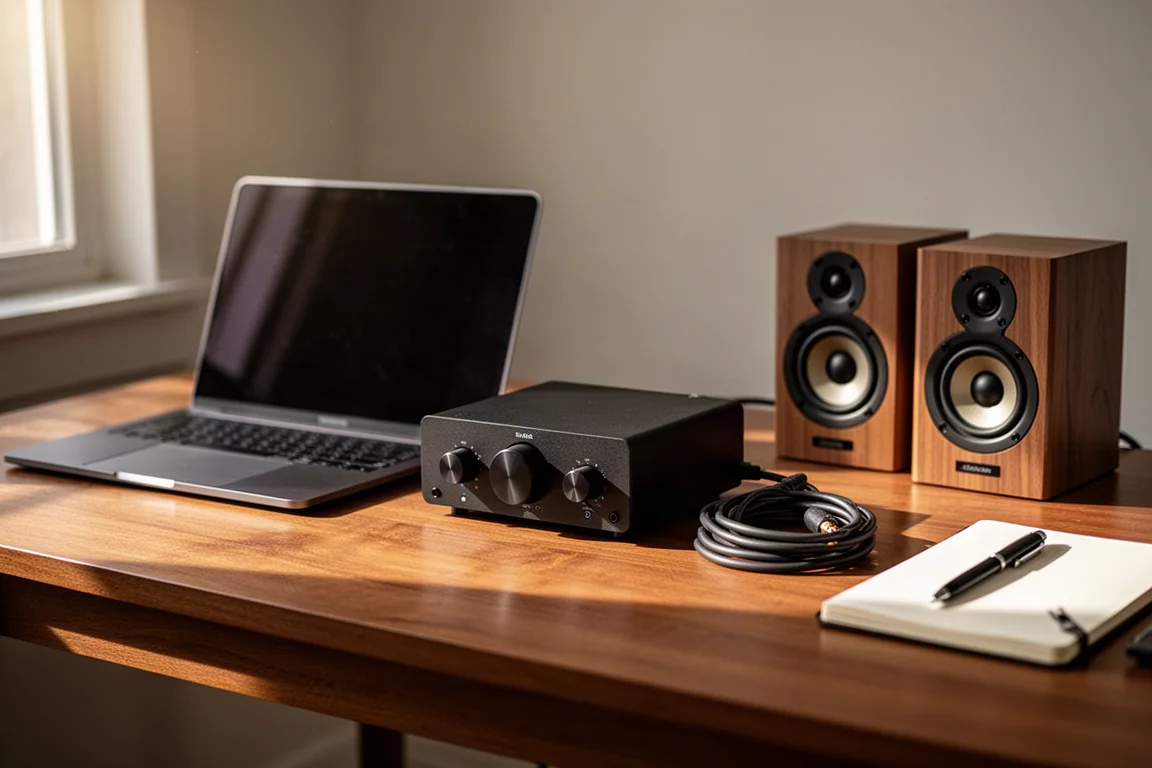
Because the amplifier is analog in nature and has no built-in DAC, it is best thought of as the power stage of a system rather than the whole system. Anyone with a good external DAC, a turntable preamp, or a phone as a source will find it easy to slot in. Listeners who want a single box that handles digital inputs will need to look elsewhere.
What Changed From the Original BT20A
The original BT20A used the TPA3116 chipset and earned a reputation for a natural, easygoing sound. Its limitation was power headroom. The TPA3255 in the BT20A Pro addresses that directly, and the manufacturer’s own figures point to a large drop in distortion along with a higher signal to noise ratio, 108 dB against 98 dB on the earlier model. Higher is better here, so the Pro moves in the right direction on both counts.
The BT20A Pro is also slightly larger than the amplifier it replaces, and the Bluetooth behaviour has been rethought. The original was known for holding onto a paired device aggressively, which meant deleting the pairing on the phone or tablet before another device could connect. On the Pro, a long press of the volume control disconnects Bluetooth directly from the amplifier.
Main Strengths: A Cleaner, More Powerful Class D Design
The TPA3255 is the headline. It is the same chip family found in considerably more expensive Class D amplifiers, and it responds well to a good power supply and careful circuit design around it. Out of the box the BT20A Pro comes with a 32V 5A supply, which works out to about 160W. That is a sensible starting point rather than a bare minimum, and the rear panel accepts anything from 24V up to 48V, so an upgrade path is built in.
Sonically, the Pro is cleaner than the original. Instruments separate more clearly, the soundstage is deeper, and there is less smearing. It stays full-bodied without turning hard or harsh at the top end, which is the balance most listeners want from a small Class D amplifier.
Socketed Op Amps and Component Quality
The feature that sets the BT20A Pro apart from most amplifiers at this price is the pair of socketed op amps inside. They sit in removable sockets rather than being soldered down, which means they can be swapped for alternatives. The stock parts are NE5532 chips, and compatible options include the OPA2604 and OPA2134PA, along with discrete designs from Sparkos and Burson.
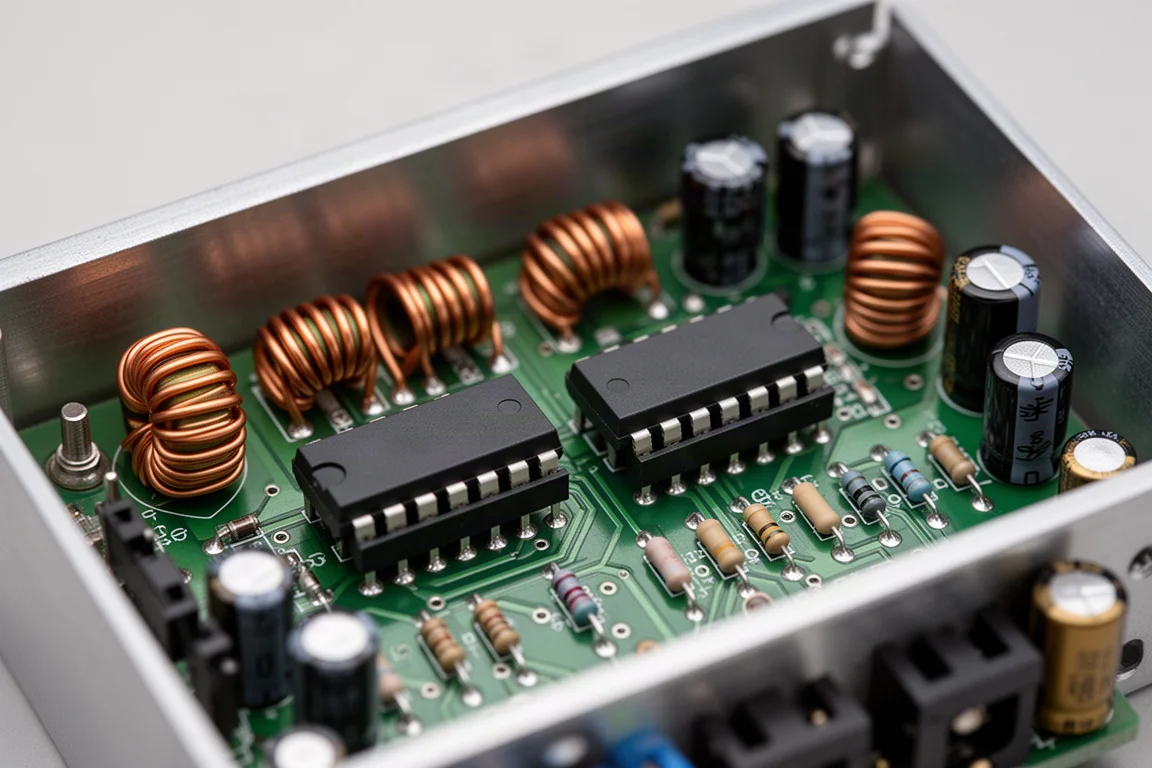
Two details are worth knowing before you start swapping. The BT20A Pro uses mono op amps, so replacements need to be the correct type, and orientation matters, since fitting one backwards can damage the amplifier. There is enough space around the sockets to accommodate larger discrete op amps, which is not always the case. The rest of the component selection follows the same logic, with high-grade inductors and capacitors throughout.
Controls, Connectivity, and Everyday Use
The front panel is deliberately simple: a power toggle, a treble control, a bass control, and the volume knob. The volume knob is the one point of customisation, since the amplifier ships with both an orange knob and a plain grey one, and either can be fitted. When the amplifier powers on it goes straight into pairing mode, and a blue light confirms a Bluetooth connection.
Around the back you get an RCA input, the 3.5mm subwoofer output, standard speaker outputs, the power input, and a Bluetooth antenna. There is no display and no menu system, which keeps the amplifier quick to live with and easy to move between rooms.
Bluetooth Pairing and Subwoofer Output
Wireless use is straightforward. The amplifier enters pairing mode on power up, connects to a phone or tablet, and holds the connection until you choose to release it. The long press on the volume control is the part that matters most in daily use, because it lets you hand the amplifier over to another device without digging through Bluetooth settings.
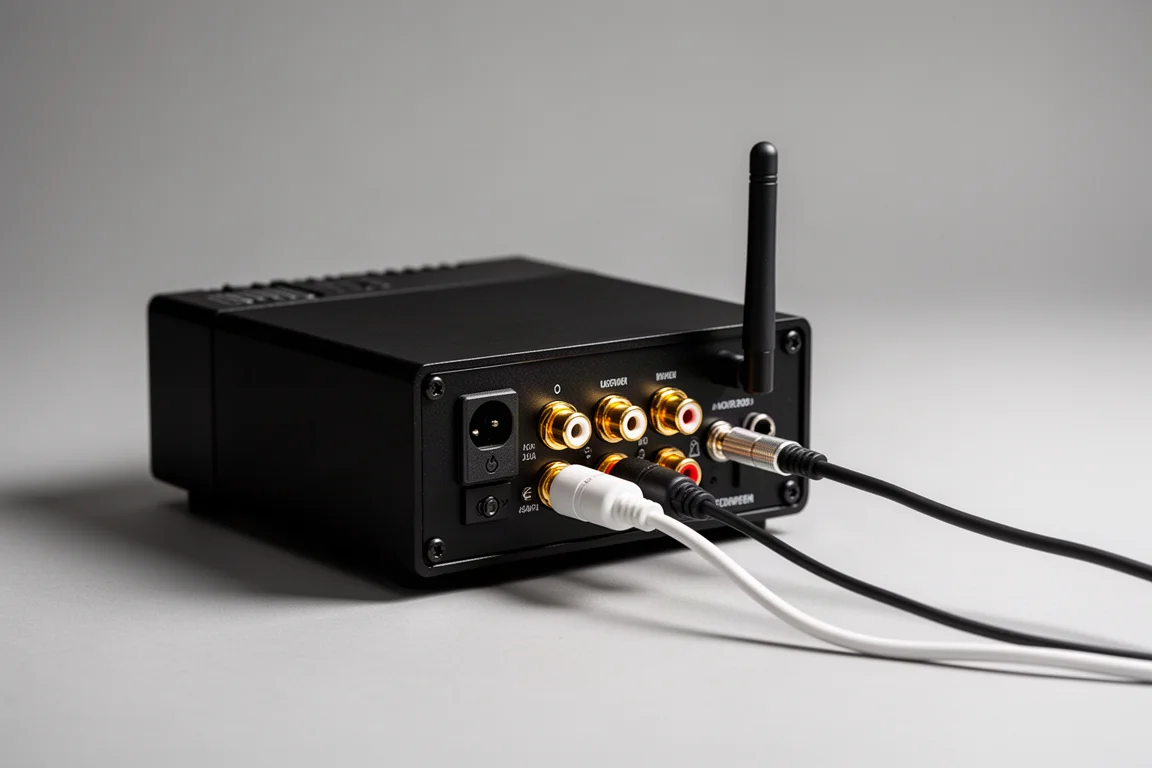
The subwoofer output is the other practical addition. It is a 3.5mm connection, and the level is tied to the main volume, so the balance between speakers and subwoofer stays consistent as you change the overall level. For a compact 2.1 system, that is a simpler arrangement than a separate subwoofer level control.
Things to Consider Before Buying
There is no DAC inside the BT20A Pro. Bluetooth is the only wireless input and the analog RCA input is the only wired one, so a digital source will need its own converter to sound its best.
Op amp rolling is optional, but it is not plug and play. Buyers need to confirm the correct mono op amp type and install each chip in the right orientation.
The metal case is compact and simple, with no display on the front panel. Buyers who want a more elaborate enclosure, metering, or a built-in converter are looking at a different class of product and a different budget.
Buying Advice
At around $100, the BT20A Pro is a strong value, and coupons can bring it lower. The decision comes down to what you already own. If you have passive speakers, a source you like, and possibly a powered subwoofer, this amplifier delivers a clean, natural Class D sound with an upgrade path that most rivals at the price do not offer.
If you need a built-in DAC, digital inputs, or a single box that does everything, budget for an external converter or choose a different amplifier. Listeners who enjoy tweaking will get the most from the socketed op amps, while those who simply want to plug in and listen will still be well served by the stock configuration.
Conclusion
The BT20A Pro is a clear step forward from the amplifier it replaces. The move to the TPA3255 chipset brings more usable power and a cleaner presentation, the power supply can be upgraded up to 48V 10A, and the socketed op amps turn a budget amplifier into something owners can refine over time. For a compact 2.1 system or a desktop setup, it is an easy recommendation at the price.
Product link
View more details for Fosi Audio BT20A Pro
This product is mentioned in the review. Check the specifications, options, and compatibility before buying.
View more details for Fosi Audio BT20A ProFurther reading
Related Reviews
Audio Amplifiers
AGD Audion Mark III Review: A Compact Class D Amplifier With Tube-Like Musicality
A gallium nitride Class D amplifier that delivers tube-like midrange warmth, serious bass grip, and a modular upgrade path in a very small chassis.
Audio Amplifiers
Best Class D Amplifiers Under $100: Douk Audio A5 vs Fosi Audio V3
Two sub-$100 Class D amplifiers built on the same 3255 chipset, compared on bass weight, midrange body, treble presence, and real-world speaker matching.
Audio Amplifiers
Best Power Amplifiers Under $500: Six Stereo Amplifiers From $74 to $579
A practical roundup of six stereo power amplifiers under $500, covering real-world power, connectivity, cooling, and which kind of system each one suits.