Audio Amplifiers
Best Class D Amplifiers Under $100: Douk Audio A5 vs Fosi Audio V3
Two sub-$100 Class D amplifiers built on the same 3255 chipset, compared on bass weight, midrange body, treble presence, and real-world speaker matching.
Introduction
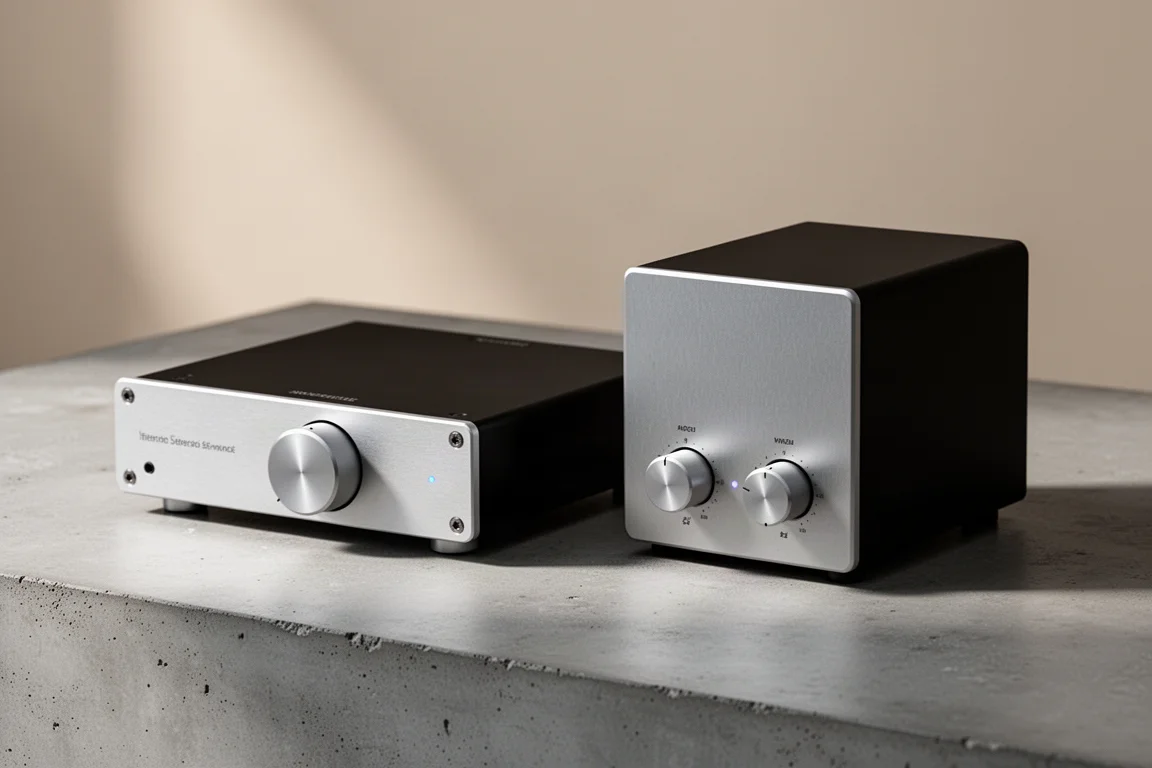
Two of the most interesting budget Class D amplifiers available today are the Douk Audio A5 and the Fosi Audio V3, and they share more than a price bracket. Both sit at or below $100, both accept the same external power supply, and both are built around the same 3255 Class D amplifier chipset. On paper that should make them sound almost identical. In practice, they do not.
That gap is what makes this pairing worth comparing. The A5 adds post-filter feedback (PFFB) circuitry, claimed to deliver more consistent power across the frequency band, and the useful question is whether that claim turns into something you can actually hear. Run both amplifiers from a single 48V 5A power supply, into the same speakers, and the answer is yes.
What to Look For in a Sub-$100 Class D Amplifier
When two amplifiers share a chipset and a power supply, the differences live in the parts around the chip: the input stage, the filtering, the volume implementation, and the tonal target the designer chose.
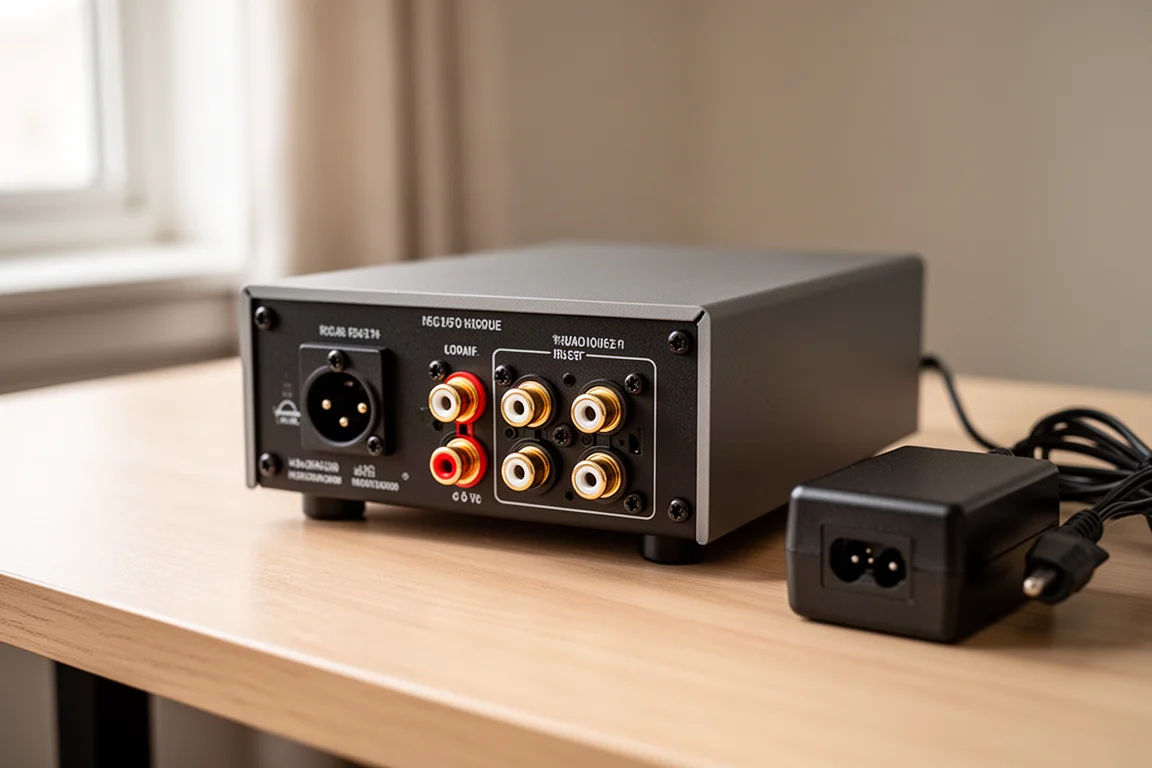
Feature set is part of that. The Fosi Audio V3 keeps things minimal, with a single RCA input on the back, speaker binding posts, and a volume knob. That is the entire control surface. The Douk Audio A5 adds a variable high-pass filter on the left side, a separate volume control on the right, and an auxiliary output on the back. If you run a subwoofer, or want to keep low frequencies out of your main speakers, that high-pass filter is a real feature at this price.
Both amplifiers power on the same way: a click at the off position, then a clockwise turn that clicks into power. Beyond layout and features, the practical test is how each one handles bass weight, midrange body, and treble presence.
Level matching belongs on this list too. A difference of a decibel or two can make an amplifier sound better when it is simply louder, so any honest comparison has to control for it.
Douk Audio A5: Fuller Bass and More Dynamics
The A5’s defining trait is weight. On The Doors’ “Riders on the Storm,” the repeating bass figure that enters around 17 seconds carried noticeably more heft and fullness than the same passage on the V3, without sounding artificially thickened. On the Beastie Boys’ “Intergalactic,” the bass drop at the 22-second mark landed with significantly more impact on the A5.
Midrange behavior followed the same pattern. On Don Henley’s “Boys of Summer,” vocals sounded heftier and more baritone on the A5, with chest weight that stopped short of sounding chesty. Chris Cornell’s voice on “Patience” came through fuller and more forward, with more dynamic movement, while the V3 stayed flatter and more even across the vocal range. The trumpet on Miles Davis’ “So What” also stepped forward of the band on the A5, where the V3 kept it cooler and more in line with the ensemble.
Treble separated them just as clearly. The ride cymbal running through “Riders on the Storm” was more pronounced on the A5 and more laid back on the V3, and the snare snap on Metallica’s “Wherever I May Roam” was noticeably more pronounced on the A5 once the drums entered.
Fosi Audio V3: Balanced, Cooler, and Even-Handed
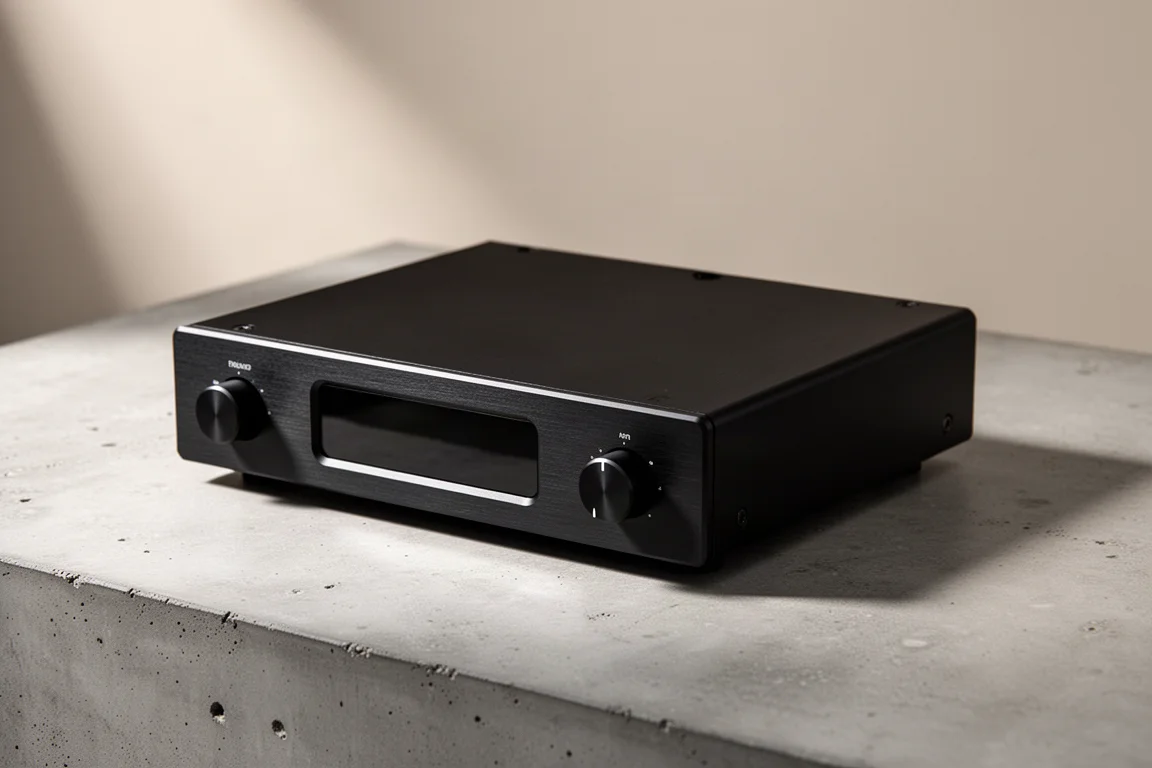
The V3 was very well received when it arrived, and it is easy to hear why. It is the more neutral of the two, and it rarely editorializes. Instrument separation was excellent on both amplifiers, and on material such as “So What,” where bass performance is about nuance rather than quantity, the two were essentially on par for clarity and bass quality.
Character is where the V3 differs. Its midrange runs a touch cooler, and vocals sit evenly within the mix instead of stepping forward. On “Patience,” that read as flatter and a little more sterile next to the A5’s extra dynamics. Treble is gently rolled off as well, which can be a virtue with brighter speakers. On “Boys of Summer,” both amplifiers showed a hint of sibilance, but it was more pronounced on the V3.
The V3 is also the simpler product to live with. One RCA input, speaker binding posts, one volume knob. There is no high-pass filter and no auxiliary output, so it suits a straightforward two-channel setup best.
Listening Notes: Bass, Midrange, and Treble
A few patterns held across the whole session. Bass quantity leaned clearly toward the A5, while bass clarity and quality stayed close enough that the difference was hard to pin down on subtle material. Midrange body and vocal forwardness also favored the A5, and treble presence was stronger there, with the V3 sitting back and running cooler overall.
The extra snap on snares and cymbals through the A5 is the kind of thing that reads as dynamics rather than brightness, and the V3’s restraint is exactly what some systems need.
One measurement oddity is worth flagging. Both amplifiers were level matched to a tenth of a decibel at 440 Hz and again at 1,000 Hz, and at those frequencies they matched. Even so, the A5 genuinely seemed one to three decibels louder than the V3 in use. Greater dynamic swing is the most likely explanation rather than a level mismatch, which is why matching the A5 by ear alone tends to leave it set a few decibels below the V3.
Matching Each Amplifier to Your Speakers
The amplifier you choose should follow the speakers you already own.
If your speakers are warm and full in the lower midrange and bass, the V3 is the sensible pairing. A rich-sounding design such as the ELAC Debut 3.0 is the kind of speaker the V3’s cooler, more even presentation suits, and its gently rolled-off top end will not pile on extra brightness.
If your speakers are clean with a little lift on top, the theory says the V3 might smooth things out. In direct listening with a pair of Emotiva bookshelf speakers, which fall into that clean and forward category, the A5 was still the preferred choice by a clear margin.
For anyone running a subwoofer, the A5’s variable high-pass filter is a practical advantage that has nothing to do with tone.
Buying Advice
Both amplifiers are capable, and both ran on the same 3255 chipset with the same 48V 5A supply here, which makes the sonic gap between them all the more striking. Same power supply, same source, same speakers, and clearly different results.
The A5 is the pick for fuller bass, more midrange body, and stronger dynamic contrast, and it brings the more flexible feature set with the variable high-pass filter and auxiliary output. Its low-end character is reminiscent of the Topping PA5, another 3255-based design that stood out for punchy, powerful bass. Expect to pay right around $100, and note that stock through Amazon can be inconsistent.
The V3 is the pick for neutrality and a simpler signal path. It is the more even-handed of the two and the better match for speakers that are already warm and bass-rich. It runs around $90, and coupons have brought it closer to $80.
Either way, the differences are large enough that most listeners should be able to hear them, especially once the two are level matched.
Conclusion
Choosing between the Douk Audio A5 and the Fosi Audio V3 comes down to what your system needs. The A5 delivers fuller bass, more body through the midrange, and stronger dynamics, along with a high-pass filter that makes subwoofer integration easier. The V3 trades that weight for neutrality, a cooler and more even presentation, and a simpler control layout that suits warm, bass-rich speakers. Both are strong sub-$100 Class D amplifiers; they simply aim at different rooms and different tastes.
Further reading
Related Reviews
Audio Amplifiers
AGD Audion Mark III Review: A Compact Class D Amplifier With Tube-Like Musicality
A gallium nitride Class D amplifier that delivers tube-like midrange warmth, serious bass grip, and a modular upgrade path in a very small chassis.
Audio Amplifiers
Best Power Amplifiers Under $500: Six Stereo Amplifiers From $74 to $579
A practical roundup of six stereo power amplifiers under $500, covering real-world power, connectivity, cooling, and which kind of system each one suits.
Audio Amplifiers
Best Value Amplifiers 2026: Four Class D and Class AB Options Compared
A practical look at four stereo amplifiers priced from about $195 to $600, covering power claims, features, sound character, and the support trade-offs of buying imported gear.