Astronomy
Explore Scientific Twilight I Mount Review: A Rock-Solid Alt-Az Mount You Can Truly Customize
After two months of use, the Twilight I proves to be a sturdy, endlessly reconfigurable alt-azimuth mount with standout customer support.
Introduction
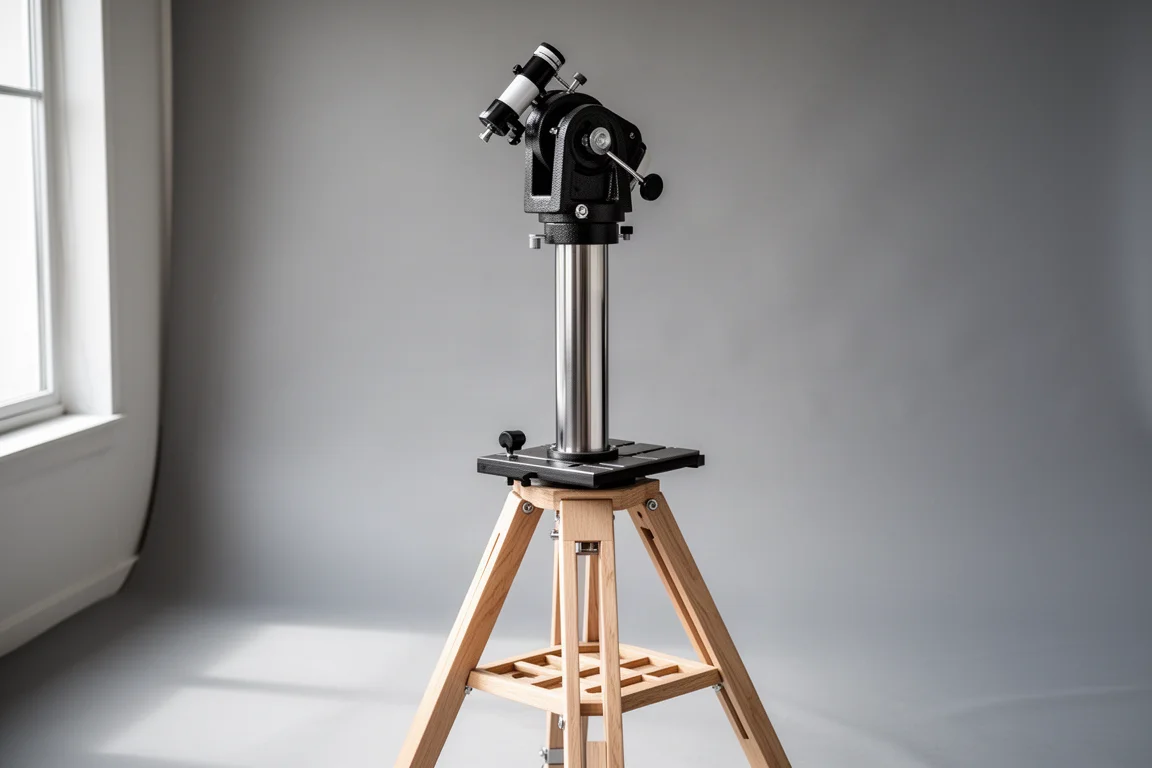
A heavy telescope without a mount is a problem waiting for a solution. A 12-pound Maksutov-Cassegrain with its center of gravity sitting well above a tripod’s pivot point will want to topple forward or backward the moment you attach it. That was the exact situation after picking up a used Maksutov-Cassegrain that shipped without any mount, and after weighing the alternatives, the Explore Scientific Twilight I turned out to be the only alt-az mount that checked all the right boxes for a telescope this large and heavy.
After a couple of months of hands-on use, it is easy to be a little smitten with this mount. Here is what makes it stand out, what to tweak, and who it suits best.
Why a Dedicated Mount Matters
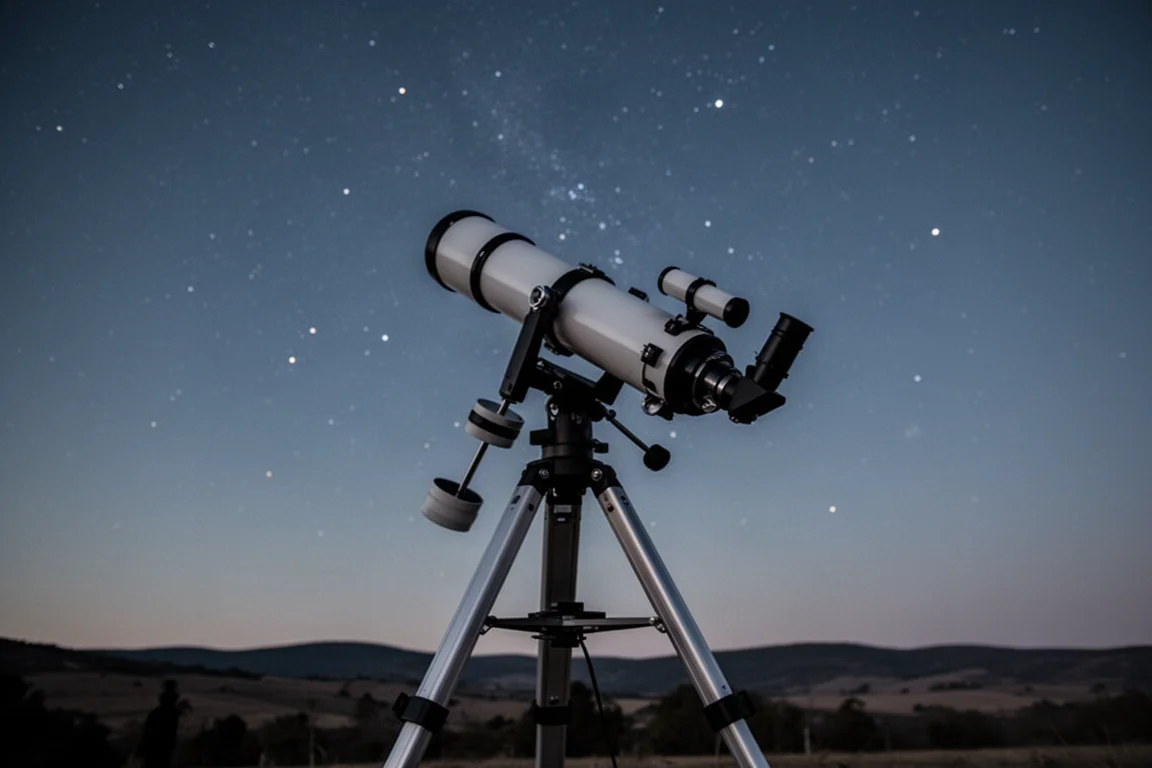
The core idea behind the Twilight I is simple: mount the telescope at its own center of gravity. Strapping a long, heavy optical tube to the top of a standard heavy-duty tripod puts all the weight above the pivot, which is a recipe for constant tipping and frustration. The Twilight I’s tall vertical column and offset head let the tube sit balanced, so it stays put and moves smoothly instead of fighting you.
The attachment plate uses the universal Vixen standard dovetail, so any telescope works as long as you can attach the dovetail block to the tube itself. That alone makes this a genuinely flexible platform rather than a proprietary system locked to one brand.
Setup and Handling
The saddle accepts the dovetail bar into its slot, where a large main screw provides the primary clamping force and a smaller secondary screw acts as a safety backup. That redundancy is a thoughtful touch worth appreciating every time you swing a 12-pound tube overhead.
Each axis gets a lock/unlock knob and a slow motion control cable. Unlock the axis and you can move the telescope by hand freely; lock it and the slow motion cable takes over for fine adjustments. There are two cables per axis with two potential input points, so you can mount the slow motion control on either side. Left-handed or right-handed, it is your choice.
The tripod itself is rock solid. A leg spreader locks rigid with a knurled nut, and the rubber feet can be removed to expose hard points if that works better for the surface you observe from.
Smooth Motion and Adjustable Tension
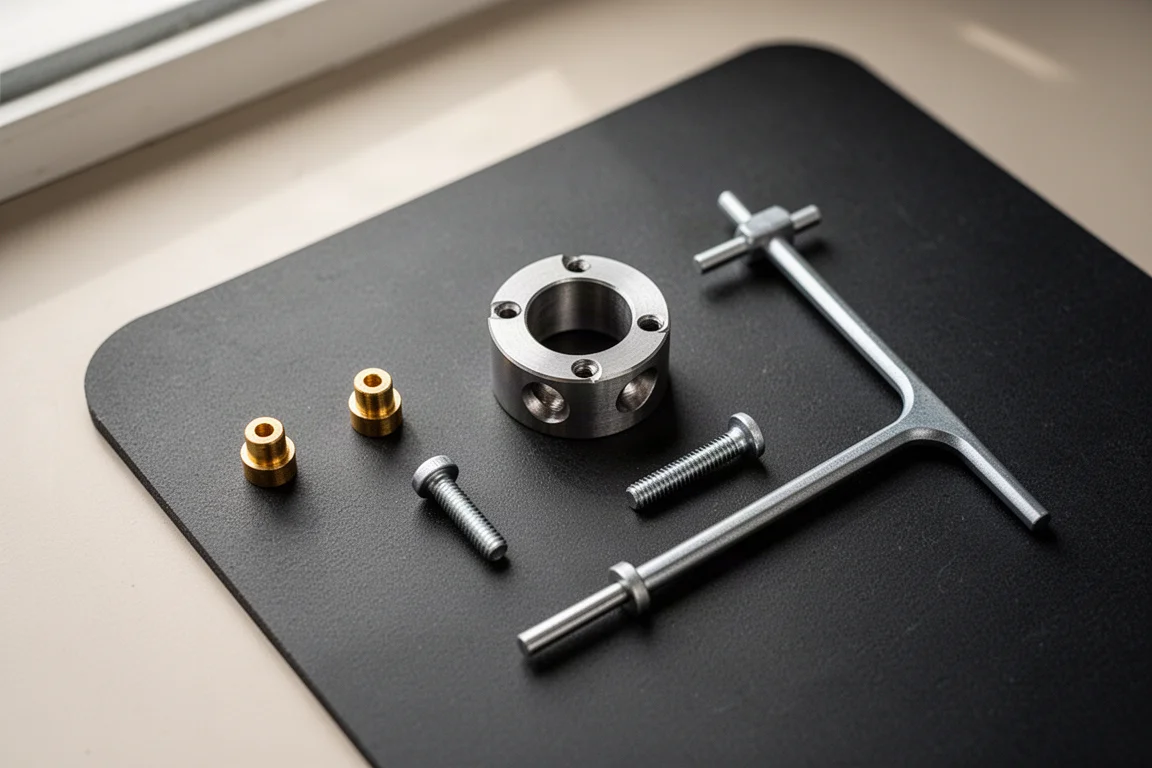
The slow motion cables are pretty smooth out of the box, but the real cleverness lies in the adjustable tension. On the azimuth axis, removing the drive gear reveals two brass nubs, one at each end, and a metal collar that is deliberately eccentric rather than concentric. It has two little dimples on each side, accessed after loosening a set screw on top.
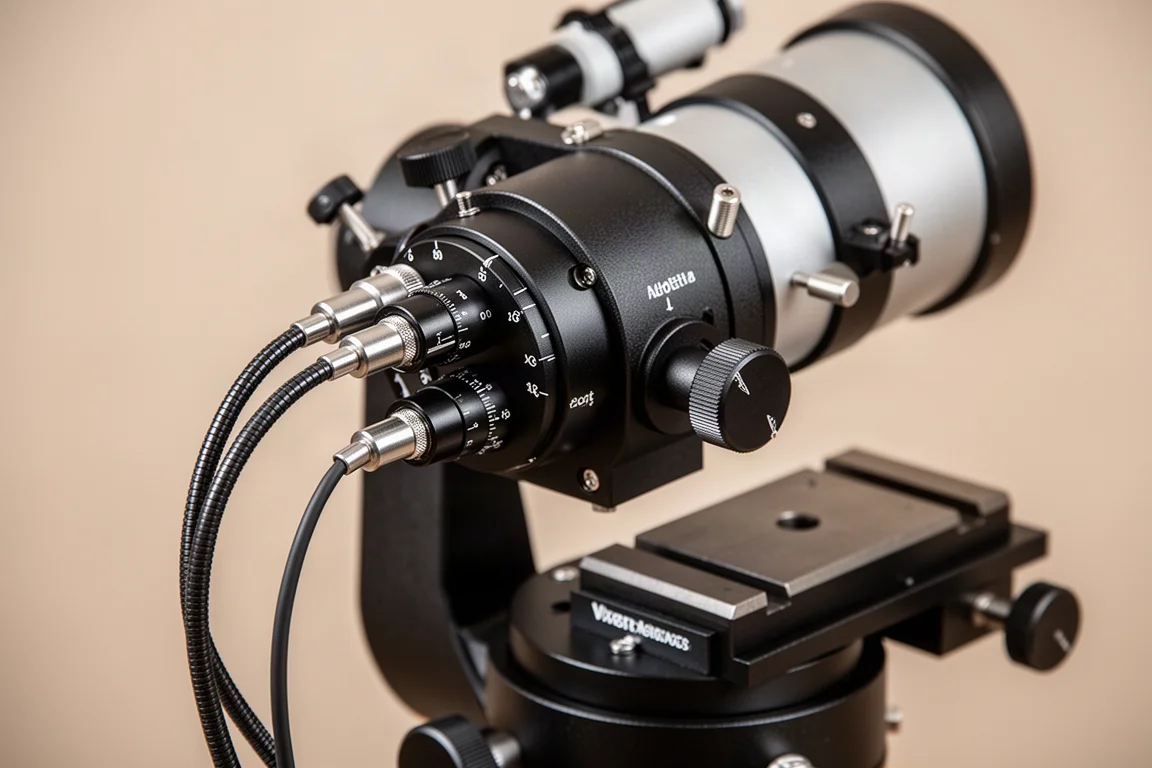
With a two-pin spanner tool inserted into the dimples, you can rotate the eccentric collar to move the drive gear closer to or farther from the tooth gear on the axis. Closer means super tight; farther means loose and sloppy. Find the sweet spot, tighten the set screw back down, and the tension is exactly where you want it. The same adjustment can be done on the elevation axis as well.
Built for Tinkerers
If you like to tinker, this mount is a playground. It can be disassembled and reconfigured in almost any imaginable way, and every Allen screw on the unit uses the same hex wrench, which is held to the mount itself by a permanent magnet. It is a small detail, but one you will appreciate every session.
The vertical column can be removed and reattached at different drilled positions: one at 30 degrees, one perfectly vertical, and another at another 30 degrees. With some drilling and threading, ambitious owners could add intermediate angles such as 60 degrees or even fully horizontal, though the default vertical position works well for a Maksutov-Cassegrain.
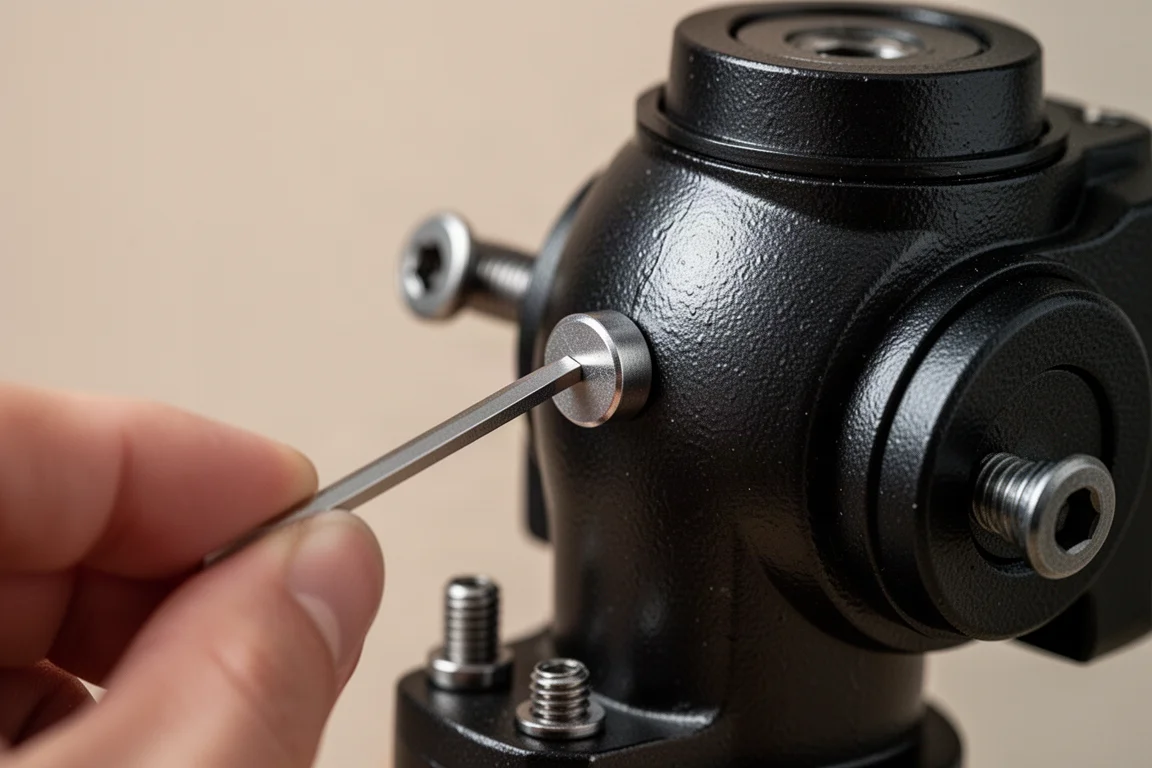
The azimuth head can also be reoriented relative to where the slow motion cable attaches to the mounting plate. If the default cable angle feels awkward in use, relocating it makes the whole setup much more comfortable. Similar repositioning options exist on the altitude head too, with a generous range of mounting holes to experiment with.
Dialing In the Drive Tension
Tension adjustment deserves its own mention because it is one of the more clever engineering choices here. The eccentric collar trick means slop and stiffness are both user-fixable without replacing anything. The only caution: remember to retighten the set screw after adjusting, or the setting will not hold.
Customer Support Worth Noting
Even well-packed used gear arrives with surprises. The azimuth lock knob arrived busted despite careful packing, and a message to Explore Scientific was answered by an actual human. After a couple of exchanges to identify the exact part, they offered a replacement for just $20 including shipping. Anyone who has tried ordering replacement parts as a non-original owner from another large telescope company will understand why that level of support is remarkable. When choosing a mount, support quality deserves a place in the decision, and Explore Scientific earns high marks here.
Buying Advice
The Twilight I suits observers with larger, heavier tubes who need a balanced, stable alt-az platform, and it especially rewards owners who enjoy customizing their gear. If you prefer a completely fixed, no-fuss setup, the reconfiguration options will simply go unused. But for the price of some tinkering time, you get a mount that adapts to your telescope, your handedness, and your observing position rather than the other way around.
Conclusion
Two months in, the Explore Scientific Twilight I has earned genuine affection: rock-solid tripod, redundant dovetail clamping, dual-sided slow motion controls, user-adjustable drive tension, and support that actually answers. For anyone mounting a large telescope on an alt-az head, it is an easy recommendation.
Product link
View more details for Explore Scientific Twilight I Mount
This product is mentioned in the review. Check the specifications, options, and compatibility before buying.
View more details for Explore Scientific Twilight I MountFurther reading
Related Reviews
Astronomy
Astronomy Gifts for Dads: Binoculars, Telescopes and Accessories Worth Giving
A practical gift guide covering stargazing binoculars from around $50, beginner telescopes under $500, and accessories under $100.
Astronomy
Best Filters for EAA in Light Pollution: What Short-Exposure Testing Actually Showed
Five astronomy filters and two noise reduction tools tested under light polluted skies for electronically assisted astronomy, with practical results for broadband and narrowband targets.
Astronomy
Six Premium Eyepieces That Transform a Beginner Telescope
A hands-on comparison of Tele Vue Panoptic, Tele Vue Nagler, and Baader Hyperion eyepieces, and why upgrading the stock eyepieces is the best first move in stargazing.