Desktop Speakers
Edifier MR3 Review: Compact Desktop Speakers With Real Tuning Flexibility
A close look at the Edifier MR3 desktop speakers, covering driver design, placement, tuning controls, output limits, and who should buy them.
Introduction
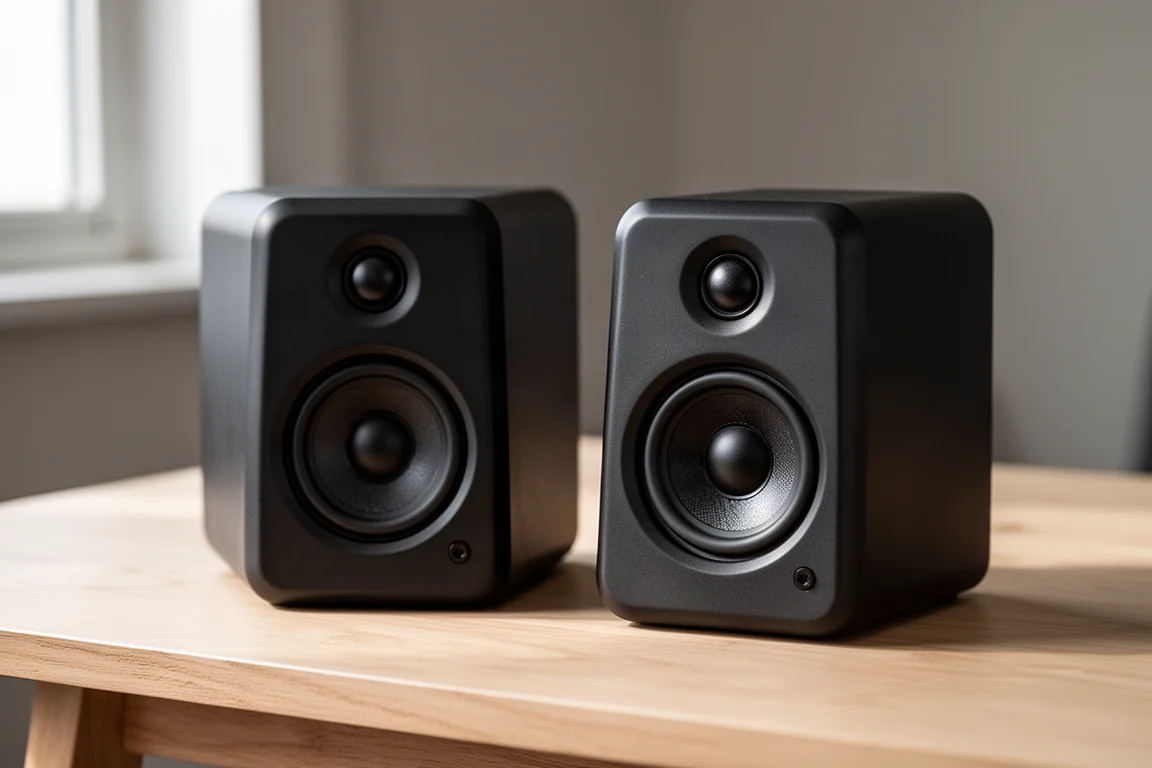
Compact desktop speakers rarely satisfy on every front. The Edifier MR3 makes a strong case that they can, at least within a realistic budget. Sold as a pair for roughly $120 to $130, it pairs a small cabinet with a waveguided tweeter and a set of tuning controls that let you adapt the sound to your desk rather than the other way around.
This review covers what the MR3 gets right, where it runs out of headroom, and how to position it so you hear it at its best.
Who the Edifier MR3 Is For
The MR3 is a nearfield speaker. It is designed to be heard from close range, roughly an arm’s length away, which is exactly how most people use desktop speakers. Placed either side of a monitor and angled slightly inward, it suits work sessions, casual listening, and light editing at moderate volumes.
It is not aimed at listeners who want maximum loudness or deep bass. The appeal here is balance and adjustability in a compact footprint, with the option to fine-tune the response through rear panel controls and a companion app.
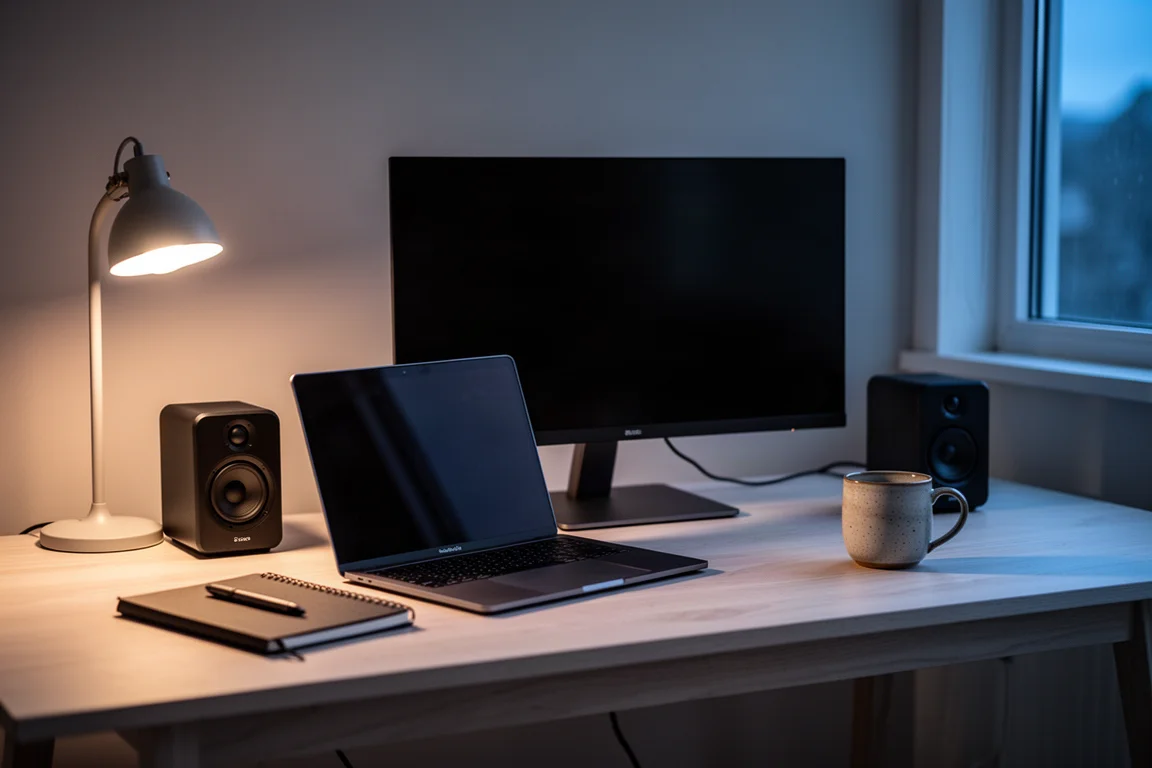
That combination makes the MR3 a practical choice for a small studio desk, a home office, or a secondary setup where space is tight and the speakers sit within a metre of your ears.
Main Strengths: Waveguided Tweeter and Tuning Controls
The driver complement is a 3.5-inch driver paired with a 1-inch dome tweeter. The tweeter sits behind a waveguide, a shallow shaped surround that controls the angle at which high frequencies leave the cabinet. The result is more consistent treble across a listening window rather than a narrow sweet spot.
All of the electronics live in one cabinet. That powered unit contains the amplifier and feeds the second speaker through speaker outputs on the rear panel, so setup involves one power connection and one cable between the two cabinets.
On-axis linearity is good for the class. Response stays within roughly plus or minus 2 dB, which is not the last word in studio neutrality, but it is measurably better than many desktop-oriented speakers at a similar price.
Horizontal dispersion is another strength. Within about 60 degrees to either side of the speakers, the tonal profile stays similar, so you can move around at your desk without the sound falling apart. Imaging shifts toward whichever speaker you are closer to, as expected.
Desk Placement and Why It Matters
The MR3 rewards careful placement. Aim for the tweeters to sit at roughly ear level, either by raising the speakers on stands or by tilting them upward.
If the speakers have to sit flat on the desk while you sit above them, keep the angle between your ears and the tweeter within about 20 degrees. Beyond that, the mid-range develops a noticeable dip, and dialogue clarity, attack, and dynamics suffer. This is the single most important setup detail with this speaker.
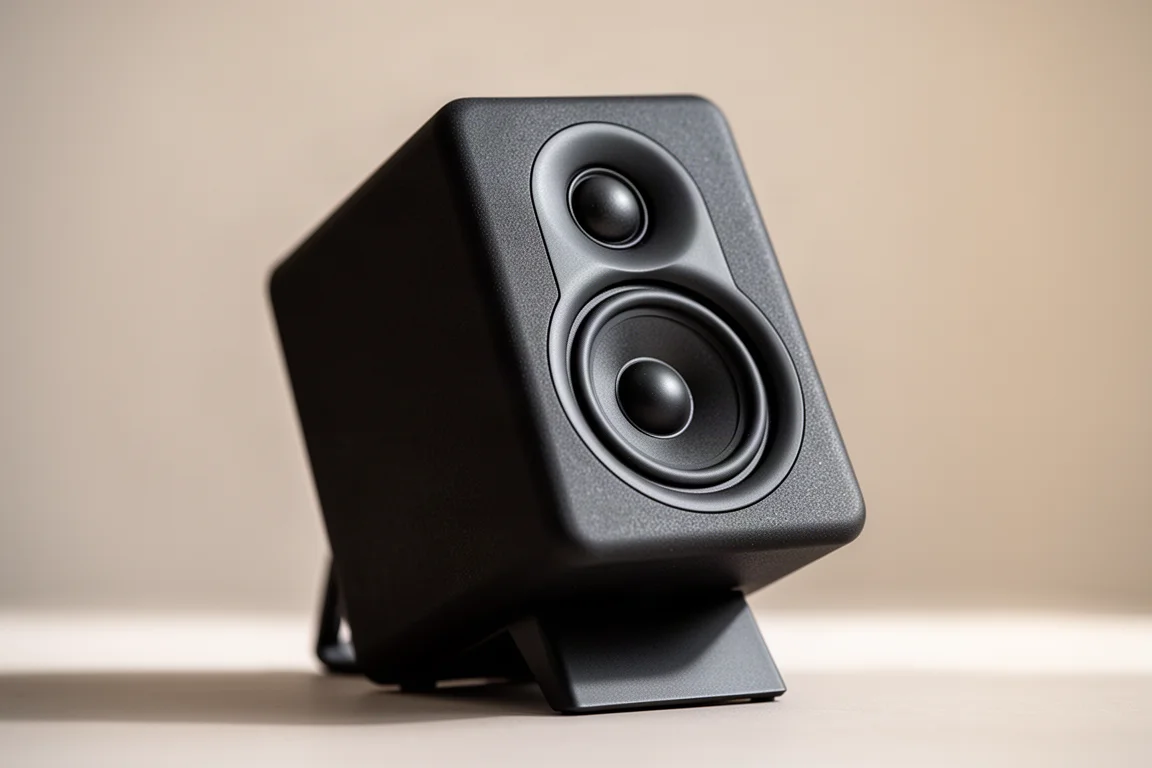
If you cannot raise the speakers, the rear treble control is there to compensate. A small boost in the high frequencies restores some of the brightness lost when listening from above the tweeter axis.
Sound Quality and Measured Behaviour
Bass extension reaches about 60 Hz before room gain or desk gain is taken into account. That is enough for most desktop listening and it keeps the cabinet small, but it will not satisfy anyone looking for subwoofer-style low end.
A limiter inside the amplifier governs output. Rather than allowing excessive excursion, it caps how hard the speaker is driven, which is why distortion stays broadly similar at high levels instead of rising sharply. Driven toward 96 dB, the speaker shows roughly 9 dB of compression, effectively landing around 87 dB. In practice this means the MR3 stays composed, but it simply stops getting louder.
Maximum output measured about 86 dB at one metre for a single speaker. A pair adds roughly 6 dB, putting the system near 92 dB. That is comfortable for nearfield use and modest room listening.
The Edifier Connect App and Rear Panel Controls
Two rotary controls on the back handle high frequency and low frequency boost or cut, and the treble trim covers roughly 3 dB of adjustment. These are the fastest way to tune the speaker to taste or to compensate for placement.
The Edifier Connect app adds a second layer of control over a Bluetooth connection. It provides a low frequency cut-off setting, an acoustic space setting, a desktop control option, and a custom EQ with six bands. Those options are unusual at this price, and they are what allow the MR3 to be tailored to a specific desk, shelf, or room boundary.
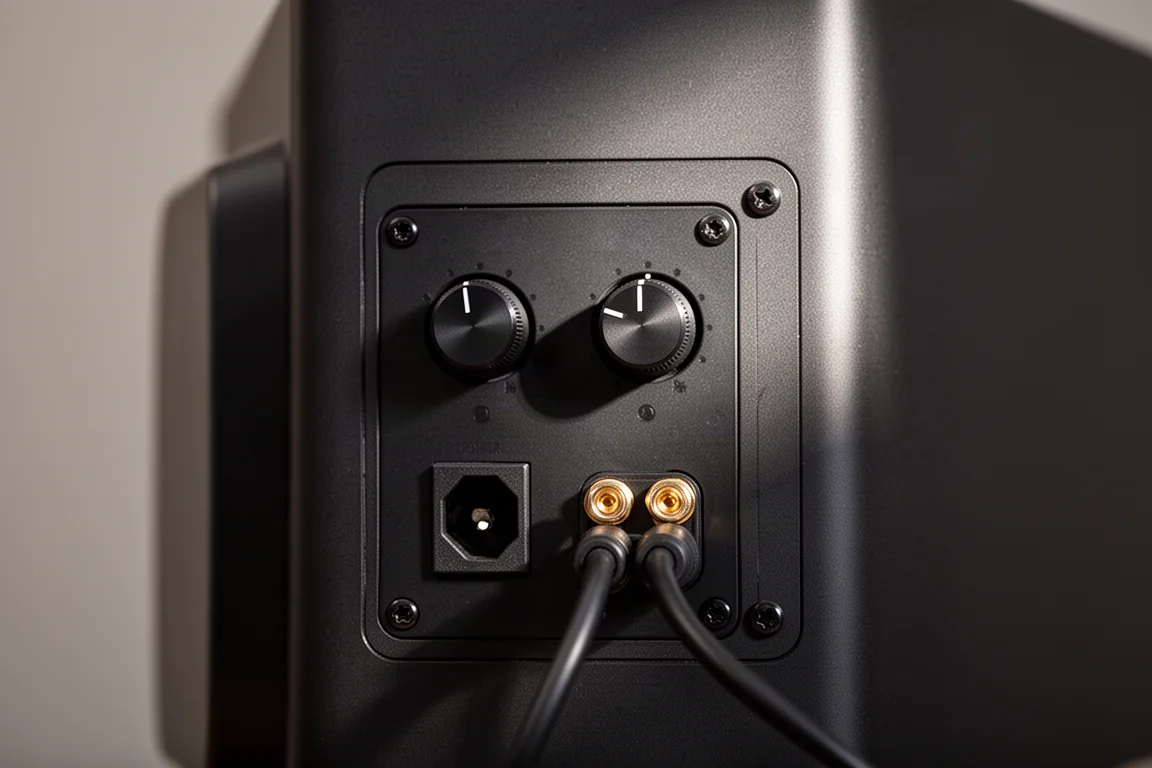
Together, the hardware trims and app settings make boundary loading and desk gain manageable, so a speaker that starts out reasonably flat can be nudged closer to a balanced response in the space where it actually lives.
Output Limits and Room Use
The most obvious limitation is loudness. The MR3 will not fill a large room, and it is not intended to. Used as desktop speakers at conversational to moderate levels, it performs well.
Beyond the desk, it can serve as a small room speaker, a television companion, or a Bluetooth playback pair. Expect it to do a good job at moderate volumes rather than to deliver party-level output.
If maximum fidelity at high output is the goal, this is not the right speaker, and the price makes that trade-off easy to accept. What the MR3 offers instead is a well-behaved, tunable speaker for close listening.
Buying Advice
At roughly $120 to $130 per pair, the MR3 is one of the strongest options in its size and price class for desktop listening, and it improves on the earlier MR4 in both sound and measured behaviour. Larger alternatives exist, including the Neumi BS5P, which is noticeably bigger and may suit some setups better, and the Kali LP-UNF, which costs around $300. For a desk, the MR3’s compact cabinet is the advantage.
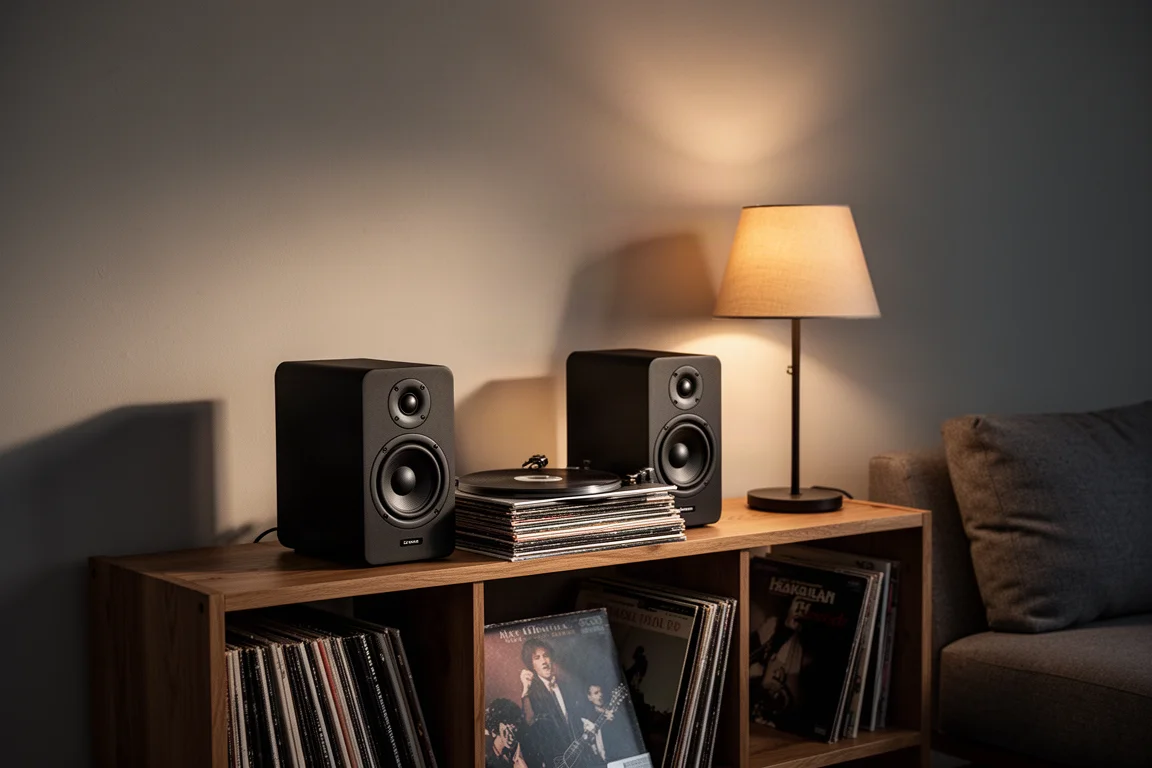
Choose the MR3 if your listening happens at a desk, within arm’s reach, at sensible volumes, and you want the flexibility to tune the response. If you need high output, deep bass, or a speaker for a large room, look at larger cabinets instead.
Conclusion
The Edifier MR3 is a genuinely well-rounded compact speaker. It stays linear on axis, offers wide horizontal coverage, reaches down to about 60 Hz, and gives you real tools for shaping the sound, all at a price that makes the compromises easy to live with. Set it up at ear level, respect its output limits, and it will handle desktop listening very well.
Product link
View more details for Edifier MR3
This product is mentioned in the review. Check the specifications, options, and compatibility before buying.
View more details for Edifier MR3Further reading
Related Reviews
Desktop Speakers
Audio Smile Little British Monitor Review: A Compact Desktop Speaker With Measured Neutrality
A small European powered desktop speaker with a waveguide tweeter, an aluminum cone woofer, and an unusually flat measured response for its size.
Desktop Speakers
Audioengine A2+ Review: A Small Desktop Speaker That Knows Its Place
The Audioengine A2+ is a compact powered desktop speaker pair with Bluetooth, a tidy footprint, and a sound profile tuned for life on a desk rather than a listening room.
Desktop Speakers
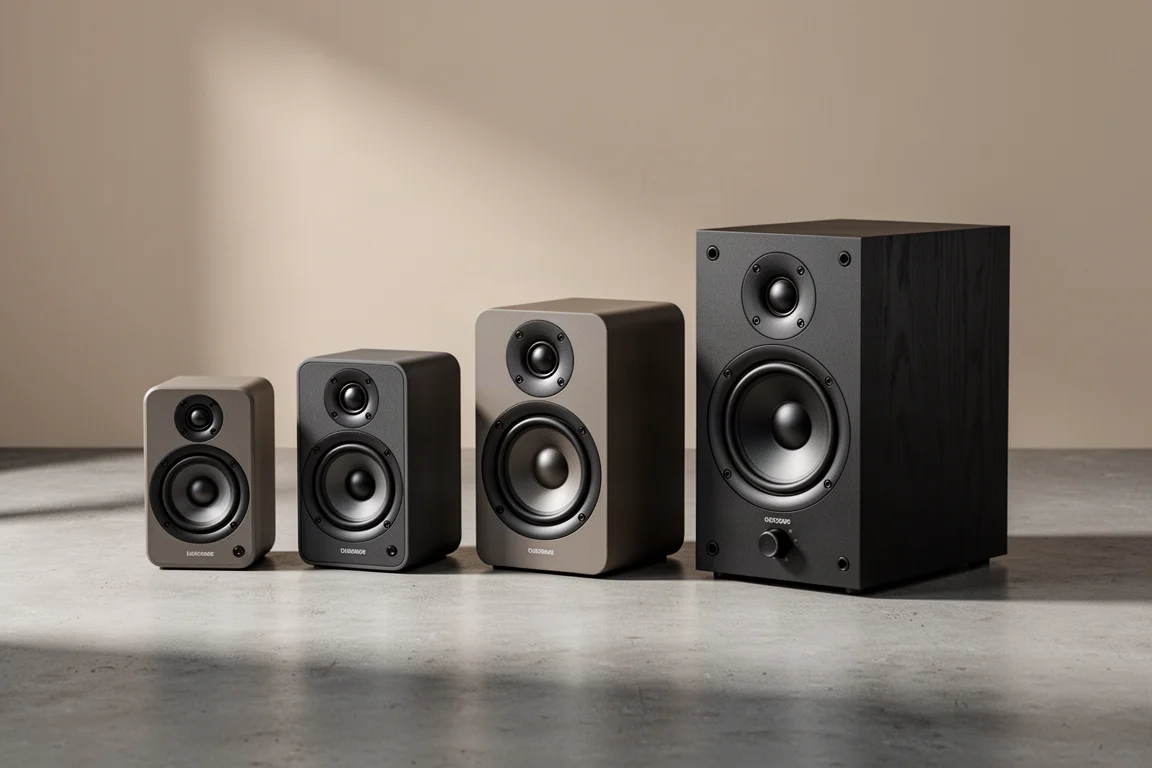
Five Desktop Speakers Compared: Edifier, Kanto, Adam Audio, and Kali
Five compact desktop speakers from roughly $170 to $349 per pair, compared on accuracy, listening window stability, output capability, and desk footprint.