Hi-Fi Equalizers
Douk Audio T8 Pro Review: A Seven-Band Equalizer That Makes Sense at $130
A practical look at the Douk Audio T8 Pro, a seven-band equalizer with balanced and single-ended connections that gives budget hi-fi systems real tone control.
Introduction
Most affordable hi-fi systems do not fail in dramatic ways. They sound a little thin in the low end, a little harsh through the upper midrange, or simply uneven from one recording to the next. An equalizer will not repair a clarity problem that starts at the source, but it can reshape tone and frequency response in ways that make an entry-level system far more enjoyable.
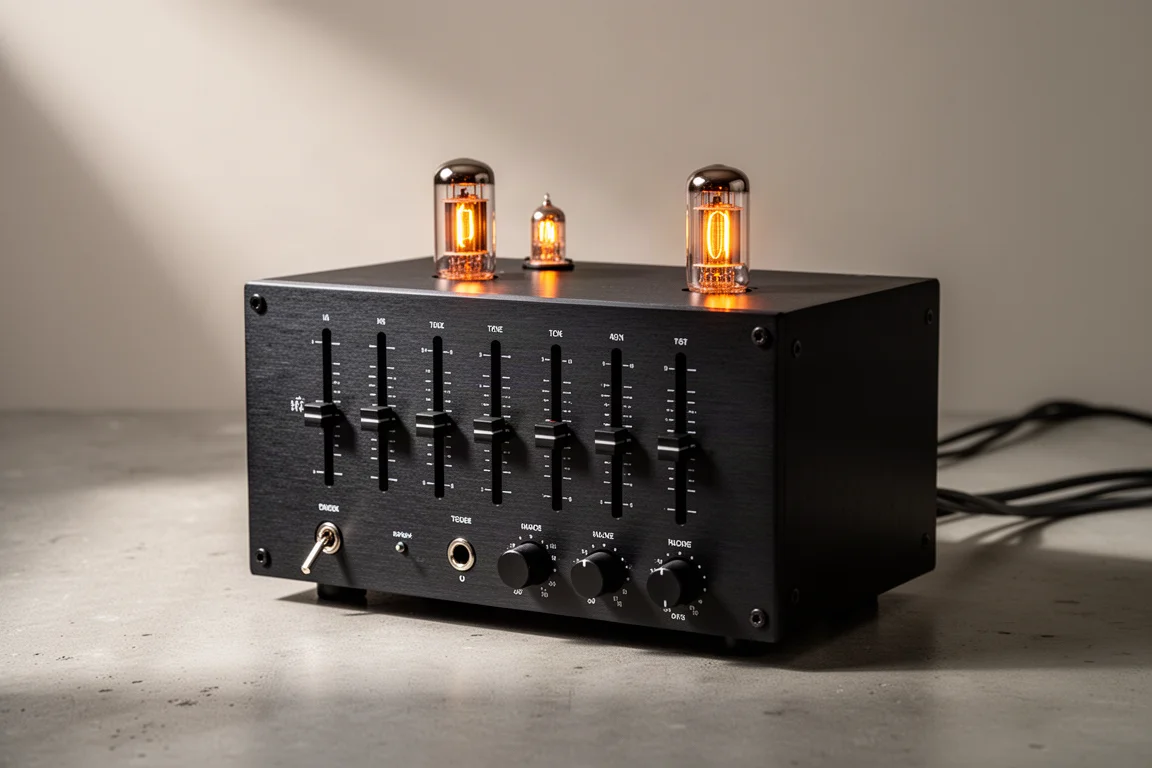
The Douk Audio T8 Pro is a seven-band equalizer priced at around $130. That is a small amount of money in component hi-fi terms, and it buys an unusual amount of control: seven adjustable bands, balanced and single-ended inputs and outputs, and a pair of tubes that glow on top of the chassis. For listeners who want to experiment with tone without committing serious money, it is a sensible place to start.
Who the Douk Audio T8 Pro Is For
This is an equalizer for people who want to understand their system better. If your speakers are inexpensive and sound lean, a gentle lift at the lowest band can add weight. If your setup carries too much thickness in the upper bass, a small cut can clean it up. Neither move requires an expensive component, and both are reversible in seconds.
It is also genuinely useful for newcomers to the hobby. Working through seven bands teaches you where vocals sit, where sibilance lives, and how much of what you hear comes from the speaker rather than the recording. That knowledge tends to pay off in better purchasing decisions later.
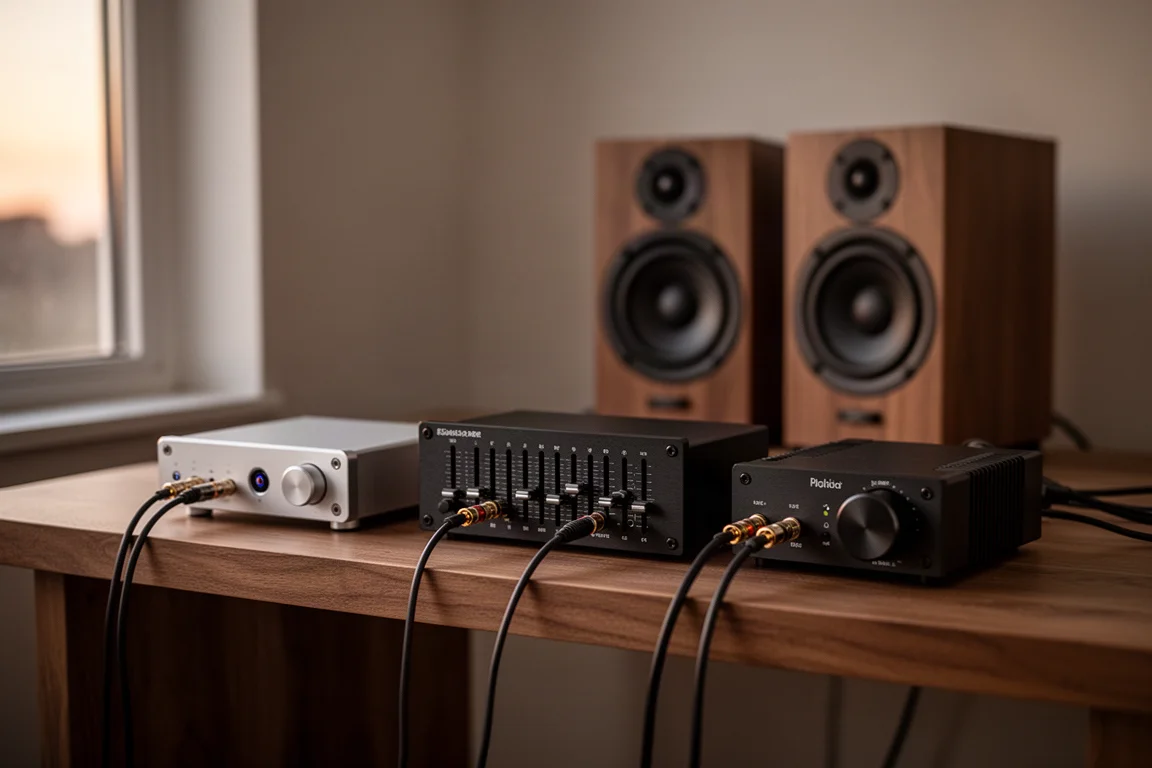
What it will not do is rescue a system with fundamental clarity problems, and it is no substitute for better speakers. Think of it as a tone-shaping tool and a learning tool, at a price that keeps the experiment low-risk.
Main Strengths
The T8 Pro improves on the earlier five-band version in a few specific ways, and most of them come down to how the bands are chosen and how cleanly the unit fits into a system.
Seven Bands With More Useful Frequencies
The T8 Pro starts at 50 Hz and moves through 125 Hz, 315 Hz, 750 Hz, 2 kHz, 6 kHz and 16 kHz. That spread is well judged. The 50 Hz band adds useful weight to small bookshelf speakers, while 125 Hz and 315 Hz cover the region where budget systems often sound thick or congested. The 750 Hz and 2 kHz pair is the most practical part of the layout, because together they span most of the vocal range and let you shape voices without disturbing anything else. The top two bands handle presence and air, and a little energy up there can make a system feel more open.
The older five-band model began at 64 Hz and jumped to 250 Hz, 1 kHz, 4 kHz and 10 kHz, leaving larger gaps across the middle of the spectrum. The extra bands and the repositioned centre frequencies make the T8 Pro noticeably easier to dial in, particularly for vocals and for tidying up the lower midrange.
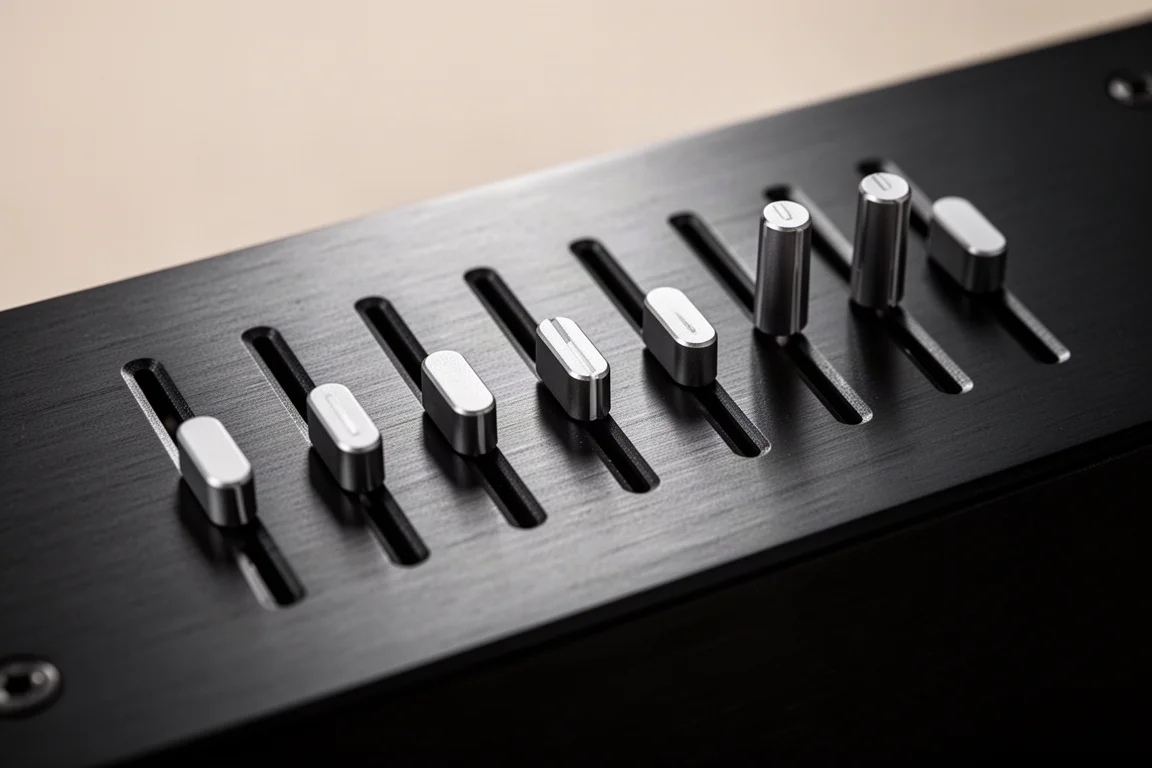
Each band has a defined width, so an adjustment never affects a single frequency in isolation. A narrow band behaves almost like a single point of correction, while a wider band pulls neighbouring frequencies along with it. Understanding that helps you make smaller, more deliberate moves instead of broad ones.
Balanced and Single-Ended Connections Stay Separate
Around the back you get a balanced input, a single-ended input, a balanced output and a single-ended output, plus a 12 V power connection. A 12 V 2 A power brick is included, and if you already own a 12 V linear power supply you can use that instead.
The front toggle selects off, channel one or channel two. Channel one is balanced and channel two is single-ended, and the two paths are kept separate, which means you cannot feed a single-ended RCA signal in and take a balanced signal out, or the reverse. Plan the rest of your chain with that in mind before you buy.
Quiet Enough to Leave in the Chain
Adding anything to the signal path carries some risk of noise or a narrower soundstage. In practice the T8 Pro stays quiet, with only a faint hum audible from the unit itself when the volume is turned up with no music playing. Soundstage did not appear to suffer, and a touch of low bass plus a little energy in the 12 kHz to 16 kHz region can make a system feel more spacious.
Against a more expensive equalizer in the region of $300, the T8 Pro held its own on noise while offering more adjustment points.
Things to Consider Before Buying
Living With the Tubes
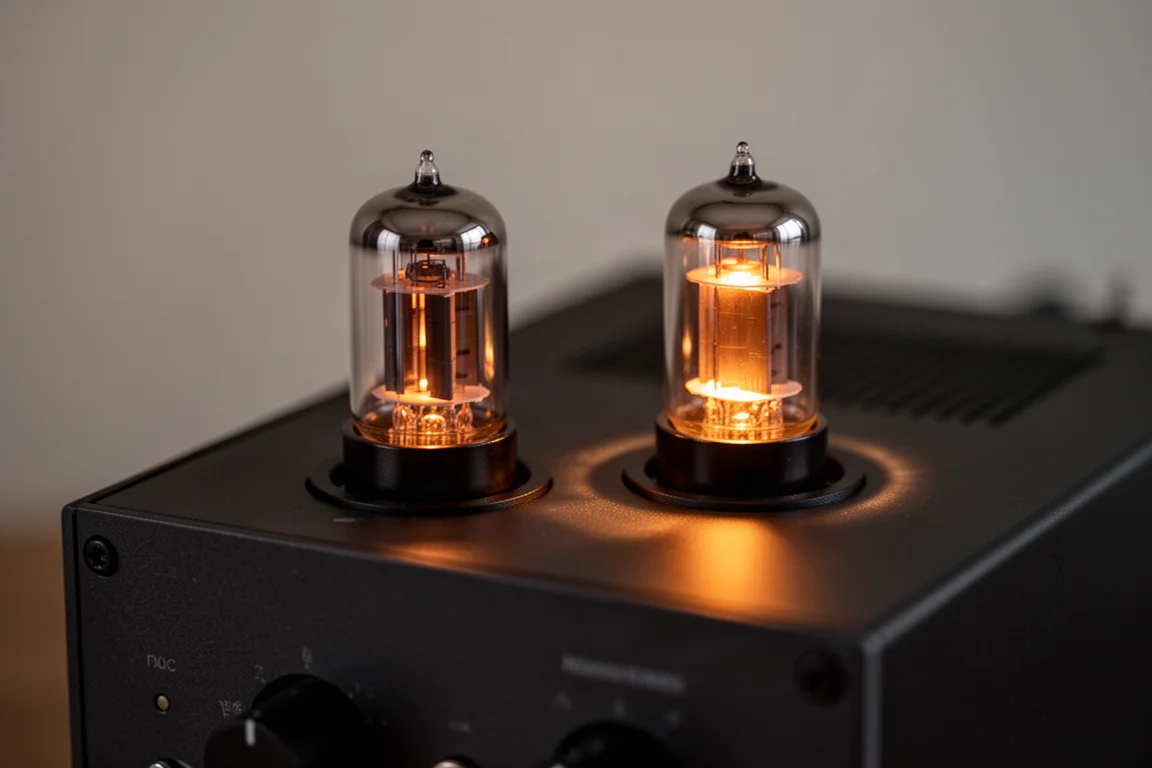
Two tubes sit on top of the chassis, lit from underneath by LEDs so the glass glows warmly once the unit is powered. They are 6H1N-BN tubes, and the glow is a pleasant detail at this price if that look appeals to you.
Whether tubes belong in an equalizer is a matter of taste, and some listeners would rather have the space and simplicity of a tube-free design, especially when the unit has to fit between a DAC and a headphone amplifier on a small desk. It is the one part of the design you cannot configure away.
The Volume Knob and the Confusing Naming
There is a volume knob on the front, and its purpose is not obvious in most systems, since the DAC or the headphone amplifier in the chain usually handles level. The practical approach is to set it high and leave it there. The balance control is adjusted with a screwdriver and has a detent at the centre of its range, which gives you a reliable starting point even though it is not a control you will touch often.
The naming is the bigger annoyance. The T8 Pro is labelled simply “T8” on the chassis, and an older five-band T8 with a built-in headphone amplifier shares that name. When buying, confirm that you are getting the seven-band version without the headphone amplifier. The extra bands are worth the small difference in price, and a separate headphone amplifier is inexpensive enough that there is little reason to have one built into an equalizer.
Buying Advice
At around $130, the T8 Pro delivers balanced and single-ended inputs and outputs, seven well-chosen bands and a pair of tubes. If your budget stretches to roughly $300, the Schiit Lokius is the more established option and remains a reasonable choice. Below that, the T8 Pro simply offers more adjustment points for less money.
The stronger argument for buying one is what it teaches you. Once you have spent time boosting and cutting specific frequencies, you begin to hear what your speakers or headphones are doing wrong, and you can describe the sound you actually want. That makes every future purchase a little better informed, whether the equalizer stays in your system for years or moves on once your speakers improve.
Conclusion
The Douk Audio T8 Pro is not a cure for a system with fundamental clarity problems, and the tubes will not appeal to everyone. What it does offer is a great deal of practical tone control for the money: seven useful bands, clean balanced and single-ended connections, low noise, and enough flexibility to fix the small tonal issues that make budget hi-fi sound less impressive than it should. For anyone curious about how frequency response shapes what they hear, it is an easy recommendation at the price.
Product link
View more details for Douk Audio T8 Pro
This product is mentioned in the review. Check the specifications, options, and compatibility before buying.
View more details for Douk Audio T8 ProFurther reading
Related Reviews

Backpacking Gear
Building a 10 lb Base Weight: An Ultralight Backpacking Gear List
A practical walkthrough of the ultralight pieces behind a 10 lb base weight, from a 765 g pack and a roomy one-person tent to a full camp chair and a dependable water filter.

Road Bikes
10 New Road Bikes Worth Watching: Aero, Titanium, Steel and Endurance Standouts
A practical roundup of 10 new road bikes, from aero flagships chasing single-watt gains to titanium, steel and endurance platforms built for real roads.

Bikepacking Gear
11 Bikepacking Essentials for Long-Distance Cycling
Eleven bikepacking essentials for long-distance cycling, from a steel gravel frame and a two-person tent to helmet lights, packable gloves, and a frame bag that puts weight in the right place.