Integrated Amplifiers
Devialet Astra Review: A Premium Hybrid Integrated Amplifier With Real Character
A detailed look at the Devialet Astra, a slim hybrid integrated amplifier that pairs class A refinement with class D power, plus its strengths, trade-offs, and buying advice.
Introduction
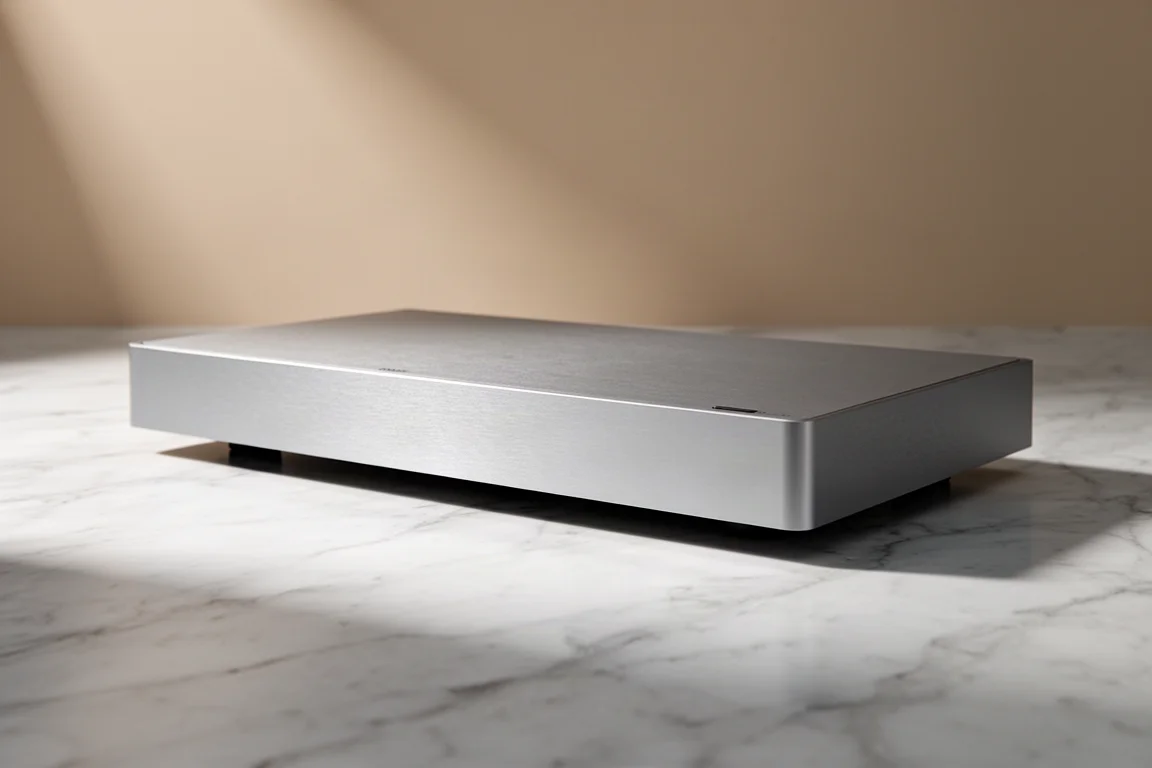
Most integrated amplifiers do not ask to be noticed. They arrive as functional black boxes, get wired into a rack, and quietly disappear. The Devialet Astra takes the opposite approach. Made in France, it is a hybrid stereo integrated amplifier that combines the linearity and refinement associated with analog class A operation with the power delivery of class D, rated at 150 watts into 8 ohms and 300 watts into 4 ohms with very low distortion. It also happens to be one of the slimmest full-width amplifiers around, which changes how a system looks and how it feels to live with. At roughly $20,000 it competes in premium territory, and the interesting question is not whether it sounds good, but whether the whole package justifies the price.
Who This Product Is For
The Astra makes most sense for listeners who want one elegant box to cover nearly everything. It handles analog and digital sources, includes a configurable phono stage, and supports Wi-Fi, UPnP, AirPlay, Bluetooth, Google Cast, Spotify Connect, Tidal Connect, and Roon. For anyone moving from a multi-box setup to a single slim chassis, the appeal is immediate: fewer cables, less clutter, and no loss of capability for most systems.
That flexibility extends to configuration. The two analog inputs can be assigned in several ways, including conversion into a moving magnet or moving coil phono preamp with full EQ and cartridge customization. The two coaxial and two optical digital inputs can also be reconfigured, with the coaxial connections usable as additional line outputs for a subwoofer or a separate amplifier. Everything is managed through an app or a laptop-based advanced configurator.
Physically, the Astra is unusual. Its full-width chassis is machined from a solid block of aluminium, yet it stands just over an inch (about 2.5 cm) tall and weighs roughly 16 pounds. Input and speaker terminals are recessed, so the rear of the amplifier stays clean once everything is connected. Owners of large, power-hungry floorstanding speakers are a natural audience too, because the amplifier’s control over difficult loads is one of its defining traits.
Main Strengths
Build quality and daily interaction are where the Astra separates itself from the category. The supplied remote is a portable, wireless rotary dial with real weight to it, and it makes volume changes feel deliberate rather than incidental. Nearly every touch-sensitive button serves more than one function, so there is a short learning curve, but the physical dial quickly becomes the natural way to use the amplifier.

Sound quality is the core of the argument. With highly sensitive horn-loaded speakers, the Astra proved completely silent, with no audible hiss from the tweeters or midrange drivers, which is unusual for those designs even with far more expensive amplification. It also maintained firm control over a large 15-inch woofer, delivering articulation that few amplifiers manage without additional digital assistance.
Bass performance is the headline. Paired with the Wilson Audio Watt Puppy, a speaker with dual 8-inch drivers and a rated in-room response down to around 26 Hz, the Astra produced some of the deepest, most detailed, and most agile low frequencies heard from a passive loudspeaker in the listening room used for evaluation. Kick drums and bass lines arrived with snap and weight rather than the slightly thin, speed-only presentation that class D designs are sometimes known for. The varying impedance of the Watt Puppy caused the amplifier no difficulty at all.
The midrange and treble are neutral without being sterile. There is a hint of character here rather than clinical perfection: grand pianos and violins keep their body and bloom, and the differences between instruments remain audible. High frequencies come across as smooth and tube-like, without the harshness that can make long listening sessions tiring. Dynamics are equally convincing, with starts and stops that resemble an active loudspeaker system, and the soundstage preserves the width and depth a capable pair of speakers can produce. The presentation stays consistent whether the source is a turntable, a digital input, or a stream.
Speaker Active Matching, or SAM, is Devialet’s approach to speaker-specific correction. The company maintains a database of speakers measured with a 60-plus point laser system, and a matching profile can be selected in the app. Not every speaker is covered: the Cornwall IV and the new Watt Puppy had no profile available, while a Sonus Faber model used in testing did. The effect is subtle rather than transformative, most noticeable as a sense of slightly deeper bass, but it is a genuine option for owners of supported speakers.
Things To Consider Before Buying
The most significant omission is HDMI. There is no HDMI input on the Astra, which is hard to justify at this price for anyone who wants a physical connection between a television and their stereo system. AirPlay from a streaming device works well as a workaround, but a TV would otherwise need an optical or analog connection.
Streaming support is broad but not complete. Amazon Music and Apple Music are not among the supported services, and owners who rely on either platform should plan around that.
Adjustability is limited as well. Beyond basic tone and balance controls, there is no room EQ or parametric EQ. Listeners who want finer control over how a system behaves in their room, or who simply prefer more tuning options, will find the Astra restrictive at this price point.
Finally, the recessed rear panel keeps the amplifier looking clean but leaves little room to work. Thick audiophile cables can make the initial connection process more awkward than it needs to be.
How It Compares With Other Class D Integrated Amplifiers
The obvious reference point is the Technics SU-R1000. It is beautifully made, includes an excellent phono preamp, and costs around $10,000, which makes it look like a bargain next to the Astra. It has neither built-in streaming nor HDMI, so the Astra’s missing HDMI is less of a disadvantage in a direct comparison. Both are strong examples of modern class D amplification, but the Astra does a better job of controlling and extracting bass from speakers that are difficult to drive. Vinyl listeners should audition both.
The HiFi Rose RA180 is a different proposition. It is an appealing design at around $7,000, but matching the Astra’s out-of-the-box capabilities means adding a separate DAC and streamer, which introduces extra boxes and cabling and can push the total cost above the Astra depending on the components chosen. The less expensive HiFi Rose RA280 is a closer call, since it delivers much of the same performance while lacking modern connectivity. Building a high-end system around the RA280 with a quality DAC and streamer could work out cheaper overall, even if the Astra remains the more streamlined and cohesive package.
Devialet’s own Expert Pro is the most interesting alternative. It is not currently shown on the company’s website but remains on sale at roughly half the price, and it shares many of the same technologies and specifications, including comparable power output. Its sound has not been reassessed recently, so a direct sonic comparison is not possible here, but the overlap in features and output makes it worth investigating before committing to the Astra.
Buying Advice
The Astra is easiest to recommend to listeners who value the complete experience as much as the specification. If a single slim chassis, an excellent phono stage, broad streaming support, and outstanding bass control matter more than HDMI and deeper EQ options, it is one of the most compelling premium integrated amplifiers available.
If HDMI is essential, or if Amazon Music or Apple Music are central to how you listen, the Astra will require compromises from the start. The same applies if you enjoy tuning your system with room correction. In those cases, the Technics SU-R1000, the HiFi Rose models, or Devialet’s own Expert Pro deserve a place on the audition list.
As always, the deciding factor should be how the amplifier behaves with your speakers in your room. The Astra’s strengths are most obvious with demanding loudspeakers, so a home demonstration with the speakers you already own is the most reliable way to judge whether the investment makes sense.
Conclusion
The Devialet Astra succeeds because it treats an amplifier as more than a component. Its build, its remote, and its minimal footprint all reinforce the listening experience rather than distracting from it, and its sound combines the speed and control expected from class D with bass weight and a smooth top end that are not always part of the package. The lack of HDMI, the limited streaming platform support, and the absence of advanced EQ are real drawbacks at this price. Buyers who can live with those trade-offs will find an amplifier that is genuinely difficult to stop listening to.
Product link
View more details for Devialet Astra
This product is mentioned in the review. Check the specifications, options, and compatibility before buying.
View more details for Devialet AstraFurther reading
Related Reviews
Integrated Amplifiers
Advance Paris A10 Classic Review: Vintage Looks and a Lively, Punchy Sound
The Advance Paris A10 Classic pairs glowing blue VU meters and a tube stage with one of the widest input sets on any integrated amplifier. Here is what it does well and what to weigh before spending $2,500.
Integrated Amplifiers
Advance Paris A12 Apex Review: A Modern Integrated Amplifier With Vintage Character
A dual mono integrated amplifier with 180 watts per channel, a tube front end, VU meters, and a connectivity list that covers turntables, televisions, computers, and headphones.
Integrated Amplifiers
Advance Paris Nova Range Review: AI130, AI190 and Modular Upgrades
A practical look at the Advance Paris Nova range, including the AI130 and AI190 integrated amplifiers and the modular streaming, Bluetooth and remote accessories that expand them.