AV Receivers
Denon AVR-A1H Review: A 15-Channel Flagship Receiver Built for Serious Home Theaters
A close look at the Denon AVR-A1H, a 70-pound, 15-channel flagship AV receiver with 8K gaming support, four subwoofer outputs, and amplifier hardware rarely seen in an AVR.
Introduction
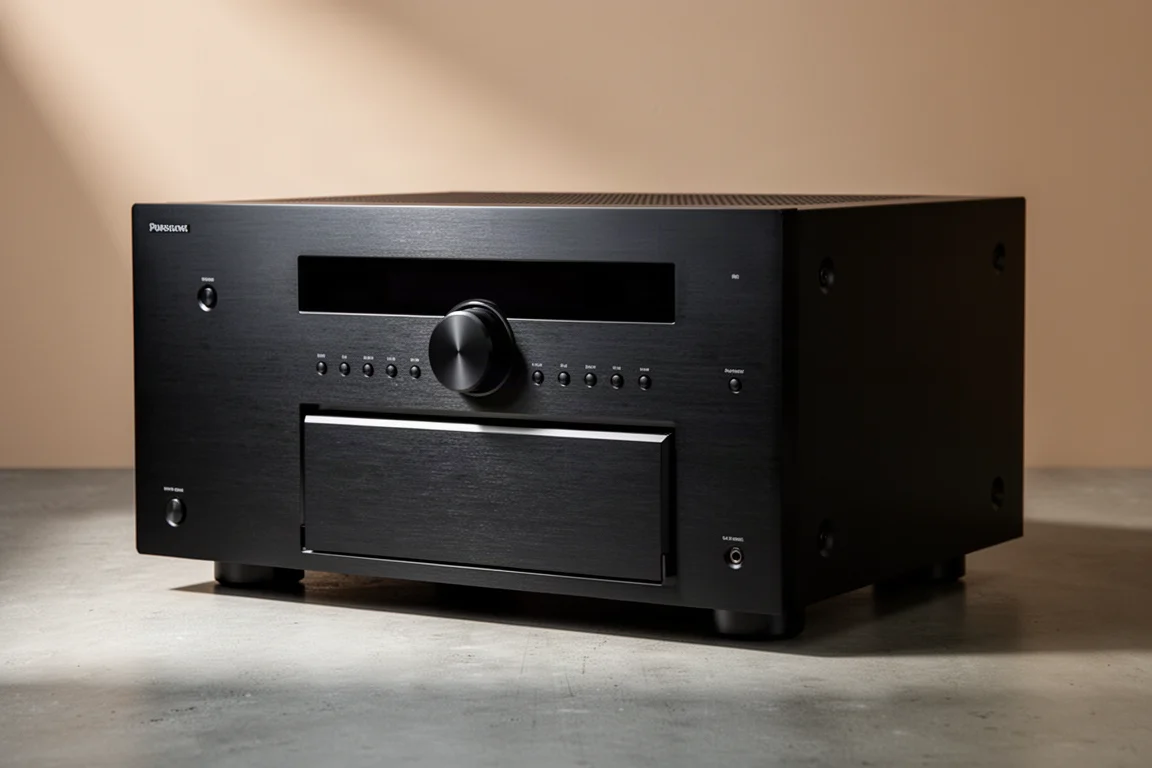
The Denon AVR-A1H is not a receiver you buy casually. It is a 70-pound, 15-channel flagship built around Class AB amplification, and it lands in a category that has been quiet for a long time. This is a super receiver in the classic sense: enormous power supply hardware, dense channel count, and a feature set aimed at people who want one box to run an entire theater.
The headline numbers are 15 amplified channels at a rated 150 watts each, plus a 15.4-channel designation that reflects four independent subwoofer outputs. Around those numbers sits hardware that is unusual for an AVR, including amplifier cards with individual heat sinking and a transformer that weighs as much as some entry-level receivers. It is expensive, and it is not trying to hide that. What matters is whether the engineering justifies the size and the price.
Who This Receiver Is For
This receiver is aimed at large, dedicated rooms. If you are running a 7.2.4 or larger layout and you want amplification for every channel without adding external power amps, the AVR-A1H is built for exactly that. The rear panel offers extensive speaker connection options, and every channel past the first five is assignable, which makes it easier to reconfigure layouts for different content without rewiring the whole room. Support for Auro-3D layouts, including a top “voice of god” position, is part of that flexibility.
Gamers are a second core audience. There are seven HDMI inputs and all of them are 8K capable, with full 40 Gbps bandwidth, 4K at 120 Hz, and variable refresh rate support. If you are running a current-generation console and a high-refresh display, this is one of the few receivers that will not become the bottleneck in the chain.
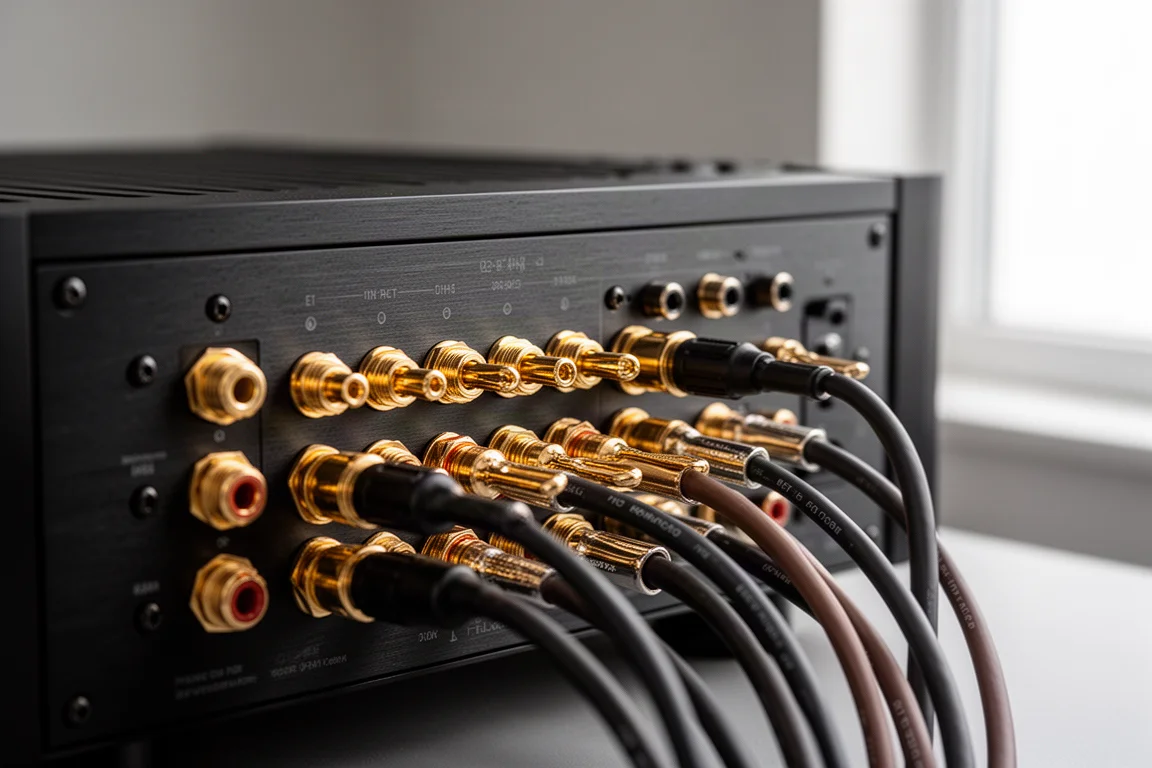
The third group is listeners who want high-quality analog and long cable runs. Balanced XLR inputs and outputs are rare in this category, and four assignable XLR outputs can serve either as subwoofer outputs or as front left, center, and right feeds to a separate power amplifier. Balanced subwoofer connections are a genuine advantage when subwoofer cable runs stretch across a large room.
Main Strengths: Amplifier and Power Supply Design
The amplifier section is where the AVR-A1H separates itself. Each channel uses monolithic amplifier modules mounted on individual cards, paired with extruded aluminium heat sinks that carry copper plating and a laminated construction for better heat transfer. That is power-amplifier style engineering rather than the compact layout you normally find in a receiver.
The power supply is equally substantial. A 25-pound E-core transformer sits at the centre, mounted over a copper base plate, feeding four-pole capacitors rated at 33,000 microfarads and 80 volts, used in pairs. The E-core choice is deliberate: a toroidal design would have made the chassis wider, and a properly controlled E-core performs equally well in this application. Six fans sit beneath the heat sinking to keep temperatures in check under sustained load.
Bench figures back up the hardware. Measured output lands at roughly 70 percent of the 150-watt rating, which works out to about 105 watts across nine channels driven simultaneously, drawing close to 1,300 watts from the wall. That is near the limit of a standard 15-amp circuit, which tells you how much current the supply can actually deliver. Under lighter loads the numbers climb further, with reported output around 170 to 175 watts per channel and close to 300 watts per channel into 4 ohms with up to two channels driven.
Main Strengths: Processing, Connectivity, and Gaming
Processing is handled by ESS 9018 stereo DACs spread across the channel array, a configuration that supports the receiver’s four independent subwoofer outputs. Directional bass routing lets low frequencies be directed to different corners of the room based on channel groups, a feature worth exploring if your room has uneven bass response.
Room correction is unusually flexible. Audyssey Pro calibration is available through PC software, and Dirac Live can be added for a nominal fee in the region of 300 to 350 dollars, with Dirac bass control hoped for later. Critically, the AVR-A1H supports multiple speaker profiles, so you can store an Audyssey calibration and a Dirac calibration side by side and compare them directly in your own room. That ends a long-running debate for anyone who has wanted to test both systems without buying two processors.
On the streaming and control side, the HEOS platform has been reworked, the on-screen interface now runs at 1080p, and Chromecast and AirPlay 2 are both on board. Chromecast playback supports high-resolution audio up to 24-bit and 96 kHz, and multi-zone distribution works through HEOS and Google Assistant. For most households, this covers everyday listening as well as serious theater use.
Things to Consider Before Buying
The most obvious trade-off is legacy connectivity. There is no composite video, no S-video, and no component video input. If you still run a VCR, a LaserDisc player, or an older game console, you will need an external converter to bring those signals into HDMI. That is a small expense but an extra step in the chain.
Size and installation also deserve honest consideration. At 70 pounds, this is a two-person lift, and it needs a cabinet or rack with real depth and ventilation. Because the amplifier can pull close to 1,300 watts under heavy multichannel load, it should live on a circuit that is not already shared with other high-draw equipment.
Finally, budget for the software side. Dirac Live is a paid upgrade rather than an included feature, and Dirac bass control is not confirmed. Directional bass is also a newer capability, and its benefit will depend heavily on your room, so it is worth treating it as something to experiment with rather than a guaranteed improvement.
Buying Advice
The case for the AVR-A1H is straightforward: it is a one-box solution, and there is very little else on the market doing exactly what it does. If you need 15 amplified channels, four subwoofer outputs, balanced connections, seven 8K inputs, and the option to run either Audyssey or Dirac, you are effectively shopping in a category of one at this price point.
That does not make it the right choice for everyone. If your room tops out at seven or nine channels, or if you rarely push your system hard, a smaller receiver plus a separate amplifier will often cost less and take up less space. The AVR-A1H makes sense when channel count, current delivery, and long-term flexibility are the priorities, and when the cabinet and the circuit can support it.
For buyers who fit that profile, the value is in the hardware rather than the marketing. Amplifier cards with their own heat sinking, a 25-pound transformer, and a capacitor bank of this scale are the kind of details that tend to hold up over years of use rather than impressing only on the spec sheet.
Conclusion
The Denon AVR-A1H is a genuine flagship in the traditional sense. It is heavy, it is expensive, and it is engineered around delivering current to a lot of channels at once, with processing flexibility that lets you choose and compare two major room correction systems in your own space. The lack of legacy video inputs and the paid Dirac upgrade are real caveats, and the 70-pound chassis demands planning.
For a large theater with demanding speakers and a current-generation gaming setup, the combination of 15 channels, four subwoofer outputs, balanced XLR options, and seven full-bandwidth 8K inputs is difficult to match in a single box. Readers who have the room, the rack, and the budget will find the engineering here speaks for itself.
Product link
View more details for Denon AVR-A1H
This product is mentioned in the review. Check the specifications, options, and compatibility before buying.
View more details for Denon AVR-A1HFurther reading
Related Reviews
AV Receivers
Anthem MRX 740 8K Review: Composed Home Theater Sound With a Few Rough Edges
A close look at Anthem's mid-tier MRX 740 8K receiver, covering its sound, ARC Genesis room correction, HDMI 2.1 features and the daily quirks worth knowing before you buy.
AV Receivers
Anthem MRX 740 vs MRX 1140: Which AV Receiver Fits Your System?
A measured look at the Anthem MRX 740 and MRX 1140, covering preamp output performance, amplifier behaviour, bass management, and expansion headroom.
AV Receivers
Best AV Receivers for Home Theater: Denon, Onkyo, Marantz and Yamaha Compared
Four home theater receivers compared on features, sound character, setup and value, with clear guidance on which one fits which kind of buyer.