Hi-Fi DACs
Denafrips Venus II vs Pontus II: Two Ladder DACs Compared
A practical comparison of two Denafrips ladder DACs, covering internal differences, sound quality, burn-in behaviour and which system each one suits.
Introduction
Denafrips has built a reputation on ladder digital-to-analog converters that favour a natural, unforced presentation, and the two models in this comparison sit at the centre of that range. The Pontus II has been the value anchor at around £2,000 in the UK. The Venus II steps up to roughly £3,000, and the extra money buys a revised power supply, a denser resistor ladder and improved clocking.
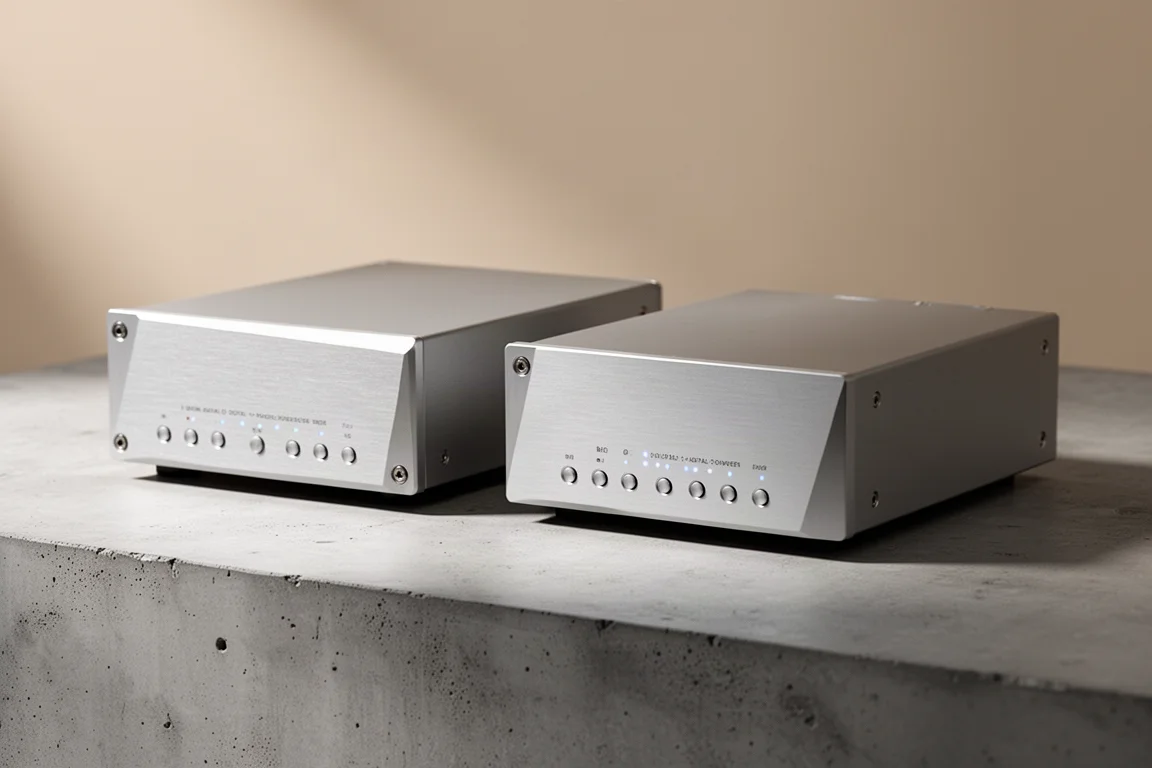
From the outside the two are almost impossible to tell apart. They share the same three-quarter-width chassis, the same button layout and broadly the same connectivity. Inside they are quite different designs, and that is what decides whether the extra outlay earns its place in your system. This comparison covers what changes between the two, how each one sounds, and which listeners should choose which.
What Sets These Two DACs Apart
Both converters use the same 330 mm (13 inch) three-quarter rack chassis and both weigh 8.5 kg (18.7 lb). Both also carry a DSP board built around an FPGA that handles digital signal processing and system control. Those boards look broadly similar, so the meaningful differences appear elsewhere.
The Venus II adds an extra sheet of metal that runs the length of the main board, giving the analogue and digital circuitry further isolation from the power supply. The internal cabling that links the power supply to the main board is silver, and there is nothing equivalent on the Pontus II. The capacitor bank is upgraded as well: the Venus II uses white polyester film capacitors alongside Elna electrolytics, while the Pontus II uses a bank of electrolytics from a different brand. The goal is lower equivalent series resistance, which translates into cleaner power delivery.
The most consequential change is the resistor ladder itself. The Venus II carries close to double the number of ladder resistors, and their output is summed and averaged to improve resolution. Clocking differs too. The Venus II uses temperature-compensated crystal oscillators with a thermistor circuit that compensates as the unit warms up, keeping the clock feed as stable as possible. The Pontus II uses regular voltage-controlled femto crystal oscillators, which are good quality parts but a step below what the Venus II carries.
Taken together, these are engineering changes rather than cosmetic ones, and they explain why the two DACs do not sound identical.
Denafrips Venus II: Build and Features
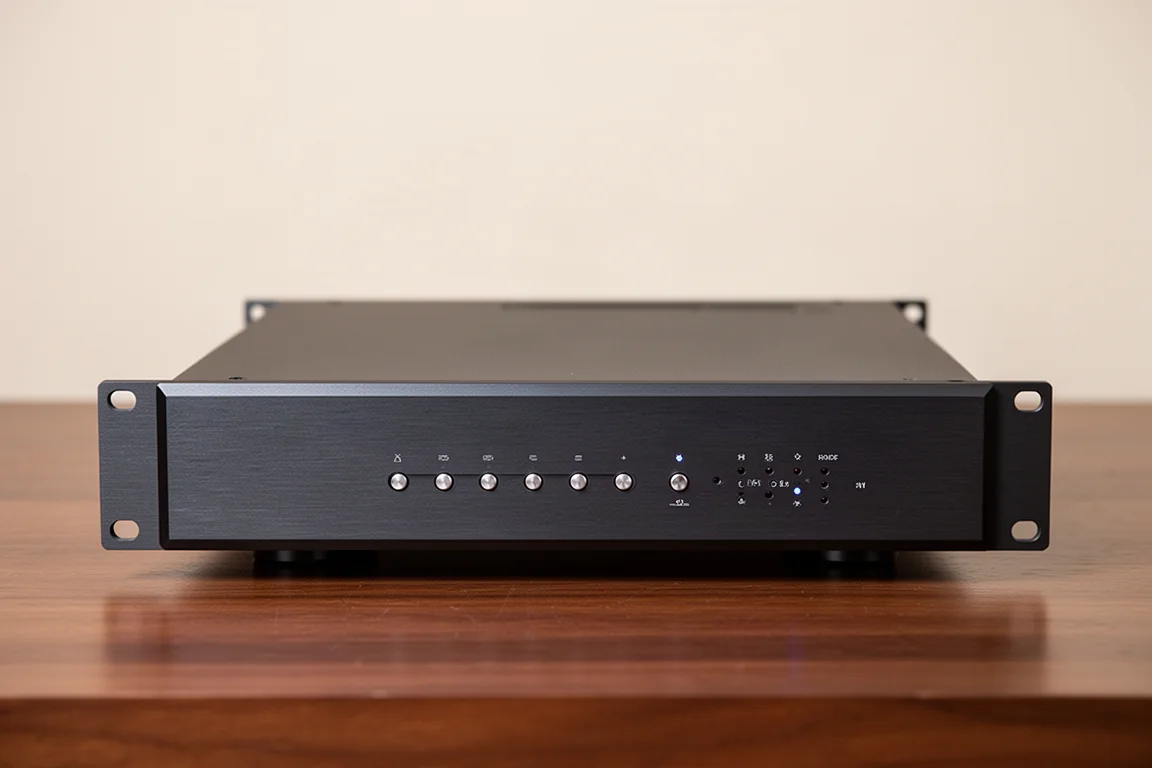
The Venus II lives in the same three-quarter-width chassis as the Pontus II, and the front panel is where the shared layout is most obvious. A central button takes the converter out of standby. Two buttons step left and right through the inputs. A phase button switches between positive and negative, with the indicator lit for positive phase, a setting that suits most systems and most recordings. Another button toggles between oversampling and non-oversampling operation, with the light on indicating non-oversampling. A mute button silences the output and runs the indicator lights through the inputs in sequence to confirm it, and pressing it again returns to the last input in use. A mode button handles I2S pin configuration and switches between the two digital filters, sharp and slow.
Around the back you get balanced XLR and single-ended RCA outputs. They cannot be used at the same time. The digital inputs cover coaxial on RCA, coaxial on BNC, AES/EBU balanced, optical Toslink, I2S and USB, which is enough to connect a wide range of sources.
One detail worth knowing before you buy: the Venus II is not a true non-oversampling DAC. The DSP board includes a FIFO buffer and digital filtering, so listeners looking for a purist ladder design with no processing at all should look elsewhere.
Denafrips Venus II: Sound Quality
Once settled, the Venus II is the more technically capable of the two. It has better clarity than the Pontus II, and it resolves more of what is in the recording. What makes it convincing rather than merely detailed is that it keeps the harmonic richness that makes the Pontus II so easy to live with. Across bass, midrange and treble it does what the Pontus II does, just a little better, and the soundstage is complete and well organised.
The gap is not enormous in absolute terms. The Pontus II is already an excellent converter, and in a system that is not especially revealing the two can sound closer than their price difference suggests. Where the Venus II pulls ahead is in the sense of control: notes start and stop with a little more precision, and quieter detail sits against a very black background. It is a converter that does nothing obviously wrong and leaves very little to criticise.
Denafrips Pontus II: Build and Features
The Pontus II uses a similar power supply architecture to the Venus II, with two O-ring transformers. One feeds the digital section and the other feeds the analogue section, and keeping them completely separate stops one from interfering with the other. The supply sits below the main board inside an encapsulated metal case.
On the main board you can see the resistor ladder network and a bank of electrolytic capacitors, and the crystal oscillators are the regular voltage-controlled femto type. The DSP board with its FPGA is very close to the one in the Venus II. Build quality is a clear step above the entry point of the range, and the casework is the same substantial three-quarter-width design used further up.
Denafrips Pontus II: Sound Quality
The Pontus II is a hard converter to fault at its price. Bass has weight, extension and definition. The midrange is rich, and it gives up very little in transient attack, so the leading edge of notes stays crisp while decays trail away beautifully. That kind of decay depends on a quiet background, and the Pontus II delivers one. Treble extension and refinement are equally convincing, and the soundstage has both width and depth.
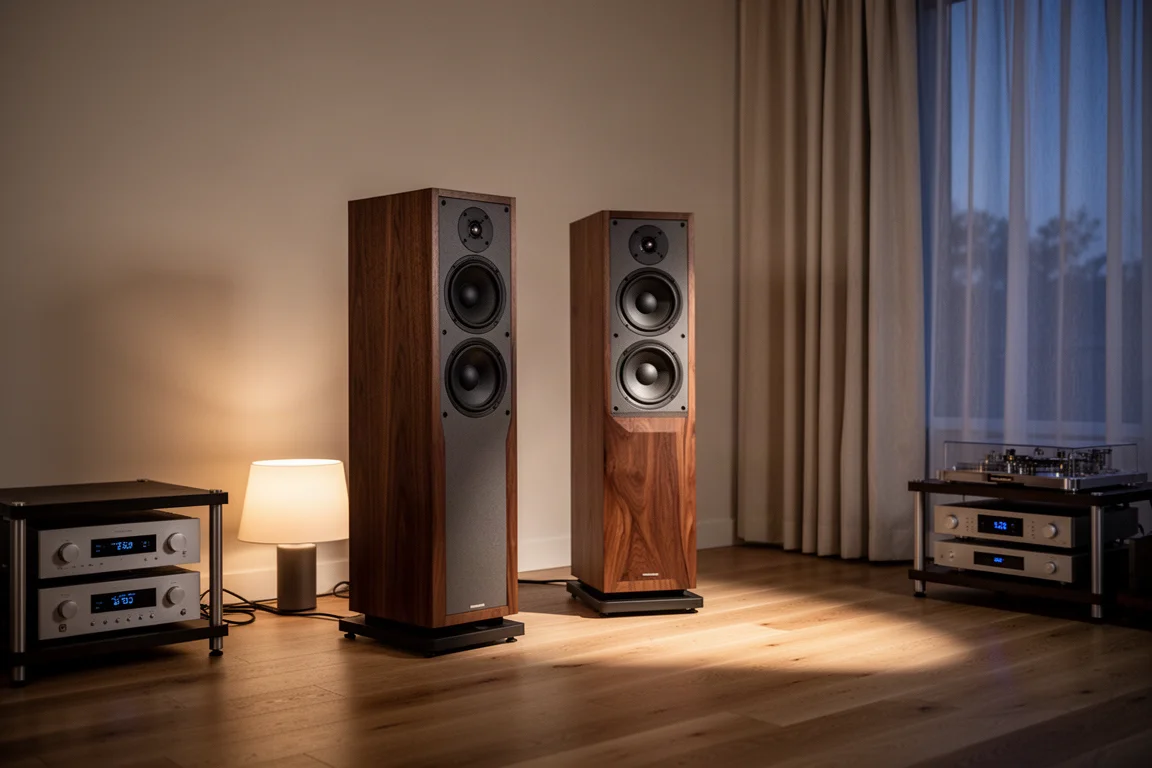
Tonally it leans slightly warm and generous rather than analytical, which makes it forgiving of modest recordings and easy to listen to over long sessions. That character is a large part of why it has become such a popular recommendation at around £2,000, and it is the reason many listeners will never feel the need to move further up the range.
Settings and Burn-In Notes
The Venus II needs patience. Straight out of the box it sounded thin in the bass and midrange, with a touch of harshness in the upper midrange next to the Pontus II. A couple of months of daily use in a secondary system changed that completely, and after roughly four months of regular listening it gave up nothing in harmonic richness. Buyers should expect a long run-in before judging it.
Two settings matter most. Oversampling is the better choice here, adding a little more clarity and resolution than non-oversampling mode. The slow digital filter is also preferable to the sharp one, which introduces a slight glare and hardness. To change filters, mute the unit first, then press the mode button: the optical indicator light off means sharp, and on means slow. Positive phase suits the majority of systems and recordings.
System Matching and Buying Advice
The Venus II only makes sense in the right company. In a system built around a solid-state integrated amplifier costing around £1,500 to £2,000 and a pair of £1,200 to £1,500 standmount speakers, the difference between the two DACs is audible but rarely worth an extra £1,000. The sensible order of spending is to put that money into the amplifier and speakers first, because the Pontus II is already good enough for the vast majority of listeners.
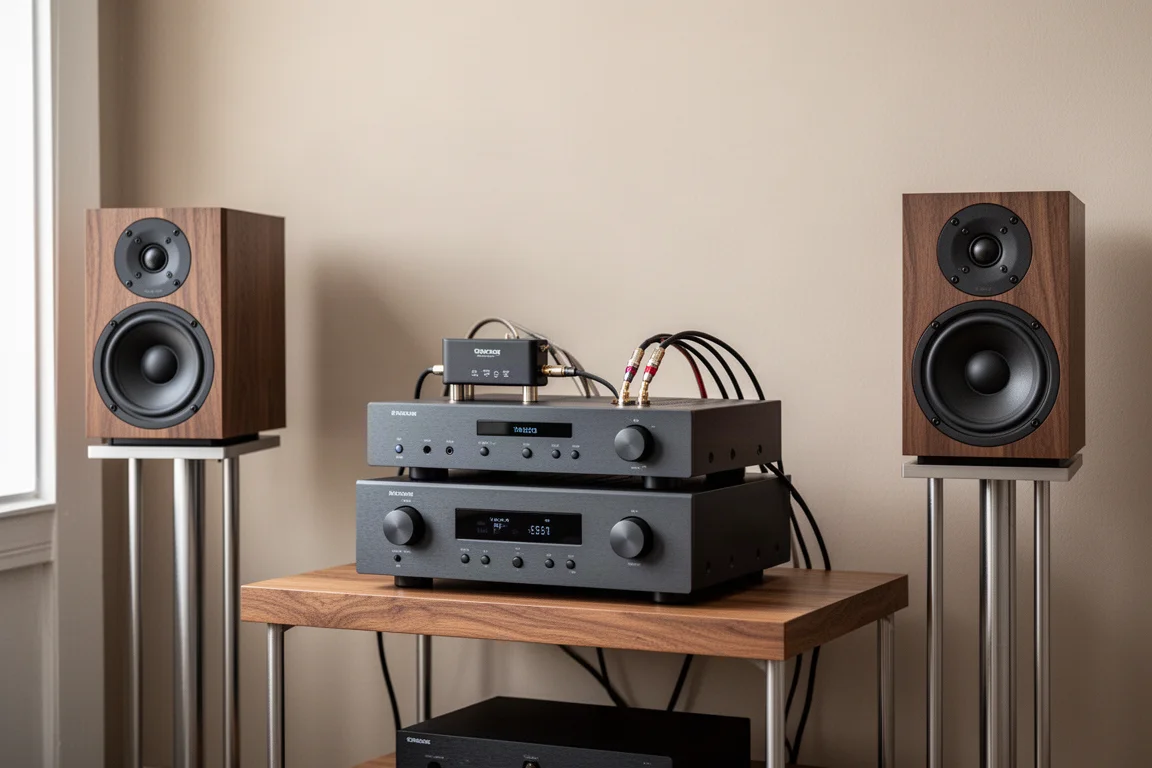
Move up to a genuinely resolving system, with a high-quality preamplifier, a pair of monoblock power amplifiers and speakers of equivalent standard, and the picture changes. The differences stop being subtle, and the additional outlay becomes worthwhile. As a rough guide, a £3,000 converter belongs in a system where the amplification and speakers cost several times that, so budget for the whole chain rather than for the DAC alone.
If you are building or upgrading a system and the converter is the last piece to fall into place, the Venus II is the more complete product. If the rest of your system still has room to grow, the Pontus II is the smarter purchase, and it will keep you satisfied while you improve everything around it.
Conclusion
The Venus II is a clear step forward from the Pontus II. It carries better isolation, a denser resistor ladder and superior clocking, and those changes show up in a sound that is more resolving and better controlled while keeping the musical warmth that makes the range appealing. It is a complete-sounding converter at its price, provided the rest of your system is resolving enough to reveal what it does.
The Pontus II remains the value pick. It is rich, weighty and refined, it is good enough for most listeners, and it leaves money in the budget for the amplifier and speakers that will make a bigger difference. Choose the Venus II if your system is already at that level. Choose the Pontus II if you would rather upgrade the rest of the chain first.
Further reading
Related Reviews
Hi-Fi DACs
Denafrips Ares 12th-1 vs Geshelli Labs J2: Two Paths to a Better DAC
A two-DAC comparison of the Denafrips Ares 12th-1 and the Geshelli Labs J2, covering build, inputs, sound character, and which listener each converter suits.
Hi-Fi DACs
Denafrips Ares 12th Anniversary Review: A Purist R-2R DAC With an I2S Upgrade
A compact, fully balanced R-2R converter with a new I2S input, free anniversary firmware and a clear upgrade path at around £1,000.
Hi-Fi DACs
Denafrips Pontus 15th Generation DAC Review: Trickle-Down R-2R Sound
A two-box R-2R converter that carries the circuit of a far more expensive Denafrips model, with airy staging and a clear system-matching rule.