Audio Amplifiers
Dayton HTA200 Review: A Hybrid Tube Amplifier With Measurable Warmth
A $350 hybrid integrated amplifier with a tube preamp stage, a full set of inputs, and a low-end lift you can hear as clearly as you can measure.
Introduction
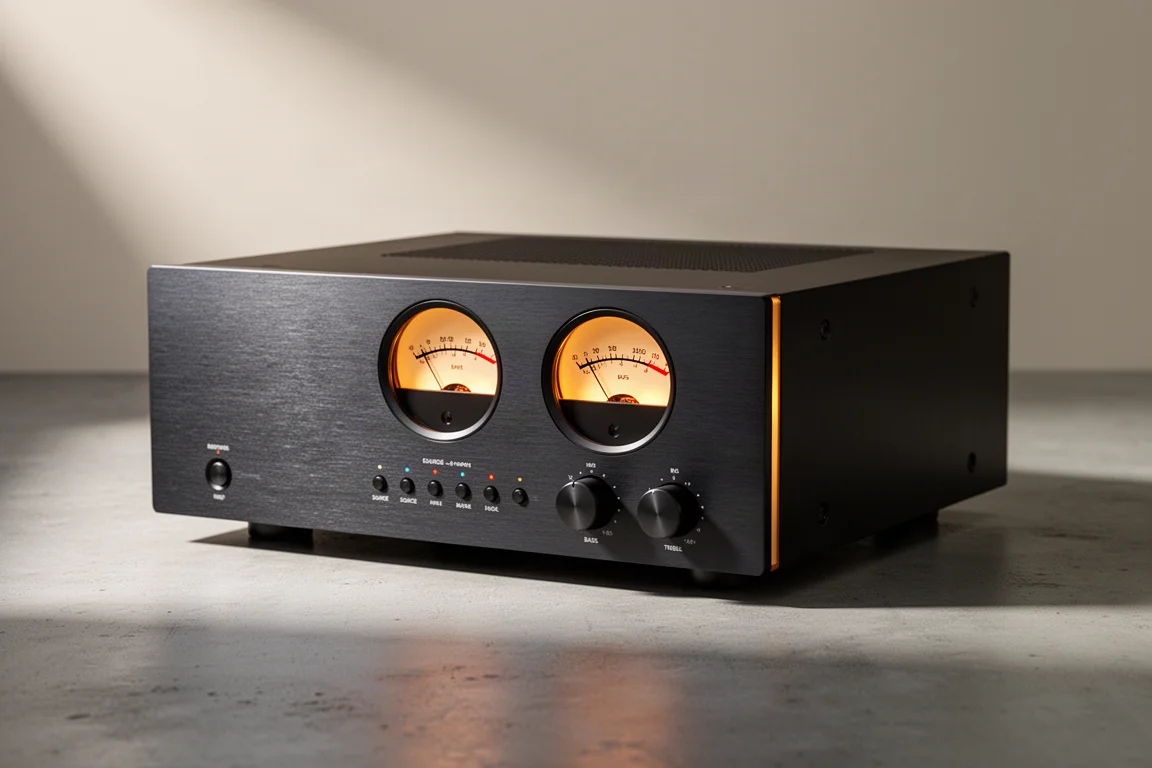
The Dayton HTA200 is a hybrid integrated amplifier: a solid state output stage paired with a tube preamplifier section. It sells for around $350 new and is carried by mainstream retailers including Parts Express and Amazon, though stock has been intermittent and it has recently been listed as unavailable. At that price it lands in a crowded field of compact integrated amplifiers, and what separates it is not only the tube front end but a frequency response that measurably departs from neutral.
That departure is the whole story. In controlled blind ABX listening, level matched to within about half a decibel and run across three rounds of eight trials, the HTA200 was consistently identified as the different amplifier in the chain. Not by name, and not by guesswork, but by a low-end signature that most listeners would describe as warmth. Measurements back it up: roughly 1.5 dB of boost centred near 50 to 60 Hz, spread across a broad region from about 20 Hz up to around 500 Hz.
Whether that is a feature or a flaw depends entirely on the speakers sitting at the other end of the cable.
Who This Product Is For
This amplifier makes the most sense for listeners who want a specific tonal result rather than a transparent wire with gain. If your speakers sound lean through the lower midrange, or you have never quite been satisfied with the body of acoustic instruments and male vocals in your system, an amplifier with a built-in low-end lift can fill that gap without any digital processing or extra boxes.
It is also a natural fit for anyone who wants a lot of connectivity in one chassis. The HTA200 covers optical Toslink, coaxial digital, USB from a computer, Bluetooth, line-level RCA, and moving magnet phono, plus a subwoofer output. That is a full system hub for a turntable, a television, a streamer, and a pair of speakers, at a price that leaves room in the budget for the speakers themselves.
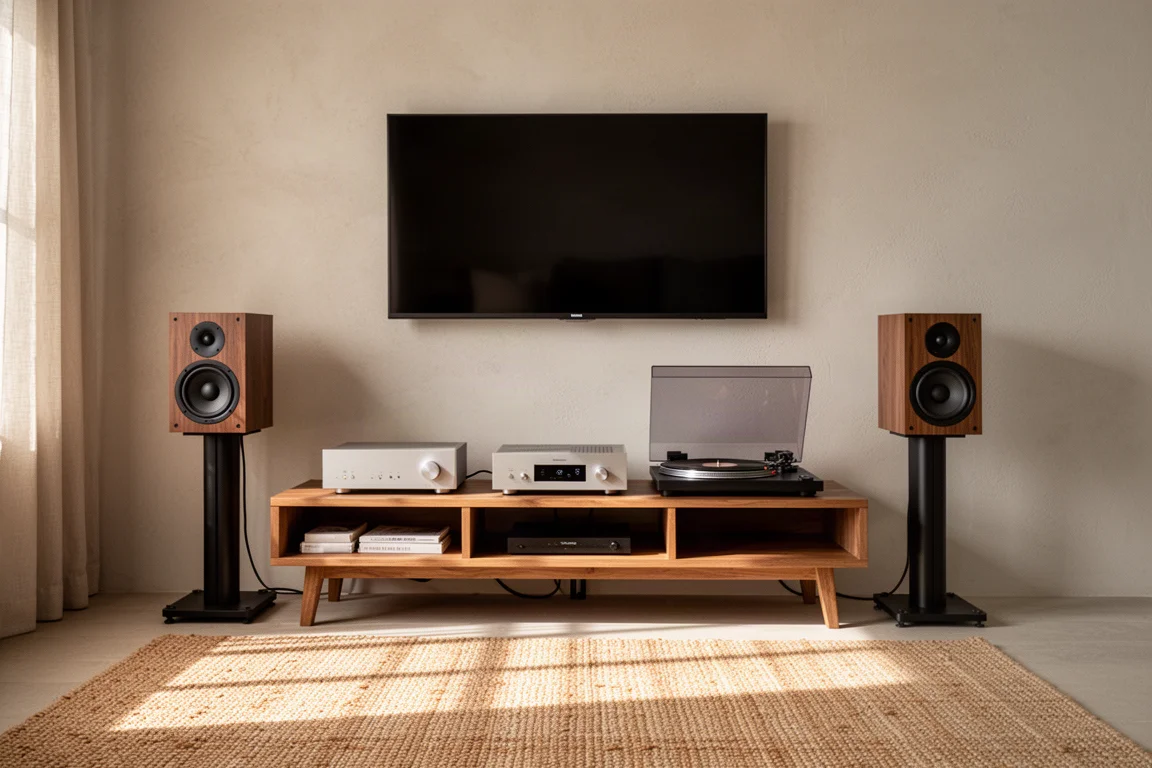
The case weakens if your speakers are already neutral and linear in the bass. In that situation the added low end is not correcting anything. It is simply changing the balance of a system you may already be happy with, and the effect is strong enough that you will notice it whether or not you asked for it.
Main Strengths
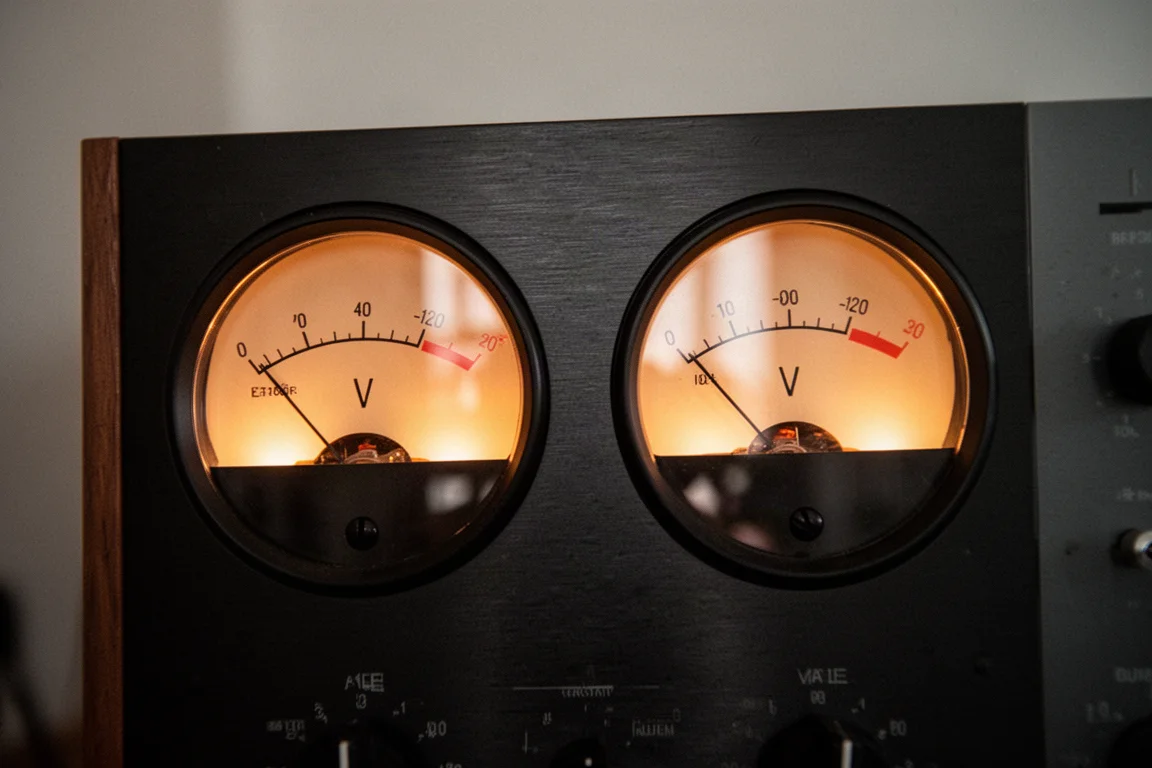
The HTA200 gets a lot right for the money. It looks purposeful, with a clean front panel and a pair of VU meters that give it a character most compact amplifiers do not bother with. It is rated at 100 watts per channel into 4 ohms at 1.5% THD, with a stated minimum speaker impedance of about 4 ohms.
Sound Character: A Measurable Warmth
The most interesting thing about this amplifier is that its voicing is not a matter of opinion. Frequency response sweeps into 4 ohm and 8 ohm static loads, and into both simple and complex reactive loads, show the same broad lift. It peaks at roughly 1.5 dB around 50 to 60 Hz and returns toward flat by about 500 Hz at the upper end and near 20 Hz at the bottom.
In listening tests the lift was easy to identify against a WiiM Amp and an NAD integrated amplifier used as references. Across three rounds of eight blind, level-matched comparisons, the HTA200 was reliably distinguished every single time. The giveaway was the bottom end, not the treble. That detail matters, because tube gear is usually discussed in terms of added harmonic distortion rather than frequency response. Here the audible signature is tonal, and the data explains exactly what was heard.
Distortion does rise with output. At 1 watt into 4 ohms the total harmonic distortion is dominated by second order content. By 5 watts it sits near 0.5%, by 100 watts near 2%, and at the roughly 186 watts the amplifier could deliver it approaches 3%, with third order components separating from the higher orders. As with most amplifiers, whether that becomes audible depends on your speakers, your listening distance, and how demanding the material is.
Power, Inputs, and Everyday Flexibility
Power delivery is generous for the class and the price. Measured output reaches roughly 90 watts into 8 ohms, about 140 to 150 watts into 4 ohms, and around 200 to 210 watts into a complex reactive load, depending on where the distortion knee is drawn. For most domestic speakers in most rooms, that is more than enough headroom.
Connectivity is where the HTA200 punches well above its price. Toslink optical, coaxial digital, PC USB, Bluetooth, auxiliary RCA, and phono RCA inputs cover almost any source a household is likely to have, which means fewer adapters and fewer switching boxes on the shelf. The front panel adds bass and treble controls for adjusting the contour to taste, and the VU meters make the amplifier pleasant to look at while it works.
Things to Consider Before Buying
Two measured behaviours are worth knowing before you commit, and neither shows up in the marketing copy.
Noise Floor and Subwoofer Output
The noise floor measures around 80 dB down. That is not a bad figure in isolation, but it is noticeably higher than a modern class D integrated amplifier, which can sit at the limit of what test equipment is able to resolve. Whether it matters in practice depends on speaker sensitivity and listening distance. With a pair of KEF LS50 Meta speakers at roughly ten feet, no additional background noise was audible. With high sensitivity designs, or in a nearfield setup, it could become noticeable.
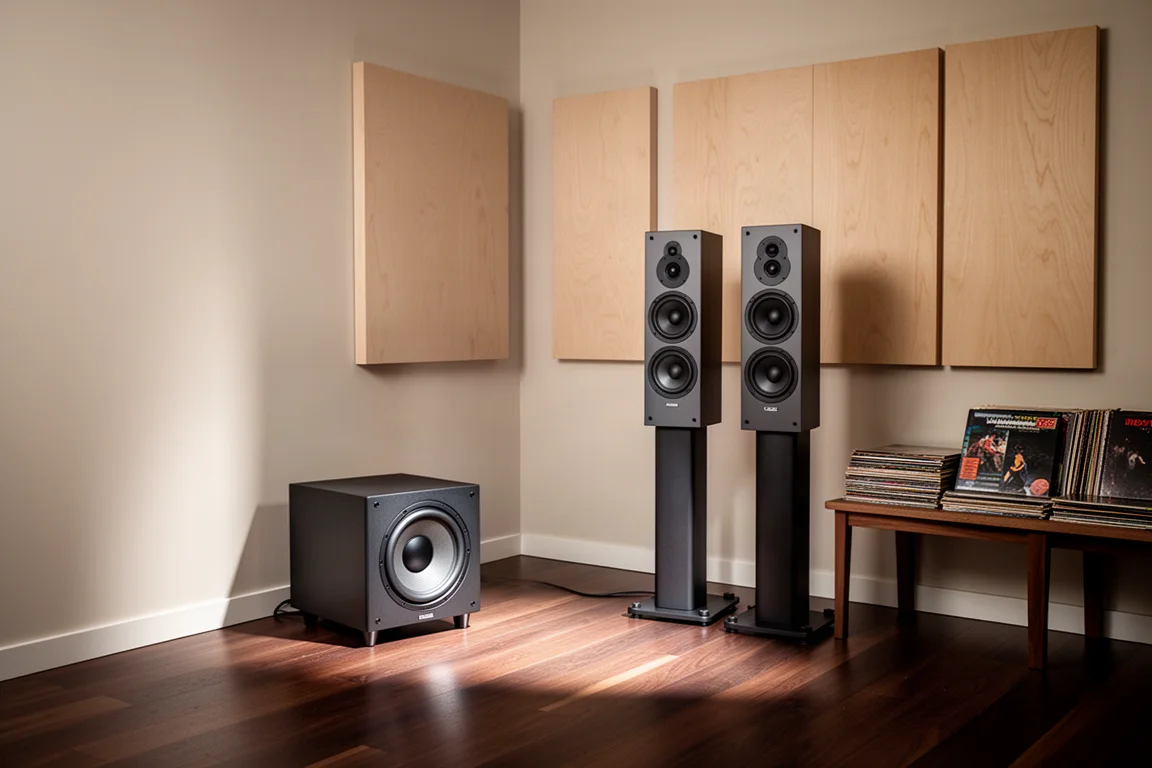
The subwoofer output is the other point to weigh. It is described as full range, and it does pass a wide band, but it begins to roll off from roughly 500 Hz rather than extending cleanly to the bottom. More importantly, connecting a subwoofer does not engage a high pass filter on the main speakers, so the mains keep running full range alongside the sub. If you want clean integration between satellites and a sub, you will need to handle that filtering elsewhere in the chain.
Load Behaviour and Speaker Matching
The good news is that the HTA200 behaves consistently across loads. Response into 4 ohm and 8 ohm static loads and into simple and complex reactive loads tracks closely, with variation of only a couple of tenths of a decibel. Whatever speakers you connect, the tonal shift will take the same shape.
That consistency cuts both ways. Some speakers are designed to sit close to the wall behind them, and their response dips through the lower midrange when they are pulled out into the room. An amplifier with a lift in that same region can make such a speaker sound fuller, which is a legitimate way to build a satisfying system. It is also the kind of mix-and-match tuning that is easier and more precise to accomplish with EQ, if your system supports it. There is nothing wrong with choosing the amplifier route, but it helps to know that is the choice you are making.
Buying Advice
At around $350, the HTA200 is easy to recommend on value. It has enough power for most domestic speakers, an unusually complete set of inputs, and a look that stands out in a category full of plain black boxes. It is a piece of gear that invites you to build a system around it rather than hide it in a rack.
The decision comes down to what you want the amplifier to do. If you are looking for a neutral, transparent component that adds nothing at all, this is not that amplifier, and the measurements show why. If you want a single box that handles every source in the house and gives lean-sounding speakers more weight through the lower midrange, the HTA200 does exactly that, and the effect is strong enough to be heard rather than merely measured.
Availability is worth checking before you commit, since stock has been intermittent. When it is available, it is a low-risk way to add a tube front end and a wide set of inputs to a system without spending a large sum.
Conclusion
The Dayton HTA200 is a genuinely interesting amplifier at a modest price. Its hybrid design, extensive input selection, and VU meters give it character, and its measured frequency response gives it a sound that is easy to identify even in a blind comparison. Buy it for the warmth and the flexibility, and go in knowing that the warmth is real, repeatable, and part of the design rather than an accident.
Product link
View more details for Dayton HTA200
This product is mentioned in the review. Check the specifications, options, and compatibility before buying.
View more details for Dayton HTA200Further reading
Related Reviews
Audio Amplifiers
AGD Audion Mark III Review: A Compact Class D Amplifier With Tube-Like Musicality
A gallium nitride Class D amplifier that delivers tube-like midrange warmth, serious bass grip, and a modular upgrade path in a very small chassis.
Audio Amplifiers
Best Class D Amplifiers Under $100: Douk Audio A5 vs Fosi Audio V3
Two sub-$100 Class D amplifiers built on the same 3255 chipset, compared on bass weight, midrange body, treble presence, and real-world speaker matching.
Audio Amplifiers
Best Power Amplifiers Under $500: Six Stereo Amplifiers From $74 to $579
A practical roundup of six stereo power amplifiers under $500, covering real-world power, connectivity, cooling, and which kind of system each one suits.