Hi-Fi Amplifiers
Dayton Audio DTA-100ST Review: A Compact $135 Amplifier With a High-Pass Filter
A well-built two-channel amplifier with an internal power supply and a defeatable high-pass filter, plus clear limits when it meets hard-to-drive speakers.
Introduction
The Dayton Audio DTA-100ST is a two-channel amplifier priced at around $135, and it brings something that is still uncommon at this price: a defeatable variable high-pass filter. That single feature reshapes what a small amplifier can do in a desktop or 2.1 system, because it lets you keep deep bass out of the main speakers and leave that work to a powered subwoofer. Add an internal power supply, and the DTA-100ST also sidesteps the external brick swapping that defines many compact Class D designs.
Dayton Audio is the in-house brand of Parts Express, a long-established supplier for DIY speaker builders and audio hobbyists, and that background is visible in the hardware choices here. This article covers the published specifications, the build, the sound, and the situations where the amplifier is likely to struggle, so you can judge whether it suits the speakers you already own.
Who This Amplifier Is For
This is a compact stereo amplifier for listeners who want a simple, well-made two-channel solution for a desk, a small room, or a secondary system. With line in and line out, it can also serve as a preamp feeding another amplifier or a powered subwoofer.
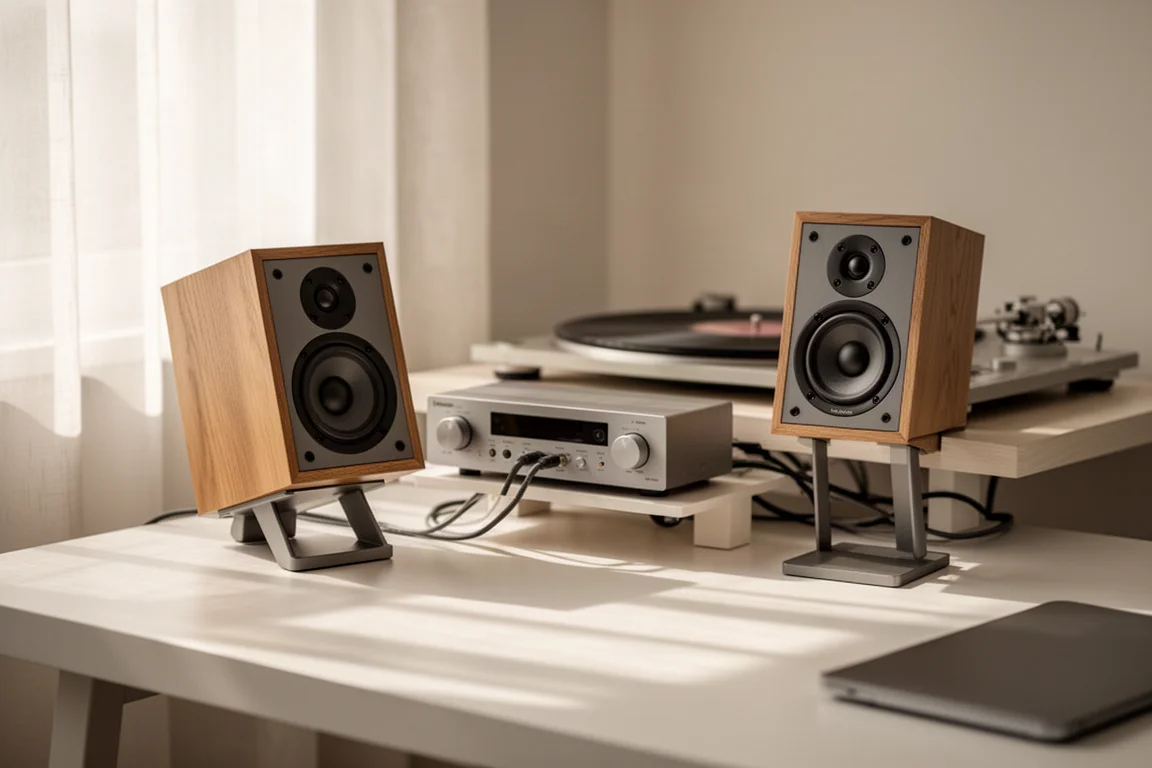
The more compelling case is a 2.1 system. Pairing the DTA-100ST with compact bookshelf speakers and a powered subwoofer lets the high-pass filter strip low bass from the mains, which reduces woofer excursion and distortion and allows more usable volume from modest speakers. If your plan already includes a subwoofer, that flexibility is the strongest reason to consider this amplifier.
It is a less obvious fit for anyone running large floorstanding speakers, low-sensitivity designs, or a room where high playback levels are the priority.
Build Quality and Connections
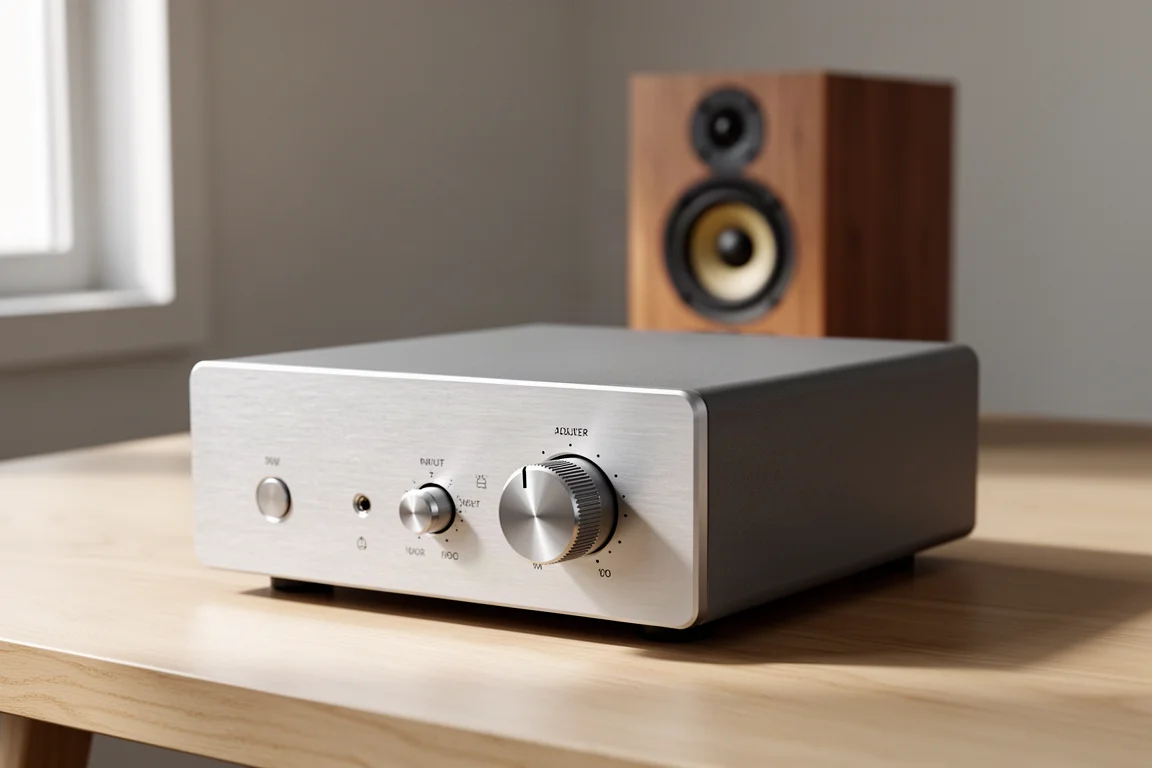
The chassis is the standout. A brushed aluminum front plate, a matte bead-blasted finish, and a case that feels noticeably heftier than many Class D amplifiers in this price range. Ventilation slots run along the sides and the underside, and rubber feet keep it stable on a shelf. Even under sustained use, the amplifier stayed cool.
The front panel keeps things minimal: a power button, an input selector for line in or Bluetooth, and a stepped volume knob with tactile detents.
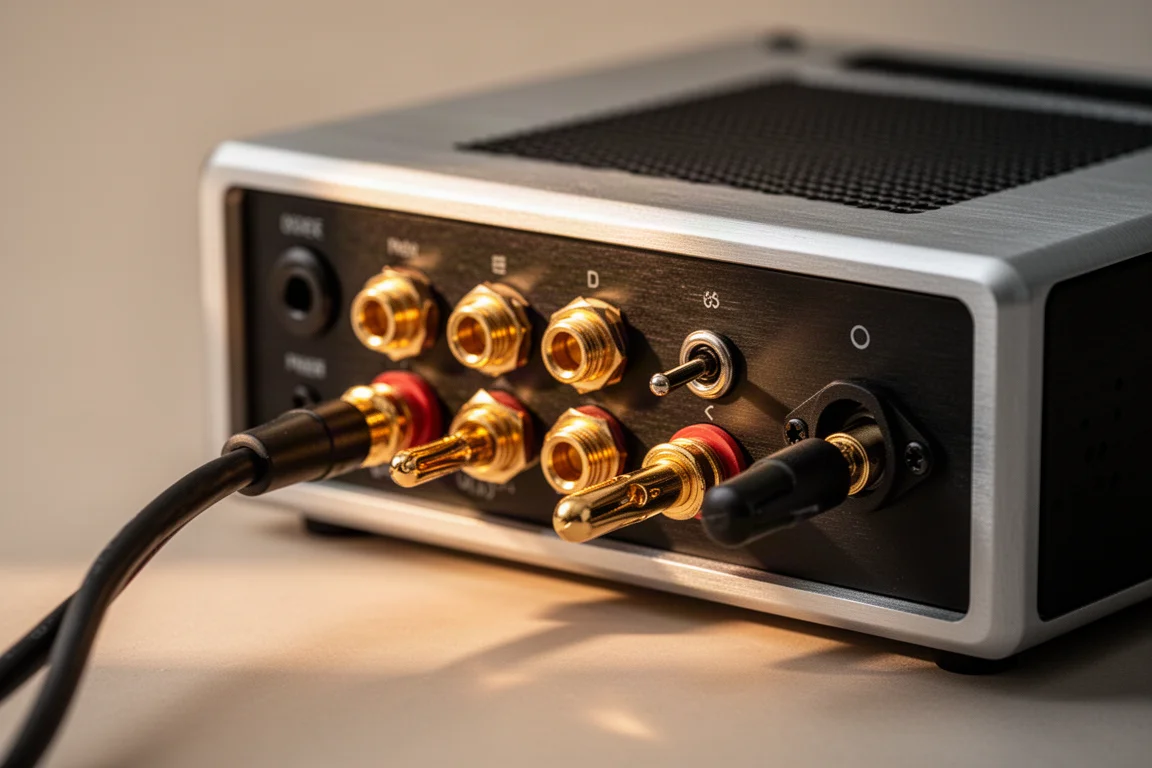
The rear panel is where the useful extras live. A Bluetooth antenna, line in and line out, a variable high-pass filter with a defeat switch, sturdy speaker binding posts, the power inlet, and a master power switch. Because the power supply is internal, the only cable required is the included figure-eight cord.
Dayton Audio’s published ratings are fairly sparse: 51 to 100 watts RMS per channel at 8 ohms, with no 4 ohm figure listed. A 4 ohm figure of 57.7 to 69.6 watts RMS at 0.43% THD is quoted as well, and the 8 ohm number comes out to roughly half of that, around 28 to 35 watts RMS. Keep those numbers in mind for the pairing discussion further down.
How It Sounds
Partnered with a WiiM Pro streamer and a pair of 4 ohm standmount speakers rated at 86 dB sensitivity, the DTA-100ST delivered a midrange-focused signature that worked well for film and television. Dialogue came through with clarity, and there was enough power on tap for home theater duties. The same held true when the amplifier was used for center channel work with an 8 ohm bookshelf speaker of around 89 dB sensitivity driven by a compact surround processor.
For music, the tonality is a little thin through the bottom end. The top end can lean slightly bitey on cymbals, and percussion attacks sit forward in the mix. Bass, by contrast, is clean, articulate, and quick. The soundstage is typical for the category rather than expansive, while imaging places instruments in space reasonably well.
Direct comparison with a compact Class D rival that offers no tone controls and a single analog input highlighted where the differences sit. On vocal-heavy passages, the rival rendered reverb tails and hi-hat texture a touch more naturally, and voices were placed slightly better in space. The amplifier chipset inside the DTA-100ST is not disclosed, and its overall character resembles many Class D designs built on Infineon MA12070 chipsets. The gap against the rival is subtle, and it is most apparent when switching quickly between amplifiers rather than listening to either one on its own.
Where the DTA-100ST Runs Into Trouble
With demanding material at higher levels, the amplifier runs out of steam. In near-field listening at roughly 80 dB, about three feet from the speakers, a bass-heavy track produced distortion almost immediately, and the distortion persisted even after the volume came down. Switching tracks allowed the amplifier to recover. Connecting the speakers directly rather than through a switcher made no difference. A dense, layered track showed the same behavior once the arrangement filled out in its middle section.
That pattern suggests limited current delivery rather than a heat problem, since the case stayed cool throughout. The stepped volume control adds a second quirk: some detents produce almost no change in level while others jump noticeably, which makes precise level matching harder than it should be.
The High-Pass Filter and 2.1 System Flexibility
The high-pass filter is variable and can be switched out entirely when you want a full-range signal sent to the mains. On the subwoofer side, most powered subwoofers already include an integrated low-pass filter, so high frequencies are handled by design. What is missing on most small amplifiers is the high-pass half of the equation, and that is exactly what the DTA-100ST provides.
Practically, that means small speakers can play louder with less distortion, because the low bass that consumes the most amplifier power and the most woofer excursion is no longer sent to them. The line output also allows the amplifier to act as a preamp, which opens up configurations with an external power amplifier or an active subwoofer feed.
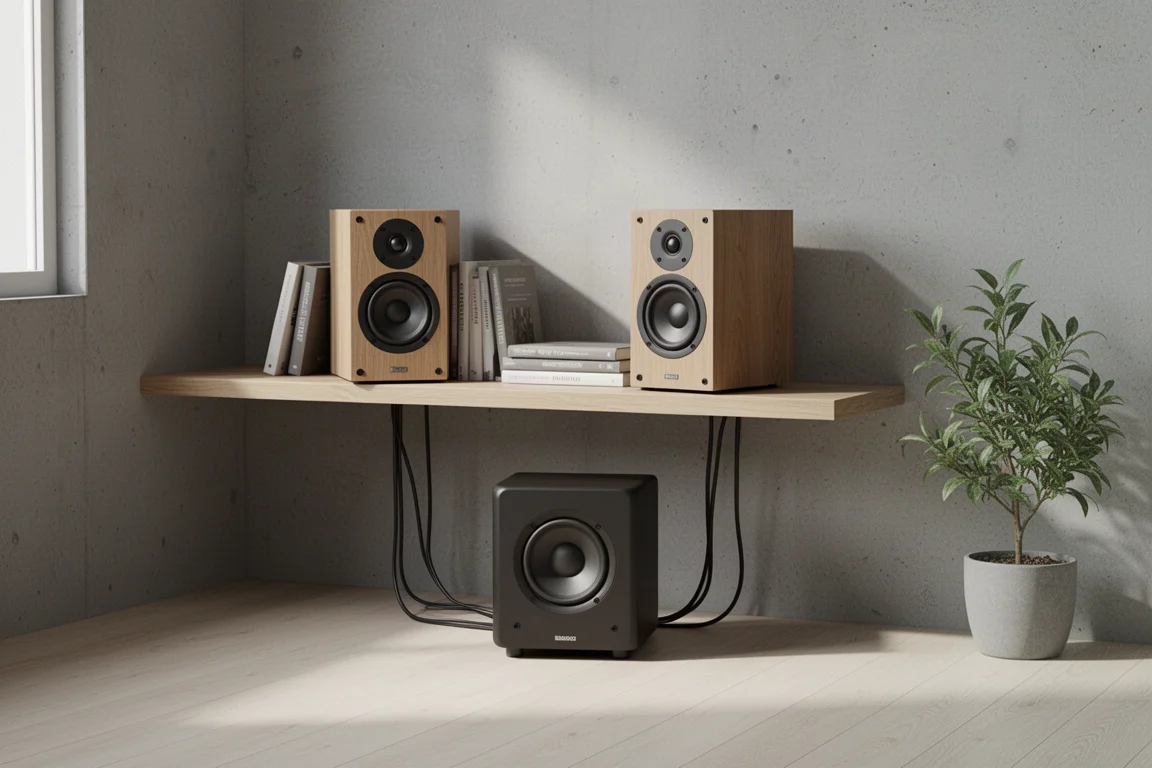
For a desktop system or a small room where a subwoofer is part of the plan, this combination of features is more useful than a higher wattage number on a spec sheet.
Speaker Pairing Notes
Match the amplifier to speakers that are easy to drive. An 8 ohm bookshelf speaker with sensitivity around 89 dB, such as the RSL CG3M, worked without complaint, including in a center channel role mounted on a wall. A 4 ohm speaker rated at 86 dB sensitivity asks considerably more and exposes the amplifier’s limits at higher volumes.
If you already own difficult speakers, this amplifier is unlikely to be the right match. If you are building a system around modest speakers and a subwoofer, it should be a comfortable fit.
Buying Advice
At roughly $135, the DTA-100ST makes its case through build quality, an internal power supply, Bluetooth, a preamp output, and above all the high-pass filter. For a near-field desk system or a small room built around compact speakers and a powered subwoofer, that feature set is difficult to match at this price.
Buyers with low-sensitivity 4 ohm speakers, or a preference for loud playback in a larger room, should look at alternatives with more current on tap or plan on different speakers. This amplifier rewards reasonable expectations: keep the load friendly and the volume moderate, and it performs well.
Conclusion
The Dayton Audio DTA-100ST is a well-built, genuinely versatile compact amplifier. Its high-pass filter, internal power supply, and solid chassis set it apart from much of the affordable Class D field, and at moderate levels with suitable speakers it sounds good and behaves predictably. Its weakness is current delivery into difficult loads, which shows up as distortion once hard-to-drive speakers are pushed. Choose it for small speakers and subwoofer integration, and it will do exactly what you need. Pair it with demanding speakers and expect limitations.
Product link
View more details for Dayton Audio DTA-100ST
This product is mentioned in the review. Check the specifications, options, and compatibility before buying.
View more details for Dayton Audio DTA-100STFurther reading
Related Reviews
Hi-Fi Amplifiers
Accuphase E-280 Review: Entry-Level Accuphase With Flagship Attention to Detail
A close look at the Accuphase E-280 integrated amplifier, covering its champagne build, AAVA volume control, sound quality, and the speakers and sources that suit it best.
Hi-Fi Amplifiers
Advance Paris A10 Classic vs Yamaha A-S301: Two Integrated Amplifiers Compared
A practical comparison of a $350 integrated amplifier and a $2,500 reference model, covering the differences that matter and the ones that do not.
Hi-Fi Amplifiers
Affordable Chinese Amplifiers Worth Buying: Five Budget Hi-Fi Amps Compared
A practical look at five affordable amplifiers, what each one does well, and the trade-offs to weigh before you buy.