Bike Computers
COROS DURA First Impressions: Solar Power and a Digital Dial on a Bike Computer
After nearly three weeks of riding with the COROS DURA, here is a close look at its solar charging, digital dial, navigation approach, and what is still missing in the software.
Introduction
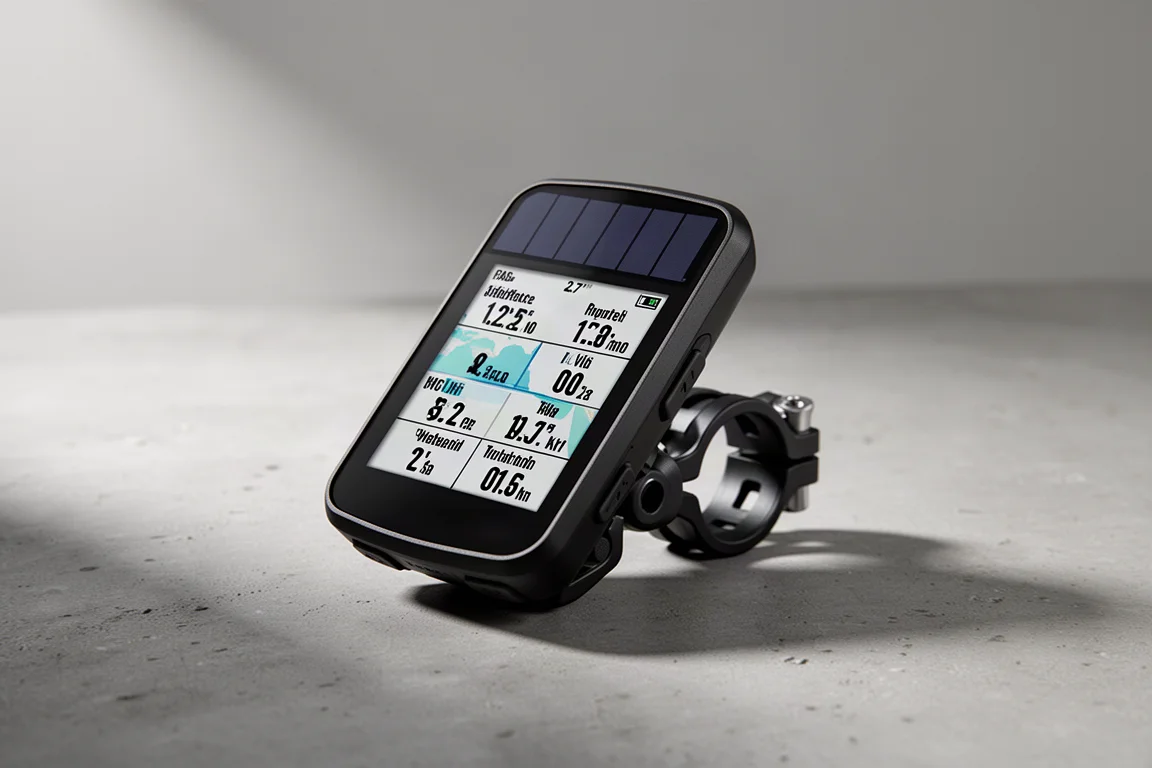
COROS made its name in the running world with its watches, and the DURA marks the company’s first step into cycling. Rather than copying an existing bike computer, it arrives with a couple of genuinely fresh ideas: a large solar panel on the front and a digital dial borrowed from the brand’s watches.
After nearly three weeks of testing across plenty of outdoor riding, including navigation, plus some indoor sessions, one number stands out: the unit has not been plugged in once, and the battery is still at roughly half. That alone says a lot about where this product is aiming.
One important caveat: this is not a final review. The software was still a work in progress during testing, with final software arriving after launch. Think of this as a very detailed first look, focused on hardware and characteristics that will not change with updates.
Price and What’s in the Box
The DURA is priced at $250, which is competitive in this segment. For comparison, the Wahoo ELEMNT BOLT V2 currently runs $279 and is probably the closest competitor on features.
Inside the box you get the DURA itself, an out-front mount with adapters for both 25.4mm and 31.8mm handlebars, Allen wrenches for the mount, a USB-C to USB-C charging cable, manuals, and a sticker. The mount uses a standard quarter-turn interface, so any existing quarter-turn mounts you already own will work. There is also a screw on the underside of the mount if you want extra security or plan to leave the computer attached permanently.
The mount feels genuinely robust, clearly designed with broken mounts from other brands in mind. With the advertised battery life and enough solar exposure, the idea is that you may never need to take the unit off the bike to charge it again.
Hardware, Display, and Everyday Handling
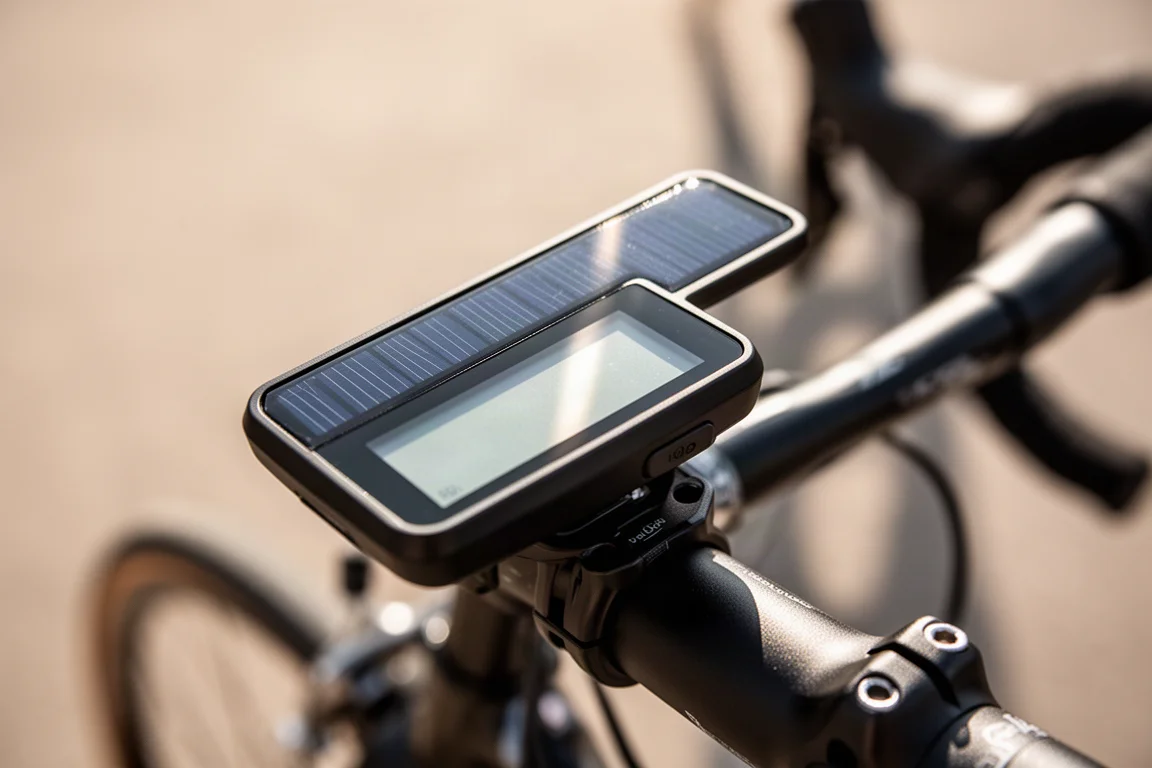
The DURA hits a good middle ground on size: well suited to road and gravel, and probably compact enough for most mountain biking, though riders who prefer a shorter unit for crash protection may want something smaller. The computer weighs around 97 grams and the mount around 44 grams. For context, a Garmin Edge 840 Solar weighs about 89 grams, while something like the Karoo 3 comes in at 118 grams.
The 2.7-inch transflective memory-in-pixel touchscreen looks excellent in direct sunlight and very good in the shade. It is weakest when dealing with glare, such as moving in and out of shade or clouds, and readability drops a little at off angles. Overall visibility is comparable to watches using the same display technology, which is high praise for a head unit.
A small quality-of-life detail: there is no need to power the unit off. It simply sleeps after a few minutes of inactivity, and tapping the back button wakes it instantly. Anyone who has waited close to a minute for another bike computer to boot before rolling out will appreciate this.
Interface and the Digital Dial
Navigation around the device uses a touchscreen plus two buttons, one of which is the digital dial. The lower button wakes the device and acts as back, while the touchscreen or the dial moves through menus, with a press of the dial acting as enter.
On a watch, a digital dial is easy to be skeptical about, but on a bike computer it works well. A quick flick changes data pages even at a brisk riding pace, which is harder with small side buttons that usually require gripping the unit on both sides to press. It also works reliably with gloves of pretty much any size, where small buttons can be ambiguous.
One thing to understand: both touchscreen swipes and dial turns are designed as flick gestures rather than smooth scrolling. This is not phone-like fine control, and trying to use them precisely does not feel the same.
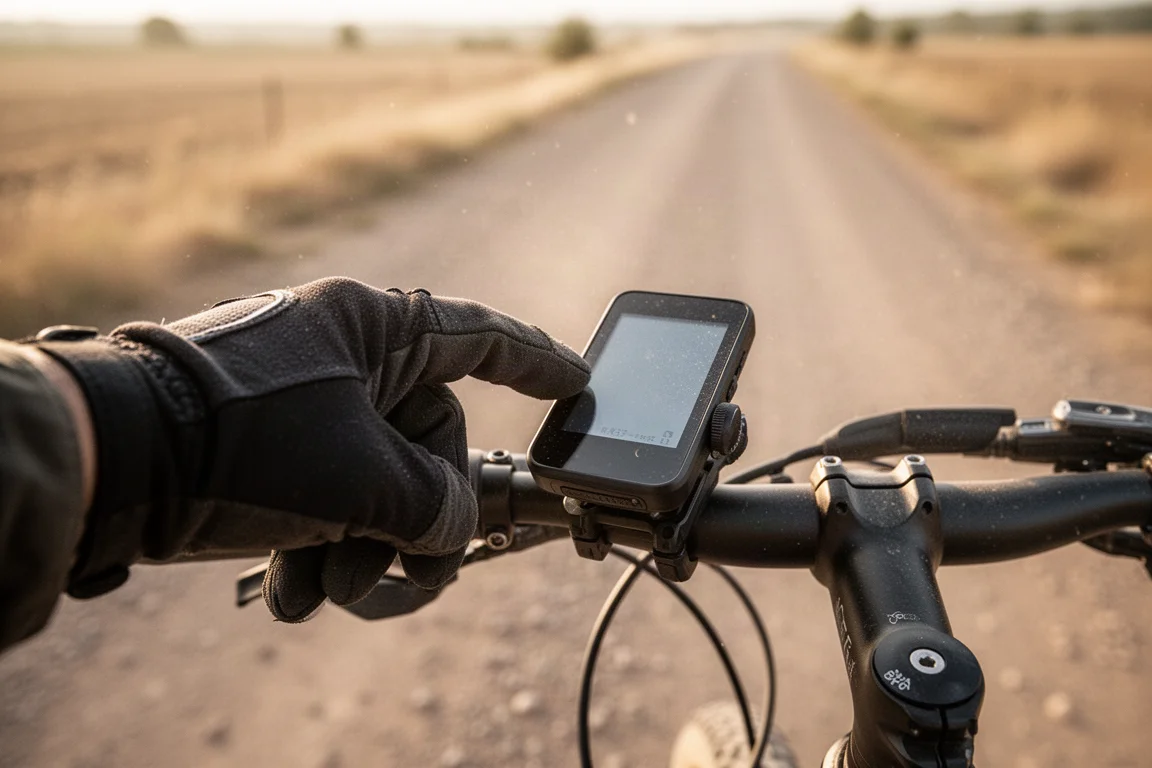
Ride profiles support different setups of data pages and fields, with up to nine data fields per page and up to five pages including the map page. The field selection is solid, covering timers, distance, speed, power, heart rate, and cadence, plus graphical fields like heart rate and power that show zone indicators and fill with the color of your current zone, which is a very clear way to read your effort at a glance.
Data page customization happens through the app rather than on the device, which is very similar to how Wahoo handles things.
Solar Charging and Battery Life
The panel above the display is not just delaying discharge like some other solar bike computers; it can genuinely recharge the device. COROS claims up to 120 hours of battery life in all-systems satellite mode and up to 70 hours in the higher-accuracy dual-frequency mode, both without any solar exposure. With enough sun, the claim goes further: an hour outside in at least 75,000 lux conditions can potentially add battery life, with the suggestion that indefinite battery life is possible.
In testing so far, the best result has been a 1:1 ratio: a two-and-a-half hour ride in all-systems mode with a heart rate monitor, power meter, and Varia radar paired, navigation running, on a very sunny day, where the battery simply did not drain. Actual recharging above the starting level has not been seen yet, though more testing on final software is planned. Even without that, battery life is remarkably good.
The unit also appears to recharge while idle: left in the sun on standby, it currently gains about 1% per hour in strong Colorado sunshine, against a claim of roughly two hours of ride time added per hour outside.
Mapping and Navigation
The DURA includes worldwide landscape and topo maps showing streets, trails, and bodies of water for context. These are map images, similar to the maps on COROS watches: they show all the information, but are not fully routable maps with street names, trail names, or points of interest the way Garmin or Hammerhead units offer. There is no on-device on-demand routing.
Turn-by-turn directions work with pre-loaded routes, which you can build in the COROS app, import as GPX files, pull from Komoot, or sync automatically from Strava. Ride GPS support is planned for the near future. The navigation experience itself is very good so far: the route line colors are clear, directional arrows help a lot, and the high-contrast screen makes routing details easy to distinguish. You can also push a new route to the unit from the app mid-ride, which is genuinely convenient.
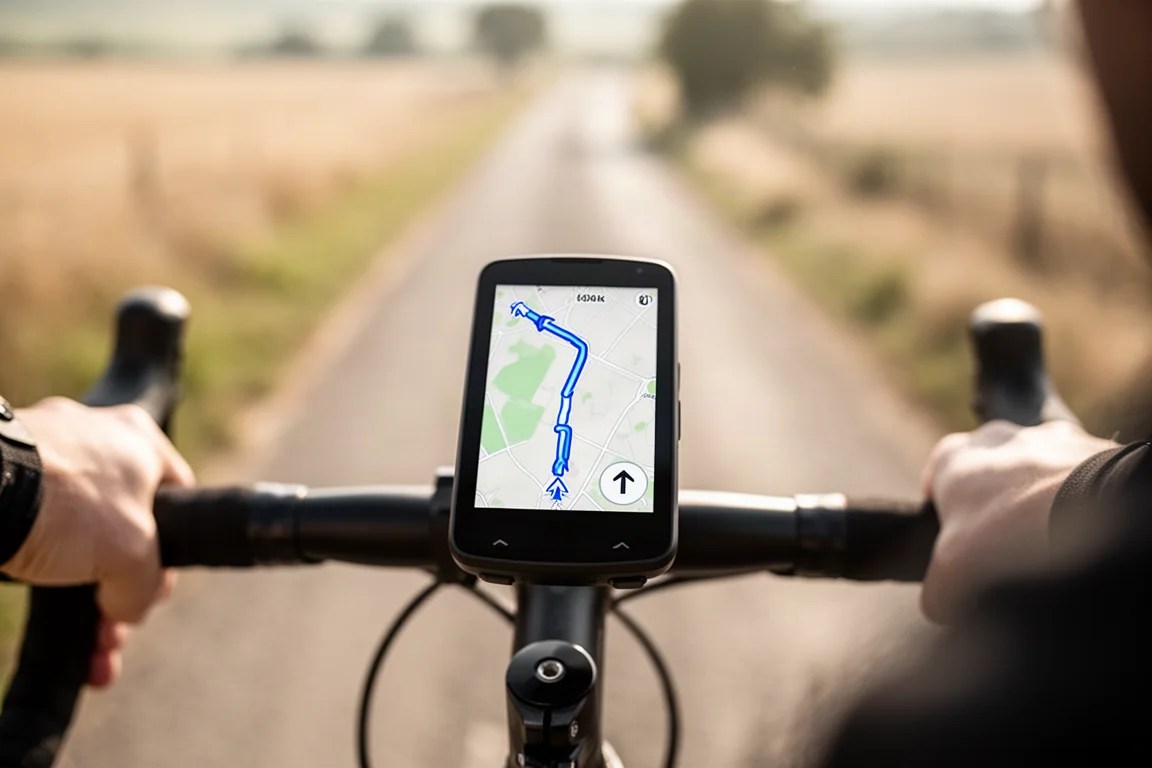
A climb feature activates when a route is loaded, breaking out climb sections of at least 500 meters with an average slope of at least 3%. At the base of each climb, a popup shows distance, elevation gain, and average grade, with a clear visual of steepness ahead that responds well to grade changes. Without a route there is no automatic climb detection, since the maps are not fully routable.
Rerouting is the workaround area. If you deviate, you can choose “back to route” or “navigate to destination,” both of which leverage Google Maps on your phone. Right now the unit beeps when you are off-route, with automatic rerouting coming in a future update. The important caveat: this requires a cell signal. Out in the middle of nowhere you can still navigate manually using the map, a directional arrow, and a line pointing toward your route, but full turn-by-turn rerouting needs your phone connected.
Sensors and Connectivity
The DURA supports both Bluetooth and ANT+ external sensors, a meaningful step up from COROS watches, which are Bluetooth only, since ANT+ remains essential in cycling. You can pair heart rate monitors and power meters, though only single-sided power is collected at the moment, with dual-sided support promised. It also connects to smart trainers, Varia radar and lights, SRAM AXS and Shimano electronic shifting, and e-bikes. The built-in beeper is loud enough that radar alerts are easy to hear.
There are some neat ecosystem touches as well. Start an activity on the DURA with a COROS watch nearby and the unit will automatically find the watch to use as an external sensor for heart rate and more. A continuous sync feature pushes data to the app during your activity so saving afterward is faster, though for most riders the benefit will feel subtle.
Safety, Tracking, and Extra Features
Live tracking lets you send links to emergency contacts when you start an activity so they can follow along. A bike alarm beeps if the unit detects movement, which could be handy if you use the mounting screw and leave the computer on the bike during a coffee stop. A crash detection feature, using GPS and gyroscope data to spot sudden deceleration or impact, will send an alert to an emergency contact through your phone, and it is coming in a future update.
Triathlon integration is also planned: paired with a compatible COROS watch, the DURA will act as an external display during the bike leg, so after the swim you simply hop on the bike, wake the unit, and see the data your watch is collecting.
GPS Accuracy and Training Metrics
Three GPS modes are available: all-systems, dual frequency, and an auto mode that picks the best option based on signal quality to save battery. Even without final software, GPS and altimeter accuracy have been perfectly fine across numerous rides, with zero issues.
One quirk worth knowing: if a power meter is paired, training load is calculated from power; with only a chest strap, it uses heart rate; with neither, it is not calculated at all. If you see suspiciously high training load numbers, check your FTP setting in the app, since a beta software cycle briefly reset one tester’s FTP to a low value around the low 200s versus an actual FTP of around 285.
What’s Still Coming
Several features are planned for future updates: on-device point of interest search, media controls for phone music, a group ride feature, automatic rerouting, dual-sided power support, and Strava live segments slated for around the fall. The feature list is ambitious, but the software is clearly still a work in progress.
Buying Advice
At $250, the DURA undercuts its closest feature rival, the $279 Wahoo ELEMNT BOLT V2, while bringing solar charging and battery life that are genuinely class-leading in testing so far. The dial works better on a bike computer than skeptics might expect, and the display visibility is excellent.
The trade-offs are real, though: no fully routable on-device maps, no on-demand routing without a phone and cell signal, single-sided power only for now, and several headline features still pending software updates. Riders who want a fully self-contained navigation unit today may want to wait for final software, or look at competitors. Riders drawn by the battery life and solar story, who mostly navigate with pre-planned routes and ride with phone coverage, are the natural audience here, and the value proposition at this price is strong.
Conclusion
The COROS DURA is an interesting new device with a lot of fresh ideas, and the solar-assisted battery performance in early testing is genuinely impressive. Because the software is not final yet, a full recommendation has to wait, but the hardware foundations, the display, the mount, the dial, and the battery life are already easy to form solid opinions about, and they point in the right direction.
Product link
View more details for COROS DURA
This product is mentioned in the review. Check the specifications, options, and compatibility before buying.
View more details for COROS DURAFurther reading
Related Reviews
Bike Computers
Best Bike Computers 2026: Wahoo ELEMNT ACE, Garmin Edge 1050 and Two Value Alternatives
A practical comparison of the Wahoo ELEMNT ACE and Garmin Edge 1050, plus two cheaper computers that cover the essentials for far less.
Bike Computers
Bryton Rider 650 Review: High-Performance GPS Without the Premium Price
A full-featured touchscreen GPS bike computer at a fraction of the cost of its premium rivals, with a few quirks worth knowing before you buy.
Bike Computers
Coros Dura Review: A 120-Hour Battery Claim and a Serious Value Pitch
The Coros Dura pairs a claimed 120-hour runtime with a $250 price. Here is what stands out, what to weigh, and who it suits.