Desktop Amplifiers
Burson Audio Funk Review: A Speaker Amp and Headphone Amp in One Compact Box
The Burson Audio Funk packs a Class A headphone amplifier and a 45W speaker amplifier into one desktop enclosure, with op amp upgrades left open to the owner.
Introduction
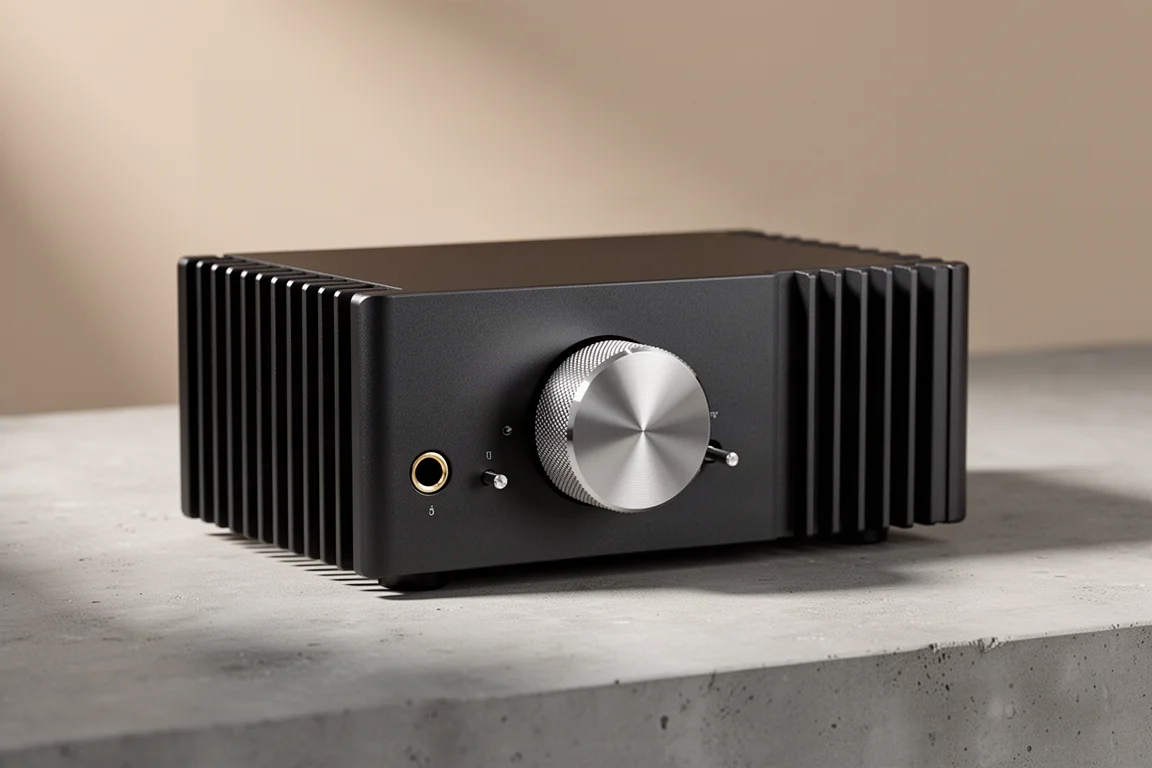
Burson Audio is a Melbourne based manufacturer whose catalog spans headphone amplifiers, speaker amplifiers, DACs and discrete op amps, the latter being multi-component modules built as an alternative to a single small chip. The Funk is one of its more distinctive desktop products: a single enclosure that contains a speaker amplifier and a headphone amplifier as two electrically separate circuits. They share a chassis and a power supply arrangement rather than a signal path, so the unit can serve as a headphone amp, as a speaker amp, or as both on the same desk.
At $540 it sits in a busy part of the market. Small Class D integrated amplifiers cost considerably less and have improved steadily, which makes the Funk’s case rest on what it does differently rather than on raw output. The short answer is imaging, build quality and an upgrade path that few rivals at this size offer.
Who This Product Is For
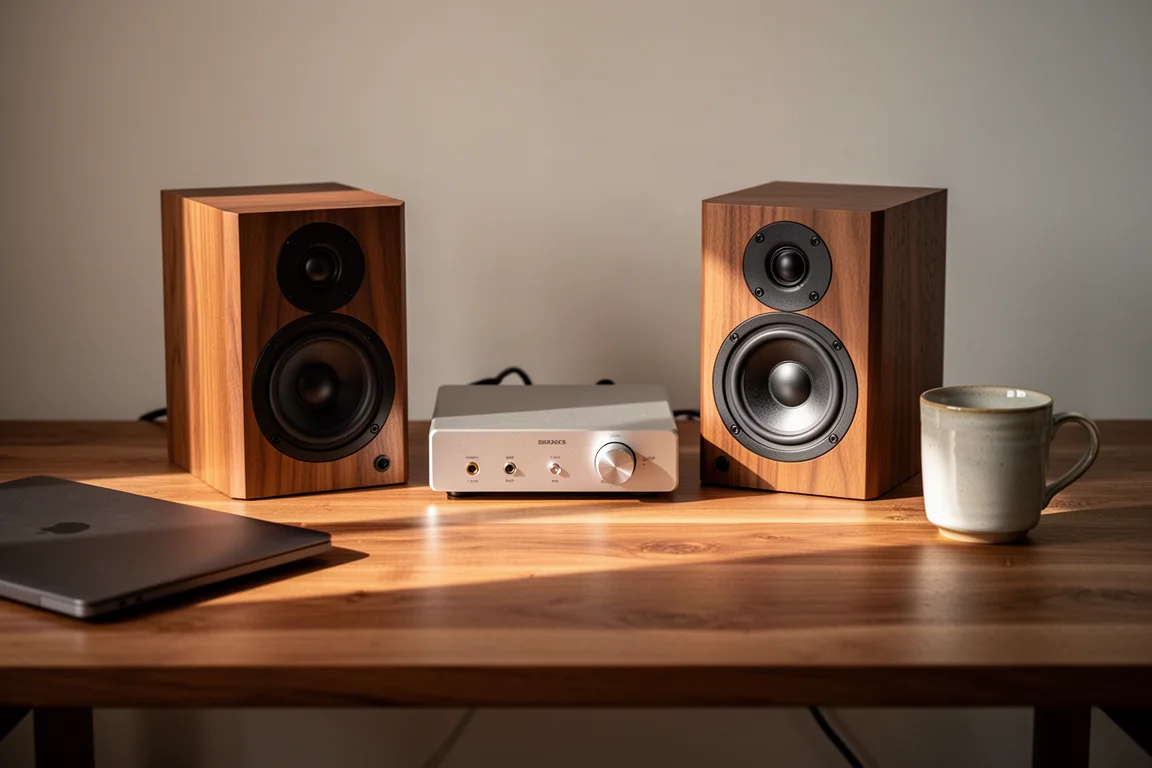
The Funk is aimed at listeners who want one box on a desk rather than two. If you split your time between headphones and a pair of reasonably efficient bookshelf speakers, having a single chassis with a selector switch between the two sections removes a fair amount of cable clutter and shelf space.
It also appeals to anyone who likes to tinker. Both the headphone section and the speaker section accept alternative op amps, so the amplifier can be tuned over time rather than replaced. That said, the stock configuration already sounds good, and upgrading is a choice rather than a requirement.
It is a less obvious fit for two groups. Anyone on a tight budget can assemble separate components that get close for less money, and anyone driving genuinely power-hungry speakers should look carefully at the power rating before committing.
Main Strengths
Headphone Amplifier Performance
The headphone section is a 3 watt Class A design, which is a generous amount of output for almost any headphone load. In listening it comes across as very clean and largely uncoloured, adding little of its own character to the recording.
Soundstage width sits in the middle of the field rather than at either extreme. It is not as narrow as some of the more clinical amplifiers in this category, and not as expansive as a good tube design. That middle ground is a reasonable place to land, because it keeps the presentation tidy without flattening it.
Speaker Amplifier Performance
The speaker section is rated at 45 watts per channel. The exact load and distortion conditions behind that figure are not clearly spelled out, so it is best treated as a general indication rather than a precise specification. In practice it drove a pair of Acoustic Energy AE-100 Mark II speakers and a pair of Wharfedale Denton 80th Edition speakers without difficulty.
The more interesting story is spatial. Compared with a well-regarded small Class D integrated amplifier of similar output, the Funk is narrower across the stage but noticeably deeper, and it places instruments more firmly in space. Imaging and layering are where it separates itself, with a centre image that locks in more convincingly. The differences are clearest in near-field listening and become harder to detect as you move further back, which suits the desk-sized format it was built for.
Build Quality and Upgrade Options
The enclosure is a rectangle, deeper than most desktop Class D amps, with heat sink fins running around its periphery. That is a practical response to a Class AB speaker stage and a Class A headphone stage, neither of which is especially efficient. The unit runs warm rather than hot, and the casework handles the dissipation without drama.
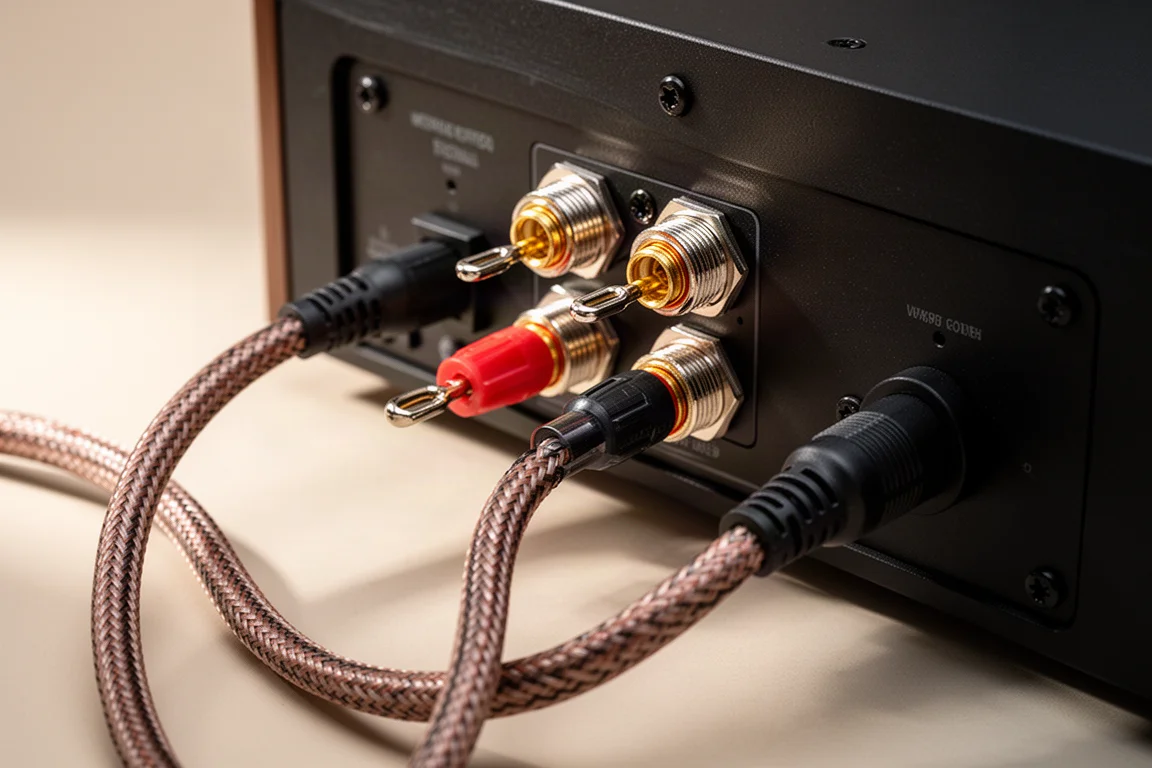
The volume knob deserves specific mention: knurled, smooth in operation and unusually well made for this price bracket. The speaker binding posts are also a cut above the norm, of the type found on considerably more expensive amplifiers. Four screws on the top panel allow access to the internals, and the foam bumpers underneath keep the chassis stable on a desk. The amplifier can also be stood vertically, either with a dedicated stand sold separately or simply on its side.
Things to Consider Before Buying
Cost adds up if you plan to modify the amplifier. Op amp rolling is one of the Funk’s main attractions, but a set of alternative modules can take the total outlay to roughly $750 or even $800 depending on what you choose. That is a meaningful increase over the $540 entry point, and it is worth deciding up front whether you actually intend to experiment.
Power is the other consideration. The 45 watt rating handled the speakers used here comfortably, but speakers that are known to be demanding will likely want more. Several small Class D amplifiers can deliver considerably more output for less money, though they give up some of the imaging advantage.
A few smaller points are worth knowing. There is an audible pop through the speakers when the amplifier is switched off, which is common among amplifiers but can be alarming the first time. There are no preamp outputs, so connecting a powered subwoofer or feeding a larger power amplifier while keeping the Funk’s volume control in the chain is not possible without speaker-level inputs on the downstream device. Opening the case requires Allen wrenches in more than one size, because the top and rear screws differ.
Buying Advice
If your priority is a single, well-built box that handles both headphones and efficient bookshelf speakers, the Funk makes a strong case. It looks considered, it feels more substantial than typical budget desktop amplifiers, and the imaging is the kind of quality normally associated with considerably more expensive equipment.
If your priority is maximum output per dollar, the math is less favourable. A small Class D amplifier paired with a separate budget headphone amplifier can get close on tone for less, though it will not match the imaging depth and it will occupy two boxes instead of one.
The deciding factor is usually the upgrade path. Buyers who intend to roll op amps and tune the amplifier over time get more out of the design, and the stock sound is good enough that doing nothing at all is also a perfectly reasonable outcome. For a small desk where space, appearance and future flexibility all matter, the Funk is easy to recommend.
Conclusion
The Burson Audio Funk succeeds at the thing it set out to do: put a genuinely good headphone amplifier and a capable speaker amplifier in one compact, well-finished enclosure. Its strongest quality is the depth and definition of its imaging, followed closely by build quality that outclasses its price class. Its limitations are equally clear, namely a moderate power rating, no preamp outputs, and a total cost that climbs quickly once op amp upgrades enter the picture. For the right desk, in the right system, that trade-off is worth making.
Product link
View more details for Burson Audio Funk
This product is mentioned in the review. Check the specifications, options, and compatibility before buying.
View more details for Burson Audio FunkFurther reading
Related Reviews
Desktop Amplifiers
Fosi Audio MC101 vs Fosi Audio V3: Which Compact Amplifier Fits Your Desk?
A side-by-side look at two compact Fosi Audio amplifiers: the retro MC101 and the higher-powered V3, with the strengths, trade-offs, and use cases that matter most.
Desktop Amplifiers
Sabaj A1 Review: A Tiny Desktop Amplifier With Tone Controls
The Sabaj A1 pairs Bluetooth and RCA inputs with an Infineon MA12070 chip and practical tone controls in a very small, very light desktop chassis.
Audio Components
Advance Paris ACD Apex vs Onkyo Icon C-30: Two CD Players, Two Very Different Paths
A $1,400 tube-equipped CD player against a $400 deck. Where the extra money goes, what you actually hear, and which one suits your system.