Bookshelf Speakers
Buchardt A500 Review: A Compact Bookshelf Speaker That Reaches 25 Hz
A premium compact bookshelf speaker with a waveguide-loaded tweeter, deep bass for its size, and app-based room EQ that rewards careful setup.
Introduction
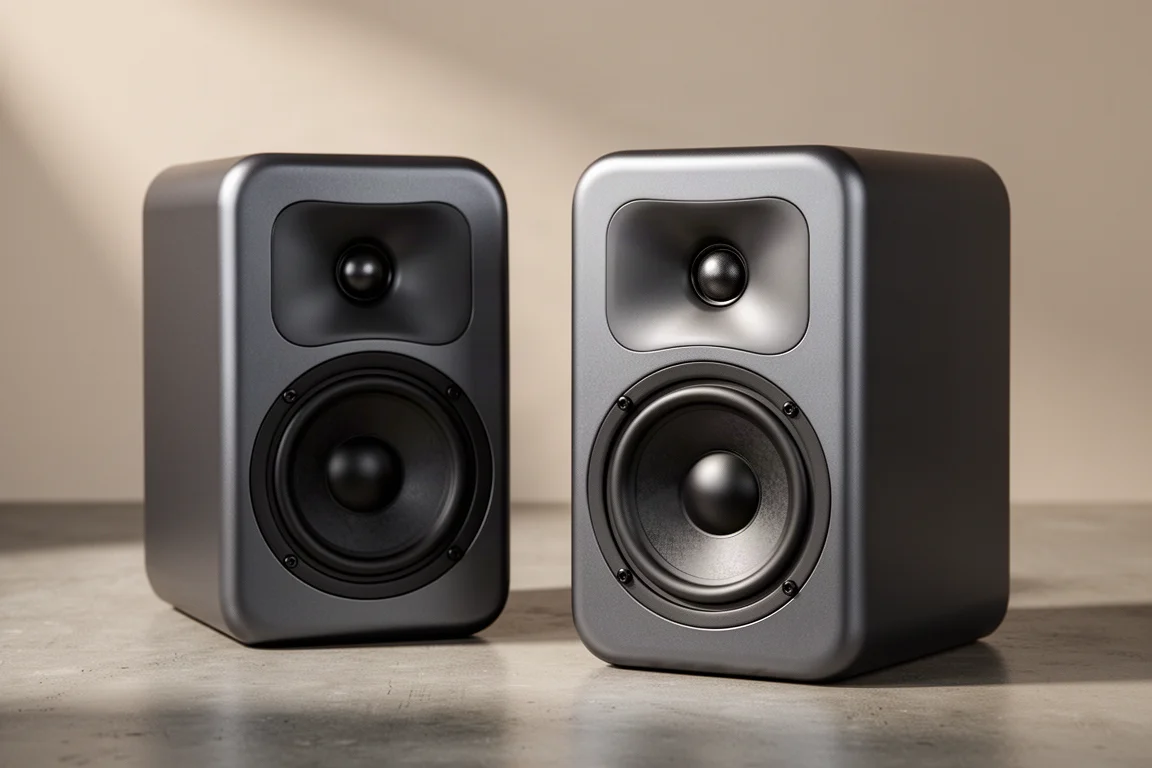
The Buchardt A500 is a compact bookshelf speaker with an unusually ambitious brief. The cabinet houses a 6-inch woofer and a 3/4-inch dome tweeter on the front, plus a second 6-inch woofer on the back, and with the right tuning loaded it measures flat in anechoic conditions and in-room down to 25 Hz. That is a serious figure for a speaker of this size.
Pricing sits at around 3,500 EUR, which works out to roughly 4,100 USD. Buchardt also sells a separate wireless hub that accepts HDMI, optical, coaxial, USB audio and analog RCA sources, then sends the signal to each speaker wirelessly. The hub is what unlocks the app-based EQ and room correction, and it is the piece that turns an A500 pair into a complete system.
Who the Buchardt A500 Is For
This speaker is aimed at listeners who want a small, high-quality system without a rack of separates. It rewards anyone willing to spend time with equalization. The app allows manual adjustments, and the hub can run a room correction routine that plays pink noise and uses a phone’s built-in microphone to identify room modes, then works to smooth them out. Listeners who enjoy tuning a system to their own room will get a great deal out of that.
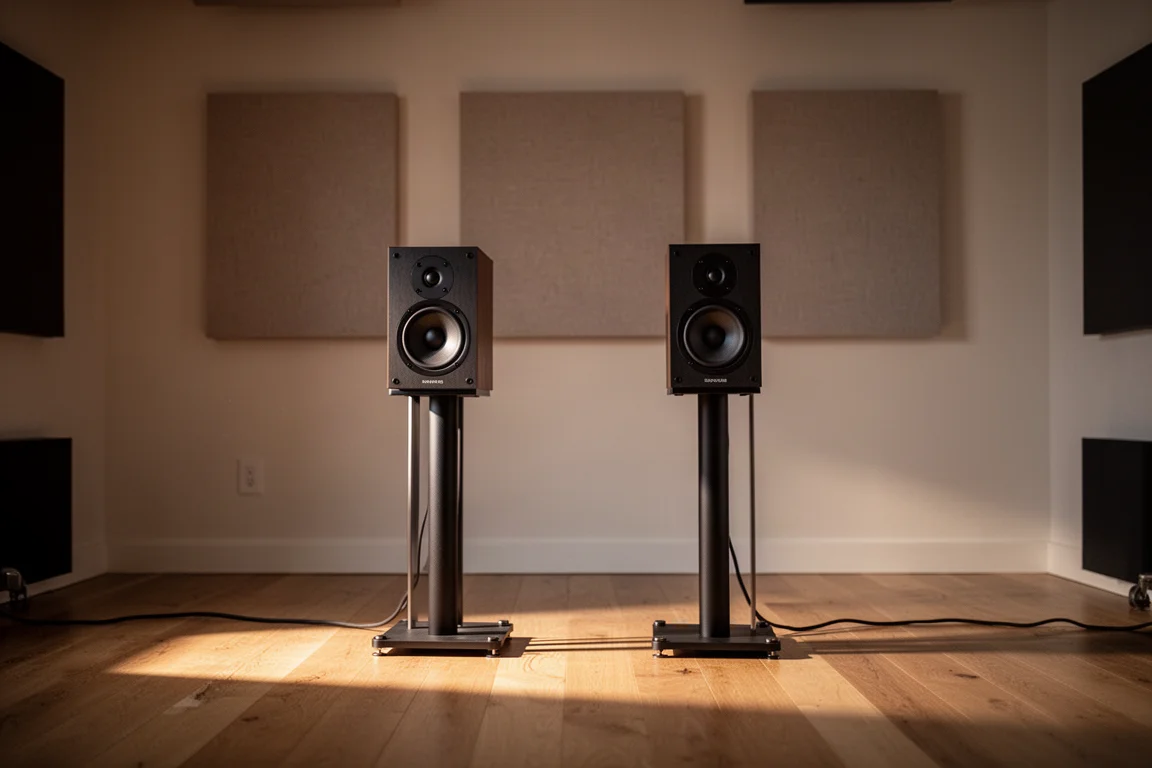
It is a less natural fit for very large rooms, or for anyone who wants to listen at high levels from four meters or more. In that scenario the A500 runs into its own protection limits, and a safer tuning plus a subwoofer becomes the more sensible route. Buyers who mainly want maximum output at any distance should weigh those trade-offs carefully before committing.
Main Strengths
The A500 gets the fundamentals right. Its on-axis response stays linear to within about plus or minus 1 dB, and the listening window and early reflections track that on-axis response closely, which means the sound arriving directly and the sound reflecting off the room share a similar tonal character. That consistency also means the speaker responds predictably to equalization, so adjustments in the app behave the way you would expect them to.
Tweeter and Waveguide Design
The 3/4-inch dome tweeter sits in a large waveguide, and the design is more clever than the small dome suggests. The flare of the waveguide is steeper close to the tweeter and opens up further out, which raises sensitivity at the bottom of the tweeter’s range and allows a lower crossover point, while still controlling dispersion at higher frequencies. In effect the design behaves partly like a horn at low frequencies and partly like a waveguide higher up.
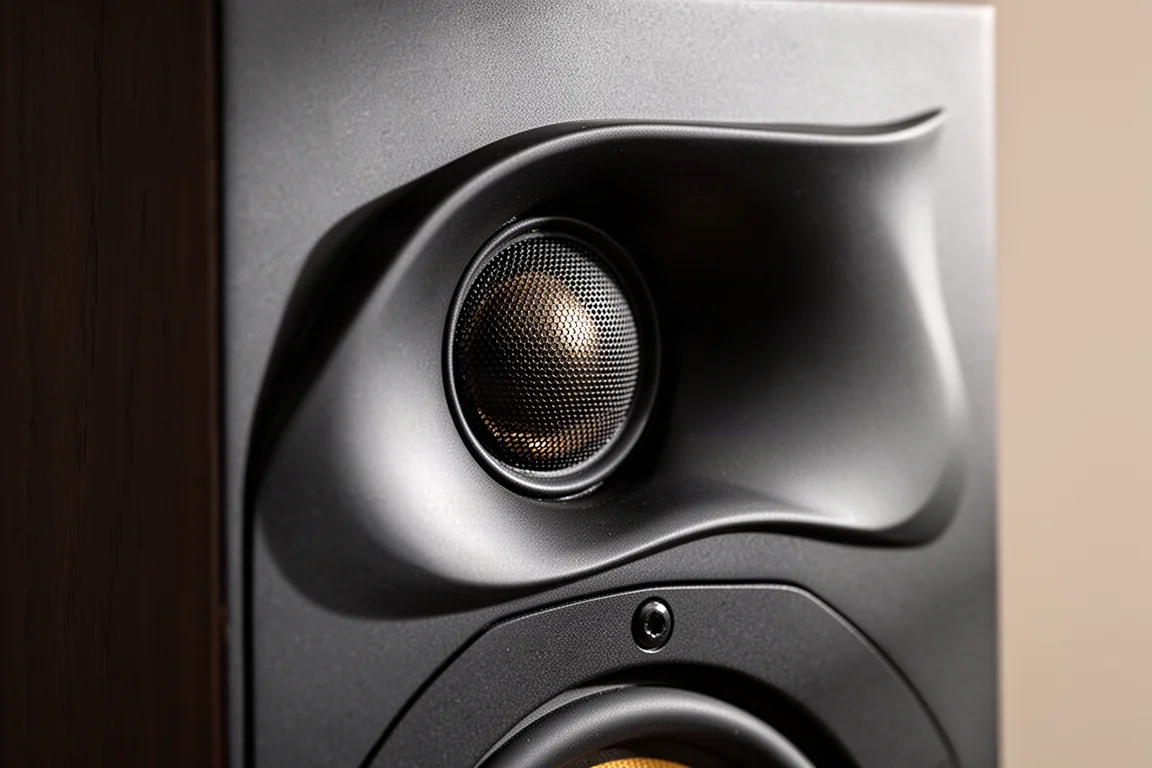
The practical payoff is controlled horizontal dispersion of roughly plus or minus 50 degrees, which is enough to give the speaker a convincing sense of width and room involvement. The trade-off appears in the vertical plane, where there is some lobing above and below the tweeter, but that sits outside the plus or minus 10 degree vertical window most listeners occupy, which makes it a reasonable compromise.
Flat Response and Output Capability
Bass extension is the headline. With the correct tuning the A500 reaches down to 25 Hz, and it does so while staying flat rather than simply adding a hump. That extension comes with a caveat. The lower you push the response, the more output capability you give up, and the built-in DSP applies hard limiting to the woofer to protect it. Measured distortion reaches roughly 3 percent THD around 80 Hz at 86 dB, which is acceptable for a cabinet this size.
In practice the speaker handles normal listening well. A pair reached around 103 to 105 dB at three meters without mechanical noise or audible distortion, and that was near the point where pushing further stopped making sense. For most rooms and most music, that is more than enough headroom.
Things to Consider Before Buying
The A500 is not a speaker for every room or every listener. Off-axis behavior includes a resonance around 600 Hz in the horizontal response, which becomes more noticeable beyond roughly 50 degrees off axis. The estimated in-room response also carries a slight upward trend that can sound bright in rooms with hard, reflective surfaces, though the speaker takes equalization well enough that this is straightforward to address.
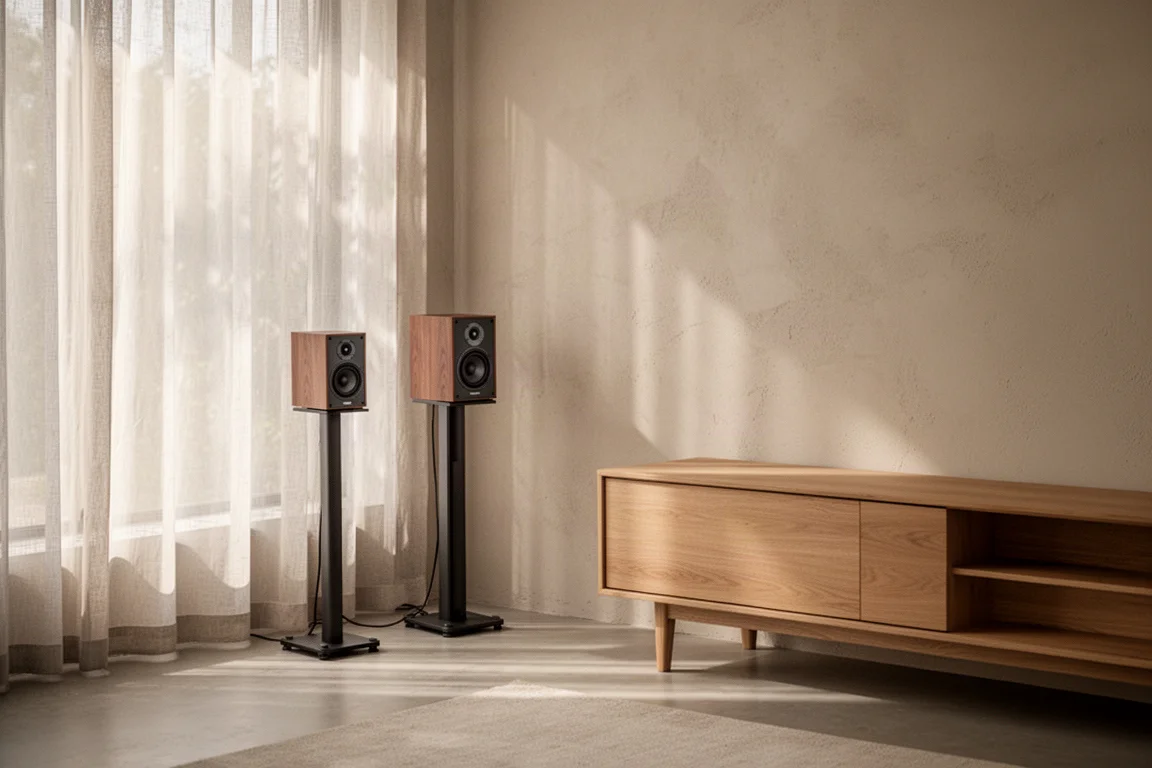
Output limits deserve attention as well. Hard limiting on the woofer is present from 76 to 86 dB and increases at 96 dB and 102 dB, with additional limiting in the mid band and through the tweeter. None of that was audible at normal levels with a pair in a room, but it is a genuine consideration for anyone planning long listening distances or very dynamic material.
Room Interaction and the Wireless Hub
The hub is not optional in practice if you want the full experience. It is a separate purchase, currently around 300 USD on sale with a regular price closer to 500 USD, and it is what enables app-based equalization, the room correction routine, and the ability to switch between the roughly 11 master tunings Buchardt offers. Those tunings, loaded from a USB stick into the back of the speaker, include the theoretical new setting, theoretical standard, theoretical all-around new, a warm profile and a neutral high pass 60 Hz option. They change both tonal balance and output capability, so there is plenty of room to find a profile that suits your room.
Buying Advice
For anyone already considering the A500, the hub should be part of the plan rather than an afterthought. Saving a little longer to include it makes far more sense than running the speakers without it, because so much of what the A500 can do lives in the app and in the master tunings. It is the difference between a good speaker and a system that adapts to your room.
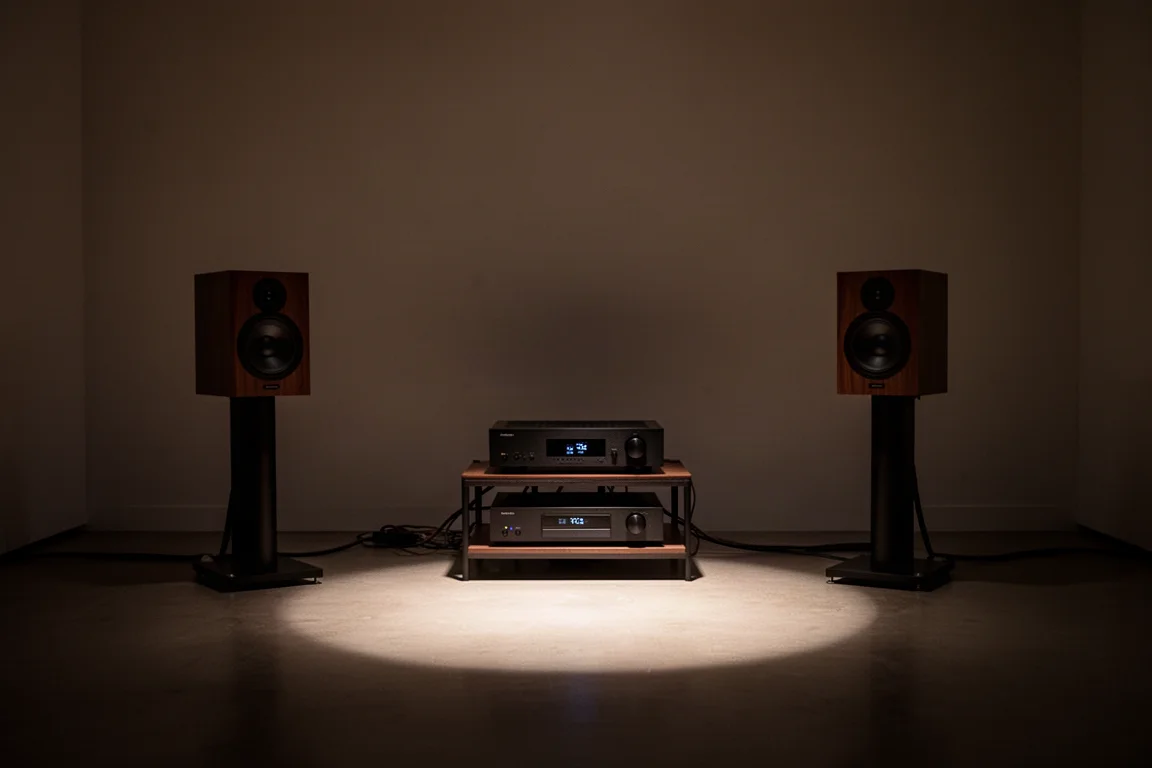
If you listen from roughly four meters or more, or you favor very high volumes and wide dynamic swings, choose a tuning that protects the drivers and add a subwoofer rather than pushing the A500 harder on its own. The high pass tunings exist precisely for that kind of setup, and they let the speaker play to its strengths while a subwoofer handles the low end.
In a treated room at moderate distances, though, the A500 is a genuinely impressive compact speaker. The combination of flat response, deep bass for the size, and flexible tuning makes it easy to recommend within its intended use case.
Conclusion
The Buchardt A500 delivers on a difficult brief. It is a small speaker that measures flat down to 25 Hz with the right tuning, controls its dispersion well through a thoughtfully designed waveguide, and responds beautifully to equalization. Add the wireless hub and it becomes a flexible, room-aware system rather than a passive pair of boxes.
The caveats are real but specific: output limits, a bright-leaning in-room estimate in untreated rooms, and vertical lobing outside the main listening window. Buyers who understand those trade-offs and who plan for the hub will find a compact speaker that performs well beyond what its size suggests.
Product link
View more details for Buchardt A500
This product is mentioned in the review. Check the specifications, options, and compatibility before buying.
View more details for Buchardt A500Further reading
Related Reviews
Bookshelf Speakers
Acoustic Energy A100 Mark II Review: A Compact Standmount With an Expansive Soundstage
The Acoustic Energy A100 Mark II brings clarity, natural tonality and a wide soundstage to an entry-level standmount, with a few setup details worth knowing first.
Bookshelf Speakers
Acoustic Energy AE-100 Mark II Review: Compact Bookshelf Speakers With Standout Imaging
A compact British two-way bookshelf speaker with deep, layered imaging, fast bass, and a slight treble lift to weigh against a crowded $500 field.
Bookshelf Speakers
Acoustic Energy AE100 MK2 Review: Measured Performance and Four Alternatives
A close look at the Acoustic Energy AE100 MK2 bookshelf speaker, what its measured performance reveals, and four alternatives with different trade-offs.