Hi-Fi Audio
Brunoco Terra 300B and Klipsch Forte IV: Building a High-Sensitivity Tube System
Two unconventional hi-fi components that only make full sense together: an 8-watt single-ended 300B tube amplifier and a 99 dB horn-loaded floor stander.
Introduction
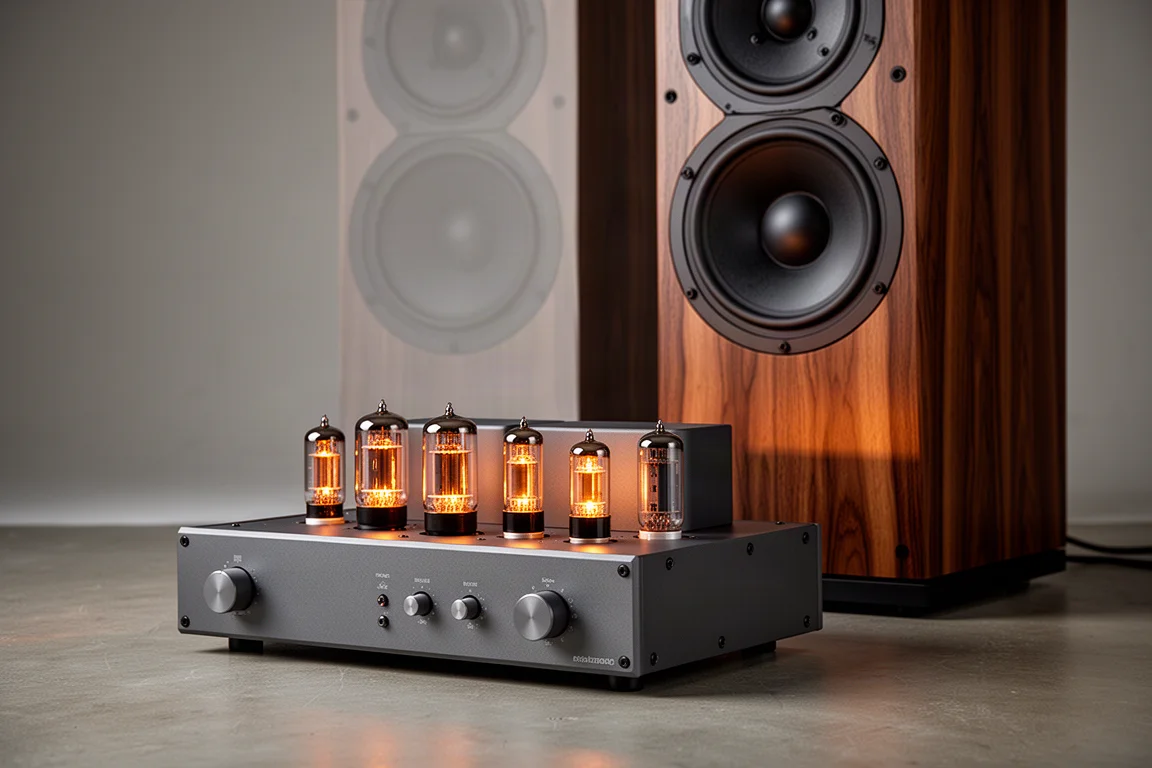
Most hi-fi purchases happen one box at a time, but every so often two components arrive that only make full sense together. The Brunoco Terra 300B is an 8-watt single-ended tube amplifier. The Klipsch Forte IV is a 99 dB sensitive floor stander with a 12-inch woofer and horn-loaded midrange and treble. On paper the amplifier looks short on power and the speakers look oversized for a modern room. Heard as a pair, they make a strong case for the low-power, high-sensitivity approach that part of the hi-fi world never abandoned.
That approach has history behind it. Before transistors, tube amplifiers were the norm and electricity was expensive, so speakers tended to be large and efficient. Wide front baffles are fashionable again, and younger listeners are returning to vinyl along with retro-styled amplifiers and speakers. A group of enthusiasts argues that something was lost when homes were adapted to smaller, less sensitive speakers that are harder to drive, and that solving the problem with more power is not the same as solving it well. The claim is that a simple tube amplifier coupled to high-sensitivity speakers has an effortlessness and openness that small boxes driven hard cannot match.
This pair is a direct test of that idea.
What This High-Sensitivity System Is Built Around
Two numbers frame everything that follows. The Brunoco Terra 300B delivers 8 watts per channel. The Klipsch Forte IV is rated at 99 dB sensitivity. Sensitivity, not amplifier wattage, decides how loud a system plays, which is why a high-sensitivity speaker can be driven to normal listening levels by an amplifier that would struggle with a typical modern floor stander.
That is also why this kind of system divides opinion. A low-power single-ended amplifier asks more of the speaker than a powerful solid-state design does. It rewards careful matching and it punishes mismatch, particularly with speakers that present a demanding load or need large amounts of current. The useful question is not whether 8 watts is enough in general, but what it is enough for.
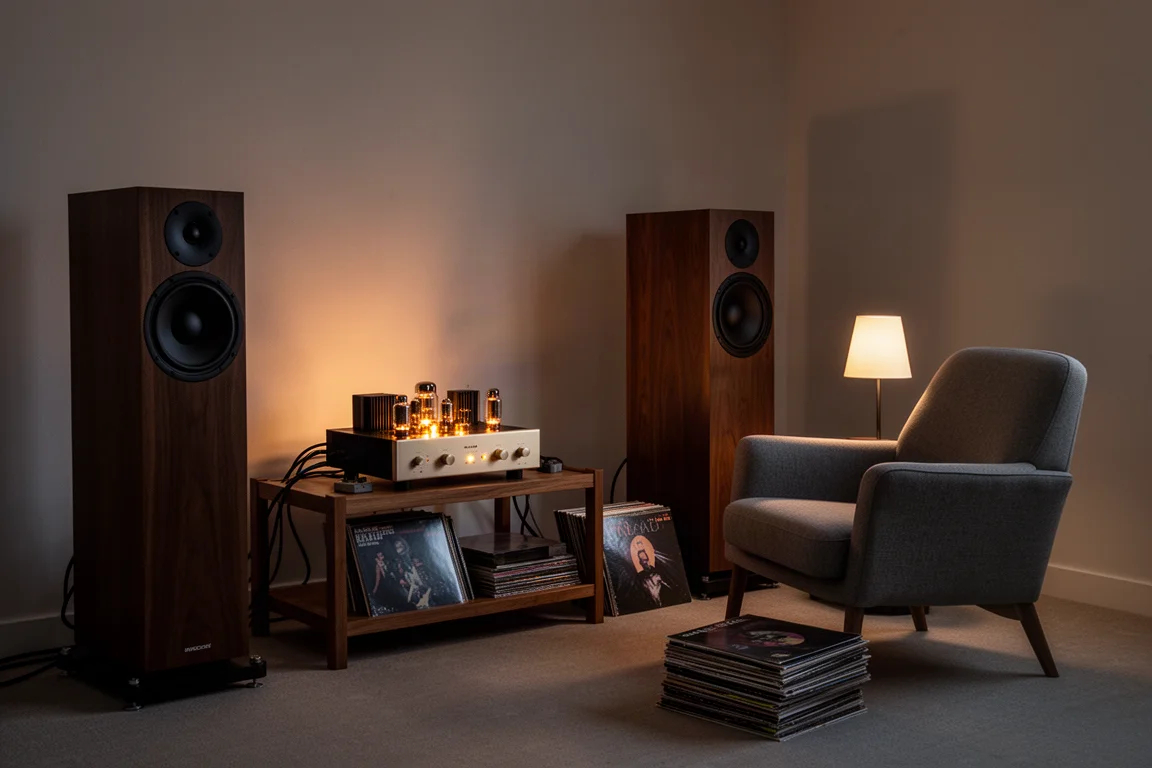
System building around this idea tends to favour simple signal paths, few components, and speakers that convert small amounts of power into high output. It also tends to favour listening at realistic levels in rooms of moderate size rather than filling a large space at party volume.
Brunoco Terra 300B: The Amplifier
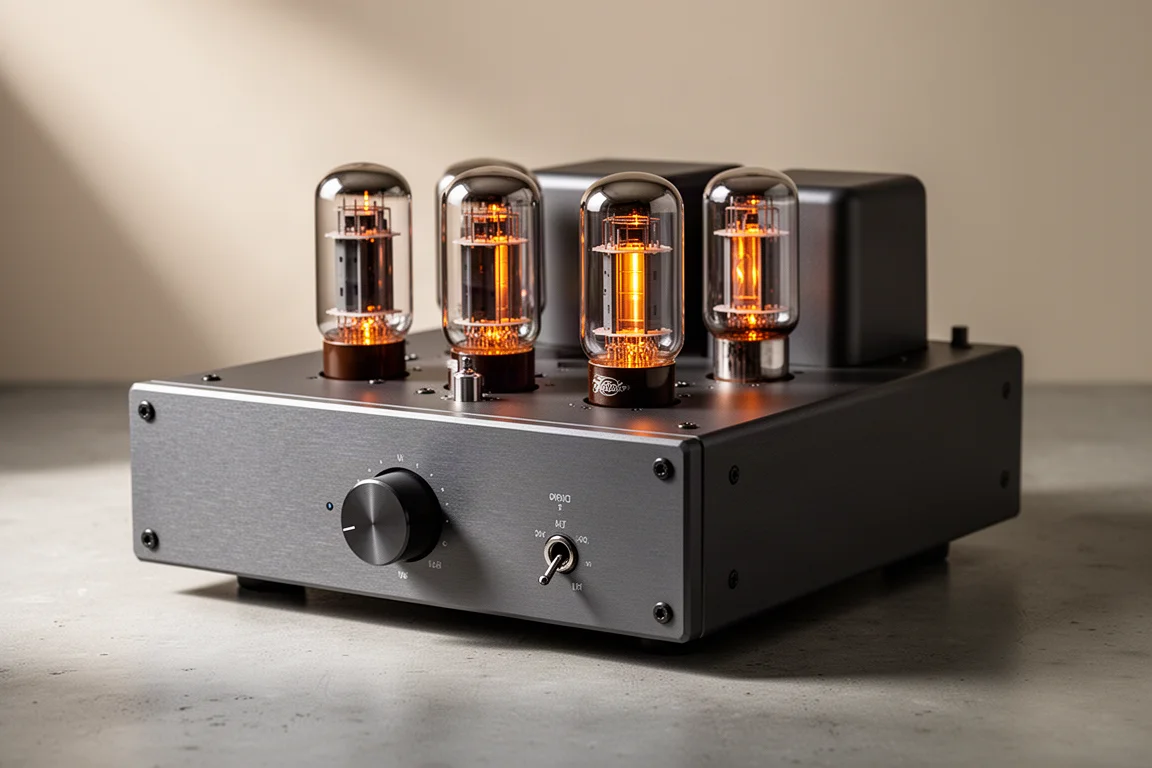
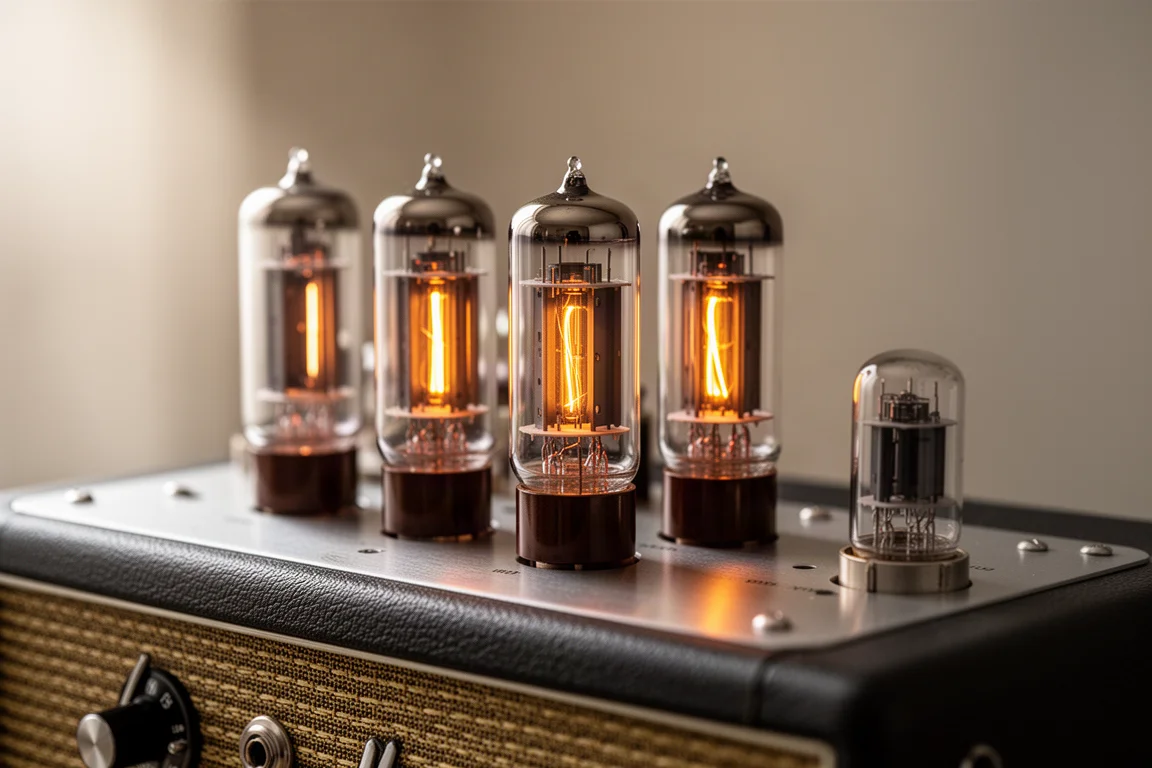
The Terra 300B follows the purist end of tube amplifier design: single-ended rather than push-pull, with half the tubes in the signal path, class A operation, and zero negative feedback. The trade-off is power, which drops to 8 watts per channel. The 6SN7 dual triodes handle the preamplifier stage, while 300B triodes do the work in the power amplifier stage.
The chassis is built from thick aluminium plates finished in gunmetal grey, measuring 370 mm wide and weighing 14.5 kg. All transformers are wound in house, including the two output transformers, the central power supply transformer, and the smaller choke transformer used for rectification and power supply smoothing. Controls are limited to an on/off button, an input selection dial, and a volume dial. A remote control is available as a $200 option and adjusts volume only, not input selection.
The rear panel keeps things equally simple: RCA connections for four inputs, no pre-outs, and no balanced connections. Speaker terminals offer taps for 4 ohms and 8 ohms, with 16 ohm taps available on request. Inside, a neatly laid out main board carries discrete through-hole components, and a smaller board houses the input switching relays. The component count is low, which is part of the design intent.
A few details leave room for improvement. A top plate concealing the numerous screw fittings would be a nice touch, and a future revision with more point-to-point wiring and upgraded small electrolytic capacitors would be welcome. The Terra 300B retails for $3,400, with shipping to the USA, Asia, and the EU included but taxes excluded.
Klipsch Forte IV: The Speakers
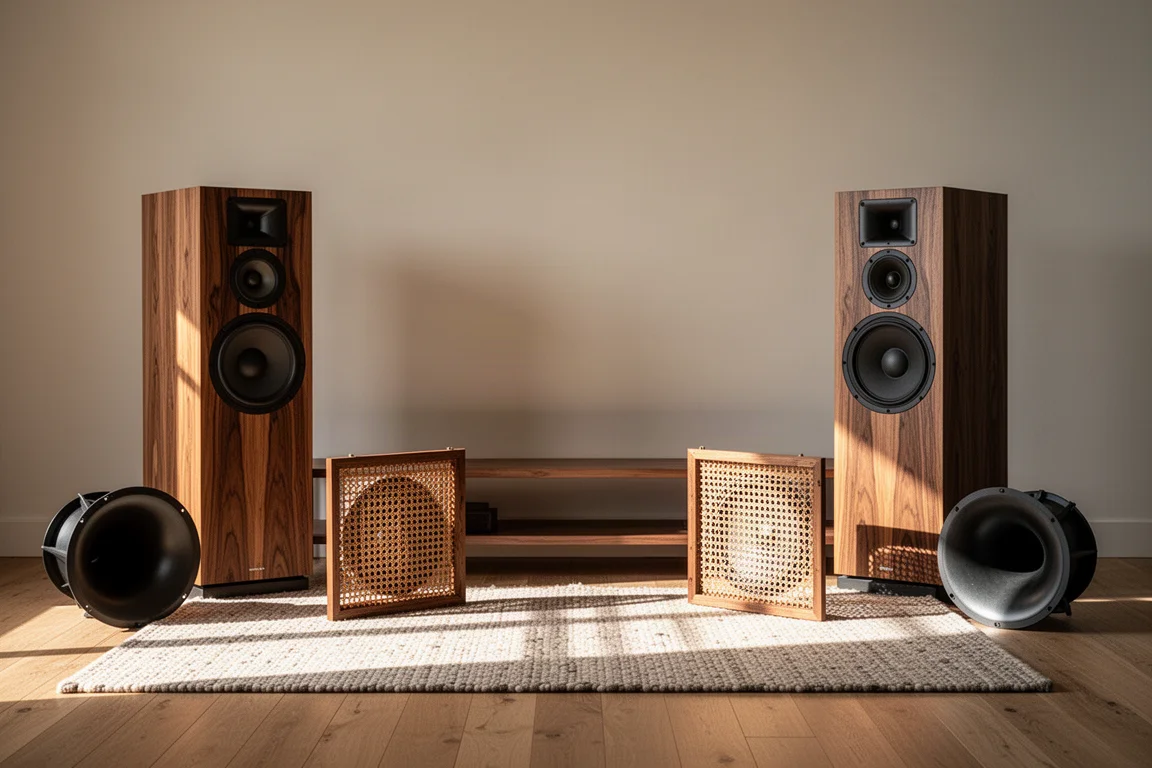
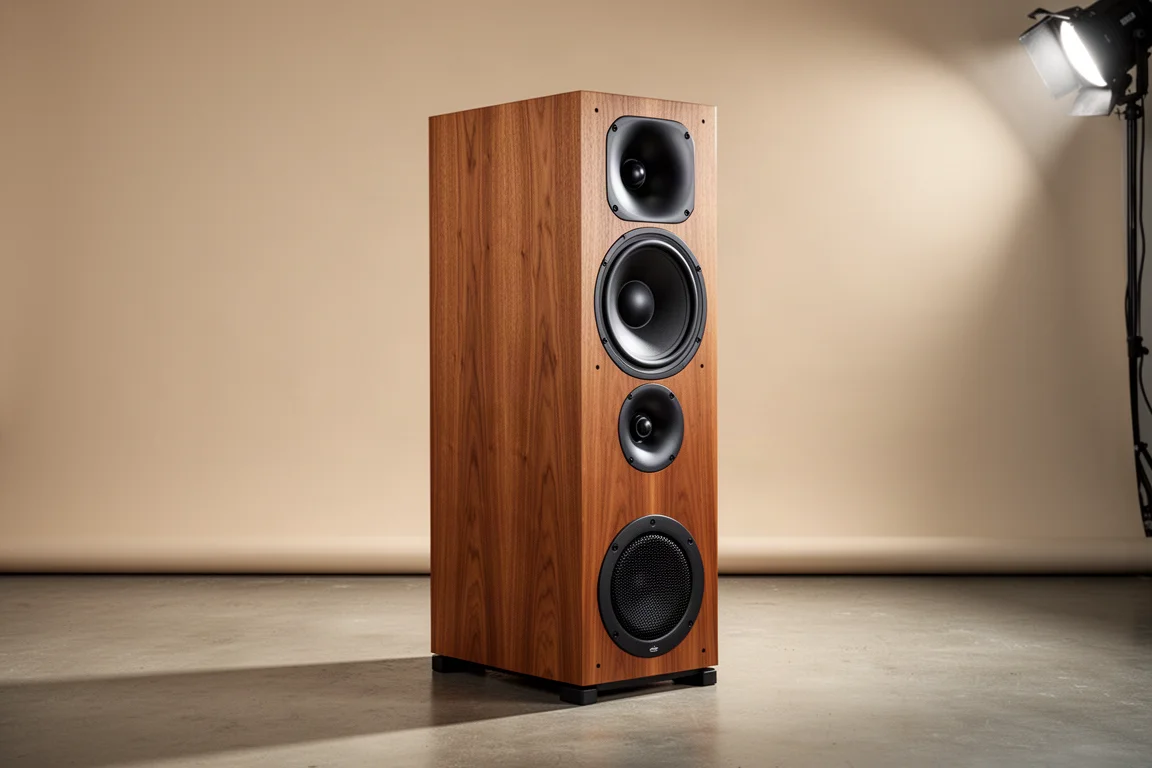
The Forte IV is the second smallest model in the Klipsch Heritage range, hand-built in Arkansas, USA, and priced at £6,099 in the UK. It comes in four book-matched real wood veneer finishes. The 42 cm wide front baffle makes it look larger than it is; the cabinet stands 91 cm high and 33 cm deep, and each speaker weighs 33 kg.
Behind the open-weave grille is a three-way design with drivers developed in house. The K-281 12-inch fibre composite cone woofer carries over from the previous generation. The K-702 1.75-inch polyamide compression midrange driver sits in a Tractrix horn and is taken directly from the more expensive Cornwall model, replacing the titanium-based driver used in the Forte III. The K-100-TI 1-inch titanium diaphragm compression tweeter also sits within a horn, and its phase plug has been revised to aid dispersion. The crossover uses better quality components and steeper slopes than the Forte III, which Klipsch says improves integration between the drivers.
Around the back there are two sets of speaker binding posts, and a 15-inch passive radiator helps the cabinet reach down to 38 Hz. The headline specifications are an 8 ohm nominal load, 99 dB sensitivity, and a maximum SPL of 116 dB.
Tonally, the Forte IV is more balanced than its reputation might suggest. There is some forwardness and leanness to the midrange, but less than on the Monitor Audio Gold 106 II, a highly detailed speaker that needs careful amplifier matching to avoid sounding bright. The Forte IV asks for less compensation. It is also not a bass monster; both the Scansonic MB 2.5 B and the Quadral Vela 2 pushed a room’s tolerance for bass energy further than the Klipsch does. The 12-inch woofer barely moves even at average listening levels of 90 dB, and the bass is easeful and articulate with an appropriate sense of weight. Midrange transients have excellent snap without sounding etched, and together those qualities produce an extremely dynamic presentation.
Sound staging also exceeds expectations. Aimed directly at the listening position, the speakers lock down a central image and throw a sound field a couple of feet wider than the cabinets, with good layering front to back and an intimate rather than laid-back presentation. They do not disappear the way accomplished stand mounts do, and performers between the speakers tend to be pulled either towards the cabinets or towards the centre. For a wide-baffle design the Forte IV does very well here, helped by horn-loaded midrange and treble that direct more sound forwards than sideways and reduce time smearing from edge diffraction.
How the Pairing Sounds
Power requirements depend entirely on the speaker. Eight watts is ample to drive mini monitors such as the £1,500 Dali Menuet SE to average listening levels of around 75 dB, and the Terra 300B lets those small speakers produce a detailed sound with an authentic tone. More challenging stand mounts are a different story. With speakers such as the Quadral Vela and the ProAc Response 1 SC, dynamics are suppressed, the leading edge of notes is rounded, and the lack of bass control becomes obvious. Moderately sensitive floor standers, including the Scansonic MB 2.5 B at £3,750 and the Quadral Vela 2 at £3,499, are a better match as long as the listener does not intend to play at party levels; transient attack improves, but some bloom remains in the lower registers.
The Forte IV changes the picture. With 99 dB sensitivity, the pairing is dynamically impressive with plenty of headroom to play loud. With the stock tubes, two things remain underwhelming: a bloom to the bass and a rounding to the leading edge of notes. Swapping to the top of the range PS Vane Summit Series tubes transforms the performance. The 6SN7s have the greater effect on cleaning up the mids and highs, while the 300B output tubes do the same for the bass. A set of Summit Series tubes costs about £1,000 for this amplifier, and once heard, the stock tubes are hard to return to.
With those tubes in place, the amplifier and speaker combination delivers a sense of scale, dynamics, and clarity with nuanced, realistic tonality.
Tubes, Power, and Speaker Matching
Some context helps place the Terra 300B. A Willsenton R300 Plus, at roughly half the price, falls short in resolution where the Brunoco comfortably exceeds it. A Sugden Masterclass IA-4 is also class A and single-ended, but it uses transistors and produces 33 watts instead of 8. That extra power lets it play louder, sound more dynamic, and drive a wider range of speakers, though overall fidelity between the two is too close to call without hearing both side by side. A Willsenton R8, at around £1,500 with upgraded preamplifier and output tubes, remains the safer bet for all-round ability, with tighter and harder-hitting bass and the ability to drive a wider range of speakers, but it cannot match the Terra 300B for resolution and expansive sound stage.
Solid-state amplification also works well with the Forte IV. The Hegel H190 and its 150 watts of power offer no advantage over the lower-powered options here, and it is the £2,000 Exposure 2510 that shows extra finesse with this benign load. That is a useful reminder that sensitivity, not wattage, sets the ceiling on what a speaker can do.
Who This System Suits
Neither product earns a universal recommendation. The Terra 300B and the Forte IV are unconventional, and they perform at their best as part of a carefully curated system with complementary components. Taken individually, both are highly recommended, because each has clear limitations alongside standout features. Taken together, the sum is greater than the parts, particularly if the budget allows an extra £1,000 for the Summit Series tubes.
This system suits listeners who already own, or plan to own, high-sensitivity speakers, who listen at realistic levels in a moderately sized room, and who value tonality, dynamics, and sound staging over the ability to drive difficult loads. Anyone who wants to play at party volume, or who owns demanding stand mounts, should look elsewhere.
Buying Advice
Start with the speakers, not the amplifier. An 8-watt single-ended design only makes sense with a load that is genuinely easy to drive, and the Forte IV’s 99 dB sensitivity is what makes this pairing work. Buyers who already own low-sensitivity speakers will get more from a higher-powered amplifier.
Budget for tubes as part of the purchase. The amplifier’s stock valves leave some bass bloom and a rounded leading edge, and a set of PS Vane Summit Series tubes at around £1,000 resolves both. That changes the true cost of the system considerably, and it is worth planning for from the outset.
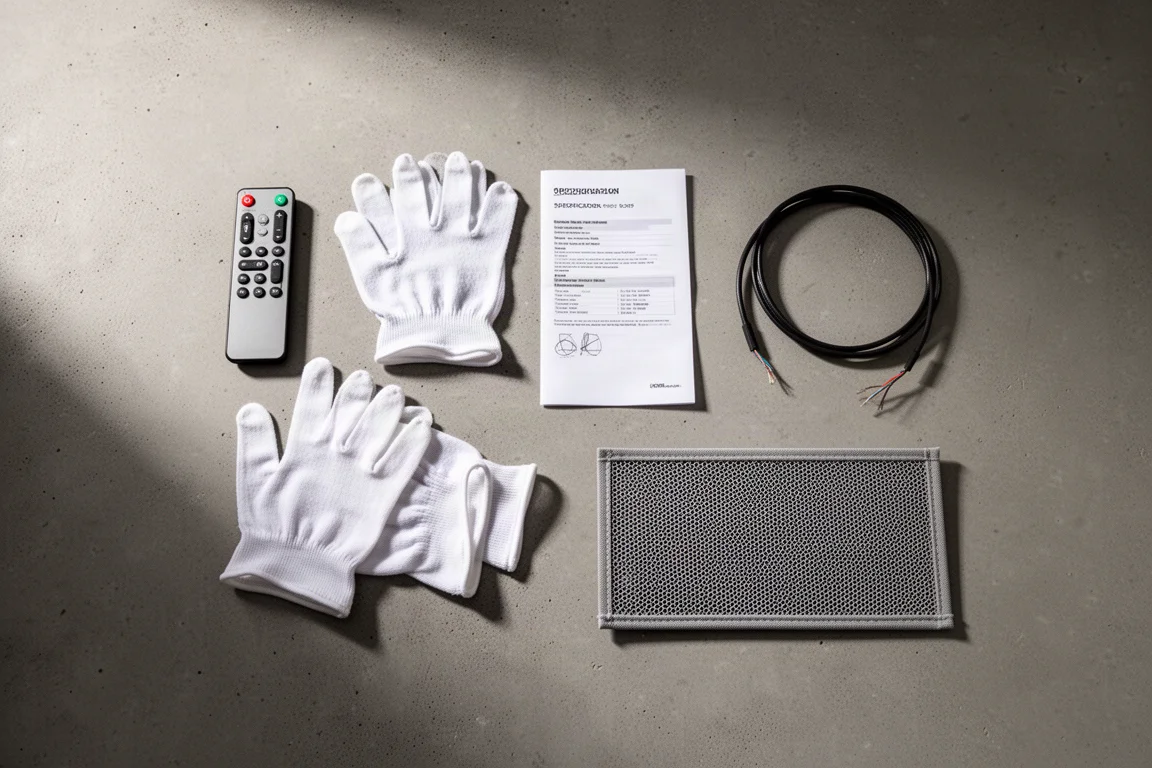
A few practical details are worth noting before ordering. The Terra 300B retails for $3,400 with shipping to the USA, Asia, and the EU included but taxes excluded. The optional remote control adds $200 and adjusts volume only. Speaker terminals cover 4 ohms and 8 ohms, with 16 ohm taps available on request, and there are four RCA inputs but no balanced connections or pre-outs. On the speaker side, the Forte IV is priced at £6,099 in the UK and comes in four book-matched real wood veneer finishes.
Conclusion
The Brunoco Terra 300B and the Klipsch Forte IV are not for everyone, and they are not meant to be. One is an 8-watt single-ended amplifier with a deliberately minimal signal path; the other is a 99 dB floor stander with a 12-inch woofer and horn-loaded drivers. Each has limitations that are obvious on its own. Paired together, with a set of premium tubes, they deliver scale, dynamics, clarity, and tonality that make the low-power, high-sensitivity approach feel less like nostalgia and more like a genuinely rewarding way to build a system.
Further reading
Related Reviews
Hi-Fi Audio
Accuphase C-57 vs Allnic H-7000V: Two High-End Phono Stages Compared
A fully balanced solid-state phono stage with a pitch-black noise floor meets a tube design built for well-loved records. Here is how to choose between them.
Hi-Fi Audio
Active vs Passive Hi-Fi: Five Components for a Modern System
Five components that define modern active and passive hi-fi systems, with the strengths, trade-offs and setup details worth weighing before you buy.
Hi-Fi Audio
Advance Paris A10 Apex Review: A Hybrid Integrated Amplifier That Covers a Lot of Ground
A French hybrid integrated amplifier with a class A tube preamp stage, analogue power meters, and an internal DAC and phono stage good enough to make extra boxes unnecessary.