Camping Tents
Big Agnes Bunk House 6-Person Tent Review: Walkable Space and Real Rain Protection
A detailed look at the Big Agnes Bunk House 6-Person Tent, covering interior volume, vestibule space, storage, setup time, and how it handles sustained heavy rain.
Introduction
The Big Agnes Bunk House 6-Person Tent sits at the top of the six-person camping tent market, with a price in the $700 range against the $500 to $600 range typical of other popular six-person models such as the NEMO Aurora Highrise 6, the REI Base Camp 6, the REI Wonderland 6, and The North Face Wawona 6. The useful question is whether the extra spend buys anything a camper will actually notice on a trip.
It does, and mostly in one place: interior volume. The Bunk House is built around a hubbed aluminum pole set with a pre-attached ridge pole, which holds headroom high across almost the full length of the tent rather than tapering it away toward the doors. A front vestibule adds enough height to stand up in. Across 20 measured tests covering setup, pack away, spaciousness, storage, seam taping, and waterproofing, this tent performed better than the six-person average in 11 of them and worse in 4.
Who This Tent Is For
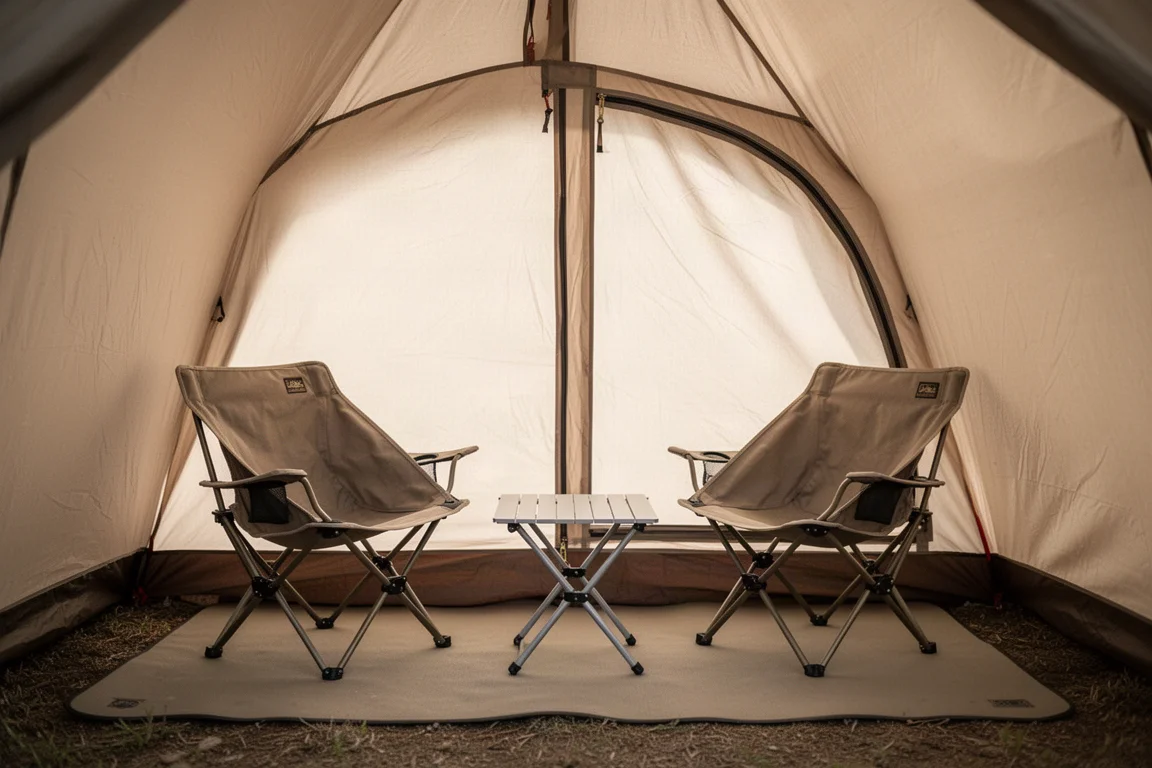
This tent is aimed at campers who treat their shelter as a living space rather than somewhere to simply sleep. The extended peak height and near-vertical end walls mean adults can move around upright, stand near the centre, and walk several feet toward the sides without stooping. That matters most on longer trips, in poor weather, and for anyone who has spent a rainy afternoon hunched inside a low dome tent.
Sleeping capacity is more nuanced than the six-person label suggests. Six wide pads can be laid across the length of the floor, but the arrangement is genuinely shoulder to shoulder, with only about 6 inches of length and roughly 2 feet of width left over for gear. The far more comfortable setup is two queen mattresses or four people, which also leaves noticeably more headroom when lounging. Note that the floor length is slightly shorter than two full-size queens, so two 80 by 60 inch mattresses will bulge slightly past the walls.
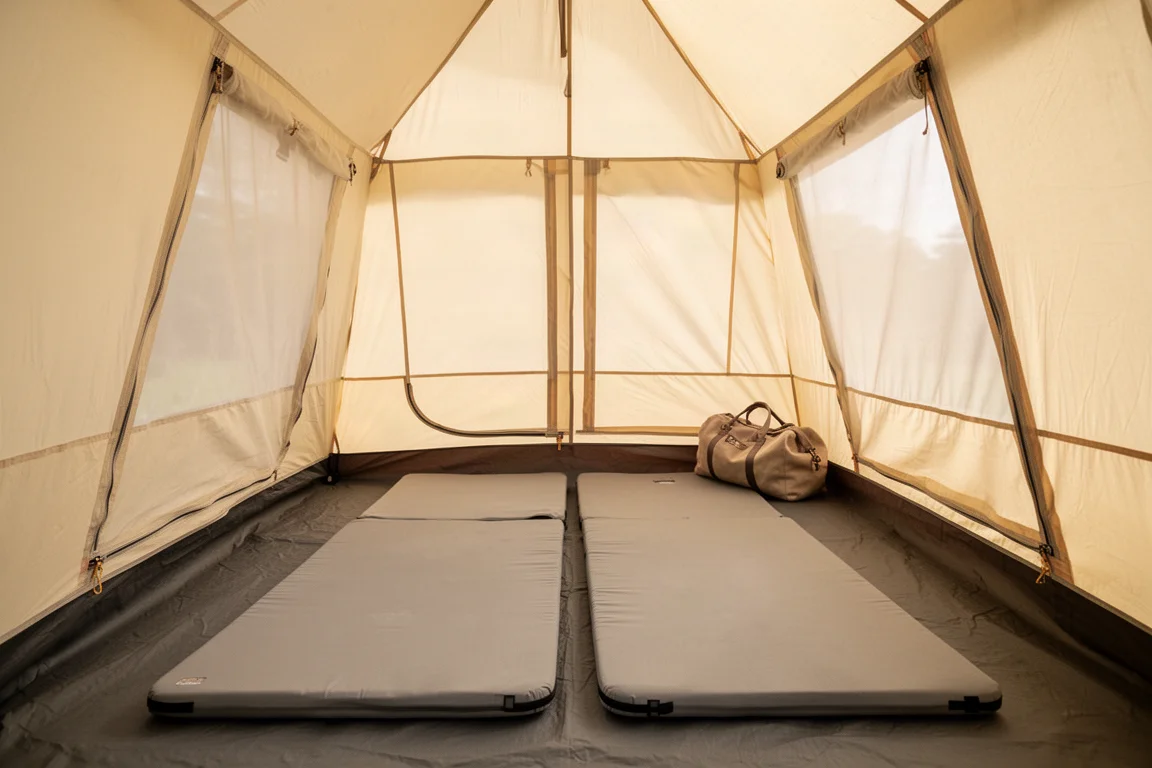
Where it fits best is with families of three or four, or with two campers who want a genuinely roomy basecamp and a vestibule they can sit in when the weather turns. Groups who plan to sleep six adults every night should expect a tight, functional fit rather than a comfortable one.
Main Strengths
The strongest arguments for this tent come from its architecture and its weather performance. Both are the result of deliberate design choices rather than marketing language, and both are measurable.
Extended Peak Height and Walkable Space
At the centre, peak height measures 77.25 inches. That figure alone is close to the six-person average, but the number that matters is what happens as you move away from the centre. Three feet along the length from the peak, height still measures about 70.5 inches. At 4.5 feet, right at the end of the tent by the door, it holds at 63.5 inches. Two feet across the width from the peak, height measures about 61.5 inches, which is roughly where a shorter adult’s head meets the ceiling.
In practice, this creates an extended peak height running the entire length of the tent, plus vertical walls at both the front and the back. The base area measures about 116.5 inches front to back and almost 100 inches side to side, for a total of roughly 80.5 square feet. Very few tents in this class offer the same walkable footprint, and the two vertical end walls come from the four-ended hubbed pole that anchors into the four corners.
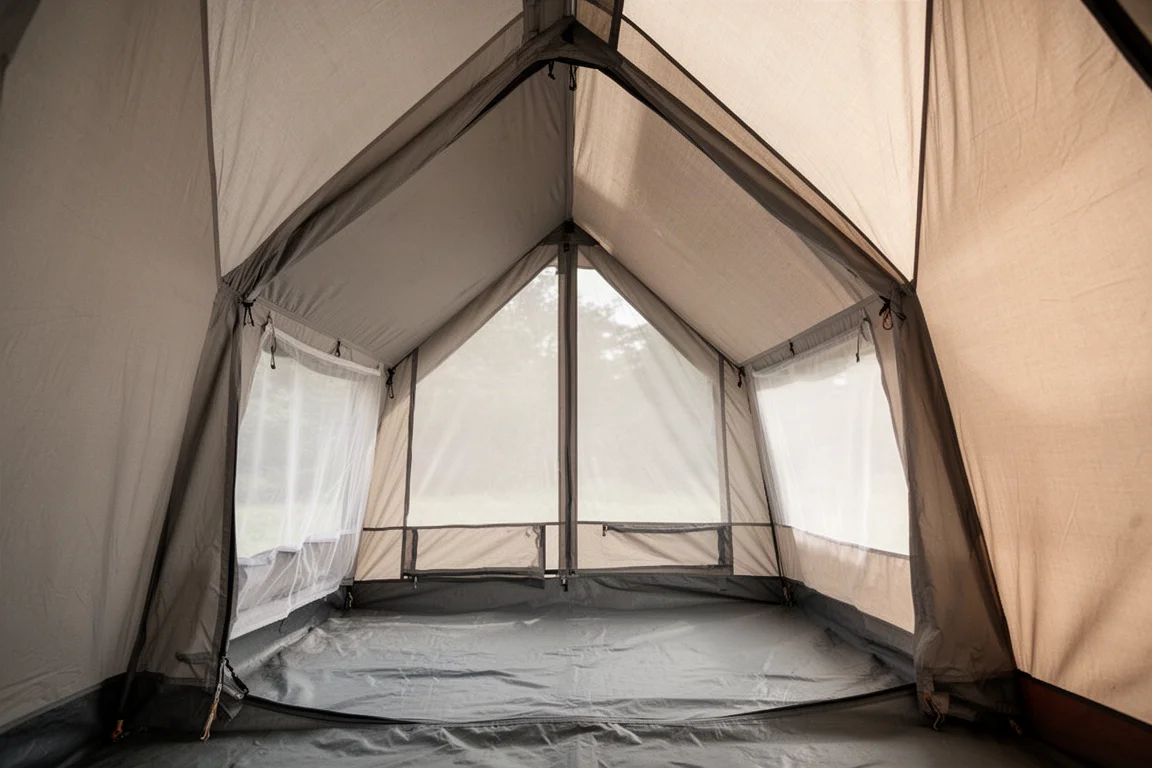
This is the clearest reason to choose the Bunk House over a cheaper six-person tent. The extra volume is not a claim on a spec sheet, it is floor space you can stand up in.
Heavy Rain Performance
The tent was subjected to more than an hour of heavy rain to test its waterproofing. After the rain stopped, the floor was dry, the corner seams did not leak, and the floor edges showed no leaks either. The rainfly was dry from the inside, and lifting it from the outside showed that rain barely splashed onto the tent body at all, which is why the interior walls stayed dry.
The construction supports those results. The floor uses 75-denier polyester taffeta with a 1,500-millimeter waterproof coating, and the rainfly uses the same 75-denier polyester taffeta with the same 1,500-millimeter coating. The tent body is 75-denier polyester with no coating. The floor seams running across the tent, the floor edge seams, and the corner seams are all taped, though the taping extends only a few inches up the walls. Every seam on the rainfly is fully taped.
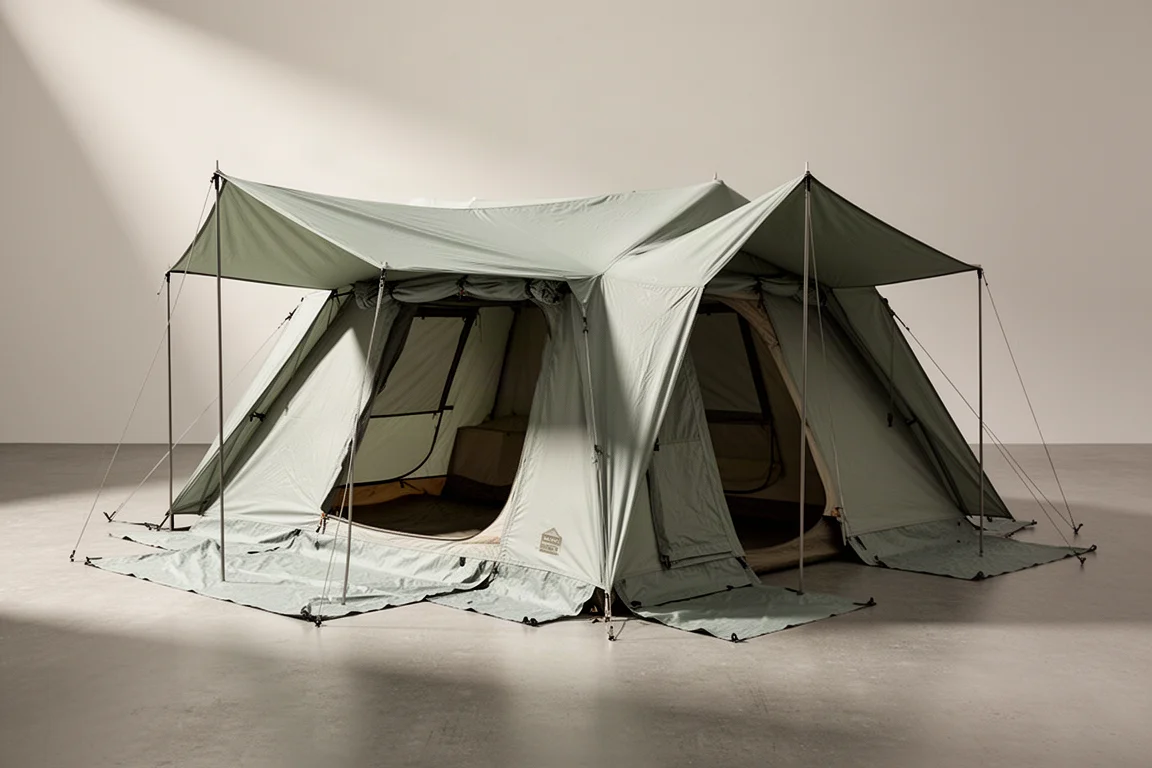
The rainfly itself is a full-length fly that extends almost all the way to the ground. Guy-out points along the lengths of the tent let you pull the fly away from the body for better ventilation and rain protection, and some of the guylines are forked, which adds stability in wind. The guy-out points are also slightly reflective. Only a small number of tents in this class ship with a full fly, so this is a meaningful advantage in sustained wet weather.
Vestibules, Doors, and Storage
The front vestibule is one of the largest in the category at roughly 36.5 square feet, about 5 square feet more than the six-person average. It measures about 66 inches along the shorter front edge, 99.5 inches along the longer inner edge, and 63.5 inches in width. Standing height reaches about 67.5 inches next to the tent door and 57.75 inches at the outer front edge, so an adult can stand comfortably inside near the door and sit inside with the vestibule fully closed.
The back vestibule is about half the size at 19.5 square feet, with the same 66-inch and 99.5-inch lengths but a much shorter 34-inch width. It offers around 67 inches of standing height, but only right next to the door, with no real room to move around, and it becomes purely storage space once zipped closed.
The front vestibule is also highly configurable. Twin loops at each end let you stake the inner loops to open both sides and tie them back, or stake the outer loops to unzip the middle section and bunch the fabric at the top. Unstaking the whole vestibule creates a neat awning with a little shade, made possible by the vestibule pole. Two YKK zipper tracks with two zippers each run across the front, all snag-free when zipped with two hands. The back vestibule has a single track with the same YKK zippers and a similar double loop arrangement, though without a vestibule pole there is no shade, only the end of the ridge pole overhead.
Both tent doors sit under the vestibules. Each door measures 57 inches at its widest and about 64.5 inches from the ground to the top, and the narrow top section means you will need to duck when entering or leaving. A Door Keeper lets you tuck the open door fabric away in about three seconds, against roughly ten seconds for the fabric toggle. Each door has two YKK zipper tracks, one running top down and one running right to left, both snag-free. Two windows sit on the doors, each about 63 inches long by 22 inches wide, with very fine mesh that may be no-see-um, a toggle for holding them open, and two YKK zipper tracks per window.
Storage is generous in count. There are 16 pockets in total, 8 on each side wall. The rectangular pockets measure about 15 by 11 inches, which is large for a tent pocket. The triangle pockets are doubles, with the larger measuring 17 by 18 inches and the smaller offering very little capacity, and the top triangle pockets measure about 15 by 12 inches, so they hold less than the rectangular ones. There are 17 closed felt loops in all, 8 on each of the front and back walls plus one at the top centre of the tent.
Things to Consider Before Buying
Setup is not the fastest in this class. A full pitch took about 18 minutes, slightly longer than the six-person average, and the hubbed pole set tended to pop out of the corner grommets while being raised, which likely cost a minute or two. It is an annoyance rather than a dealbreaker, but it is worth knowing before a first pitch in bad weather. Pack away was quicker than average at about 13 minutes, helped considerably by the oversized carry bag.
The doors are the most consistent daily frustration. The narrow top and the vestibule pole mean ducking twice on the way in and out, and because the front of the vestibule measures only about 58 inches high, it is easy to catch a head on the pole. Anyone tall should expect to duck deliberately every time.
Storage capacity and pocket size do not always match. There are plenty of pockets, but most are small in real terms, so bulky items will still end up on the floor. Ventilation is another area to weigh: the tent body has a limited amount of mesh, with a little on the widths and less than half on the lengths, and the mesh is yellow in colour, which dulls the view out. The whole top is mesh, which helps, but more mesh and additional vents would improve airflow on both hot and wet days.
The floor is 75-denier polyester, which is thinner than some comparable tents, so a cheap ground tarp underneath is a sensible purchase. Finally, the tent ships with 10 stakes, which falls short of what a full pitch with all guylines requires, so plan on buying a handful of extras.
Buying Advice
The Bunk House costs more than the other popular six-person tents in its class, and the case for paying the difference rests on two things: walkable interior volume and weather protection. It is one of the few cabin-style tents that combines an extended peak height with a front vestibule you can stand in, and no other model in this comparison offered both. It also pairs a full-length fly with forked guylines, which is why it handled sustained heavy rain and wind well while many of its peers manage only a partial fly.
The hardware supports the price. Zippers are top-tier YKK throughout, and the poles are lightweight DAC aluminum, the best quality option in this group. The tent is also PFAS-free, and it is made mostly in China and sewn in Vietnam.
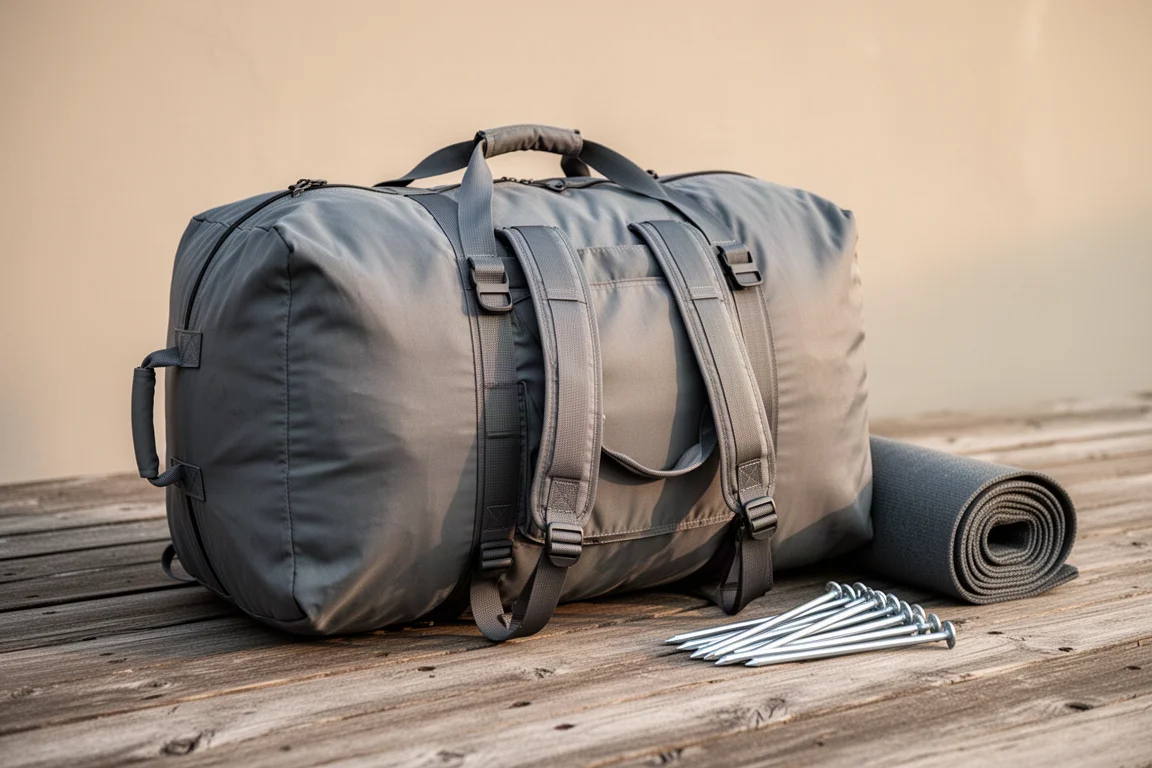
Two additions are worth budgeting for alongside the tent. A ground tarp protects the thinner 75-denier floor, and a set of extra stakes covers the shortfall in the supplied 10. Packed, the tent measures about 27 inches long, 16.25 inches wide, and 9 inches high, and everything weighs 18.6 pounds. For scale, that pack is noticeably larger than a two-person dome tent and stands well above a one-litre bottle. The carry bag is genuinely well designed, with a side handle, fully adjustable backpack straps, and a second grab handle at the top, which makes the walk from car to pitch far easier than the weight alone would suggest.
Conclusion
The Big Agnes Bunk House 6-Person Tent earns its premium through space you can stand up in and a rainfly that keeps the interior dry through hours of heavy weather. Its compromises are real but modest: a slightly slower pitch, doors that demand ducking, small pockets, and a floor that benefits from a groundsheet. For campers who want a cabin tent with a genuinely usable front vestibule and reliable protection from rain and wind, this is one of the strongest options available, and the clearest reasons to choose it over cheaper six-person tents are the ones you notice every single day of a trip.
Product link
View more details for Big Agnes Bunk House 6-Person Tent
This product is mentioned in the review. Check the specifications, options, and compatibility before buying.
View more details for Big Agnes Bunk House 6-Person TentFurther reading
Related Reviews
Camping Tents
3F UL Gear Taiji Two-Person Tent Review: Field Waterproofing Results and Buying Advice
The Taiji pairs an attached fly with a removable inner, but sustained rain exposed untaped vent seams that need sealing before this shelter can be trusted.
Camping Tents
3FUL Gear Lanshan 2 Pro 4-Season Review: A Sub-$200 Single-Wall Trekking Pole Tent
An early look at the 3FUL Gear Lanshan 2 Pro 4-Season, covering its straightforward pitch, generous interior space, and the condensation and seam-sealing questions that come with any single-wall shelter.
Camping Tents
Alps Mountaineering Lynx 1-Person Tent Review: Big Value in a Small Budget Tent
A close look at the Alps Mountaineering Lynx 1-Person Tent, covering real interior dimensions, materials, setup time, ventilation limits, and who should buy it.