Hi-Fi Speakers
Best Retro Hi-Fi Speakers 2026: Six Models Compared and Ranked
A practical comparison of six retro-styled hi-fi speakers, covering measured bass extension, sensitivity, dispersion, and which models actually suit a real listening room.
Introduction
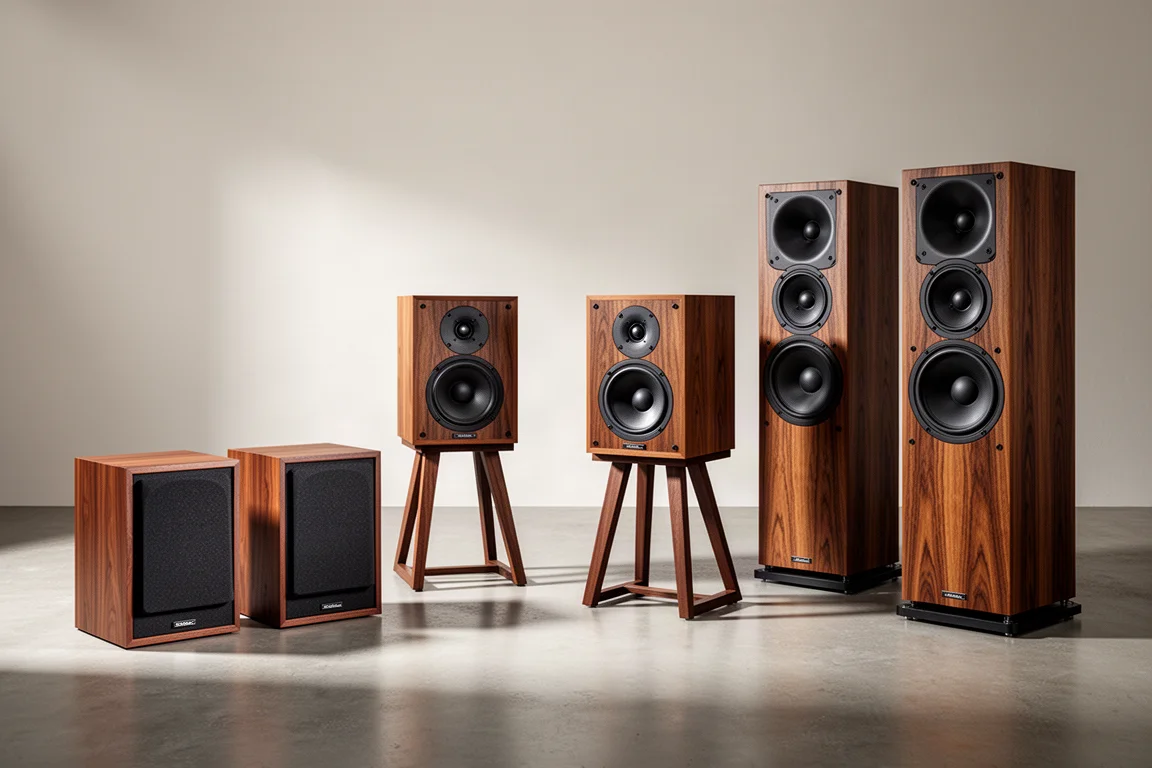
Retro-styled speakers are having a long moment, and the current market runs from compact walnut bookshelf models to large horn-loaded floorstanders. This roundup covers six of them: the JBL L52 Classic, the Wharfedale Linton 85, the MoFi SourcePoint 8 and SourcePoint 10, and the Klipsch Heresy IV and Forte IV.
Every model here was assessed the same way. Listening impressions came first, then the measurements, so that what the ear reports can be checked against what the data shows. When a speaker sounds bright, there is usually a measurable reason for it. When one rolls off early in the bass, the numbers explain why. The result is a practical picture of what each speaker does well, where it falls short, and which rooms and listeners it actually suits.
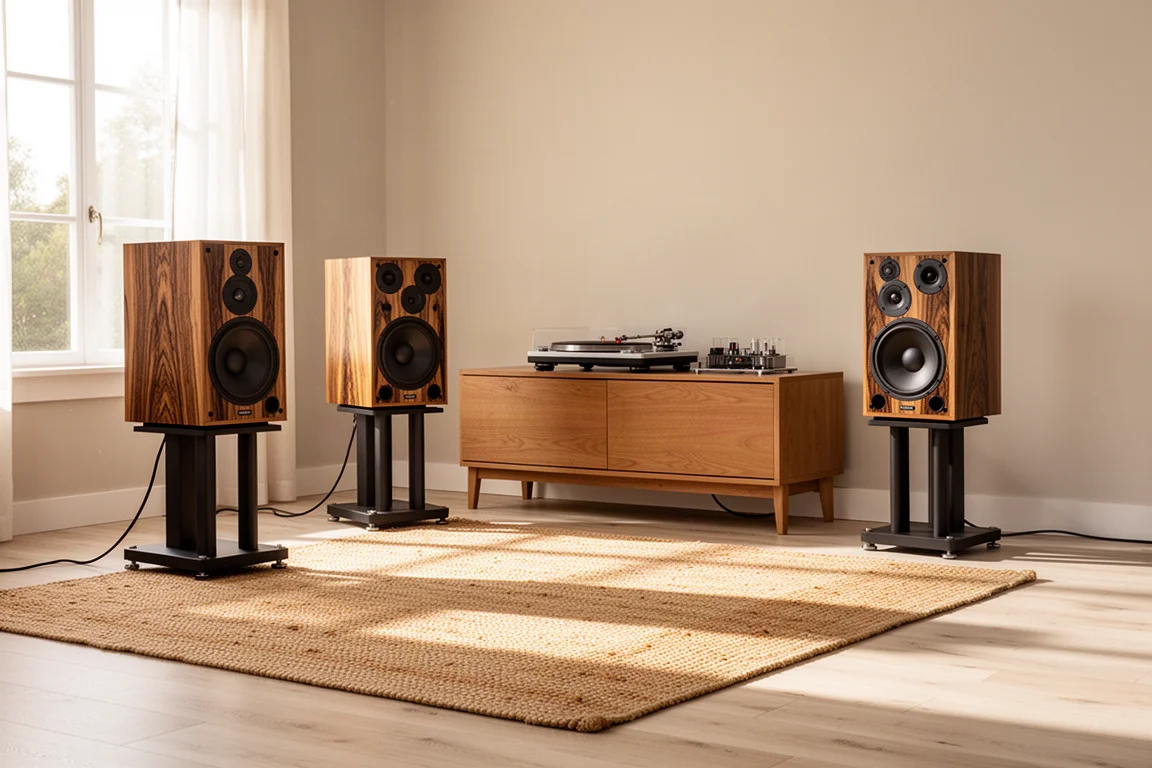
Two models in this group stand clearly above the rest. The MoFi SourcePoint 8 and the Wharfedale Linton 85 are the speakers most listeners should start with, for different reasons and at noticeably different budgets. The two Klipsch floorstanders cost the most here and deliver the least consistent performance, which is worth knowing before you spend the money.
How These Speakers Compare
Four things separate these speakers in practice: how low they reach, how sensitive they are, how evenly they radiate sound into a room, and how neutral their overall balance is.
Bass extension is usually described with two figures. F3 is the point where output has dropped by 3 dB, and F10 is the point where it has dropped by 10 dB. A speaker with a low F3 but a steep rolloff below it can still feel thin with music that has real low-frequency content. That distinction matters a great deal in this group.
Sensitivity is the other half of the trade-off. A high-sensitivity design plays loudly with modest amplifier power, but high-sensitivity drivers almost always give up bass extension in return, which pushes their F3 higher up the frequency range. The Klipsch models here are the clearest example of that bargain, and the JBL sits at the opposite end.
Dispersion, meanwhile, decides how the speaker behaves in a real room rather than on a measurement axis. A speaker that radiates consistently in every direction holds its tonal balance when you stand up, walk around, or sit off to one side. A speaker with an uneven pattern sends different frequencies into the room’s reflections at different strengths, and that is audible as a soundstage that shifts and breathes in ways the recording never intended.
JBL L52 Classic: Retro Style With Inconsistent Sound
The JBL L52 Classic is the smallest and most overtly nostalgic speaker in this roundup. It pairs a walnut cabinet with a foam grille, and the blue grille is the signature look, though other colours are available if you want to change the character of the front baffle.
Sonically, it is a mixed experience. The mid-bass is genuinely punchy, and that energy is the most appealing part of the presentation. It does not extend low, though. Bass output peaks around 100 Hz and then rolls off quickly, so there is little of the low rumble that gives larger speakers their sense of weight and scale. Sharp hand claps came across as aggressive, and snares lacked the snap and attack that make percussion feel immediate.
Soundstage width is the bigger issue. It flares outward and pulls back in at different frequencies, which prevents vocals from locking into a precise position. Instruments that should sit hard left do not always land in the same place as other elements panned to the same side, so the image drifts depending on the recording.
The measurements line up with those impressions. Mean SPL is 85.1 dB, F3 sits at 62 Hz, and F10 is at 45 Hz, with a clear bump around 100 Hz that explains the punchy character. The overall response stays within roughly plus or minus 3 dB, but it moves around inside that window rather than holding a stable line, and there is a dip around 800 to 900 Hz that corresponds directly to the missing snare snap.
Wharfedale Linton 85: The Value Leader
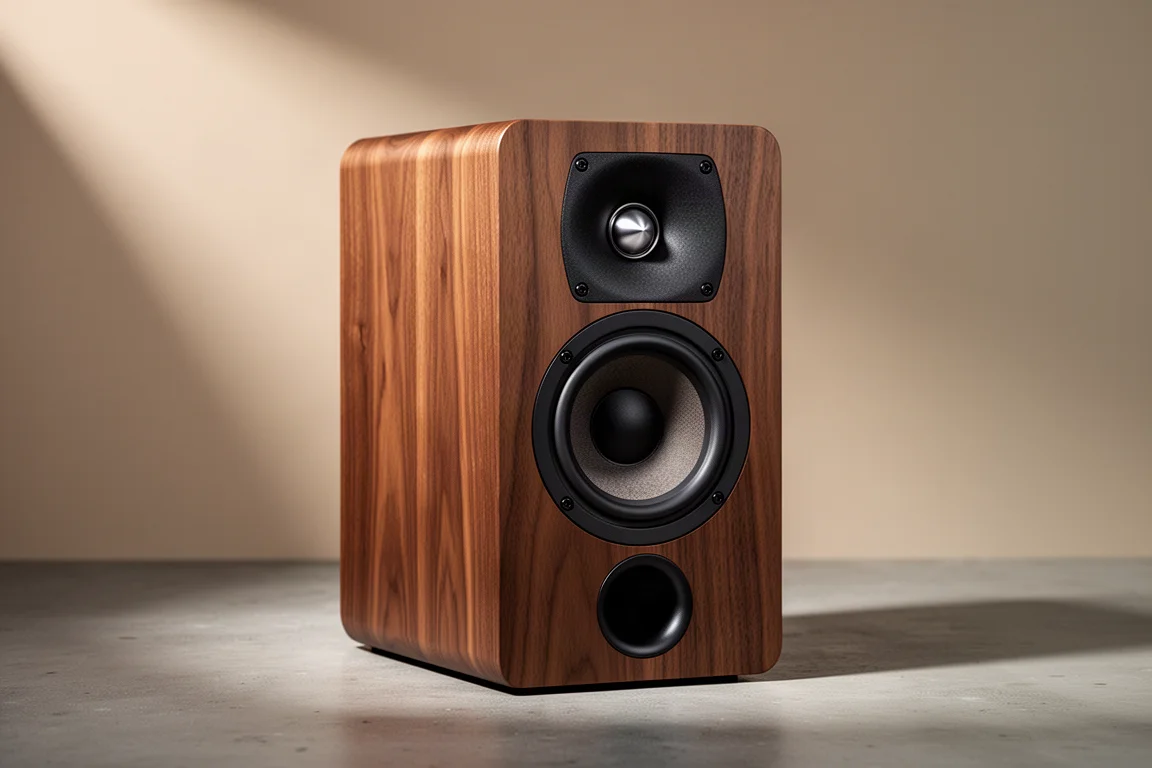
The Wharfedale Linton 85 is the value story of this group. It runs from about $1,500 to $2,000 per pair depending on whether it is discounted and whether the matching stands are included, and at that money it delivers deep bass extension in room down to roughly 40 Hz. For most music that means you can skip a subwoofer entirely, though some tracks do extend well below 40 Hz and will still benefit from one.
The tonal character is neutral and relaxed rather than forward. There is a mild shortage of attack and detail through the upper mid-range and lower treble, which takes a little bite out of percussion and brass, but it is not severe enough to undermine the speaker. Soundstage width is generous at roughly plus or minus 70 degrees, and the speaker manages to radiate widely while staying balanced, which is a harder combination than it sounds. One practical note: this speaker performs at its best with the grille left on.
The data supports the listening notes. F3 is 52 Hz and F10 is 35 Hz, both lower than the JBL, and there is no bump near 100 Hz, so the punch is traded for genuine extension. Sensitivity is broadly similar to the JBL, but the response is smoother and more neutral overall. The estimated in-room response shows extended bass, a mid-range that loses some attack around 1 kHz, and a gently rolled-off treble.
That rolled-off treble and the slight lack of attack are the two things worth knowing about. Both respond well to a simple tonal adjustment if your amplifier or source offers EQ, which makes the Linton unusually easy to tailor to taste. Neither trait is pronounced enough that EQ becomes mandatory, and many listeners will be perfectly happy with the speaker exactly as it comes.
MoFi SourcePoint 8: The Most Neutral Of The Group
The MoFi SourcePoint 8 is the strongest all-round performer here. Regular pricing sits around $2,800 per pair without stands, and discounts have brought it closer to $2,000, which puts it in direct competition with the Linton despite a higher list price.
Its tonal character is close to the Wharfedale’s, but it fixes the one weakness that holds the Linton back. The upper mid-range and lower treble are more neutral, so there is no sense that attack or detail has been scooped out of that region. Bass output is adequate rather than generous: it reaches down to roughly 50 Hz in room and then rolls off quickly, so a subwoofer is a sensible addition for anyone who listens to material with real low-frequency content.
The coaxial driver layout is the defining feature. Because the tweeter sits at the centre of the woofer, dispersion is unusually even both vertically and horizontally. You can stand up, walk around, or sit well off to the side and the overall tonal balance stays largely the same. Imaging still shifts as you move across the room, as it does with any speaker, but the fundamental balance does not fall apart. These speakers also reward a small amount of toe-out, somewhere between 10 and 20 degrees rather than firing straight ahead.
Measured at about 15 degrees off axis, mean SPL is around 86 dB, making it slightly more sensitive than the Wharfedale. F3 is 52 Hz and F10 is 42 Hz, which confirms the quick rolloff below 50 Hz. The overall response holds within about 2 dB and is reasonably neutral, with the on-axis response slightly elevated and some diffraction effects visible. A dip near 500 Hz could make some vocals sound a touch hollow, though that did not come through in listening.
MoFi SourcePoint 10: More Output, Brighter Treble
The MoFi SourcePoint 10 is the larger sibling, priced higher than the SourcePoint 8 and available at around $3,300 per pair without stands when discounted. Optional stands add roughly $200 to $300 per pair on top.
The differences between the two MoFi models are more significant than the size difference suggests. The 10 has a brighter top end, with high frequencies sitting roughly 2 to 3 dB above the mid-range. If you associate that lift with extra detail or resolution, this is the version that will appeal to you. If you prefer a more relaxed and neutral balance, the 8 is the better choice.
Bass extension is not dramatically lower than the smaller model. Both start to roll off around the same point, but the 10 rolls off at a shallower rate, so it holds its output a little longer below 50 Hz before falling away. Sensitivity is also higher, which makes it easier to drive to loud levels. It shares the same coaxial dispersion benefits, so tonal balance stays consistent as you move around the room.
Klipsch Heresy IV: Sensitivity Comes At A Cost
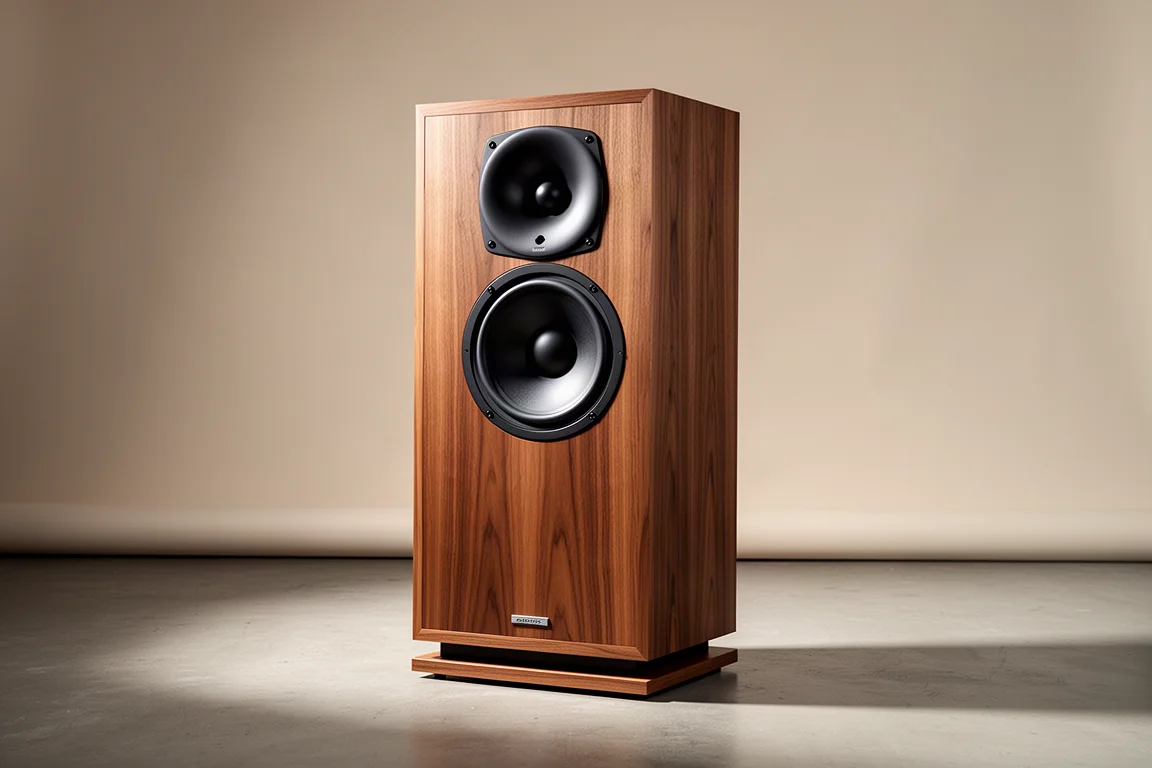
The Klipsch Heresy IV retails at about $3,200 per pair, and it is built around a very high sensitivity figure of 94.5 dB. It will play extremely loudly on very little amplifier power. That efficiency is paid for in bass extension: output rolls off around 100 Hz, and in practice a subwoofer is close to mandatory unless your music never goes below about 60 Hz.
The mid-range is where the speaker struggles most. Lower male vocal resonances are prominent, and investigation points to significant internal cabinet resonance for a speaker at this price. The radiation pattern is also uneven, with some frequencies radiating much more broadly than others, and it swings wider and narrower across the range. That makes precise imaging difficult, and elements that should sit together in the soundstage often do not.
Measurements back this up. The response varies by roughly plus or minus 4 to 4.5 dB and moves around considerably rather than holding a stable shape. A decay plot shows a resonance between about 100 Hz and 200 Hz that lingers for a long time, which is what makes male vocals sound chesty and boomy. There is also a mid-range dip of about 3 to 4 dB, and combined with the resonances it produces a presentation that sounds hollow in one region and thick in another. Above 600 Hz the response remains uneven.
This is the classic high-sensitivity compromise in its most visible form: an easy-to-drive speaker that gives up low-frequency reach and consistency to get there. That trade-off is normal and predictable, but how far a design leans into it is a choice, and here it leans a long way.
Klipsch Forte IV: A Step Up With Uneven Tonality
The Klipsch Forte IV retails at about $5,000 per pair, making it the most expensive speaker in this group. Like the Heresy IV it is a high-sensitivity design, measured at about 93.8 dB, but it reaches noticeably lower. F3 is actually a little higher than the Heresy IV, yet the bass is extended further out so that F10 lands at 39 Hz. That means kick drum and the 50 Hz region are usable without a subwoofer, while anything below that still calls for one.
Tonality is better than the Heresy IV, and this is clearly the stronger of the two Klipsch models. It is still uneven, though. A peak around 1.5 kHz is followed by a recess in the 2 to 4 kHz region, and that contrast makes the mid-range sound forward and then immediately withdrawn, which reads as unnatural on voices. Radiation is more controlled than on the Heresy IV but still not uniform, so sounds reflected off the walls are not treated consistently across the frequency range.
Linearity sits within about 3 to 4 dB, and there are noticeable diffraction effects from the horn that hold the design back from being more pleasant than it is. If you want the Klipsch horn character and deeper bass than the Heresy IV offers, this is the one to consider. Just budget for it accordingly.
Overall Buying Advice
If you want the short version: the MoFi SourcePoint 8 is the best speaker in this group, and the Wharfedale Linton 85 is the best value. The SourcePoint 8 wins on neutrality through the upper mid-range and lower treble, and its coaxial design gives it a rounded, enveloping soundstage without hard edges. Its limitation is bass depth, so plan on adding a subwoofer, or two, to get the low end where you want it.
The Linton 85 is the easier recommendation for most people. It reaches down to about 40 Hz in room, it stays neutral and uncoloured, and it never does anything exaggerated enough to become fatiguing over long sessions. The mild lack of attack and the gently rolled-off treble are both easy to live with and easy to adjust with EQ if you want to.
The two Klipsch floorstanders sit at the other end of the ranking, and notably they are also the two most expensive speakers here. The Forte IV is the better of the pair, with more usable bass and more coherent tonality, but neither matches the consistency of the MoFi or the Wharfedale. High sensitivity is a real advantage if you have a low-powered amplifier or a large room to fill, but it should not be the only reason to choose a speaker.
Room and placement matter as much as the speaker itself. A wide-radiating design like the Linton 85 will energise reflections heavily in a small room with glass and hard surfaces, so it rewards a little care with positioning. A coaxial design like the SourcePoint 8 is more forgiving of where you sit and how far off axis you listen. And if you choose either Klipsch model, treat the subwoofer as part of the purchase rather than an optional extra, because that is the only way the low end will feel complete.
Conclusion
Six retro-styled speakers, two clear favourites. The MoFi SourcePoint 8 takes the top spot for its neutral balance and even dispersion, with a subwoofer filling in the bottom octave. The Wharfedale Linton 85 follows closely and offers the strongest value of the group, reaching down to about 40 Hz and staying relaxed and inoffensive in the process. The JBL L52 Classic delivers the look and a punchy mid-bass, but its uneven response and limited extension make it a compromise. The Klipsch Heresy IV and Forte IV round out the list with high sensitivity and a clear set of trade-offs, and the Forte IV is the more convincing of the two. Match the speaker to your room and your listening habits, and any of the top choices here will serve you well for a long time.
Further reading
Related Reviews
Hi-Fi Speakers
1723 THX Tower vs 1528 Bookshelf: Which Speaker Fits Your Room?
Two speakers at roughly the same price, built very differently. How the 1723 THX tower and the 1528 bookshelf compare on construction, bass, power needs, and sound.
Hi-Fi Speakers
Acoustic Energy AE 300 Review: Deep Bass From a Compact Standmount
A two-way standmount with real wood veneer, surprising low-end weight, and a warm, easygoing character. Here is what to know before buying.
Hi-Fi Speakers
Acoustic Energy AE1 40th Anniversary Review: A Modern Take on a British Classic
A compact standmount that revives a 1980s favorite with all-new parts, a warm mid-centric balance, and a price of £1,499 per pair.