Running
Best Marathon Training Books for Every Type of Runner
From complete beginners to 80-mile-per-week runners, these marathon training books cover the full spectrum of plans, philosophies, and running culture.
Introduction
Choosing a marathon training book is less about finding the perfect plan and more about finding the right level of structure for where you are right now. A plan that suits a first-time runner coming back from years of desk life will be wasted on someone already running 80 miles per week, and vice versa. This guide walks through the standout marathon training books in order of complexity, from the most beginner friendly approach all the way up to advanced, high-mileage systems, plus a few books that are less about plans and more about how to think like a runner. If you use only as much complexity as you need to reach the next level, these books will carry you from zero to your fastest marathon.

Best for Beginners: Jeff Galloway
Marathon: You Can Do It by Jeff Galloway
Galloway is one of the original American coaches who helped pioneer the running boom and made marathoning accessible to ordinary people. His philosophy centers on a run-walk approach: literally stopping to walk during runs to extend time on your feet and make longer runs easier to hit. The idea is that a first marathon does not need to be a painful death march where you run hard for two hours and limp through the rest.
Early Structured Training: Hal Higdon
Marathon: The Ultimate Training Guide by Hal Higdon
Higdon, still writing well into his 90s, built one of the gold standards in accessible training plans. If you follow a popular running app, its plans are likely similar to what you will find here. The book is full of anecdotes and community stories, written in accessible, straightforward language you can finish in a weekend. The training plans live in the back, broken out day by day, including half marathon options. This is the right book if you have run a few races before, or if this is your first marathon but you have some running background and want your first structured plan with a bit of intensity.

Best for Most Runners: Hansons Marathon Method
Hansons Marathon Method by Luke Humphrey
This is the book recommended for most people, and the one behind a half marathon personal best in this roundup’s research. The structure is famously clean: three quality workouts per week, often thought of as faster than race pace on Tuesday, race pace on Thursday, and the long run on the weekend. The notable quirk is that long runs cap around 16 miles, though you can go longer if you want. Where Higdon aims to get you to the finish line in one piece, Hansons starts breaking you down partway through training to build you back up stronger, using the concept of cumulative fatigue. If you have any athletic background, have run a few races, and want a genuine challenge in your first or second marathon, this is the sweet spot.
Best for Advanced Runners: Pete Pfitzinger
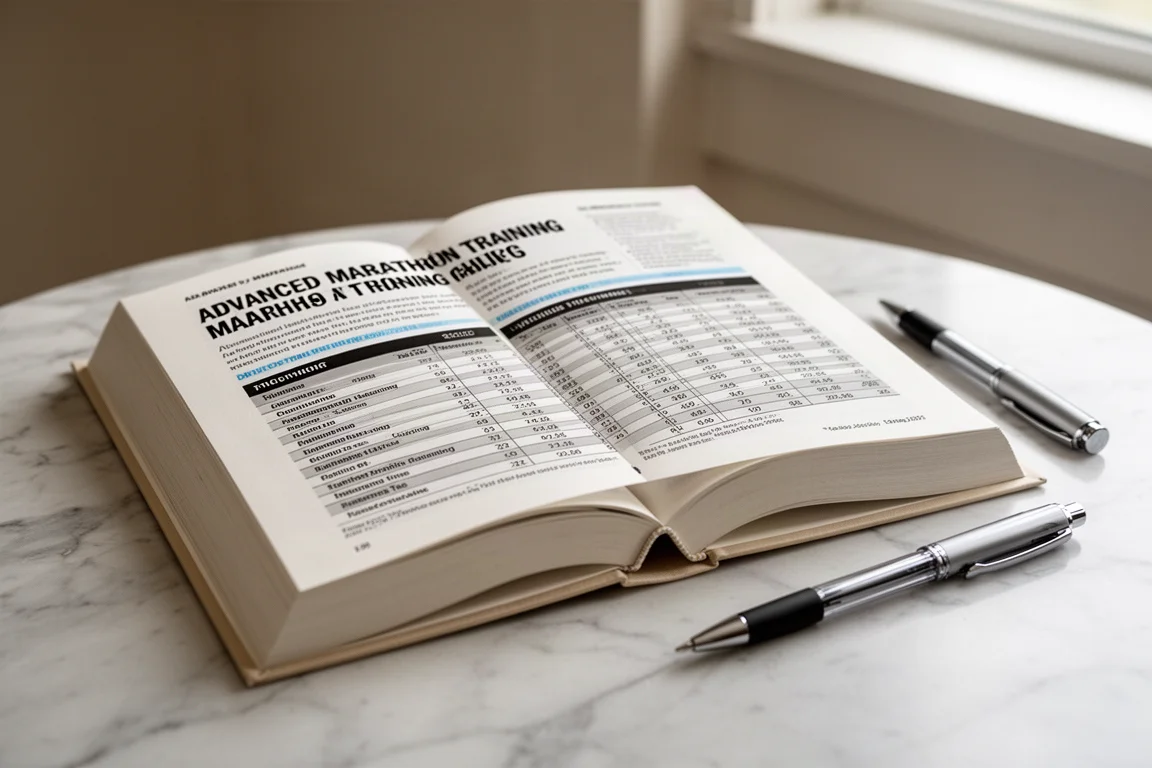
Advanced Marathoning by Pete Pfitzinger
The title says it all. Pfitzinger adds real complexity, with specific plans built for higher mileage levels that program out every day of the week. If you think in spreadsheets and want total clarity on what is coming, this book does a lot of the work for you. It also programs midweek medium-long runs, something like 15 miles, which matters once you are pushing 60 to 80 miles per week. The trade-off is that the plans can feel unnecessarily complex if you prefer controlling the details yourself, and the writing is less approachable than Higdon or Hansons. But for runners with a few marathons behind them who want a coach-on-paper, it is excellent.

Best Pace System: Jack Daniels
Daniels’ Running Formula by Jack Daniels
Daniels pioneered race pace calculators through his VDOT system, and that is the real gift of this book. Plug in a recent race result, like a 20-minute 5K, and the tables tell you exactly what your marathon pace, threshold pace, interval pace, easy pace, and long run pace should be. The philosophy is refreshingly honest: pace does not lie. If your goal is to run a specific time over a specific distance, your heart rate, the temperature, and the humidity are noise. The system exposes your weaknesses too, since struggling at a target pace tells you exactly where your endurance needs work. The workouts themselves can get complex, with multiple paces inside one session, so a popular approach is to use the VDOT tables for pace guidance while following the simpler Hansons structure. Consider Daniels once you are running 60-plus miles per week or have a competitive background, and expect two quality sessions per week rather than Hansons’ three.

Beyond the Plans: Books That Shape Your Running Philosophy
These books are less about week-by-week structure and more about how great coaches and runners think. They are worth reading at any level.
Running with the Kenyans by Adharanand Finn
Finn moves his family from the UK to Kenya to embed himself in the country’s running culture, and the boots-on-the-ground reporting is the draw. He is a genuinely good writer, and the book offers a rare inside look at how the world’s best distance runners train and live.

Run Faster by Brad Hudson
Hudson’s philosophy is adaptive running: adjust your training based on how you feel, and be your own coach whether or not you actually have one. The book is best for its general approach and mindset rather than its specific plans, and it pairs naturally with training by feel.
Run to the Top by Arthur Lydiard
Lydiard shaped a huge amount of modern high-mileage thinking. His emphasis on building the aerobic system through large volumes of steady running and gradually increasing mileage underpins much of what the other books in this list assume. If you have never read Lydiard, start here.

Tales from the Times by Bob Hodge
A sociological memoir of running in the Greater Boston area before the sport professionalized. Hodge signed with New Balance and Reebok at a time when you could not yet make a full living from the sport, and he ran alongside Bill Rodgers in the same track club. If you want the story of a competitive runner before Instagram, this is it.

Overall Buying Advice
Match the book to your mileage and background. Starting from zero, a run-walk approach like Galloway’s is the gentlest entry point. With some running or athletic history, Higdon gives you approachable structure and Hansons gives you the right balance of intensity and simplicity. At 60-plus miles per week, or if you want everything spelled out, Pfitzinger and Daniels earn their place on the shelf. One more general principle from across these books: the biggest gains come from the unglamorous basics, running nearly every day, consistent long runs, and one or two sessions a week where you run genuinely hard for 20 to 30 minutes. Complexity beyond that is a garnish, not the meal.
Conclusion
No single marathon book is the best for everyone. The right pick is the one that matches your experience, mileage, and appetite for structure, and the honest answer is that reading several of them will make you a better-trained, better-informed runner than committing to just one.
Further reading
Related Reviews

Running
Adidas Adizero Ambition Review: A Middle Distance Spike That Gets the Job Done
A high school middle distance runner puts the Adidas Adizero Ambition through a full track season in the 800m and mile. Here is how it scored.

Running
Starting Running Today: The Essential Gear and Beginner Shoes Worth Considering
A practical starting point for new runners: daily trainers, race shoes, and GPS watches that cover most beginner needs without overspending.

Running
Best Daily Running Shoes of 2025: Our Top Five Picks
Five daily trainers that stood out over a full year of testing, plus the popular models that just missed the cut.