Bookshelf Speakers
Best Bookshelf Speakers Under $500: ELAC Debut 3 vs JBL Stage 250B vs Emotiva XB2
A side-by-side look at three sub-$500 bookshelf speakers, covering specifications, build quality, sound character, and which listener each one suits.
Introduction
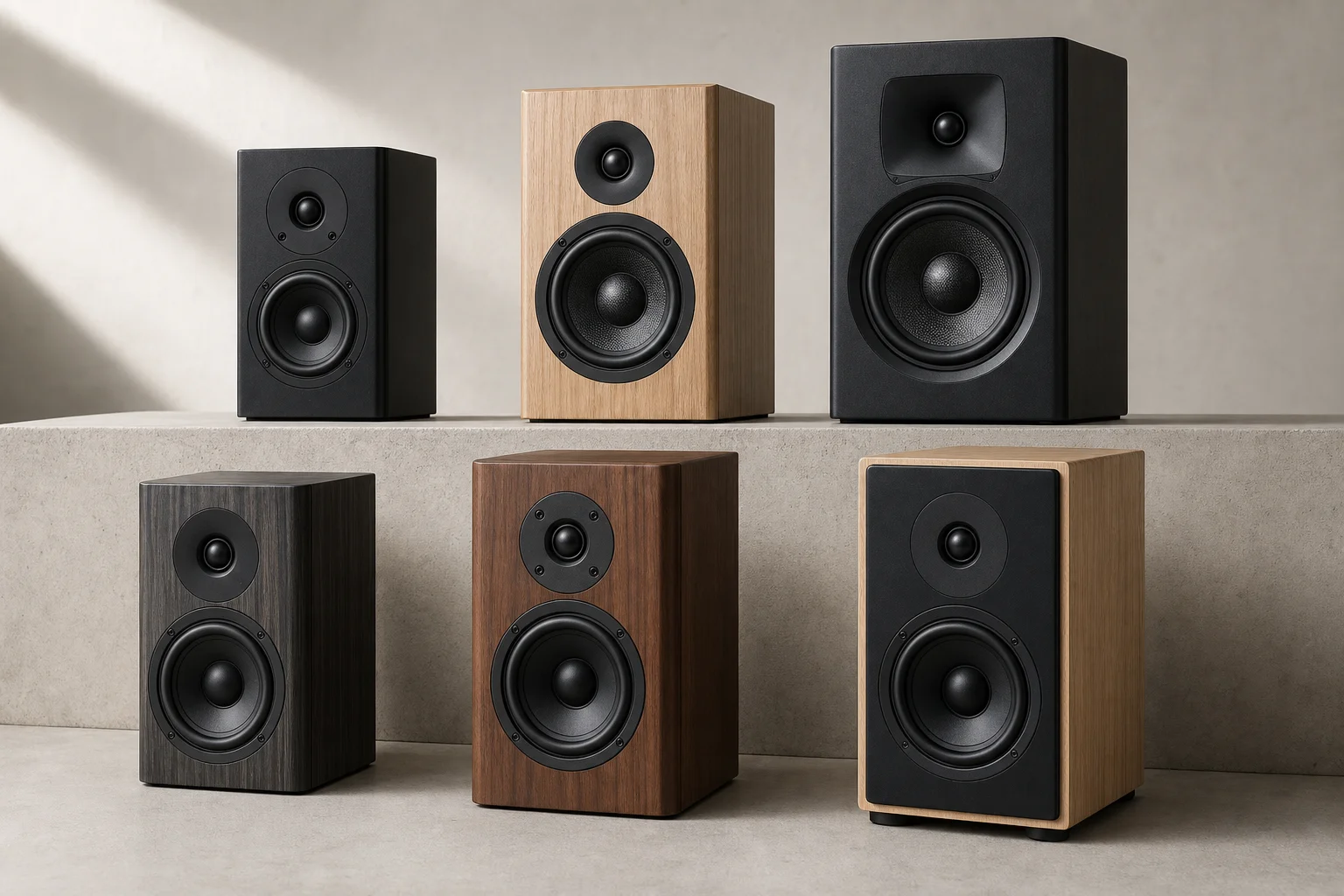
Three compact speakers released within roughly the past year, two of them within the past month, form the basis of this comparison: the ELAC Debut 3, the JBL Stage 250B, and the Emotiva XB2. All three sit below the $500 mark, and each takes a noticeably different approach to the same job. One is the largest and heaviest of the group, one is the smallest and lightest, and one pairs a large woofer with a folded ribbon tweeter.
Specification sheets only tell part of the story at this price. What matters more is how each speaker handles bass, mid-range detail, and the music you actually listen to. The sections below cover the numbers, the build quality, the listening character of each model, and which listener each one suits.
How These Three Speakers Compare
The ELAC Debut 3 is the biggest and heaviest speaker here. It uses a 6.5-inch woofer with a 1-inch aluminum dome tweeter, and it lists a frequency response of 42 Hz to 38,000 Hz at plus or minus 6 dB, a nominal impedance of 6 ohms, and a sensitivity of 87 dB. Recommended amplifier power runs from 20 to 140 watts, although something closer to 100 watts is the more realistic target in practice. The specification sheet quotes 17.3 lb per speaker.
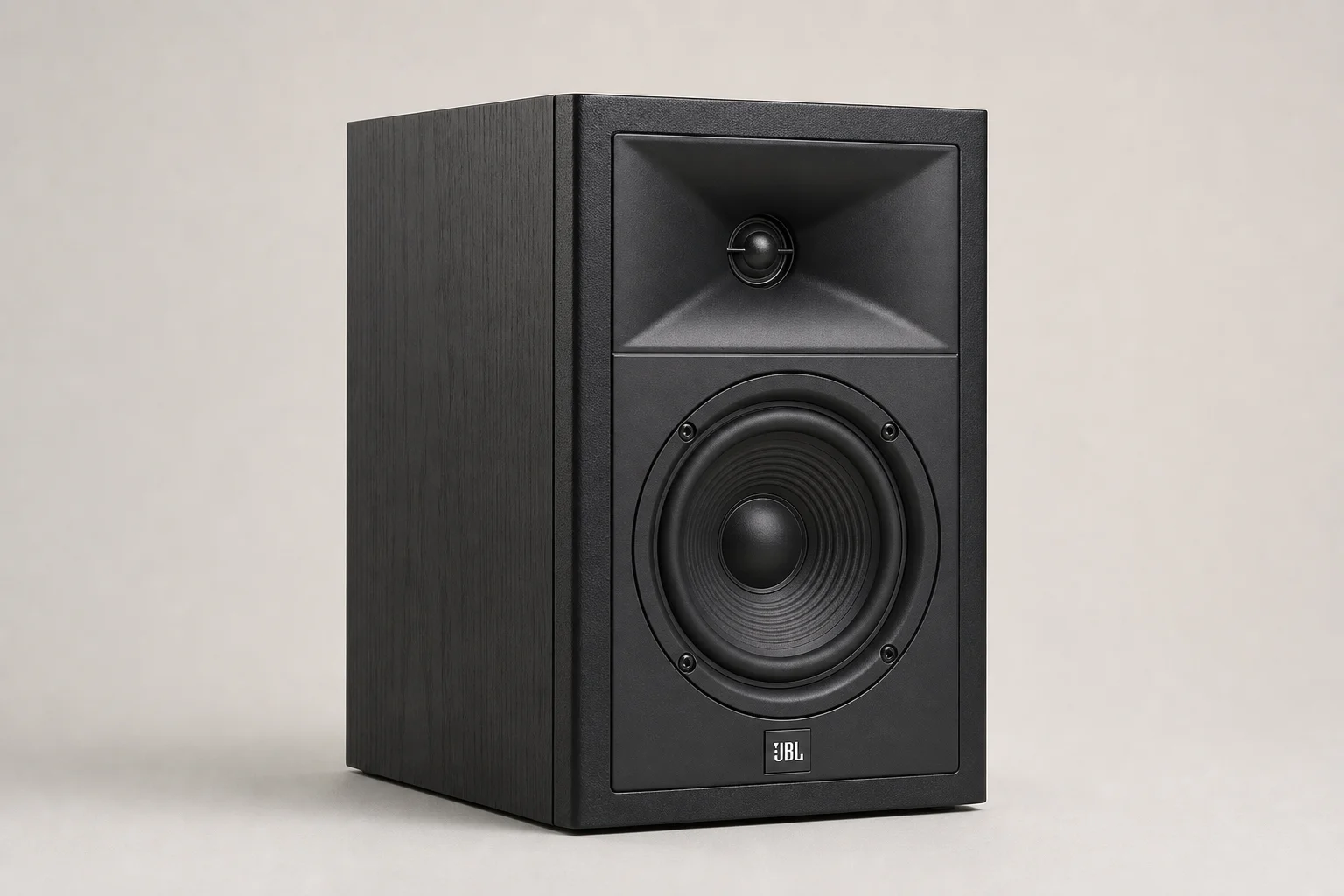
The JBL Stage 250B is the smallest and lightest of the three at roughly 13 lb. It pairs a 5.25-inch ribbed poly cellulose woofer with a 1-inch aluminum dome tweeter and a next-generation waveguide. Frequency response is rated at 55 Hz to 25,000 Hz at plus or minus 3 dB, with 86 dB sensitivity and a nominal 6-ohm impedance.
The Emotiva XB2 sits between them at 15.4 lb. It combines a 6.5-inch woven cone diaphragm woofer with a 25 mm by 32 mm folded ribbon tweeter and a neodymium magnet system. Sensitivity is 86 dB, nominal impedance is 4 ohms, and the rated frequency response is 48 Hz to 27,000 Hz at plus or minus 3 dB.
Two details are worth flagging before you compare prices. The Emotiva’s 4-ohm nominal impedance asks more of an amplifier than the two 6-ohm designs, and the ELAC’s plus or minus 6 dB window is a looser tolerance than the plus or minus 3 dB figures quoted by the other two.

On price, the ELAC Debut 3 lists at $450, the JBL Stage 250B at $400, and the Emotiva XB2 at $499. The ELAC and the JBL are both the kind of model that tends to see promotional pricing over time, so it is worth watching for a sale if you are not in a hurry.
ELAC Debut 3: The Most Dynamic of the Three
The Debut 3 makes the strongest physical impression of the group. A waveguide curves over the tweeter, a second waveguide wraps the woofer, and the wood-grain wrap reads as a clear step forward from the first and second generations of the model. Around the back there is a horn-style flange with a cardboard port tube, along with binding posts carried over from earlier generations.
Those binding posts deserve one practical note. Screw them down fully, especially when you use banana plugs. A partially loose post can resonate at a specific frequency and give the impression that the cabinet itself is buzzing, when the real cause is the connection.
On sound, the Debut 3 leans warm. On a sibilance-heavy live recording it was the most relaxed of the three, to the point that the sibilance almost disappeared. The trade-off is a lower mid-range region around 200 to 500 Hz that sounds full and forward, which can mask some mid-range and top-end detail. What it gives back is scale, because the soundstage is noticeably wider than either of the other two speakers here.
Feed it properly and the character shifts. With a capable amplifier and playback levels around 80 dB and above, the treble and bass balance out and the detail arrives. Below that level it can sound soft and light on detail next to the JBL or the Emotiva.
The Debut 3 was also the only speaker in this group that took a bass-heavy cinematic piece in its stride from start to finish, and it kept inviting more volume. It is the most dynamic speaker here and the most physically engaging, with low frequencies you can feel through the furniture.
JBL Stage 250B: Best Looks, Mid-Range Focus
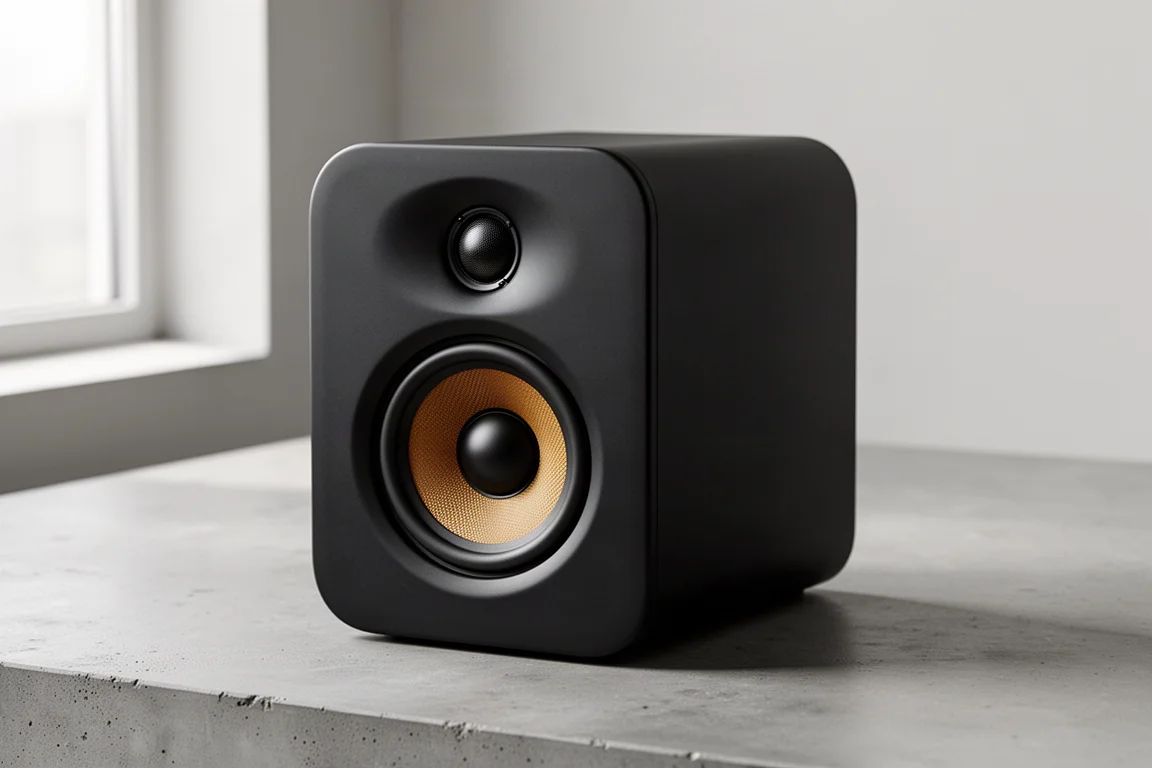
The Stage 250B is the best-looking speaker of the three. The waveguide detail around the tweeter is intricate, and a second waveguide surrounds the woofer. The baffle sits slightly proud of the enclosure, and the walnut-look wrap gives it a finish the other two cannot match. The heather grey grilles are magnetic, and a small diffuser sits at the tweeter. Around the back you get a rear port and binding posts that feel a touch lighter than the Emotiva’s. For its size the cabinet is well executed, if not especially inert.
The sound is mid-range focused. On the sibilance test it was the most forward of the three in that region, which is either character or limitation depending on your taste. The mid-range itself is clean, and there is real appeal in the way it transitions into the treble. On a busy metal recording it performed well, just without the dynamic punch of the two larger speakers.
Bass is where the limits show. On the cinematic piece the speaker bottomed out around the three minute twenty-nine second mark, at a passage that drops to almost nothing but low bass, and playback had to be paused. That track is an absolute torture test for any small bookshelf speaker, and with a 5.25-inch driver in a compact cabinet the outcome is predictable rather than surprising.

Given that, the Stage 250B makes the most sense with a subwoofer, but that changes the maths. Add a budget subwoofer at around $300 and you are comfortably past the price of the other two speakers here.
Emotiva XB2: The Most Detailed All-Rounder
The XB2 is the most straightforward design of the three. A 6.5-inch woofer sits below a folded ribbon tweeter, and the cabinet wears a textured, leather-like wrap with a black baffle. It is a plainer look than the JBL, and a wood-grain option would suit it well, but nothing about it feels cheap. Two sets of binding posts allow bi-wiring or bi-amping, and those posts feel a little better finished than the JBL’s. The rear port uses the same plastic flange and cardboard tube arrangement as the others. The cabinet is slightly bottom heavy.
On detail, the XB2 is the strongest of the group. Cymbals, the crack of a guitar, and finger slides on strings all come through where the other speakers smooth them over. The mid-range is solid, and the bass is tight and quick rather than deep and heavy. It handles low bass content without strain, though it is not as dynamic as the Debut 3 and does not throw as large or as nuanced a soundstage.
Its character reads as a blend of two earlier Emotiva models, which is what makes it the most balanced all-rounder of the three.
Build Quality and Design Notes
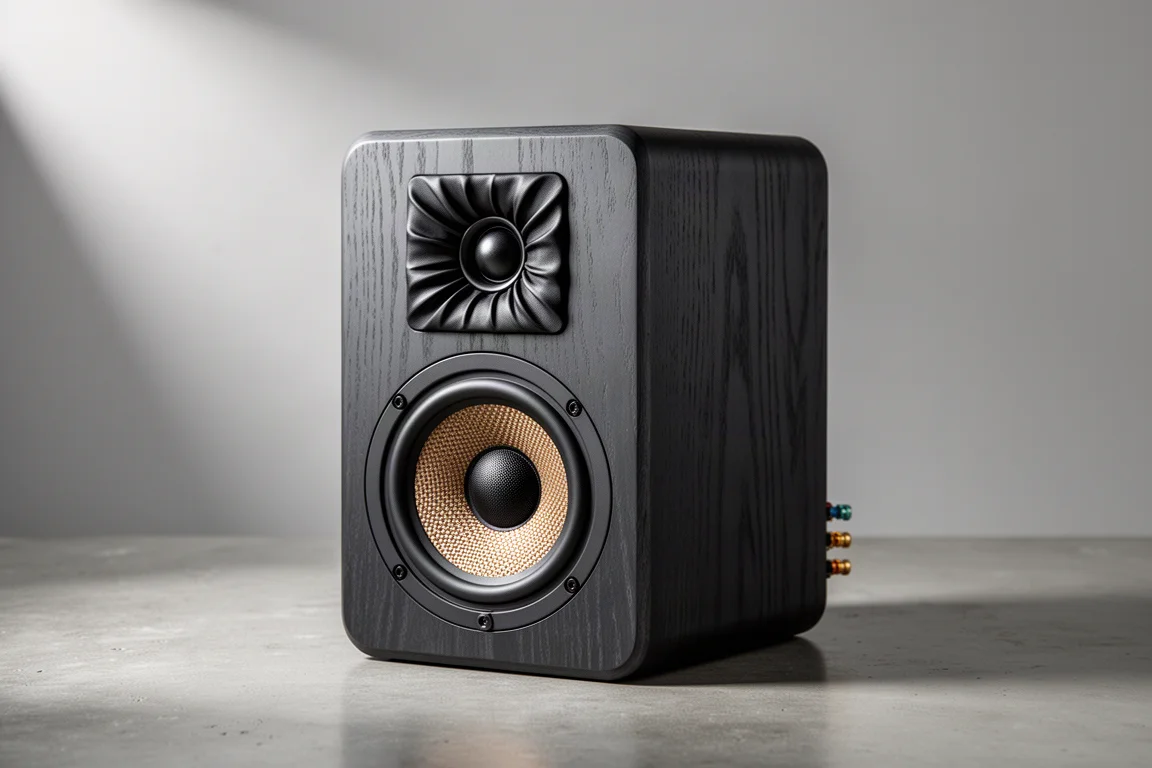
All three speakers share a similar rear-port arrangement: a plastic flange with a cardboard tube behind it, which is what you should expect at this price. None of them use top-tier binding posts, and the ELAC and the JBL are the two where the hardware feels most closely related to earlier generations of the same lines.
If this comparison handed out two build awards, the JBL Stage 250B would take the one for the most attractive cabinet, and the ELAC Debut 3 would take the one for the best-built speaker. The Emotiva sits in the middle on finish, with a plain but solid presentation and the most flexible connection options.

Practically, that means the ELAC is the one to choose if cabinet rigidity and a step up in construction matter to you, the JBL is the one to choose if the speaker has to look good in a living space, and the Emotiva is the one to choose if you want the option to bi-wire or bi-amp later. Whichever you pick, check the binding posts are fully tightened before you start listening, and give the speakers a little space behind the rear port.
Track-by-Track Listening Notes
Three very different recordings exposed three very different weaknesses. On a sibilance-heavy live cover, the JBL and the Emotiva both did a fairly good job, while the ELAC was the most forgiving and the most relaxed of the three.
On the bass-heavy cinematic piece, the ELAC was the clear winner. It handled the whole track without strain and stayed dynamic throughout, while the Emotiva reproduced the low end cleanly and the JBL reached its limits. On the dense metal recording, the Emotiva took the win on detail, with cymbals and guitar articulation that the other two rounded off, while the ELAC was the most dynamic and engaging on the low end and lower mid-range.
The pattern across all three tracks is consistent. The ELAC is the warmest and most dynamic, the Emotiva is the most detailed and the most linear, and the JBL is the most mid-range focused with the least low-end headroom.
Which Bookshelf Speaker Should You Buy?
If detail is what you chase, the Emotiva XB2 is the pick. It is the best speaker of the three from front to back, with tight bass, a solid mid-range, and top-end resolution that reveals parts of a recording the others miss. Just be aware that its 4-ohm impedance and revealing top end reward a capable amplifier and well-recorded material.
If you want warmth, scale, and impact, the ELAC Debut 3 is the pick. It is the most dynamic speaker here, it makes almost any recording sound good, and it throws the largest soundstage of the group. It does need power and a listening level around 80 dB and above to balance out, and it is not the choice for someone who prioritises maximum detail.

If you want the best-looking cabinet with a clean, articulate mid-range, the JBL Stage 250B is the pick, ideally in a smaller room or a home theater setup where a subwoofer carries the low end. On its own it cannot match the other two on deep bass dynamics, and the cost of a subwoofer has to be part of the decision.
There is also a case for buying two of these rather than one. With roughly $900 to $1,000 to spend, two speakers that sound genuinely different, one warm and dynamic and one detailed and linear, can cover more of your music than a single pair ever will.
Conclusion
These three speakers are close enough in price that the decision comes down to character rather than budget. The ELAC Debut 3 is the most dynamic and the best built, the Emotiva XB2 is the most detailed and the most balanced, and the JBL Stage 250B is the best looking with the cleanest mid-range and the least low-end capability.
Match the speaker to the way you listen and the amplifier you already own, and any of the three will serve you well. If you want one answer without further deliberation, the Emotiva XB2 is the most complete performer of the group, and the ELAC Debut 3 is the one to choose if warmth and physical impact matter more to you than absolute detail.
Further reading
Related Reviews
Bookshelf Speakers
Acoustic Energy A100 Mark II Review: A Compact Standmount With an Expansive Soundstage
The Acoustic Energy A100 Mark II brings clarity, natural tonality and a wide soundstage to an entry-level standmount, with a few setup details worth knowing first.
Bookshelf Speakers
Acoustic Energy AE-100 Mark II Review: Compact Bookshelf Speakers With Standout Imaging
A compact British two-way bookshelf speaker with deep, layered imaging, fast bass, and a slight treble lift to weigh against a crowded $500 field.
Bookshelf Speakers
Acoustic Energy AE100 MK2 Review: Measured Performance and Four Alternatives
A close look at the Acoustic Energy AE100 MK2 bookshelf speaker, what its measured performance reveals, and four alternatives with different trade-offs.