Hi-Fi Audio
Bang & Olufsen Beolab 28 vs KEF LS50 Wireless II vs Bowers & Wilkins Formation Duo: Premium Wireless Speakers Compared
A close look at the Bang & Olufsen Beolab 28 and how it stacks up against the KEF LS50 Wireless II and the Bowers & Wilkins Formation Duo.
Introduction
Ask ten listeners what an audio system is actually for and you will get ten different answers. Some will talk about convenience, about making the act of listening second nature. Others will talk about the gear itself: the amplifiers, the cables, the endless small upgrades that promise a little more of everything. The Bang & Olufsen Beolab 28 sits in an interesting place between those two ideas, and that is what makes it worth comparing carefully.
The Beolab 28 is a fully active wireless music system rather than a conventional pair of passive speakers. It arrives with its own amplification, its own streaming platform, and its own room correction, which means there is no amplifier or preamp to choose and no source component to add unless you want one. Two other systems, the KEF LS50 Wireless II and the Bowers & Wilkins Formation Duo, take a similar all-in-one approach for considerably less money.
This guide covers what the Beolab 28 does well, where it asks for patience, and how the two more affordable alternatives compare on the points that shape daily ownership rather than a first hour of listening.
What Matters in a Premium Wireless Speaker System
Before comparing individual systems, it helps to know which qualities tend to matter over years of ownership.
Built-in amplification removes an entire layer of decisions. In an active system each driver gets its own amplifier, which allows the manufacturer to tailor power delivery to each driver instead of asking one amplifier to cover the whole frequency range.
Streaming support determines how well a system fits into a household. AirPlay 2, Chromecast, Spotify Connect, Bluetooth, and network connectivity all matter if the speakers need to work with phones, tablets, laptops, and televisions without extra boxes.
Tuning and room correction decide whether a system can adapt to a real room. Shelving, glass, and open floor plans change bass response dramatically, and an app that can measure the room and adjust the output is often worth more than a slightly better driver.
Dispersion modes matter in rooms that cannot accommodate perfect placement. Some systems offer different driver configurations that change how wide or how direct the sound feels.
Full-range bass without a subwoofer keeps a living space uncluttered, but it demands real engineering from slim cabinets.
Finally, physical design and setup deserve attention. A system that looks beautiful but is awkward to assemble, or awkward to reconfigure, will test your patience every time you change a source.
Bang & Olufsen Beolab 28: The Most Flexible System Here
The Beolab 28 is a two-speaker system in which each loudspeaker houses five drivers: a one inch soft dome tweeter, three three inch mid-range drivers, and a six and a half inch woofer. Every one of those drivers has dedicated amplification. The tweeter and each of the three mid-range drivers get their own 100 watt Class D amplifier, while the woofer receives a 225 watt Class D amplifier of its own. The reported frequency response is 27 Hz to 23 kHz, which is unusually deep for a cabinet this slim.
Connectivity is broad. There is Wi-Fi and Bluetooth 5.0, along with AirPlay 2, Chromecast, and Spotify Connect. The system also supports WiSA, the wireless audio standard that enables wireless stereo and surround performance with compatible televisions. Physical inputs include line level in, optical, USB-C, RJ45, and Ethernet, so a television, a turntable with the right adapter, or a wired network connection can all be accommodated.
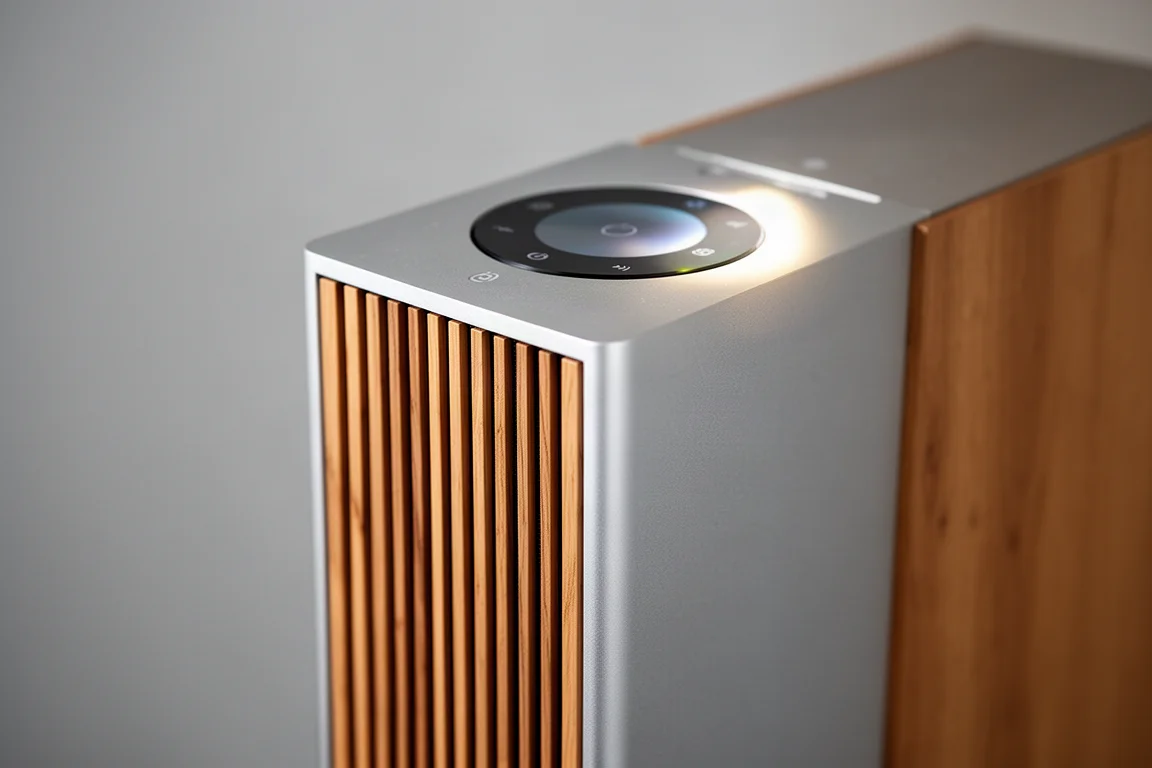
Control is handled two ways. Touch sensitive controls sit on top of each speaker with a dot pattern for favourite selections, and the companion app handles everything else. Setup can be fussy on an older phone, where the Wi-Fi procedure may need two or three attempts to take hold, while a newer phone completes it without trouble. Once connected, the app maintains its connection reliably.
The app is where the Beolab 28 separates itself from most powered speakers. Tone controls are joined by listening modes that can be shaped by dragging a cursor around a dial toward descriptions such as bright or warm. Those settings can be named, saved, and recalled later according to mood or source material. Active room correction is included as well: at the touch of a button each speaker emits a tone, measures the result, and tailors its performance to the room.
Two dispersion modes change the character of the system. In wide mode, side-mounted mid-range drivers are active, which produces a broader, more spacious presentation with a laid-back and slightly warmer mid-range. In narrow mode those side drivers are disabled, giving a more direct, forward, and detailed mid-range with sharper separation between vocals and instruments. The mode can be switched from the app or saved into sound profiles and recalled at will.
Bass is the biggest surprise. With a six and a half inch woofer per cabinet, the Beolab 28 delivers bass that is visceral, detailed, and quick on the attack, and it integrates so seamlessly with the rest of the frequency range that a separate subwoofer starts to look unnecessary. The system gets close to subwoofer-like depth on its own, and it does so from a far smaller footprint than a large passive speaker.
Higher frequencies are handled differently than in many high-end designs. A soft dome tweeter will not extend or excite in the same way a metal dome will, and even with the sound profile pushed toward bright, the tuning keeps the top end from becoming aggressive or forward. Detail and airiness are still present, so cymbals, flutes, and fine vocal inflections come through naturally, just without a hard edge.
Imaging and dynamics complete the picture. The speakers are difficult to locate in space even when you are looking straight at them, and performances appear to come from the room rather than from two cabinets. Dynamically, the system scales well beyond its size and can play loud without strain, which is remarkable given the driver count.
The design has real drawbacks. The system requires a fair amount of assembly, and the wooden curtains and speaker grilles are not magnetic, which makes them fiddly to remove. Access to the physical connections is inside the speaker column, so changing a cable means taking off the grilles and curtains first. The spine cover is screwed into place from inside as well. The top-mounted controls are appealing, but the large silver ring that caps each speaker does not rotate for volume the way some remote controls do. The base of each speaker houses the woofer and can rotate upward to act as a wall mount, which shortens the tower somewhat, though the performance impact of that arrangement is unclear. Finally, when the system is used as an AirPlay speaker, an Apple TV sleep setting can occasionally prevent sound from coming on at power up. Setting the Apple TV never to sleep, powering it off completely, or restarting it resolves the communication error.
KEF LS50 Wireless II: A More Affordable Smart Speaker
The KEF LS50 Wireless II is the first alternative that comes to mind for anyone considering the Beolab 28. Like the Beolab 28, it is a smart powered speaker that can connect to a television or a streaming device such as an Apple TV 4K and deliver a high-end audio experience. The key difference is price, and the LS50 Wireless II costs less than the Beolab 28.
What it does not match is flexibility. The LS50 Wireless II lacks the near-infinite adjustability of the Beolab 28, and it is not as full range, so listeners who want deep bass without a subwoofer should weigh that carefully. Design is a personal matter, but the LS50 Wireless II does not make the same visual statement as the Beolab 28.
Bowers & Wilkins Formation Duo: A Design-Forward Alternative
The Bowers & Wilkins Formation Duo is another less expensive option, and it has plenty to recommend it. The catch lies in the platform around it. The Formation app has become somewhat convoluted, and the system is not as flexible or as adjustable as the app-based control on the Beolab 28.
Sound quality and full-range response raise the same questions here as they do with the KEF system. The Formation Duo is a capable wireless speaker, but it does not reach the same level of adjustability or low-frequency extension as the Beolab 28.
Who Each System Suits
The Beolab 28 suits listeners who want a complete high-end system with no amplifiers, no preamps, and no cable decisions beyond the initial setup. It also suits anyone whose room is less than ideal, because app-based tuning and room correction can compensate in ways a passive system cannot. Buyers should be comfortable with the assembly process and with a design that occasionally asks to be partially disassembled to reach the connections.
The KEF LS50 Wireless II suits listeners who want a smart powered speaker that works with a television or a streamer and delivers strong sound for less money, and who do not need extensive on-the-fly tuning or deep bass without a subwoofer.
The Bowers & Wilkins Formation Duo suits buyers who want a well-known wireless speaker system at a lower price and are willing to accept a less polished app experience and less low-end reach.
Buying Advice
It helps to compare the Beolab 28 against the right class of product. Judged as a smart speaker, it looks expensive. Judged as an alternative to a high-end passive system built around something like the Focal Diablo Utopia EVO, which costs $16,000 a pair before electronics, a capable subwoofer, and the rest, the Beolab 28 starts to look like reasonable value in the high-end space.
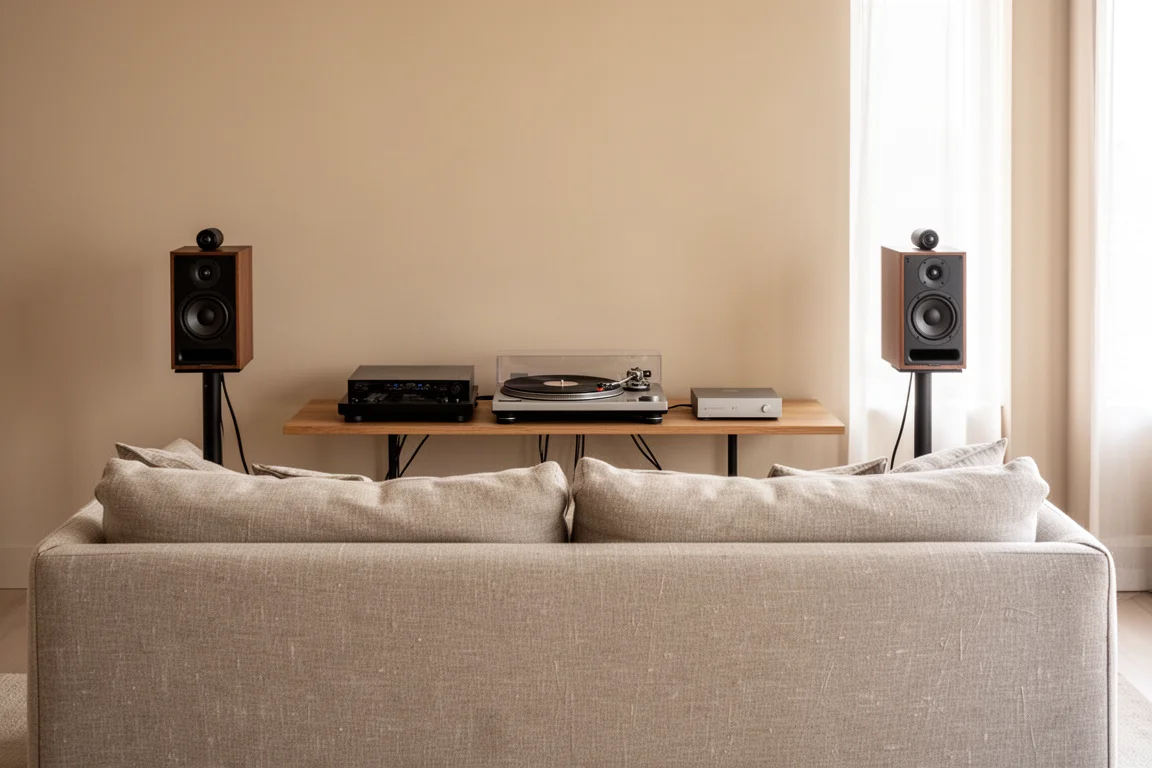
For vinyl listeners, the practical details matter. A Bluetooth turntable can stream wirelessly to the system with no extra hardware. A standard turntable needs an adapter to convert the system’s connection to standard RCA, and if the turntable has no built-in phono preamp, an external phono preamp is required as well. Adapters are inexpensive and widely available, but they are worth ordering before the speakers arrive.
Multi-room and multi-channel expansion is possible within the same app ecosystem. The Beolab 28 can be grouped with other products from the same brand, and a compatible television can serve as a centre channel with additional wireless speakers in front and behind. Using a soundbar as a centre channel between two Beolab 28 towers is not available yet, but the grouping framework suggests it could arrive over time.
If budget allows, the Beolab 28 is the strongest of the three systems here. If it does not, the KEF LS50 Wireless II and the Bowers & Wilkins Formation Duo remain credible ways to get a high-end active setup for less, as long as the reduced adjustability and full-range performance are acceptable.
Conclusion
The question of what an audio system is for has a practical answer in the Beolab 28. It removes the equipment carousel: no amplifiers to swap, no preamps to match, no subwoofer to integrate, and no reason to stop listening in order to change something. What remains is the music, delivered with depth, control, and a soundstage that is genuinely difficult to describe.
That experience comes with a premium price, a fiddly assembly process, and a couple of quirks worth knowing about in advance. For listeners who value flexibility, room adaptation, and a complete system in two slim towers, it is the most compelling of the three. For everyone else, the KEF LS50 Wireless II and the Bowers & Wilkins Formation Duo offer a lower entry point into the same idea, with fewer adjustments and less low-end extension.
Further reading
Related Reviews
Hi-Fi Audio
Accuphase C-57 vs Allnic H-7000V: Two High-End Phono Stages Compared
A fully balanced solid-state phono stage with a pitch-black noise floor meets a tube design built for well-loved records. Here is how to choose between them.
Hi-Fi Audio
Active vs Passive Hi-Fi: Five Components for a Modern System
Five components that define modern active and passive hi-fi systems, with the strengths, trade-offs and setup details worth weighing before you buy.
Hi-Fi Audio
Advance Paris A10 Apex Review: A Hybrid Integrated Amplifier That Covers a Lot of Ground
A French hybrid integrated amplifier with a class A tube preamp stage, analogue power meters, and an internal DAC and phono stage good enough to make extra boxes unnecessary.