Home Audio
Bang & Olufsen Beosound Theatre Review: A Luxury Dolby Atmos Soundbar
A twelve-driver Dolby Atmos soundbar with exceptional craft, deep adjustability, and a price that places it in a class of its own.
Introduction
The Bang & Olufsen Beosound Theatre arrives with a very specific brief: replace a rack of separates with one sculpted object that can carry an entire Dolby Atmos system. It is the most expensive soundbar on the market right now, and it is built less like a soundbar and more like a piece of furniture that happens to contain a surround system.
Inside the enclosure are twelve speakers and twelve amplifiers, arranged to fire directly at the listener and also toward the side walls and ceiling to create a 7.1.4 Atmos effect. Two 100-watt amplifiers drive the woofers, while the remaining ten drivers each receive 60 watts, and the system is capable of reaching 112 dB. That headroom is one reason it suits medium to large rooms rather than a compact living space.
The connectivity is equally complete. An HDMI ARC/eARC input supports pass-through up to 8K at 60 Hz and 40 Gbps, and there are three additional HDMI inputs for a Blu-ray player, a streaming box, or a games console. Bluetooth 5.1, AirPlay 2, Chromecast, Spotify Connect, and Wi-Fi round out the wireless side.
Who this product is for
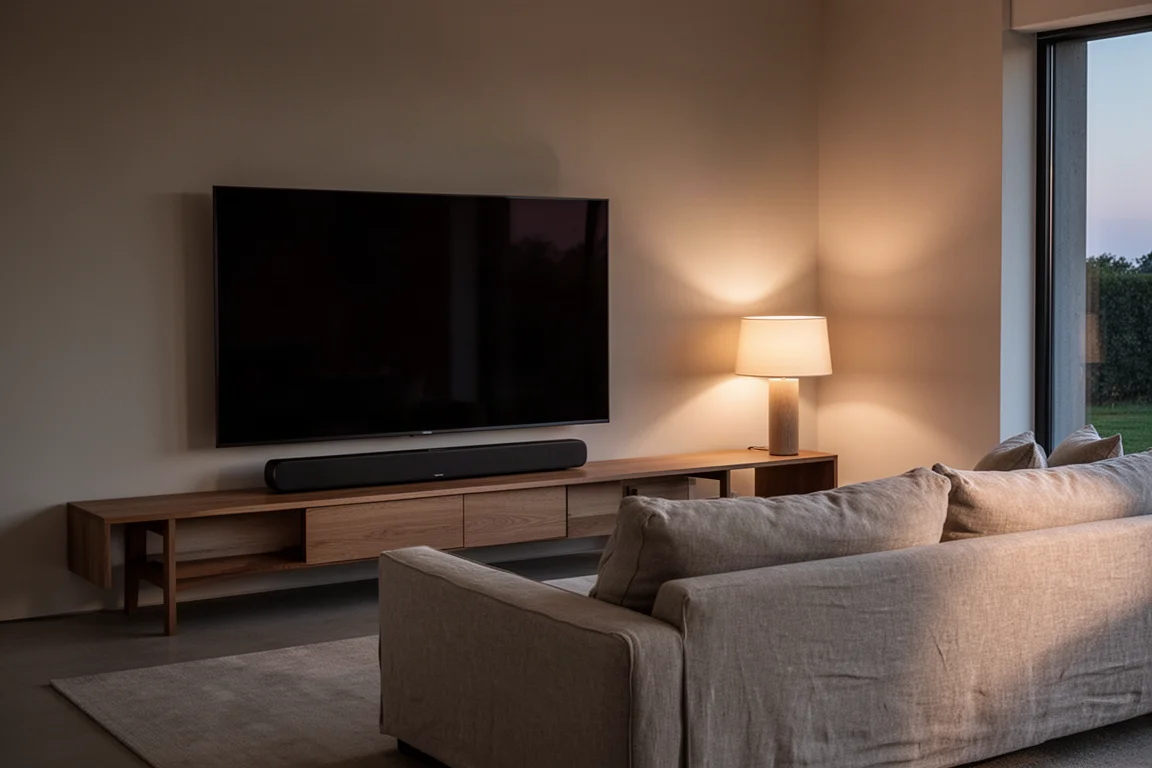
The Beosound Theatre makes the most sense for a listener with a genuinely large room and a genuinely large screen. The scale, dynamics, and movement it produces when fed a Dolby Atmos or surround signal are cinematic, and it fills the front of a room in a way that few single-box systems manage. It has been used beneath a 98-inch TCL XL series mini-LED TV and an 85-inch Sony display, and it looks entirely at home under both.
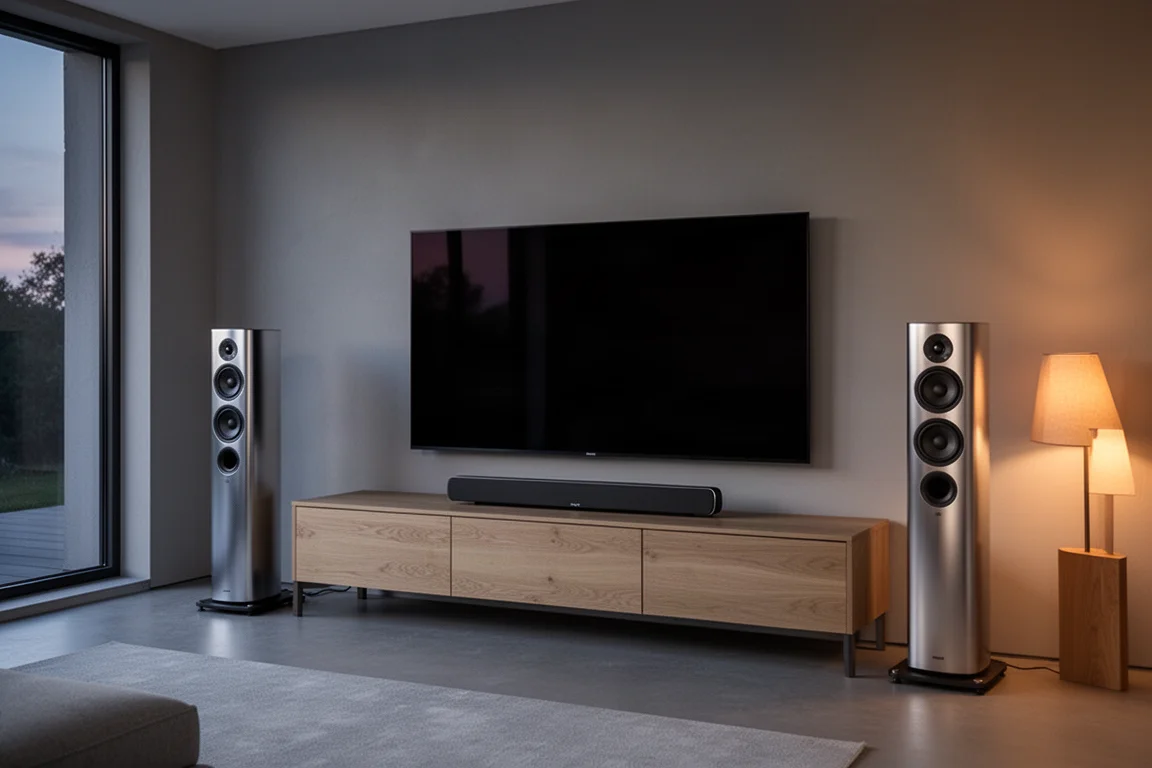
It is also the natural upgrade for households already invested in the Bang & Olufsen ecosystem. Existing owners can connect the Theatre to a number of current and older Bang & Olufsen speakers, including the Beolab 28, and effectively turn it into a dedicated centre channel and a hub for a full surround system. For those buyers the Theatre is less a soundbar and more the missing piece of a multi-speaker arrangement, and it is likely that a large share of owners use it exactly that way.
A third group is worth naming: people who want one beautifully made object that handles both films and music without adding a separate stereo system. The Theatre is designed to pull double duty here, and it does so convincingly.
Main strengths
The case for the Theatre rests on three things: how it sounds with film material, how it is built and finished, and how much control it hands to the owner.
Sound quality and Dolby Atmos performance
With a movie preset engaged, the Theatre measures roughly as you would expect from a premium bar in a cinema profile. Bass is slightly boosted, the midrange is recessed, and the treble is extended. There is a noticeable dip somewhere between roughly 150 Hz and 400 Hz, but the bass below 150 Hz masks it well enough that it rarely registers in everyday listening.
What is more interesting is what happens when the house processing, True Image, is switched off and the bar is placed in direct mode. The dip disappears and the response becomes far more linear, to the point where it can be tuned close to textbook neutrality. That flexibility matters, because few brands let owners reshape the sound of a product as thoroughly as this one does. Custom presets and saved settings for multiple listening positions make the bar unusually adaptable.

On film material the result is excellent. Dialogue is clear and intelligible with strong separation from the rest of the mix, and there are several ways to lift dialogue specifically if someone in the household prefers it a click or two forward. With Atmos content the bar sounds cinematic and captivating, and it can fill the front of a room in a way that is reminiscent of a traditional 3.1.2 setup.
One honest limitation: the Theatre does not produce sound from behind the listener in an open room. In a space that is open on one side, the effect lands closer to 180-degree immersion than a full 360-degree field, which is worth knowing before assuming a single box can replace rear speakers entirely. Adding compatible Bang & Olufsen speakers as surrounds is the way to complete that picture.
Design, build, and daily usability
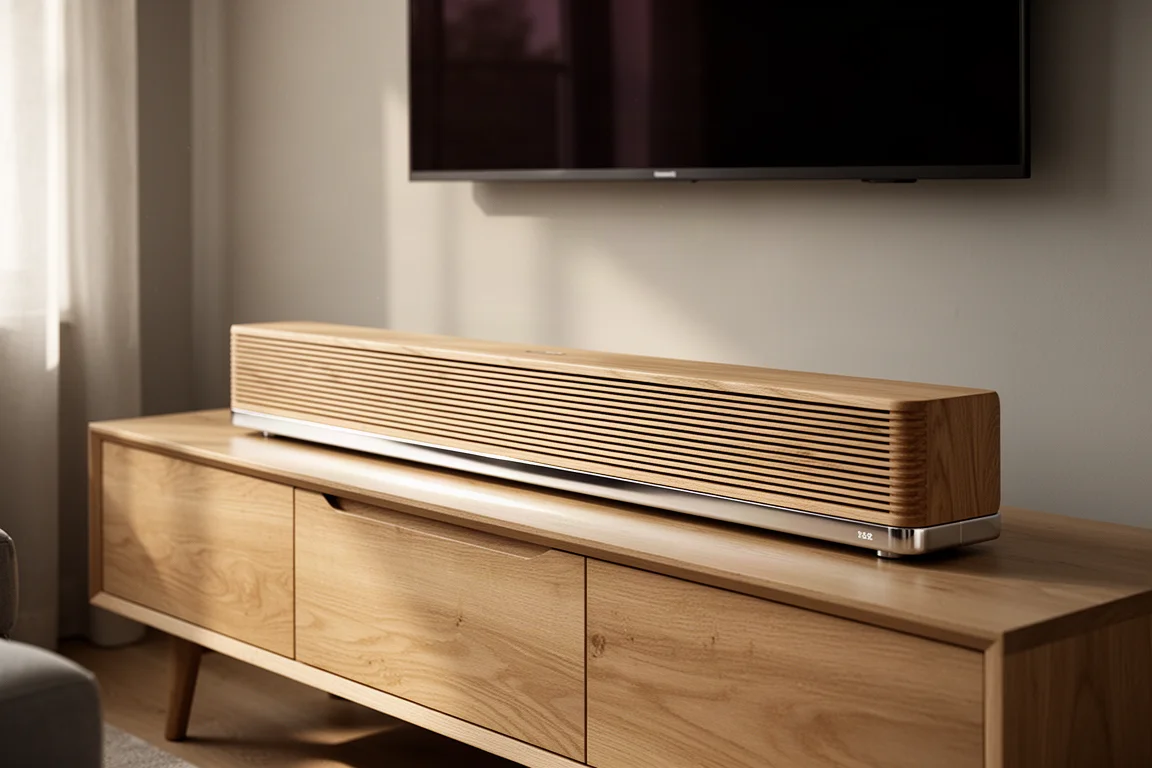
The Theatre is available in several finishes. The entry point is a natural grey fabric version, while the natural oak model adds a wood slat grille and a chrome aluminium base. It can sit on a table or be mounted to a wall, and it can also be bought as part of a complete TV package with an LG screen. It is a large bar, but it looks right at home beneath a large display.
Setup on the home network is straightforward through the companion app, and day-to-day living with the Theatre will feel familiar to anyone who has used a current Bang & Olufsen product. A supplied calibration microphone runs a series of sweeps through the app to level-match the drivers and tune the bar to the listening position, and those settings can be saved for more than one seat.
The remote deserves a mention. It is the same handset design the brand has used for the better part of a decade, and it is beautiful in the hand with the best range of any remote of its kind, working without a clear line of sight. The one annoyance is that changing the batteries requires taking the remote completely apart.
Things to consider before buying
There is no way around the central question with this product, and it is not only about sound.
Price and positioning
As configured with the oak finish, the Theatre sits at around $8,000, and the entry grey fabric version brings that closer to $7,000. That is a serious sum, and it invites direct comparisons.
The Sennheiser Ambeo Soundbar is the closest all-in-one rival. It cannot expand into a wider Bang & Olufsen system, which is exclusive to the Theatre, but in most other respects it delivers a comparable experience for considerably less money. The Samsung Q990B takes a different route entirely: it is a full surround system with wireless rear speakers and a separate subwoofer, and at roughly one-seventh the cost it can produce a cinematic result that is hard to surpass, even if it cannot match the Theatre’s footprint or finish. For a smaller room, the Beosound Stage is the more sensible Bang & Olufsen option, offering much of the experience for far less. And for buyers who care most about traditional two-channel listening, the Beolab 28 is the stronger choice, at roughly twice the price.
None of that changes what the Theatre is. It is exceptionally well made, and its styling is in a different league from plastic-clad alternatives. The cost reflects more than the wood slats and the aluminium base: there is manufacturing, processing, and programming behind it, and the brand has moved toward producing its products in a more sustainable way, which carries its own premium. It is also worth noting that pricing in the United States currently runs a little higher than in Europe and other regions.
Setup and room considerations
Bang & Olufsen will personally handle the assembly and in-home installation of the Theatre, which removes the most difficult part of ownership. If you end up assembling it yourself, budget a generous amount of time: it is a cumbersome job and not an experience that feels elegant or high-end.
Room shape matters more than the specification sheet suggests. Parallel walls help an all-in-one bar create a convincing surround field, so an open-concept space may not flatter the Theatre the way a dedicated room does. It is also worth being realistic about your content mix. For broadcast television such as news, sport, and other live programming, the Theatre is noticeably less impressive, and the sense of occasion and spaciousness that defines its film performance largely disappears.
Buying advice
If you have a large room, a large screen, and the budget to match, the Theatre is one of the most emotionally engaging home cinema components you can put in a living space. It is beautiful to look at, deeply adjustable, and capable of both serious film playback and genuinely enjoyable two-channel music.
The decision really comes down to what you are optimising for. Buyers who want the single most elegant all-in-one bar, and who value the ability to build it into a wider Bang & Olufsen system over time, will find the Theatre hard to beat. Buyers who want the maximum surround effect per dollar, or who mainly watch broadcast television in a smaller room, will be better served by the Stage, the Ambeo, or a system like the Q990B.
Conclusion
The Beosound Theatre is a luxury product through and through, and it earns that description as much through craft and control as through raw output. It delivers a cinematic, captivating performance with Dolby Atmos material, gives owners more tuning freedom than almost anything else in its class, and looks like nothing else on the shelf. It is not the smarter buy on paper, and it is not for every budget. But for the listener who wants one exceptional object at the centre of a large-room system, it is a soundbar worth experiencing.
Product link
View more details for Bang & Olufsen Beosound Theatre
This product is mentioned in the review. Check the specifications, options, and compatibility before buying.
View more details for Bang & Olufsen Beosound TheatreFurther reading
Related Reviews
Home Audio
Aperion Novus Tower and Center Review: Punchy Home Theater Sound With Real Refinement
A close look at the Aperion Novus tower and center speakers, from their layered paint finish and punchy bass to the 4-ohm load and what the price actually buys.
Home Audio
Arendal 1610 Tower Review: Flagship Dynamics in a Room-Friendly Tower
A compact floorstanding tower with three 8-inch aluminium woofers, a 5-inch carbon midrange, and the kind of bass heft usually reserved for much larger speakers.
Home Audio
Arendal 1723 S THX Review: A Reference Speaker Built Like a Tank
A practical look at the Arendal 1723 S THX, a sealed, THX-certified speaker with exceptional build quality, a very flat top end, and a midrange that responds beautifully to EQ.