Home Audio
Baach Canvas Review: One Speaker for Music and Your TV
A single-chassis stereo speaker that also serves as a TV floor stand or wall mount. Here is what the Baach Canvas does well, where it falls short, and who should buy it.
Introduction
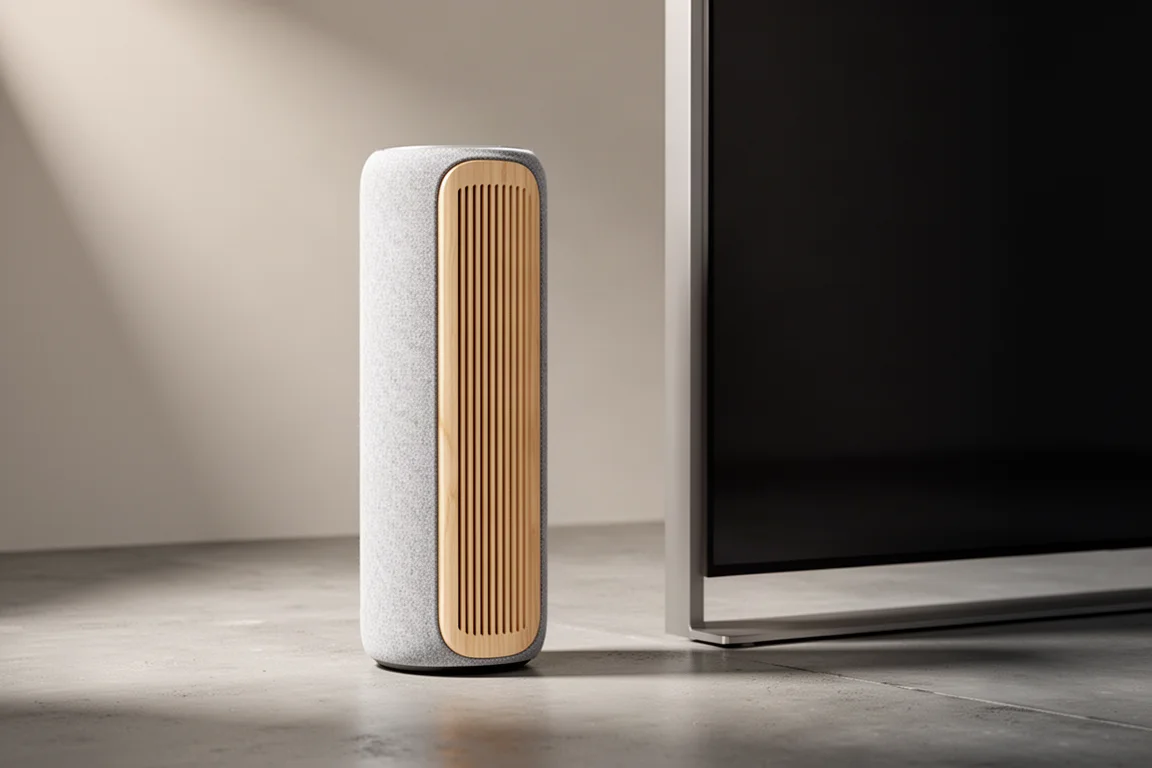
The Baach Canvas is one of a very small number of home audio products that genuinely merges form and function. Behind its grille it is a stereo speaker, but it is also designed to sit beneath a television as a floor stand or to hang on a wall as a mount, taking over the TV’s own speakers through a single HDMI connection.
That combination is unusual. There are plenty of all-in-one speakers and plenty of soundbars, but very few products work equally well as furniture, as a hi-fi music system, and as the audio foundation of a living room television.
The Canvas does not try to imitate a surround system. Its aim is to deliver something closer to the stereo experience of a pair of two-way powered speakers from a single chassis, and it pursues that goal with a level of clarity and control that stands out at its price.
At close to $4,000, it is a serious purchase. This review covers what it does well, where it falls short, and who should consider it.
Who the Baach Canvas Is For
The Canvas is aimed at listeners who would rather own one carefully designed box than a collection of components. There is no separate receiver, no subwoofer, and no pair of surround speakers to position around the room. Everything is built into a single column that can stand on the floor, sit on a sturdy shelf or cabinet, or be mounted to a wall.
It is also designed to work with any flat panel TV up to 77 inches, and all of the hardware and accessories needed to set it up are included. That makes it a practical choice for apartments, smaller living rooms, and open-plan spaces where clutter is unwelcome.
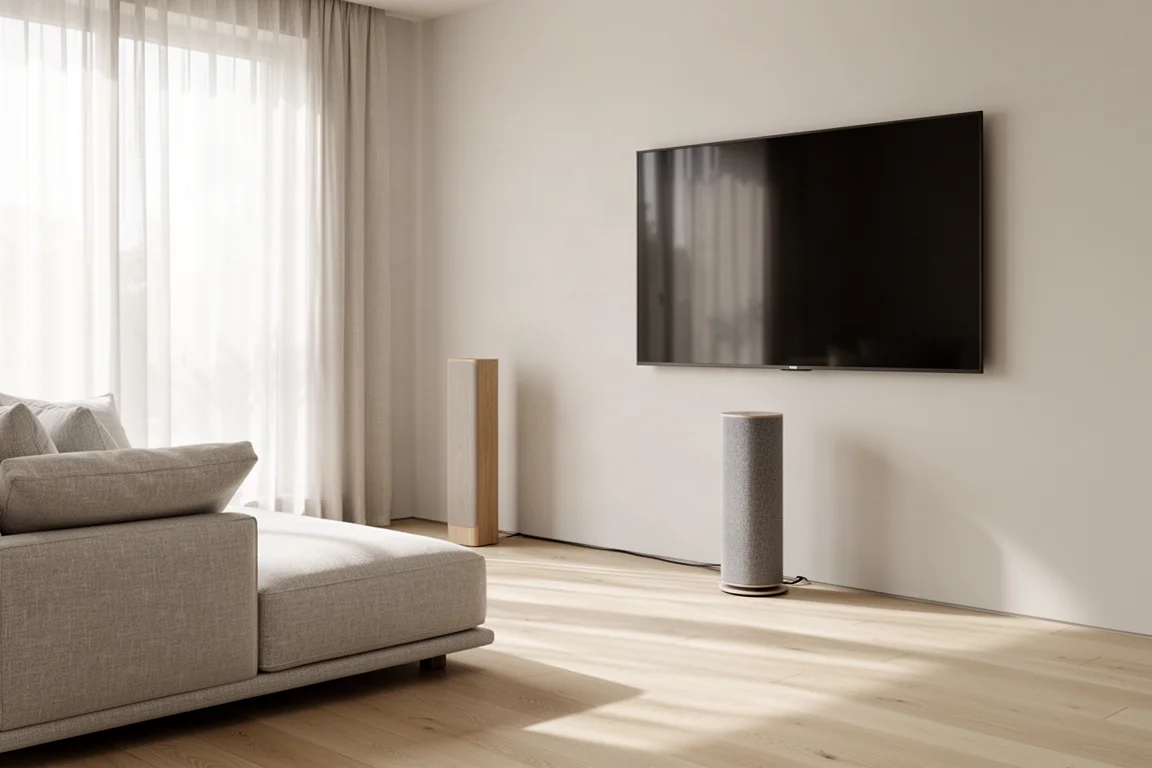
If music comes first and films come second, and you want that music to come from something that looks deliberate rather than technical, the Canvas fits the brief. If you want a true surround system with effects moving behind and above you, it is not that product, and no amount of setup will make it one.
Design, Mounting, and Setup
The included TV mount works like a spine that bolts to the top of the speaker, and it is compatible with any VESA-compliant television. With many TVs the Canvas sits entirely flush, creating a seamless line between the speaker and the screen.
The top edge of the front grille is made from an IR-transparent dark polycarbonate, which lets a remote control work straight through it. Some televisions position their IR sensors so that they protrude further than others, and in those cases a very small gap between the speaker and the TV may be necessary.
Behind the mount there is room to hide wires and third-party peripherals, such as a streaming box or a network audio bridge. It is a thoughtful detail that keeps a finished setup clean.
Sound Quality: Stereo Imaging, Tone, and Bass
Underneath the grille the Canvas uses two roughly 1-inch silk dome tweeters and two 6.5-inch paper cone woofers, supported by two passive radiators. Four Class D amplifiers deliver a total of 250 watts, and the reported frequency response is 30 Hz to 20 kHz.
Rather than firing drivers sideways and upward like a soundbar, the Canvas relies on BAACH 3D, a cross-talk cancellation approach that keeps the right ear hearing the right drivers and the left ear hearing the left ones. The result is a stereo image that opens well beyond the physical width of the cabinet, and leaving BAACH 3D engaged is the right choice for the most spacious presentation.

Tonally the Canvas is clean, clear, and almost unnaturally precise, with a start-stop immediacy that passive speakers and separate amplifiers struggle to match. It is neutral and uncolored enough that other speakers can sound slightly veiled by comparison, and the lateral soundstage can stretch to roughly 10 to 13 feet with well-recorded material.
Bass is the most distinctive part of the story. Notes rise and peak extremely quickly and hit with real authority, but they also fade quickly, so the organic sense of air and decay that a plucked double bass or a low piano note naturally produces is trimmed short. It is an articulate, detailed, and highly intelligible performance, and it takes a little getting used to.
Room Correction and Controls
Built-in room correction is included. It can be run with a phone’s built-in microphone or with the optional Zen wireless microphone, which costs about $150. Either way, the process requires pairing your device to the speaker through its app, then walking around the room for roughly 30 seconds to a minute while the system maps the space. The correction is then applied automatically.
The measurements focus mostly on bass and the lower mid-range, stopping at around 1,000 Hz. Between the two options, the Zen microphone produces the more refined and accurate result, while the phone-based process delivers a similar overall experience.
Adjustment beyond that is limited. Room correction can be switched on or off but not tuned, and there are no EQ settings or presets. A single bass tone control is provided, and many listeners will find the default setting of zero perfectly adequate.
Movie Performance: Spacious, Not Surround
The Canvas is not a surround sound system. There are no surround speakers inside it and no reflective drivers either, so effects will not fly overhead or travel to the back of the room. What it does offer is a spacious, near-surround presentation that matches the scale of the picture on screen, even with a very large television.
Dialogue sits front and center and is naturally clear, with no dialogue enhancement modes or processing to switch on. For listeners who prefer an unprocessed sound, that counts as a virtue.
Two limits are worth understanding before buying. Bass rolls off just after 30 Hz, so the deepest effects lose some dimension. The Canvas also has a physical ceiling on how high it can place sound when it is used on its floor mount: overhead effects reach roughly 6 to 7 feet, which is enough to fill the top of a television but not the ceiling of a tall room.
How It Compares to Other All-in-One Systems
Only a handful of products occupy this space, and most of them come from the same premium corner of the market. A single standalone all-in-one speaker such as the Bang & Olufsen Beosound A9 is easier to pick up and move between rooms, and it benefits from a more fleshed-out ecosystem and a more refined user experience. The Canvas is the better of the two at stereo imaging, which makes it the more compelling option when one system has to cover both music and films, while a standalone speaker remains the simpler choice for ambient, music-only listening.
The two soundbar-shaped alternatives are easy to place as well. The Bang & Olufsen Beosound Theatre is a true all-in-one seven-channel Atmos soundbar with more inputs and more customization, and it adds a slightly greater sense of three-dimensional surround, but it costs roughly three times as much, and adding its optional floor stand pushes the price higher still. The Bang & Olufsen Beosound Stage costs about half as much as the Canvas and is equally good with music and films, with reflective speakers that create a slightly more immersive sound, but it cannot match the Canvas for bass, absolute volume, or dynamic punch, and it cannot act as a TV stand or expand visually to suit a large screen.
The most obvious visual reference point is the Bang & Olufsen Beovision Harmony, which starts at around $26,000 and is built to work inside a specific ecosystem. The Canvas borrows some of that design language for far less money. Against traditional soundbar systems that rely on separate surround speakers and dedicated subwoofers, such as those from Sonos, Samsung, and Sony, the Canvas will not create the same illusion of a discreet home theater, but no conventional soundbar can match it for coherent, near-full-range fidelity from a single box.
Things to Consider Before Buying
The input and output panel is the Canvas’s weakest physical detail. The connections are limited and cramped. The HDMI port is difficult to reach and may not leave enough room for every HDMI cable on the market, while the optical and analog inputs both require adapters. Given the size of the speaker, the small panel is a puzzling compromise.
The app is functional but not finished. The interface and overall user experience need work, and there is no way to save user settings or to exercise much control over the speaker’s response beyond room correction and the bass control.
Room correction is included, but the best tool for the job is not. The wireless Zen microphone is an optional extra at around $150 on a speaker that already costs close to $4,000, and it would make more sense in the box.
Finally, the wood slat cover is one of the more elevated looks available, but its edges are sharp enough to cut if you brush against them. That is worth knowing in a home with small children or pets.
Buying Advice
Buy the Baach Canvas if you want a single, well-designed object that can serve as a genuine hi-fi speaker, as a television’s sound system, and as the stand the TV sits on. It makes the most sense for music-first listeners who value stereo imaging and a neutral tonal balance, who want a clean setup with no extra boxes, and who own a flat panel TV up to 77 inches.
Look elsewhere if your priority is true surround sound with effects moving around and above you, if you want deep bass extension below 30 Hz, or if you need a wide selection of inputs and extensive EQ control. A conventional soundbar system with separate surrounds and a subwoofer will serve those goals more directly.
Weighed against its closest rivals, the Canvas is the value pick. It undercuts the more expensive all-in-one home theater options while offering better stereo performance than a single standalone speaker, and that combination is what makes it worth the money.
Conclusion
The Baach Canvas earns its place because it solves a real problem: how to get genuinely good sound without filling a room with boxes. Its stereo imaging, tonal neutrality, and articulate bass make it a convincing music speaker, and its ability to become a TV stand or a wall mount makes it an unusually practical one.
The trade-offs are clear. It is not a surround system, its bass notes fade faster than they should, and its input panel and app still need refinement. If those limits do not describe your priorities, the Canvas is one of the most stylish and comprehensive plug-and-play lifestyle home theater solutions you can buy.
Product link
View more details for Baach Canvas
This product is mentioned in the review. Check the specifications, options, and compatibility before buying.
View more details for Baach CanvasFurther reading
Related Reviews
Home Audio
Aperion Novus Tower and Center Review: Punchy Home Theater Sound With Real Refinement
A close look at the Aperion Novus tower and center speakers, from their layered paint finish and punchy bass to the 4-ohm load and what the price actually buys.
Home Audio
Arendal 1610 Tower Review: Flagship Dynamics in a Room-Friendly Tower
A compact floorstanding tower with three 8-inch aluminium woofers, a 5-inch carbon midrange, and the kind of bass heft usually reserved for much larger speakers.
Home Audio
Arendal 1723 S THX Review: A Reference Speaker Built Like a Tank
A practical look at the Arendal 1723 S THX, a sealed, THX-certified speaker with exceptional build quality, a very flat top end, and a midrange that responds beautifully to EQ.