Hi-Fi Speakers
Audio First Fidelia Review: A Kit Speaker With Reference-Grade Balance
A compact two-way kit speaker that measures remarkably flat and stays even off axis, with output limits worth understanding before you buy.
Introduction
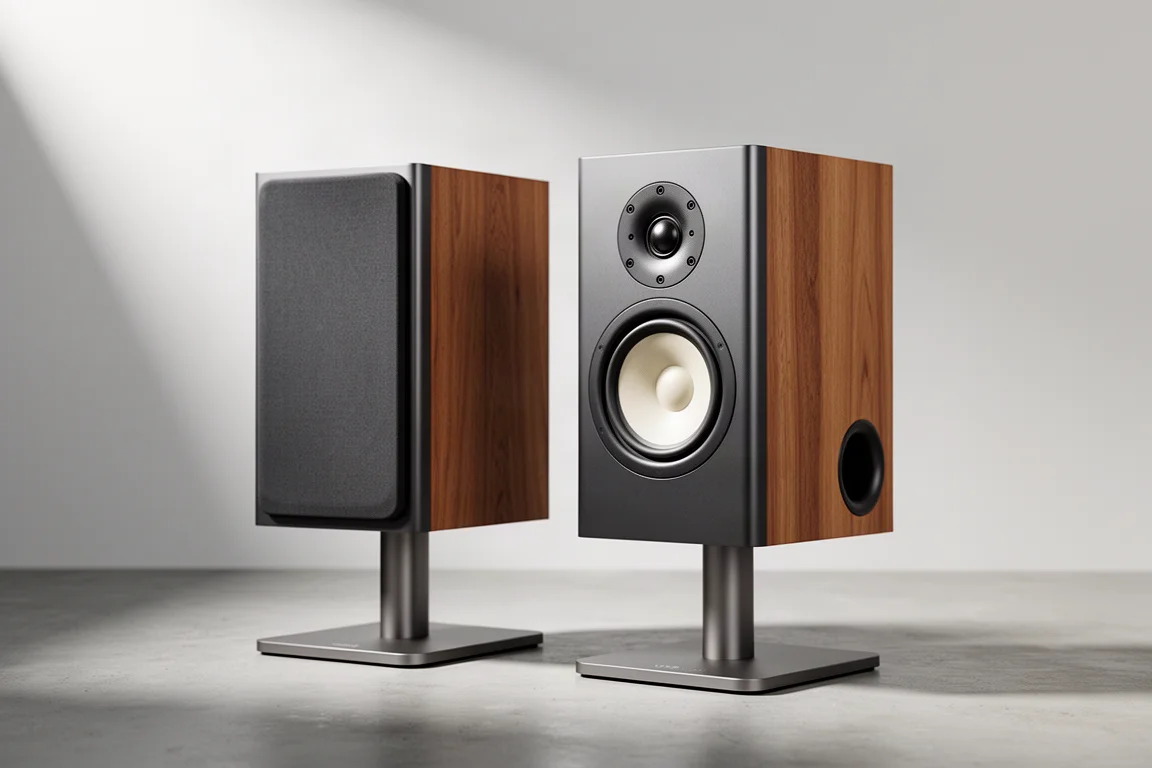
The Audio First Fidelia is a compact two-way bass reflex bookshelf speaker sold in kit form. Pricing runs at about £950 in the UK, or roughly $1,250 USD for the pair shipped to the United States. Each cabinet pairs a 1-inch ceramic aluminium dome tweeter with a 5-inch ceramic aluminium cone woofer, crossed at 1,560 Hz with a third-order acoustic slope. Sensitivity is specified at 84 dB, impedance at 4 ohms with a 3.2 ohm minimum, and recommended amplifier power at 40 to 250 watts. Each speaker weighs about 6.8 kg.
What separates the Fidelia from most speakers at this price is not a headline number but the shape of its response. It measures very linear, it keeps a wide and even radiation pattern through the midrange to tweeter handoff, and it reaches roughly 50 Hz in a normal room. Those three traits together are uncommon in a cabinet this size.
The trade-off is headroom. Push past about 90 dB at 10 feet and the speaker starts to run out of gas, which makes a subwoofer sensible in larger rooms and close to essential for home theater duty. This article covers where the Fidelia shines, where it gives ground, and which listeners it suits.
Who this product is for
The Fidelia fits listeners who put tonal accuracy ahead of volume. In a small to medium room at typical listening distances, it delivers a balanced and enveloping presentation, and it does not ask for an exotic amplifier beyond the recommended 40 to 250 watts.
It also works well as a fixed point of reference. Its neutrality and even off-axis behaviour make it a stable baseline when judging how another speaker colours a familiar recording, which is exactly the role a genuinely linear speaker should play in a collection.
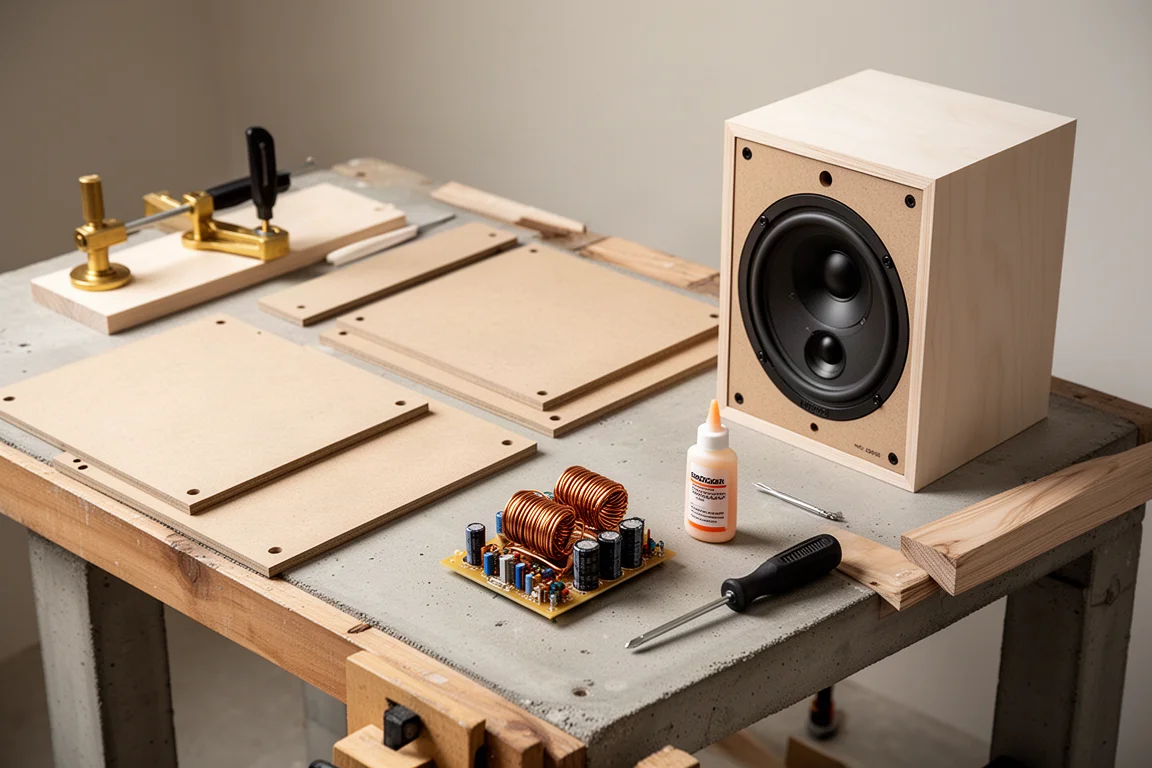
Because it ships as a kit, it appeals to builders as well. The kit supplies the crossover, flat-pack cabinet panels and the baffle, covering everything needed to assemble the speaker apart from the tools themselves. Audio First publishes build guidance for the assembly, and following it is worthwhile on a first build.
Main strengths
The clearest strength is linearity. The on-axis response is flat and accurate, and the in-room result behaves the way a well-designed speaker should, tilting down gently rather than sounding bright or thin. Bass extension lands around 50 Hz in a typical room, which is respectable for a small two-way.
Radiation is the second strength. Horizontal dispersion spans roughly plus or minus 70 degrees and stays even, so the tonal balance holds up as you move side to side rather than collapsing into a narrow sweet spot. Critically, that evenness continues through the transition from the midrange into the tweeter, a handoff that most designs only manage with a coaxial driver or a carefully matched waveguide.
That combination is what makes long sessions easy. Energy reflected from the side walls does not shift the timbre of the speaker, so the character stays consistent from seat to seat, even though precise imaging still depends on timing and level at each ear. In direct comparisons with far more expensive pairs, the Fidelia has come out ahead on overall tonal balance.
Sound quality and measured performance
Measured sensitivity comes in at about 83.5 dB, a little below the roughly 85 dB typical of bookshelf speakers. Low sensitivity usually buys something in return, and here it buys about 5 to 10 Hz of extra low-frequency reach. Anechoic F3 sits at 53 Hz and F10 at 38 Hz, with in-room bass extending to around 50 Hz. Impedance averages about 4 ohms and dips to a minimum of 3.2 ohms, so a stable amplifier is a sensible pairing.
The frequency response is smooth and flat, with only a minor diffraction artefact in the region of 4 to 5 kHz. Directivity is very even across the crossover region, which is why the reflected and direct sound stay in step rather than creating a spectral imbalance.
Two tonal notes are worth flagging. There is a mild lift around 5 to 6 kHz that can make some material sound slightly sibilant, and if the speakers are toed out about 30 degrees, a small dip between 2 and 3 kHz can add a hint of warmth to the upper midrange. Both are minor. Decay shows a little resonance hanging around 2 to 3 kHz and another near 8 kHz.
Vertically, the speaker is well behaved when you are seated above the tweeter axis, holding together to about plus 50 degrees, but listening from below the tweeter midline is not recommended. On distortion, multi-tone testing at a high output of roughly 96 dB shows increased distortion through the midrange, and crossing over to a subwoofer at 80 Hz measurably reduces that distortion while freeing up usable power. Compression testing shows a loss of about 3 to 4 dB at certain frequencies when driven across a 76 dB to 102 dB range. At more moderate levels around 96 dB at one metre for a single speaker, which is representative of small and medium rooms, that compression is not a practical concern.
Things to consider before buying
The main limitation is maximum output. Above roughly 90 dB at 10 feet, with only a 5-inch midwoofer and a 1-inch dome tweeter handling the range, the speaker runs out of dynamic headroom. A large room or a home theater setup will want a subwoofer to fill in the bottom octaves and take load off the midwoofer.
The treble lift around 5 to 6 kHz is the one tonal deviation worth knowing about in advance. It is honest about what it does, but on brighter recordings it can draw attention to itself.
Placement height matters more than usual. Sitting below the tweeter axis degrades the vertical response, so stands that put the tweeter at or slightly below ear level are the right call. Sensitivity is also on the low side at 83.5 dB measured, so budget for an amplifier with real current delivery rather than a low-power valve design.
Finally, there is the kit itself. Assembly is part of the purchase, and while everything needed for the build is included apart from tools, it is still a project rather than an unboxing.
Setup, placement, and amplification
Despite the rear port, the Fidelia works well fairly close to the wall. About a foot of space behind the cabinet proved plenty to get the low end working, and moving them much further out made the roll-off more apparent. As always, the exact distance depends on the room, so it is worth experimenting.
Toe-in is flexible. Both a straight-ahead on-axis setup and a 30 degree toe-out into the room produced good results, which follows from the wide radiation pattern. A 4 ohm load with a 3.2 ohm minimum and 84 dB sensitivity means the recommended 40 to 250 watts is a realistic window, and a solid-state amplifier with good current output will get the most from the design.
Buying advice
If the goal is maximum tonal accuracy per pound or per dollar, the Fidelia is one of the strongest options at its price. At about £950 in the UK, or roughly $1,250 USD for the pair shipped to the United States, it competes on balance rather than on brute output, and it holds its own against considerably more expensive speakers on that measure.
Buying it in kit form saves money if you are comfortable with assembly. The kit includes the crossover, flat-pack panels and baffle, and the published build guidance makes the process manageable. If you would rather not build a speaker, that trade-off is worth weighing against the savings.
Skip it if you need high playback levels in a large space, or if you want a speaker that can be driven hard without a subwoofer. In a small to medium room, listened to at sane levels, the Fidelia is easy to recommend.
Conclusion
The Audio First Fidelia is a rare combination: a compact, affordable two-way with a genuinely linear response, wide and even dispersion, and usable bass extension to about 50 Hz. Its limits are clear and predictable, namely a soft output ceiling, a mild lift in the lower treble, and a narrow vertical window below the tweeter axis. For listeners in small to medium rooms who value accuracy over volume, and who are happy to build a kit, it is a compelling choice. For large rooms and home theater, plan on adding a subwoofer and enjoy what the speaker does best.
Product link
View more details for Audio First Fidelia
This product is mentioned in the review. Check the specifications, options, and compatibility before buying.
View more details for Audio First FideliaFurther reading
Related Reviews
Hi-Fi Speakers
1723 THX Tower vs 1528 Bookshelf: Which Speaker Fits Your Room?
Two speakers at roughly the same price, built very differently. How the 1723 THX tower and the 1528 bookshelf compare on construction, bass, power needs, and sound.
Hi-Fi Speakers
Acoustic Energy AE 300 Review: Deep Bass From a Compact Standmount
A two-way standmount with real wood veneer, surprising low-end weight, and a warm, easygoing character. Here is what to know before buying.
Hi-Fi Speakers
Acoustic Energy AE1 40th Anniversary Review: A Modern Take on a British Classic
A compact standmount that revives a 1980s favorite with all-new parts, a warm mid-centric balance, and a price of £1,499 per pair.