Hi-Fi Speakers
Audio First Cadencia 3 Review: A Three-Way Monitor With Wide, Low-Distortion Sound
The Audio First Cadencia 3 is a three-way bass reflex monitor with very low distortion, wide directivity and punchy midbass, plus a mild upper-midrange dip that a single EQ band can address.
Introduction
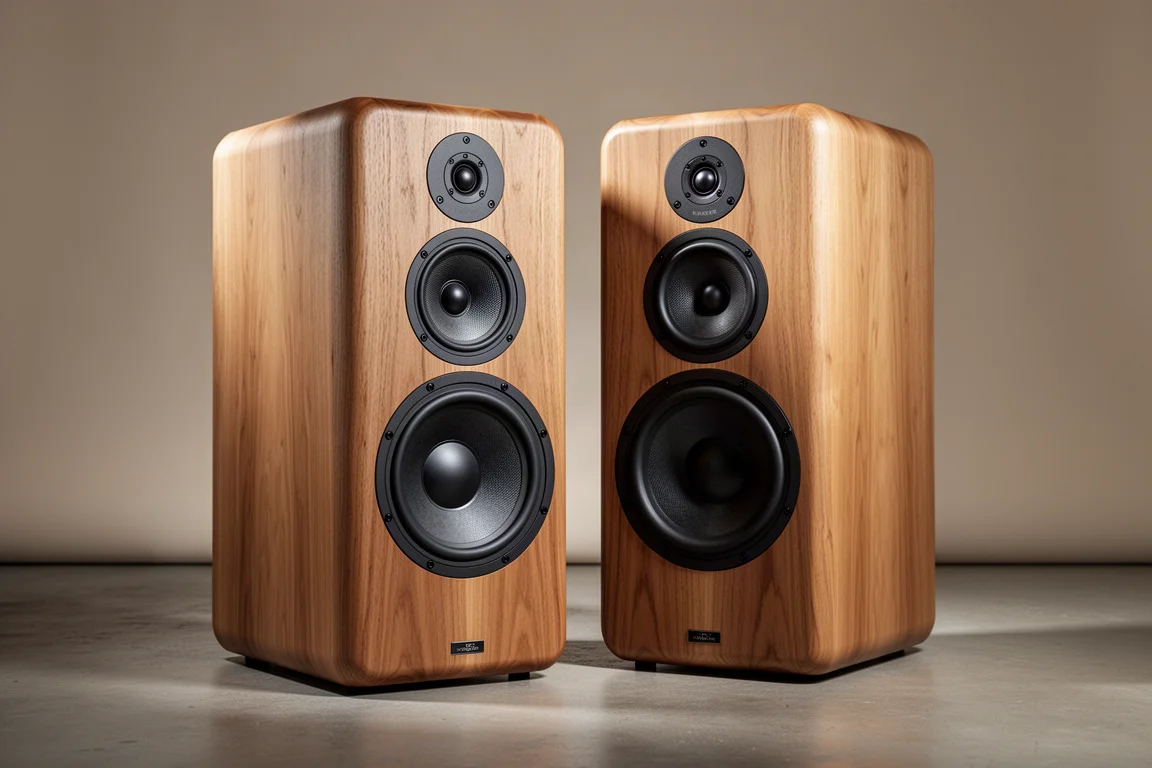
The Audio First Cadencia 3 is a three-way bass reflex monitor that can be ordered either as a kit or as a complete speaker. The pair evaluated here arrived in kit form with unfinished cabinets, while the complete version is finished in an oak veneer. Either way, the driver complement is the same: a 1.1 inch textile tweeter, a 4.5 inch textile midrange and a 9 inch woofer.
That makes it a large speaker by stand-mounted standards, and it is worth planning for before you order. The listening notes below come from a large open-plan room, so your own space will shape the result. What follows is a close look at how the Cadencia 3 is built, how it sounds with familiar material, how it measures, and how it sits next to two other monitors measured in the same session.
Who the Audio First Cadencia 3 Is For
This is a speaker for listeners who want a neutral, low-distortion monitor with a wide radiation pattern, and who are willing to place it with some care. The on-axis response and listening window are close to textbook apart from one region, and midrange distortion stays very low, which makes the Cadencia 3 a natural fit for people who listen at realistic levels and want the character of the recording rather than the character of the speaker.
It also suits buyers who like the idea of a kit. The kit version arrives with an unfinished cabinet, which gives you the option to finish it yourself, while the complete version removes that work. If you want a small, easy-to-hide bookshelf speaker, this is not that product: the cabinet is closer to a large monitor, and it needs a stand that can carry it securely.
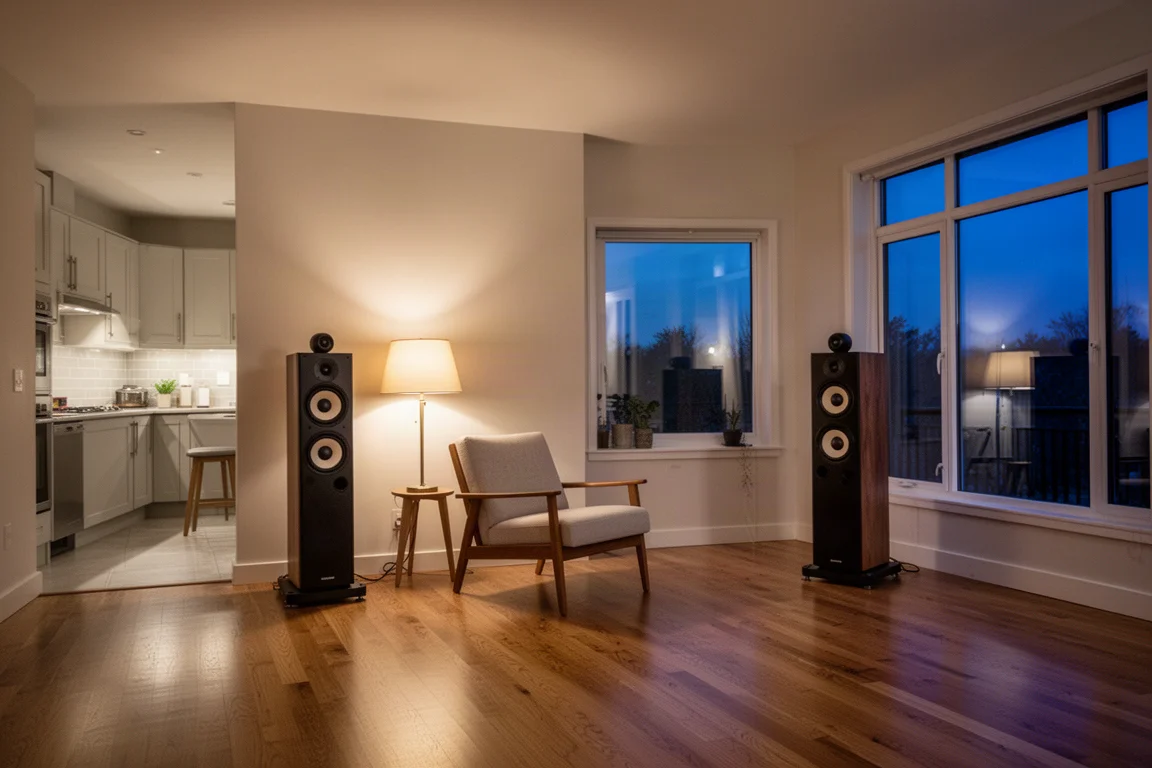
The wide directivity is worth calling out for anyone with a room that is wider than it is deep. Elements in the mix appear well outside the cabinets, roughly 60 to 70 degrees across, which gives the presentation a sense of scale that narrower speakers do not produce. Listeners who prefer a tightly focused image may find it a touch generous, but it is easy to enjoy.
Design, Drivers, and Setup Notes
The three-way layout splits duties cleanly: the 9 inch woofer handles the low end, the 4.5 inch midrange covers the critical middle, and the 1.1 inch tweeter takes the top. The bass reflex cabinet extends the low end rather than rolling off early, and the measurements back that up with an F3 of 43 Hz and an F10 of 26 Hz.
Placement matters more than usual here because the vertical window is narrow. Ears should sit on axis with the tweeter. Move much more than about 10 degrees above that line and the response becomes noticeably rougher. In practice, a small amount of toe-out worked best, around five degrees, pointing slightly over the listening position. Firing the speakers straight down the room gave up too much high-frequency detail and made the image less focused.
There is one other setup consideration. The speaker narrows fairly quickly in the top octaves, so the further you sit off axis, the more of that upper detail you lose. A little patience with positioning pays off.
How the Audio First Cadencia 3 Sounds
Start with dynamics. On material with a sharp snare, the rim shot keeps its bite at high volume instead of softening the way a compressed design would. Pushing the level up makes the midrange louder, not grainier, which is the audible signature of low distortion rather than a voicing choice.
The sense of space is the other standout. On recordings captured in a large room, the Cadencia 3 reproduces that size in a way that is easy to notice and hard to ignore, because the wide radiation pattern wraps sound around the listening position rather than projecting it in a narrow beam.
Detail retrieval is strong as well. A quiet percussive click sitting on the right side of the stage, well outside the cabinets, is easy to pick out, and it stays balanced rather than jumping forward. It is not quite the finest rendition of that particular sound, but it is close enough that living with the speaker would not feel like a compromise. A shaker near the start of the same track sounds balanced overall, though it could use slightly more air.
Low end and punch are where the Cadencia 3 plays to its strengths. Midbass has real attack, with a guttural weight around 50 Hz before the response rolls off below that, and useful output into the mid-40s in-room.
Where it gives a little away is the upper middle. Hand claps and snares come through as distinct but slightly short on lift, and the overall picture suggests a mild scoop through the upper midrange and lower treble. A vocal with sibilance baked into the recording came across a touch more forward than expected, which lines up with the same region.
The correction is simple. A single EQ band at 2.5 kHz, plus 1 dB with a Q of about 1, restores the snap, detail and dynamicism that the dip takes away. It is the only adjustment worth considering, and it does not disturb anything else.
Measurements, Directivity, and Comparisons
Sensitivity measures around 86.4 dB, which means the Cadencia 3 wants a competent amplifier rather than a low-powered one. On-axis response and the listening window are both very good, with the upper-midrange dip as the one visible deviation. There is also some roll-off in the high frequencies, so cymbals and snares lose a little air, although that matters less when you listen on axis.
Directivity is wide and well controlled through the midrange, at roughly plus or minus 70 degrees, then narrows fairly quickly above about 4 kHz. That combination explains the placement findings: too much toe-out costs high-frequency detail, while a straight-ahead setup loses focus.
Multitone distortion is very low through the midrange, and the speaker handles high output levels without complaint, which matches what the listening notes suggested. The estimated in-room response tracks the anechoic data closely: a dip through the upper middle followed by a mild lift in the lower treble.
Two other monitors measured in the same session put those results in context. The MoFi SourcePoint 10 Master Edition is about 3 dB more sensitive, does not reach as low (F3 of 56 Hz, F10 of 40 Hz), shows a more ragged anechoic response, and has higher distortion, though it stays in a tolerable range and its coaxial driver keeps dispersion uniform across a broad window. The Arendal 1528 monitor is slightly less sensitive than the Cadencia 3, extends to an F3 of 46 Hz and an F10 of 30 Hz, and posts the lowest distortion of the three, but it has a pronounced dip in the lower midrange that can thin out vocals, along with less consistent directivity and some off-axis energy around 2 kHz that benefits from sidewall absorption. On overall neutrality, the Cadencia 3 is the strongest of the group.
Things to Consider Before Buying
The upper-midrange scoop is the main thing to weigh. Depending on what you listen for, it can read as a civil, easygoing presentation or as a slight lack of attack, and both impressions come from the same measurement. The single-band EQ above resolves it if you have the tools.
The high-frequency roll-off is the second consideration. If you sit off axis, cymbal and snare air will be softer than neutral, and the vertical window is narrow enough that ear height matters. Plan for stands that put the tweeter at seated ear level.
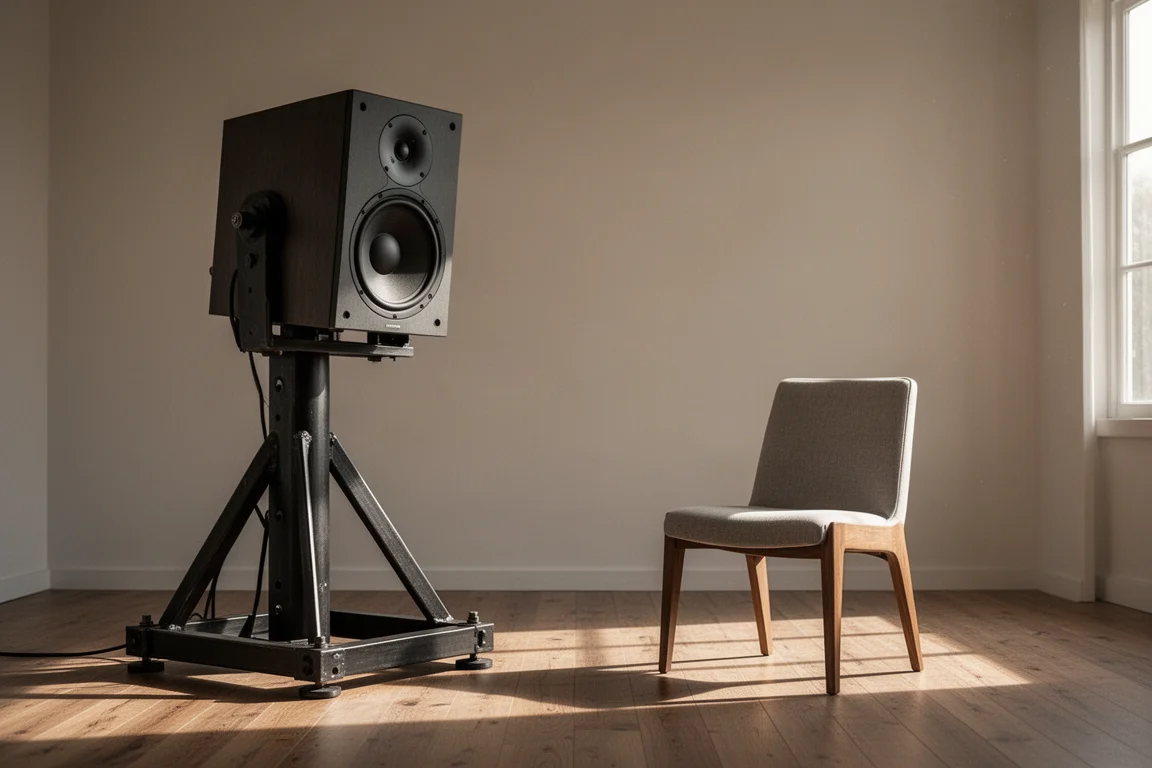
Size and support are practical points. The cabinet is large for a stand-mounted monitor, so the stand needs to be genuinely capable rather than decorative. Availability has been staggered as well, with the complete version listed ahead of the kit on the manufacturer’s timeline, so it is worth checking current lead times before ordering.
Buying Advice
Approximate pricing at the time of writing puts the kit at around €2,483, roughly $2,970, with the complete version listed at approximately 4,733 and a pair at 5,660. The kit saves money if you are comfortable finishing a cabinet yourself; the complete version in oak veneer saves time.
Pair the Cadencia 3 with an amplifier that has enough clean power for its 86.4 dB sensitivity, and budget for stands that place the tweeter at ear height. If your room is large and open, the wide directivity is a genuine advantage. If you listen close to a wall or need a compact footprint, the cabinet size and placement sensitivity are worth thinking through first.
Conclusion
The Audio First Cadencia 3 is a very good three-way monitor. Its linearity, wide directivity, low midrange distortion and punchy midbass put it in strong company, and the small upper-midrange scoop is the kind of flaw a single EQ band can address. Buyers who want a neutral, wide-sounding stand-mounted speaker and who are willing to place it carefully will find a lot to like.
Product link
View more details for Audio First Cadencia 3
This product is mentioned in the review. Check the specifications, options, and compatibility before buying.
View more details for Audio First Cadencia 3Further reading
Related Reviews
Hi-Fi Speakers
1723 THX Tower vs 1528 Bookshelf: Which Speaker Fits Your Room?
Two speakers at roughly the same price, built very differently. How the 1723 THX tower and the 1528 bookshelf compare on construction, bass, power needs, and sound.
Hi-Fi Speakers
Acoustic Energy AE 300 Review: Deep Bass From a Compact Standmount
A two-way standmount with real wood veneer, surprising low-end weight, and a warm, easygoing character. Here is what to know before buying.
Hi-Fi Speakers
Acoustic Energy AE1 40th Anniversary Review: A Modern Take on a British Classic
A compact standmount that revives a 1980s favorite with all-new parts, a warm mid-centric balance, and a price of £1,499 per pair.