Standmount Speakers
Arendal Sound 1528 Monitor 8 Review: A Full-Range Standmount Built Like a Tower
A three-way standmount with a 3-inch HDF baffle, 22 Hz tuning, and 104 pounds per cabinet. Here is what the 1528 Monitor 8 does well and what to weigh before buying.
Introduction
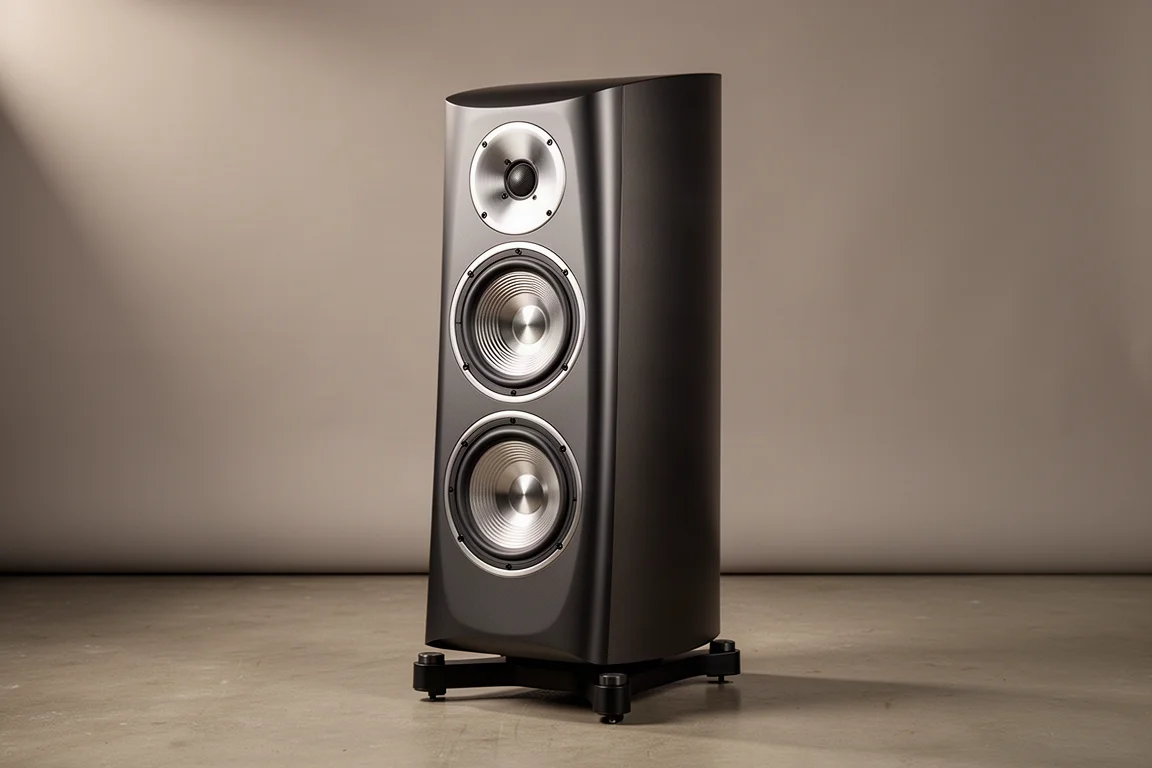
The Arendal Sound 1528 Monitor 8 is a three-way standmount loudspeaker priced at $5,900 per pair, and it exists for a clear reason: to deliver much of the character and output of the much larger 1528 Tower in a cabinet that does not dominate a room the way a full tower does. Each Monitor 8 cabinet weighs 104 pounds, so the word standmount describes the mounting approach here rather than the physical scale.
Inside each cabinet sit two 8-inch aluminium cone woofers, a 5-inch carbon graphene midrange mounted in a sealed basket, and a 1.18-inch magnesium lithium dome tweeter loaded by a waveguide. The alignment is ported and tuned to roughly 22 Hz, which is unusually low for a speaker that lives on a stand, and the power handling is rated at 700 watts.
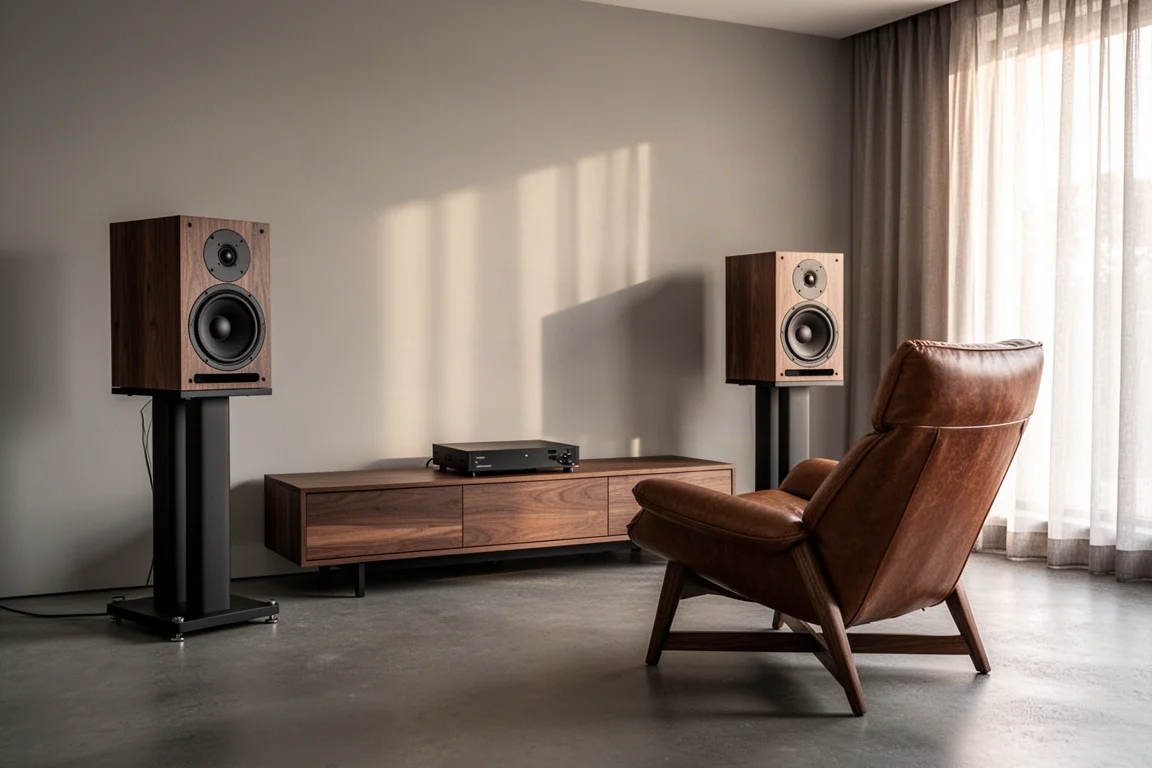
The practical result is a standmount that behaves more like a compact full-range tower. It is aimed at listeners who want deep extension without adding a subwoofer, and who are willing to give it a solid amplifier and a little floor space.
Who the 1528 Monitor 8 Is For
This speaker makes the most sense for two kinds of buyers. The first is someone who wants the performance of a large tower but cannot manage the weight or the visual bulk. The 1528 Tower weighs around 175 pounds per cabinet, which rules it out for many rooms and many owners. At 104 pounds each, the Monitor 8 is still a heavy speaker, but it is a genuinely manageable alternative.
The second is a listener who wants true full-range output from a stand-mounted design. With a 22 Hz tuning and in-room extension that reaches toward the lower limits of human hearing, the Monitor 8 does not require a subwoofer for most music. Only listeners who want very hard-hitting low-frequency effects should feel the need to add one.
The trade-off is efficiency. The rated sensitivity is 85 dB, with 87 dB measured at 2.83 volts, and the 700-watt power rating means the speaker rewards amplifier headroom. A capable 100-watt amplifier can drive it loud, but more power translates directly into more dynamic range.
Build Quality and Cabinet Design
The cabinet is where the Monitor 8 separates itself from most speakers at this price. The front baffle is three inches thick and made from HDF. The tweeter and midrange assembly mounts to a steel plate rather than directly into the wood, a decision driven by the size of the midrange motor structure, which needs that reinforcement to sit properly in the baffle.
The interior receives the same attention as the exterior. The HDF is coated inside so moisture cannot leech in and swell the material, and over that coating sits a viscoelastic, rubbery damping layer, followed by acoustic stuffing along the lines of a Dacron-type polyfill. The enclosure is heavily braced throughout.
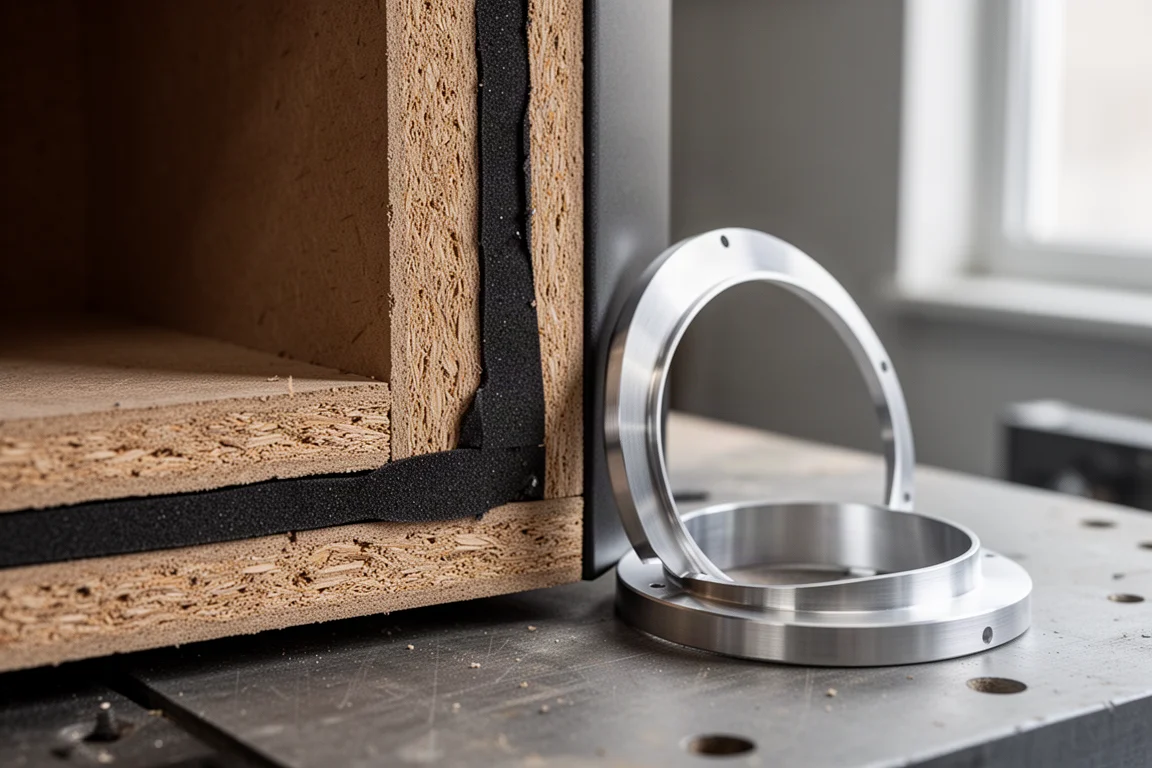
Hardware follows the same pattern. The binding post plate is a large brushed aluminium piece, and the driver trim ring is a solid aluminium component rather than the thin plastic disc found on most speakers. Internal wiring is thick-gauge twisted pair. The rear panel carries dual binding posts with a rhodium-plated jumper, plus a set of jumpers that attenuate or boost the midrange and tweeter by 2 dB. That adjustment is electromechanical rather than digital, and it is most useful for listeners running an analogue preamp without DSP or room correction.
The speaker is rear ported, and the port can be sealed, though there is little reason to do so. Even the packaging reflects the price: double-boxed, surrounded by polyethylene foam, with gloves and a cotton drawstring sleeve over each cabinet.
Drivers and Crossover
The two 8-inch woofers use aluminium cones with inverted, ribbed surrounds. The ribbing addresses distortion that comes from uneven bending of the surround, and the motor includes a bumped back plate with venting at the pole piece. Excursion is generous and linear, and the woofers are comfortable playing high enough to hand off at roughly 480 Hz.
The 5-inch carbon graphene midrange is sealed at the basket, which means it shares the cabinet volume with the woofers without any need for a separate sub-enclosure. Its motor section is as large as its cone, and the two-piece motor appears to use a bucking magnet to redirect stray magnetic flux back into the gap and raise sensitivity.
The tweeter is the most interesting piece of the design. It is a magnesium lithium dome in a waveguide, with a built-in grille that also functions slightly as a phase lens. The waveguide is deliberately asymmetric on the horizontal axis, tilting output downward so the intended reference axis sits roughly 90 degrees below the tweeter, at the midrange or even the upper bass driver. That matters because the tweeter sits high when the speaker is on a stand. Because the tweeter is also mounted very close to the midrange, the crossover region avoids the comb filtering that shows up when drivers are spaced far apart.
The crossover itself is a two-part design. One board mounts to the binding post plate and carries large resistors on heat-sinked standoffs along with air-core inductors. The second, larger board lives inside the cabinet with substantial capacitors and inductors. There is very little left to improve here, which is worth knowing before considering any aftermarket crossover work.
Measured Performance and Room Behavior
On-axis response is flat within roughly a 1.5 dB window across the range, and the off-axis response tracks the on-axis response closely. That combination produces well-controlled directivity and consistent sound power, which has practical consequences: the speaker sounds similar on and off axis, so it is not especially fussy about toe-in, and room reflections carry the same tonal character as the direct sound.
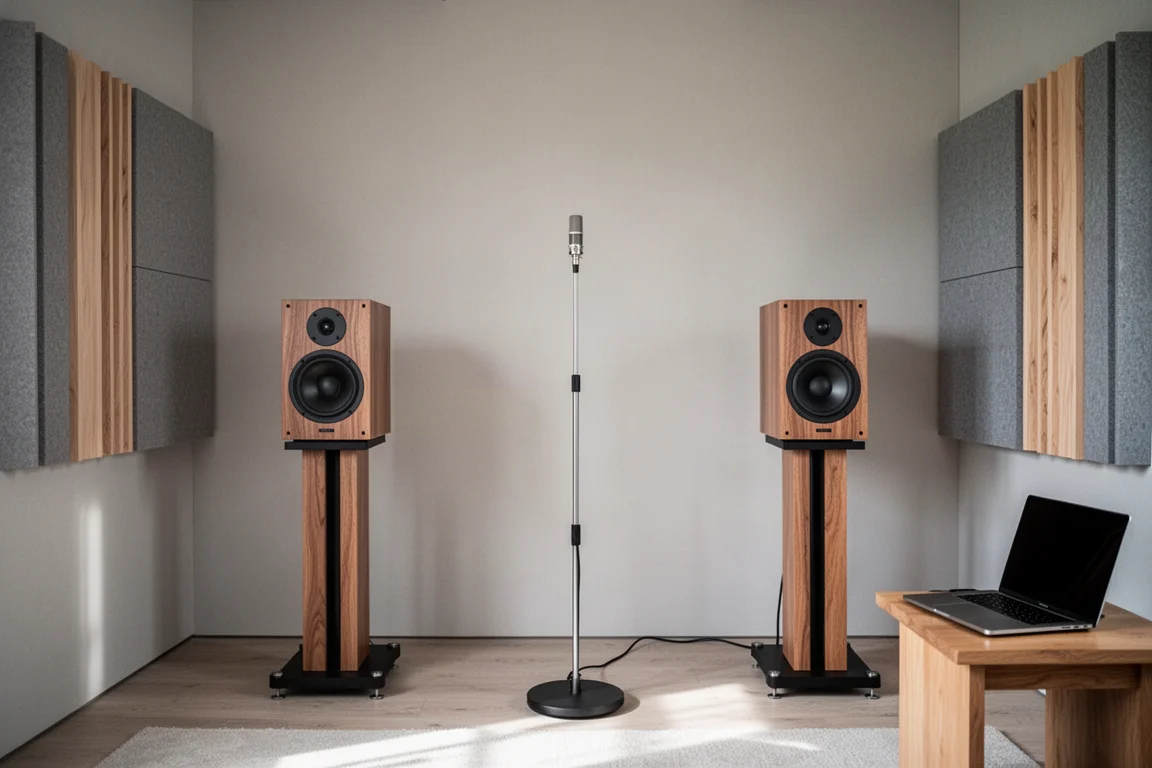
That consistency also makes the Monitor 8 a strong candidate for automatic room correction. Because the speaker is already linear, the sensible approach is to correct the bass region below the room transition frequency and leave the upper range largely alone, using shelving filters at most if a little more or less treble is wanted.
Bass behaviour is well controlled. The port is slightly overdamped relative to the woofer output, which keeps room gain from piling on too much low end, and the tuning sits near 22 Hz. The impedance curve shows two evenly matched peaks around that tuning point. Although the speaker is rated at 4 ohms, the impedance does not dip below about 3.8 ohms and only in a narrow region near 300 Hz, making this a relatively benign load for a competent amplifier.
Living With Them: Size, Weight, and Placement
The Monitor 8 demands planning. At 104 pounds per cabinet, moving them is a two-person job, and the stands required to hold them safely have wide bases. In practice, a pair of Monitor 8 speakers on their stands can occupy more floor space than some slim tower speakers, so measure the room before committing.
The rear port needs a reasonable distance from the wall behind it, although it can be sealed if a placement constraint makes that necessary. The 2 dB midrange and tweeter jumpers are a useful fallback for anyone without digital correction, since they shift the speaker’s spectral balance without touching the crossover design itself.
Things to Consider Before Buying
Weight is the first consideration. These are not speakers to move casually, and the stands add further mass and footprint. Amplifier quality is the second, because the combination of modest sensitivity and 700 watts of power handling means the Monitor 8 will keep scaling with whatever clean power you can supply.
Room size matters as well. The deep tuning and controlled directivity suit a wide range of spaces, but a very small room with limited placement freedom will not let a speaker of this size and weight show what it can do.
Buying Advice
Arendal Sound offers a 60-day risk-free trial on these speakers and covers shipping in both directions, which removes most of the risk from an audition in your own room. Given the weight and the setup involved, that trial is the single most valuable part of the purchase decision.
For amplification, a solid 100-watt amplifier is enough to play the Monitor 8 loudly, and additional power buys extra headroom and dynamic ease rather than basic competence. It is also worth noting that most direct alternatives at this price are tower speakers rather than stand-mounted designs, so buyers comparing options should weigh the Monitor 8 against floorstanders as much as against other standmounts.
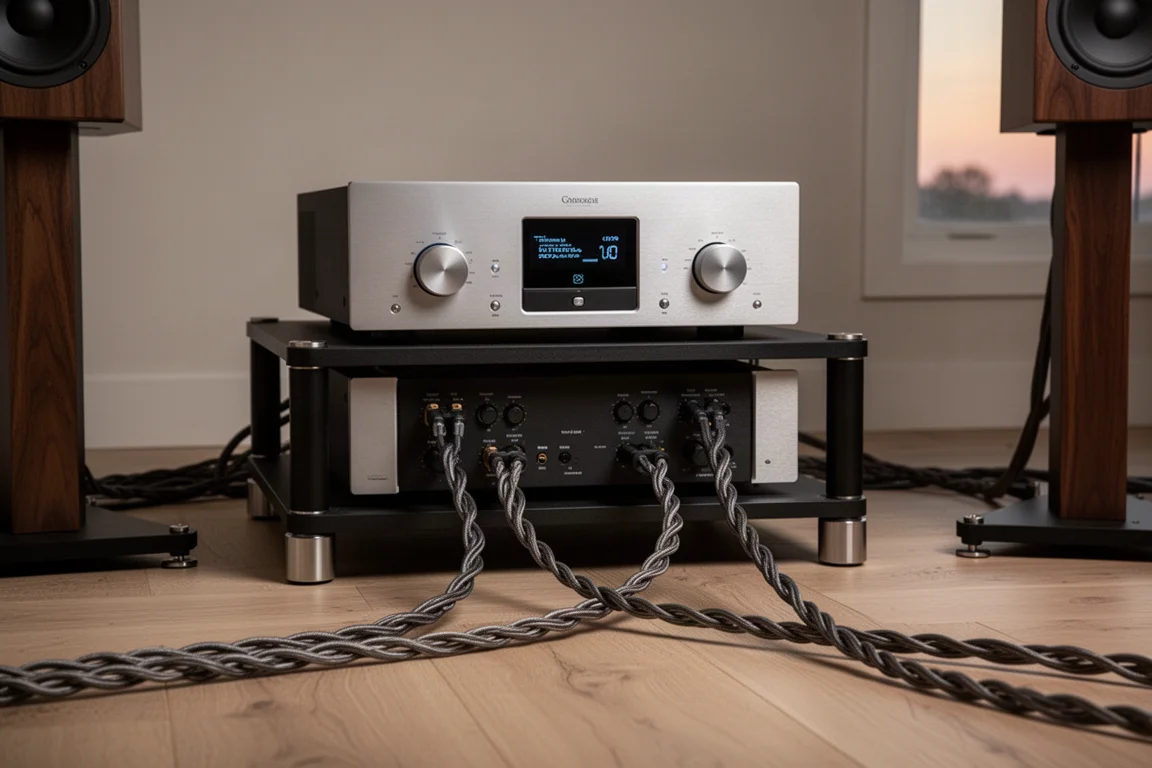
If you want a truly full-range speaker that sits on a stand, and you are prepared for a large, heavy cabinet, this is a very complete answer to that brief.
Conclusion
The Arendal Sound 1528 Monitor 8 pairs an exceptionally overbuilt cabinet with a genuinely full-range alignment, flat on-axis response, and well-controlled directivity. Its weaknesses are physical rather than sonic: 104 pounds per cabinet, a large footprint once stands are included, and sensitivity low enough to reward a serious amplifier.
For listeners who want tower-level character without tower-level weight and bulk, the Monitor 8 delivers exactly that, and the 60-day trial makes it straightforward to find out whether it suits your room.
Product link
View more details for Arendal Sound 1528 Monitor 8
This product is mentioned in the review. Check the specifications, options, and compatibility before buying.
View more details for Arendal Sound 1528 Monitor 8Further reading
Related Reviews
Standmount Speakers
Monitor Audio Silver 100 7G 50th Anniversary vs Sonus Faber Lumina II vs Q Acoustics Concept 30
A side-by-side comparison of the Monitor Audio Silver 100 7G 50th Anniversary Limited Edition, Sonus Faber Lumina II and Q Acoustics Concept 30.

Backpacking Gear
Building a 10 lb Base Weight: An Ultralight Backpacking Gear List
A practical walkthrough of the ultralight pieces behind a 10 lb base weight, from a 765 g pack and a roomy one-person tent to a full camp chair and a dependable water filter.

Road Bikes
10 New Road Bikes Worth Watching: Aero, Titanium, Steel and Endurance Standouts
A practical roundup of 10 new road bikes, from aero flagships chasing single-watt gains to titanium, steel and endurance platforms built for real roads.