Hi-Fi Amplifiers
Aiyima A20 Mono vs Fosi Audio BT20A Max: Two Compact Class D Amplifiers Compared
A practical look at two compact class D amplifiers: the monoblock Aiyima A20 Mono and the Fosi Audio BT20A Max, with listening notes, features, and buying guidance.
Introduction
Compact class D amplifiers have become one of the more interesting corners of desktop and budget hi-fi. They are small, they run cool enough to sit on a shelf, and the latest chipsets deliver far more usable power than their size suggests.
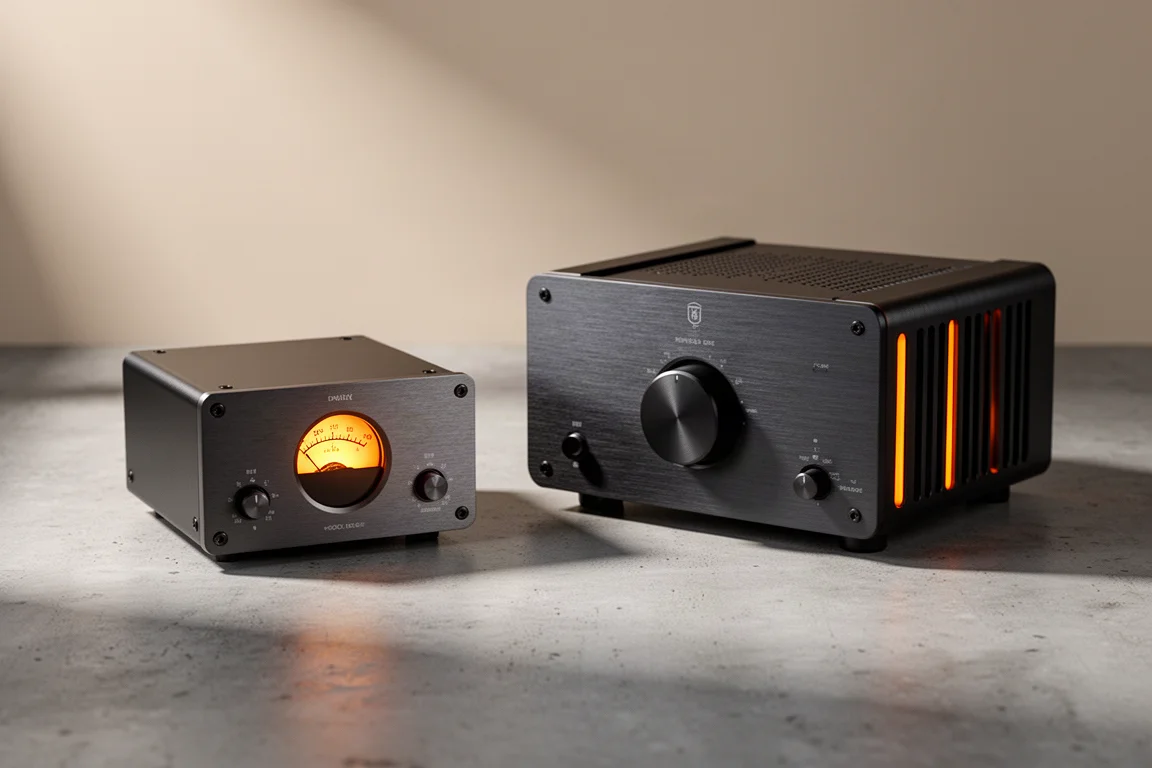
The Aiyima A20 Mono is the newest arrival, a monoblock built around a Texas Instruments 3255-A chipset. The Fosi Audio BT20A Max is the natural reference point, a compact amplifier with a similarly small footprint and a distinctly orange design accent. Both are aimed at listeners who want serious output without adding a full-size component to the rack.
Why Compact Class D Amplifiers Are Worth a Closer Look
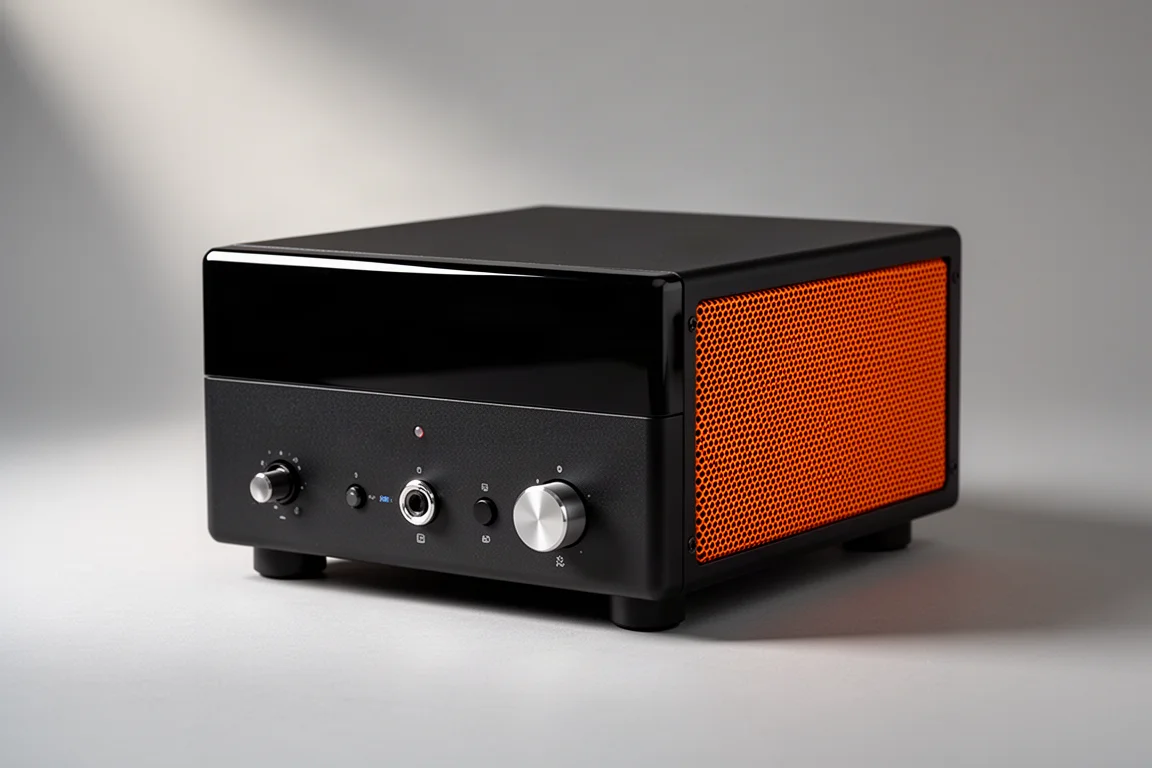
Power in a small chassis is mostly a heat problem. If an amplifier of this size cannot move heat away from the chipset, it will not hold its rated output for long. That is why the A20 Mono vents on both the side and the bottom of the case, and why a mesh-backed opening keeps air moving across the side panel. A touch of orange detailing on the side also nods to the styling that Fosi Audio has made its own.
The A20 Mono can be ordered with a GaN 48V 5A power supply. That number matters, because 48 volts multiplied by 5 amps comes to 240 watts, and because the A20 Mono is a single-channel design, none of that power has to be shared between two channels. In theory, that leaves up to 240 watts available for one speaker.
That is a meaningful difference from older compact amplifiers, which often shipped with 24V 5A supplies while claiming far higher wattage than the maths could support. With a 48V 5A supply feeding a single channel, the A20 Mono’s numbers at least add up on paper.
Where these amplifiers earn their place is on a desk or a small shelf, paired with speakers that do not demand enormous headroom. The footprint is small enough to disappear into a room, and current class D implementations no longer carry the brittle character that early examples were known for.
Aiyima A20 Mono: Monoblock Power in a Small Chassis
The A20 Mono is a monoblock, which means one amplifier per speaker. It uses a Texas Instruments 3255-A chipset, a familiar choice in this category because it delivers a great deal of power for relatively little money without the harshness that older class D designs were criticised for.
Connections are more generous than the price suggests. There is a genuinely balanced XLR input on the back alongside RCA inputs, and a front-panel switch selects between them. A 12V trigger input lets a streamer or DAC switch the amplifier on automatically. There is also a fixed 80 Hz high-pass filter on a simple toggle, a gain switch that moves between 19 dB and 25 dB, auto standby after 20 minutes, and a swappable op amp for anyone who wants to experiment. The internals are described as audiophile-grade, with Japanese capacitors.
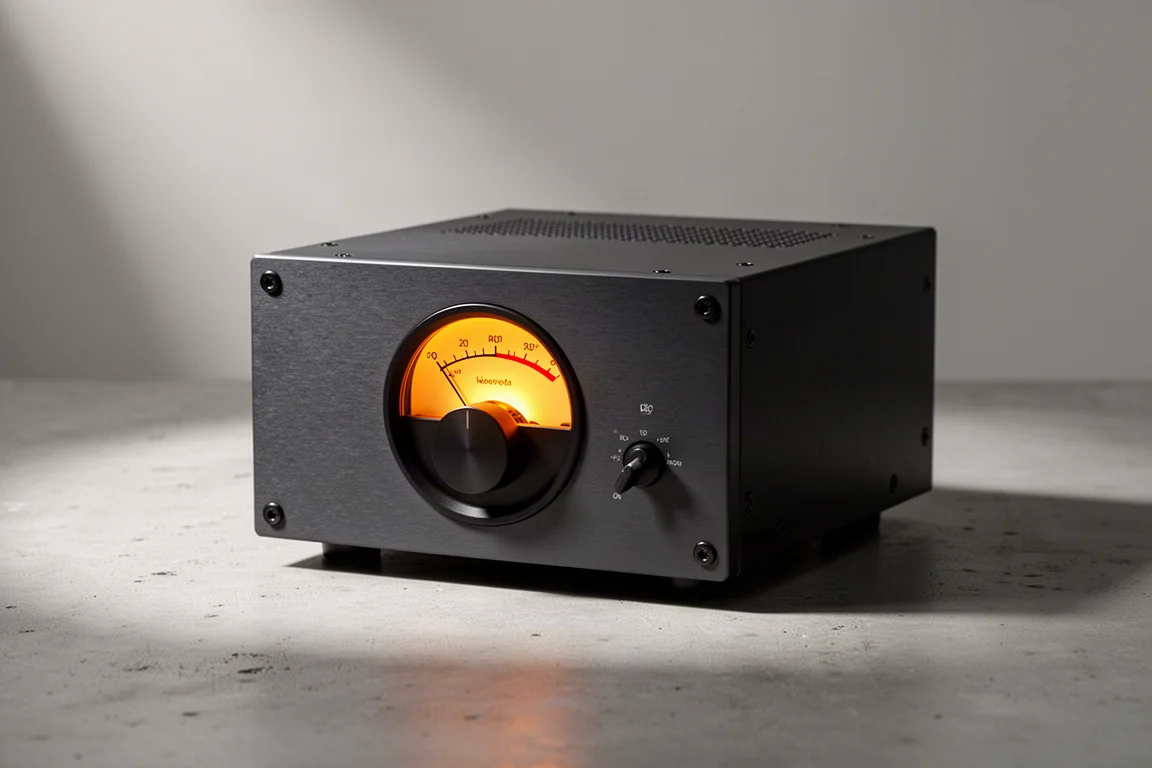
A single round level meter sits in the middle of the front panel, glowing yellow. Build quality is a clear step up from what this category offered a few years ago.
Aiyima A20 Mono Listening Notes: Bass, Dynamics, and Separation
Driven through a pair of highly efficient Klipsch Forte speakers, the A20 Mono made a strong first impression. Horn-loaded speakers of that kind are unforgiving of anything untidy in the upper midrange, and they are transparent enough to show what the electronics behind them are doing.
The monoblocks sounded balanced rather than warm, with a little extra weight at the bottom end rather than a boosted one. Bass had real presence: a deep bass passage that can disappear entirely on smaller speakers came through intact, and low frequencies were still tangible at moderate volume rather than only when the dial was pushed up. Dynamics were strong, and instruments stayed separated from one another instead of blurring into a single mass.
Not everything was perfect. There was audible sibilance on one vocal line, and cymbals on one rock track sounded slightly sizzly without much nuance. Those are small marks on an otherwise confident performance.
Fosi Audio BT20A Max: The Compact Comparison
The BT20A Max is the natural counterpart here. It is a compact amplifier, and orange has become something of a signature for Fosi Audio, appearing in the side detailing and in the mesh-backed ventilation on the case.
Heard on its own, it does not sound bad. Against the Aiyima pair, though, the differences were consistent. Vocals that were already slightly sibilant on the Aiyima became more so. Cymbals lost what nuance they had. Bass had less impact, the presentation was flatter, and instruments that stayed distinct on the monoblocks tended to run together. The overall character was a little thin.
How the Two Amplifiers Compare in Practice
The comparison comes down to a few repeatable observations. The Aiyima A20 Mono pair was more dynamic, had better instrument separation, more bass impact, and a wider sense of space. It also pushed the upper midrange less, which matters on speakers that are already forward in that region. The Fosi Audio BT20A Max was consistently flatter across the board, in the bass, the cymbals, the guitar, and the vocals.
Some of that is likely down to the mono design. Two separate chassis, one per channel, mean excellent channel separation and less interaction between the two sides of the signal.
The trade-off is practical. A stereo pair means two amplifiers and, unless you already own compatible 48V supplies, two power supplies. The A20 Mono can be ordered with or without a power supply, and ordering without one brought the unit price to $129. A pair therefore lands somewhere around $300.
At that level, the A20 Mono pair is competing with class AB amplifiers, integrated amplifiers, and receivers from more established brands. Those alternatives are not mono designs, and they usually keep the power supply inside the chassis, but they come with longer track records and, in some cases, more familiar service and returns routes.
Features and Practical Details Worth Knowing
The fixed 80 Hz high-pass filter is the kind of feature that is genuinely useful but rarely needed. If you are running small speakers and cannot apply a high-pass filter at the source, cutting everything below 80 Hz keeps those drivers from working harder than they should. If your source already handles that, the toggle will simply stay off.
The gain switch is a similar case. At 19 dB or 25 dB, it gives you a way to match the amplifier to very efficient speakers and avoid audible noise. Most bookshelf and floorstanding speakers sit in the 85 to 89 dB sensitivity range, where the difference is unlikely to matter much. Having the option costs nothing, though, and it is better to have it and not need it than the other way around.
The 12V trigger and the 20-minute auto standby are the sort of details that make a compact amplifier easy to live with in a desk or streaming setup. The swappable op amp is there for anyone who enjoys tuning a system by ear.
Buying Advice: Which Compact Amplifier Fits Your System
Choose the Aiyima A20 Mono if you want the most dynamic, weighty presentation available from a small amplifier, and you are comfortable running two units and a pair of small external power bricks. It sounds good, and it is easy to recommend on performance alone.
Go in with clear eyes about the category. Compact class D amplifiers have improved considerably over the past several years, and if the format had serious systemic problems, these brands would not still be shipping them. Build quality has improved too. Longevity and customer service, however, remain open questions for any small class D design, and warranty and return policies deserve a look before you buy.
The Fosi Audio BT20A Max makes sense if you want a compact amplifier and you are not chasing maximum bass weight or separation. It does not sound bad in isolation, and it is neatly made. In a direct comparison, though, it gives up ground on dynamics, bass impact, and clarity.
Conclusion
The Aiyima A20 Mono is a genuinely impressive small amplifier. It delivers the kind of bass weight, dynamics, and separation that is unusual at this size, and it does so with balanced inputs, a 12V trigger, and a swappable op amp. The caveats are the ones that come with the category: two units for stereo, small external power supplies, and open questions about long-term reliability and support.
The Fosi Audio BT20A Max is the more relaxed of the two. It is compact and neatly finished, but in a side-by-side comparison it sounds flatter and thinner than the Aiyima pair.
If you know what you are getting into with compact class D amplification, the A20 Mono is an easy recommendation on sound quality alone.
Further reading
Related Reviews
Hi-Fi Amplifiers
Accuphase E-280 Review: Entry-Level Accuphase With Flagship Attention to Detail
A close look at the Accuphase E-280 integrated amplifier, covering its champagne build, AAVA volume control, sound quality, and the speakers and sources that suit it best.
Hi-Fi Amplifiers
Advance Paris A10 Classic vs Yamaha A-S301: Two Integrated Amplifiers Compared
A practical comparison of a $350 integrated amplifier and a $2,500 reference model, covering the differences that matter and the ones that do not.
Hi-Fi Amplifiers
Affordable Chinese Amplifiers Worth Buying: Five Budget Hi-Fi Amps Compared
A practical look at five affordable amplifiers, what each one does well, and the trade-offs to weigh before you buy.