Amplifiers
AIYIMA A07 Max Review: A Budget Class D Amplifier That Can Run Bridged
A close look at the AIYIMA A07 Max, a TPA3255 desktop amplifier that adds bridging, swappable op-amps, and a very quiet noise floor at a budget price.
Introduction
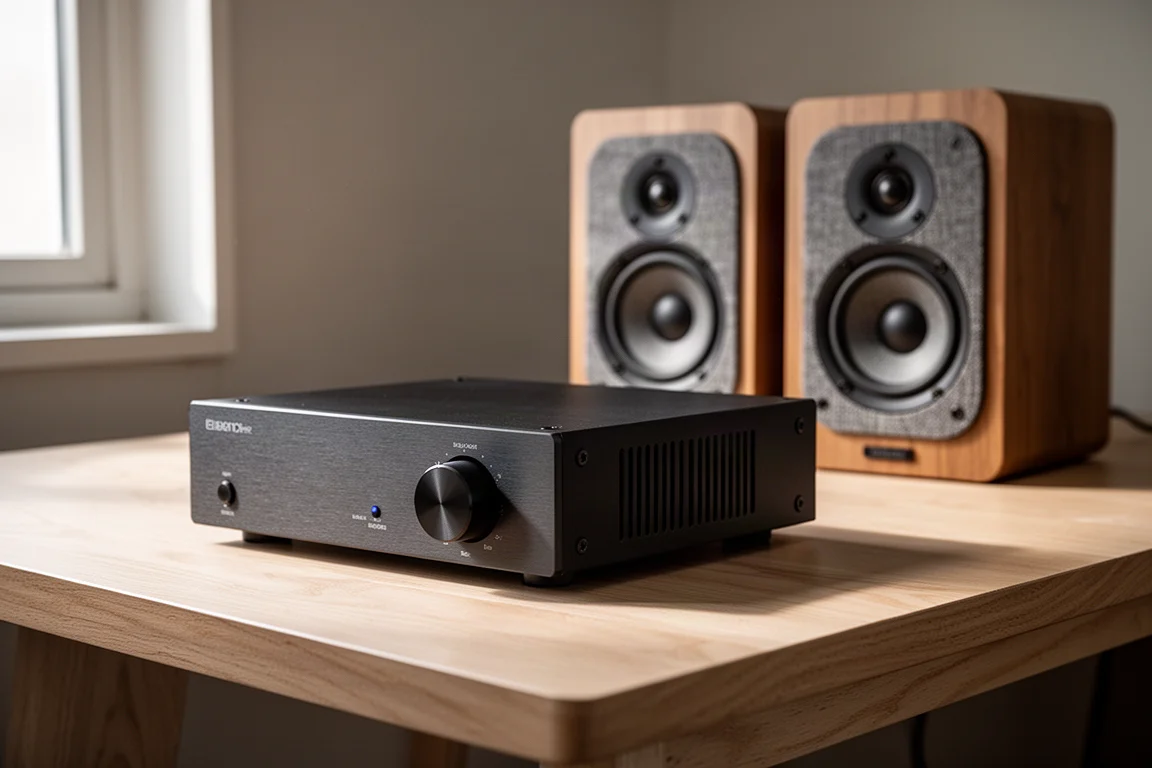
The AIYIMA A07 Max is a new take on the company’s long-running A07 desktop amplifier, and it arrives with features that are unusual at its price. It is built around the Texas Instruments TPA3255 amplifier chip, the same chipset used across a large share of affordable Class D designs, but AIYIMA has added bridging support, removable op-amps, and a revised chassis with better cooling than the A07 and the A07 Pro.
The amplifier alone, without a power brick, sits at around $65, which puts it firmly in budget territory. At launch it has been sold mainly through AIYIMA’s own store rather than through major retailers, so buyers should confirm availability before planning a purchase.
What makes the A07 Max interesting is not any single specification. It is the combination: a quiet, dynamic amplifier that can also be run as a bridged mono block, and that lets you swap op-amps later if you want to shift the sound signature.
Inside the A07 Max: Design, Cooling, and Controls
The front panel keeps things minimal. A single aluminium volume knob handles both power and level. Rotate it fully counterclockwise to switch the unit off, then turn it clockwise until it clicks to power on. The taper is quick through the first half of its travel, so most of the usable gain arrives before the halfway point, after which the adjustment becomes finer toward the top of the range.
The rear panel is equally straightforward. There is one RCA input pair, an aux output that is fixed rather than a preamp-level output, a set of offset binding posts, a stereo/mono switch, and the DC power input. The offset binding posts leave a little more room for speaker cable, which is not guaranteed on amplifiers in this size class.
Internally, the layout shows a heatsink, through-soldered joints, and two removable op-amps. The chassis is held together by two Allen screws at the ends plus two more underneath, and the volume knob is secured by a nut behind the panel. Ventilation is improved compared with earlier A07 models, which matters if the amplifier runs for long sessions on a desk.
Who This Amplifier Is For
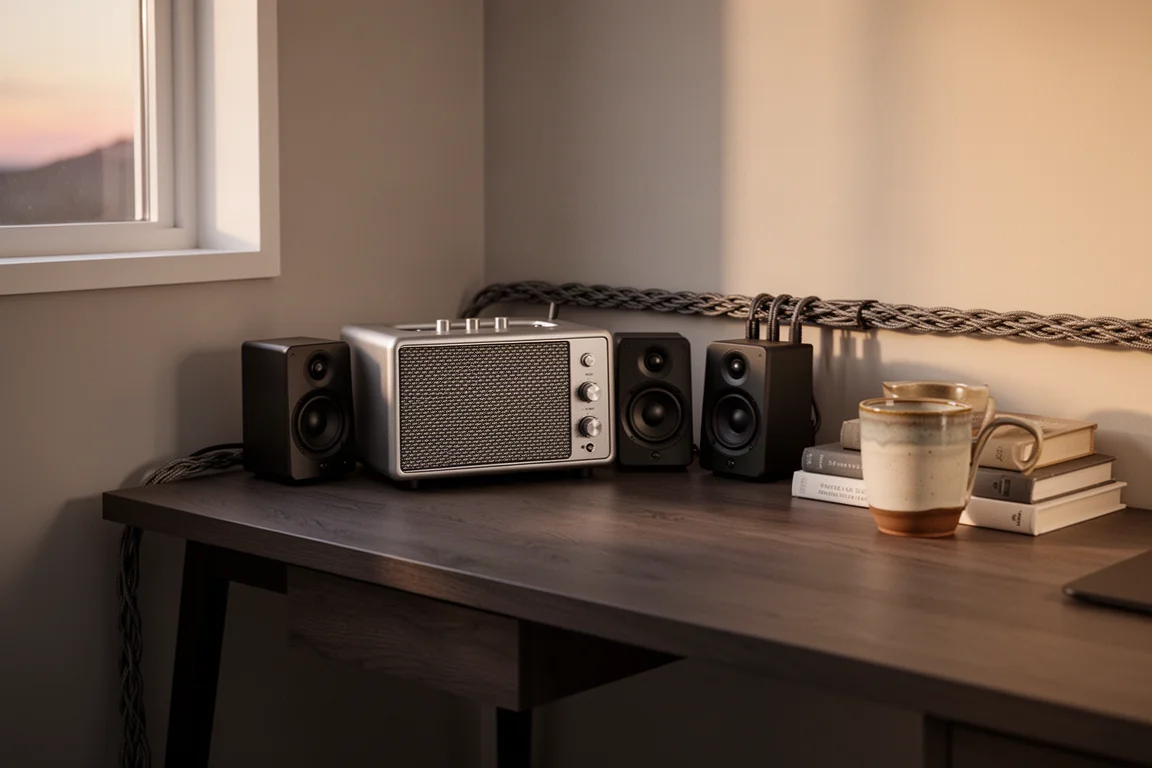
This is a natural fit for a compact desktop or nearfield system. Run with Sony SSCS5 speakers, a WiiM Mini streamer, and an SMSL SU-1 DAC, an affordable chain from end to end, the amplifier drove the speakers cleanly and left nothing feeling underpowered.
It also suits listeners who like to tinker. Because the op-amps are removable, the amplifier can be re-voiced later without replacing the whole unit. And because it can be bridged, it works as a starting point for a mono block setup, something the Fosi Audio V3 cannot do. For anyone who simply wants a fixed, plug-and-play amplifier with no interest in swapping parts, the extra flexibility will still be there but will go unused.
Main Strengths
The first thing that stands out is the noise floor. With music paused and the volume turned all the way up, the amplifier stayed essentially silent, with only the faintest impression of sound audible with an ear close to the tweeter. That is a strong result for a budget Class D design, and it means quiet passages stay quiet.
Dynamics are the second strength. Driving the Sony speakers between roughly 75 and 85 dB, and pushing into the 90s on the stock 36V 6.5A supply, the amplifier stayed clean and controlled. Those speakers have some unevenness through the midrange and into the treble that can become fatiguing at higher levels, and the A07 Max did not make that worse. If anything it smoothed the presentation slightly.
Bass response also impressed. The Sony speakers have more low-end punch than their price suggests, and the amplifier let that come through without a subwoofer being necessary to feel complete. The overall impression was of a lively, dynamic amplifier that made an inexpensive speaker pair sound considerably better than expected.
Construction is the third area of improvement. The aluminium volume knob, the offset binding posts, and the added ventilation give the A07 Max a more premium and sleeker feel than the earlier A07 and A07 Pro.
Bridging, Op-Amp Swapping, and Power Options
Bridging is the headline feature. Flipping the rear switch to mono and using the top two binding posts lets the amplifier combine its channels into a single higher-power output, turning it into a mono block. Quoted bridged output figures are ambitious, reaching around 600W into 2 ohms, but the ratings for 4 and 8 ohm loads are not clearly documented. Even a fraction of that figure would be more than enough for most desktop speakers, so the practical value is real regardless of the exact number.
Power supply choice shapes the output. A 36V 6.5A supply is commonly bundled, and the amplifier accepts anything from a 24V unit up to a 48V 10A unit. An optional 48V 5A supply is sold separately and raises the available power, and the higher quoted ratings generally assume a larger supply than the one included. Buyers who want maximum output should plan for that extra purchase rather than assume the bundled brick delivers it.
Op-amp rolling is the other long-term draw. The two op-amps are removable, and swapping them changes the harmonic profile of the amplifier, which in turn changes the perceived spaciousness of the sound. The stock configuration already sounds good, so this is an optional path rather than a required upgrade.
Things to Consider Before Buying
The aux output is not a preamp output, so it does not follow the volume knob. If you plan to feed a subwoofer or a second amplifier from it, level will have to be managed elsewhere in the chain.
Availability has been the practical obstacle. At launch the A07 Max has been sold mainly through AIYIMA’s own store, with no stock through major retailers, which means shipping times and returns may work differently than a typical marketplace purchase.
Documentation around bridged power ratings is thin. If exact output into 4 or 8 ohms matters for your speakers, treat the published mono figures with caution until clearer specifications are available.
Finally, the volume taper takes some adjustment. Most of the gain arrives early in the knob’s travel, so fine control at low listening levels requires a light touch.
Buying Advice
At around $65 for the amplifier alone, the A07 Max asks very little for what it offers. The strongest case for it is a desktop system built around efficient bookshelf speakers, where its quiet operation and dynamic character do most of the work.
If bridging matters to you, this is the amplifier to choose over the Fosi Audio V3, which cannot run in mono. If you want the highest output, budget for the optional 48V supply alongside the amplifier. And if you like the idea of tuning the sound later, the removable op-amps give you a path that most budget amplifiers simply do not offer. Confirm current stock before ordering, since availability has been inconsistent.
Conclusion
The AIYIMA A07 Max takes a familiar budget amplifier formula and adds bridging, swappable op-amps, and better cooling without giving up the low price. It runs quiet, stays composed at high volume, and made an inexpensive speaker pair sound genuinely enjoyable. For desktop listeners who want flexibility and value in the same box, it is an easy recommendation.
Product link
View more details for AIYIMA A07 Max
This product is mentioned in the review. Check the specifications, options, and compatibility before buying.
View more details for AIYIMA A07 MaxFurther reading
Related Reviews
Amplifiers
AIYIMA A08 Review: A Compact Class D Amplifier With USB DAC and Bluetooth
A practical look at the AIYIMA A08, a $115 Class D integrated amplifier that adds a USB DAC, Bluetooth, and an internal power supply to a proven budget platform.
Amplifiers
Aiyima A300 vs Topping PA5: Two Class D Amplifiers Compared
A practical comparison of the Aiyima A300 and the Topping PA5, two Texas Instruments 3255 class D amplifiers with very different prices and feature sets.
Amplifiers
Emotiva BasX A1 Monoblock Review: Affordable Stereo Power With Real Strengths
A close look at Emotiva's entry-level 200W monoblock: taut bass, a neutral midrange, and a noise floor worth checking against your speakers.