Hi-Fi Speakers
ADAM Audio A7V Review: Precision-First Active Standmount Speakers
The ADAM Audio A7V pairs a hand-built folded ribbon tweeter with a rigid mineral stone fibre woofer and 90 W of Class D power per cabinet. Here is how it sounds, who it suits, and what to weigh before buying.
Introduction
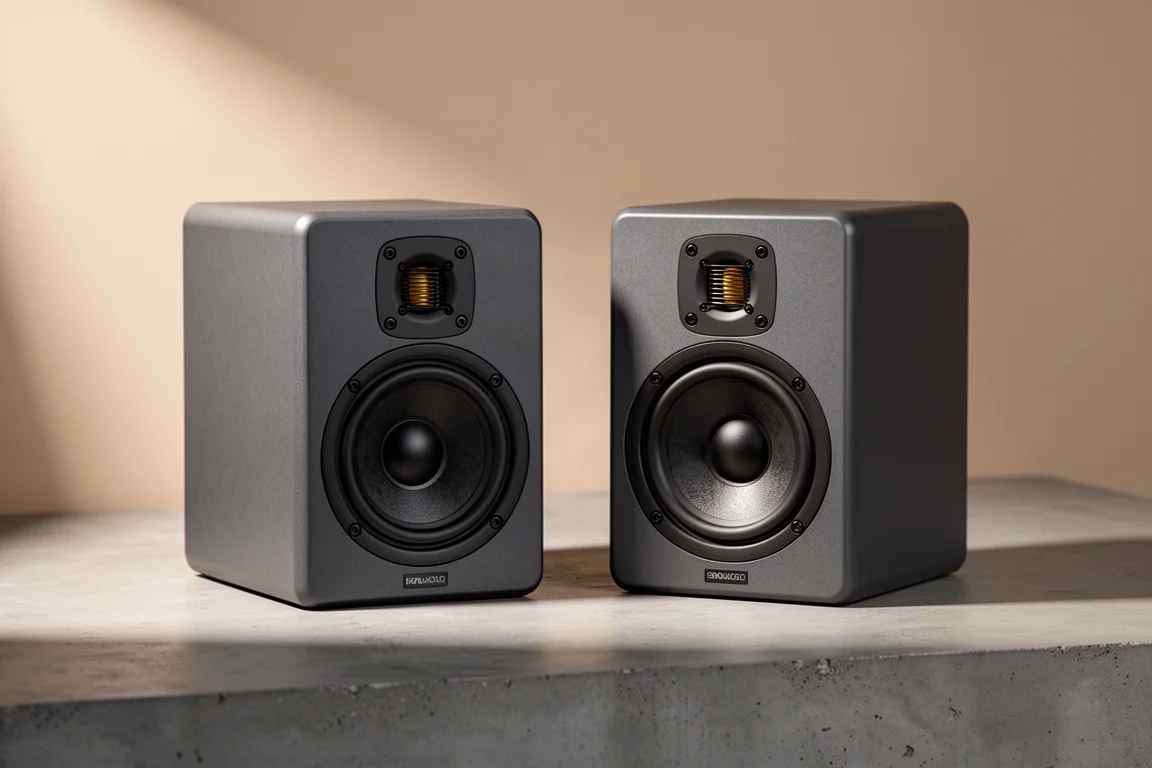
The ADAM Audio A7V is a two-way active standmount speaker, and the word active does most of the explaining here: each cabinet carries its own amplifiers, so no separate power amplifier is required. ADAM Audio is a professional audio company founded in Berlin in 1999 and still based there, and the A7V sits toward the upper end of its A Series line, a family that spent more than four years in development.
Pricing is straightforward. The A7V sells for $900 per speaker, or $1,800 per pair, in black or white. The white finish is understood to be a limited offering rather than a permanent part of the range, so buyers who want it may want to move sooner rather than later.
What follows covers the driver technology, the amplification and DSP arrangement, the sound character, the rear-panel controls, and the practical questions worth answering before committing to a pair.
Design and Build: What Goes Inside the A7V
The A7V is a two-way design built around a 7-inch woofer and a folded ribbon tweeter. ADAM Audio calls its ribbon design X-ART, and it has been part of the company’s speakers since the beginning rather than arriving as a recent trend. These tweeters are designed and hand-built in the company’s Berlin factory, and the design has been refined for over 25 years. Many competing designs use off-the-shelf folded ribbon tweeters, so the A7V benefits from a long, continuous line of development in one place.
The woofer cone is the more unusual piece of engineering. It uses multiple layers of mineral stone fibre fused together in a proprietary baking process, producing a cone that is both rigid and light. Rigidity helps a driver stay controlled through the midrange and bass, while low mass helps it start and stop quickly.
Amplification is split between two amplifiers per cabinet: a 90-watt Class D amplifier driving the woofer and a 15-watt Class AB amplifier driving the tweeter. The crossover between them is handled in the digital domain at 2.4 kHz, using a fourth-order Linkwitz-Riley topology.
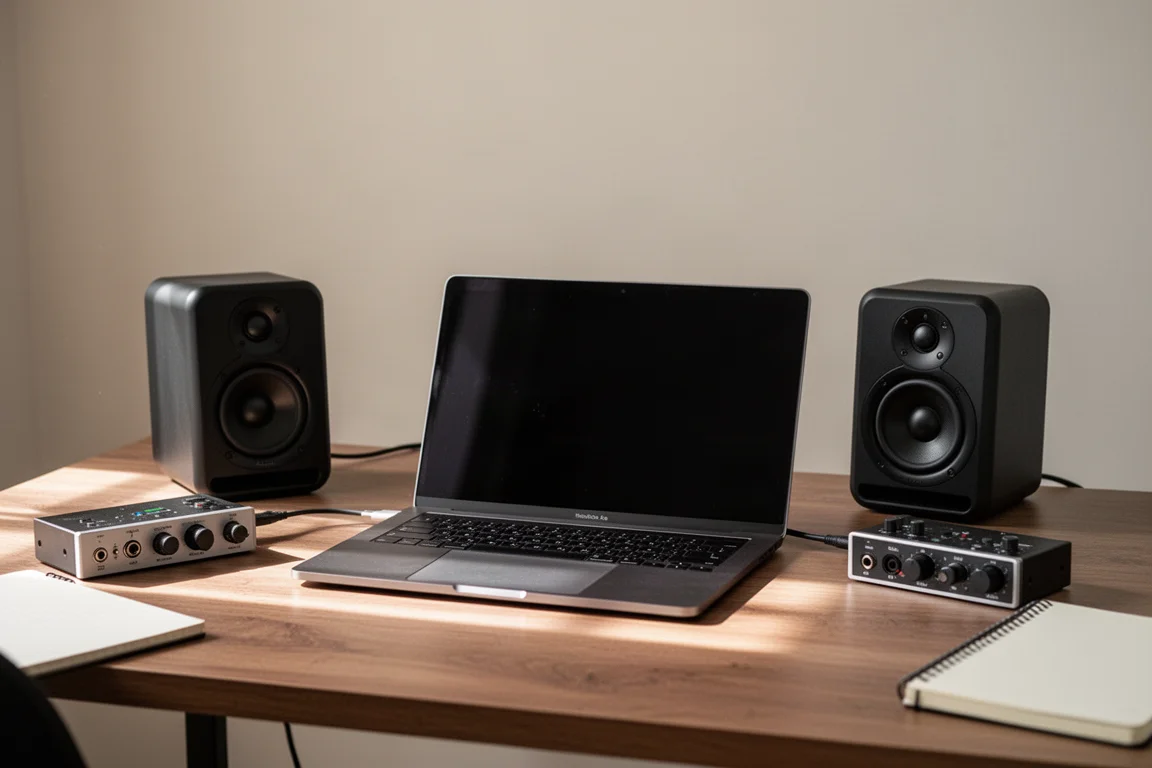
The cabinet is MDF finished in black vinyl, with the front baffle painted black. Nothing about the finish is extravagant, which suits the speaker’s working-tool character. The A7V stands a little over 13 inches tall and weighs a little over 19 pounds, so there is a considerable amount of technology inside a compact box. Two large bass ports sit on the front, directly below the woofer, which means the speaker does not demand the generous wall clearance a rear-ported design would.
Placement is more flexible than most standmounts. The A7V can be used upright or laid on its side, and when it is horizontal the tweeter can be rotated so its waveguide still faces the listening position. That is a genuinely useful feature for desk and console setups, even if most owners will keep the speaker vertical.
Who This Speaker Is For
The A7V is aimed at listeners who want to hear what is actually on a recording rather than a flattering version of it. Its balance is neutral and accurate, closer in character to a studio monitor than to a soft, sweet, or rich sounding home speaker. Listeners who chase precision, transient accuracy, and an honest midrange will find a great deal to like.
It also suits anyone who would rather not buy a separate power amplifier. Because the amplification and the DSP crossover are already inside the cabinet, a preamplifier or a source with its own volume control is enough to assemble a complete system, which simplifies both the signal chain and the budget.
Sound Quality: Precision First
The defining quality of the A7V is precision. It is an exacting speaker that presents the facts of a recording directly, with strong edge definition, palpability, and texture rather than warmth. That character holds whether the speaker is set to its flat voicing or to the gently contoured alternative.
Bass is a genuine surprise given the cabinet size. ADAM Audio rates the A7V down to 44 Hz, plus or minus 3 dB, and test tones confirmed substantial output well into the mid-40 Hz region. On material with real low-frequency weight, the speaker delivers both depth and impact, and bass instruments come through with texture rather than as a single indistinct thump.
Transient response is equally strong. Drum attacks, snare hits, and cymbal strikes arrive with a snap that makes rhythmic material feel immediate, and acoustic instruments and saxophones carry a you-are-there quality that is hard to fake. The A7V also plays loud without strain. Even at peaks in the low 90 dB range there was no sense of impending distortion, and the speaker simply kept going.
Nearfield listening changes the presentation. Placed around 4 feet apart and heard from roughly 4 feet away, the A7V opens up noticeably, because a larger proportion of what reaches the listener is direct sound rather than reflected energy from walls and floor. That said, the speaker is equally comfortable at a more conventional distance, with the cabinets about 7 feet apart and the listening position about 7 feet back.
Set against a smaller-driver standmount such as the KEF LS50 Meta, the differences are instructive. The LS50 Meta uses a 5.25-inch Uni-Q driver that combines tweeter and midrange woofer in a single unit, so it is not a like-for-like comparison on driver size. Tonally the two are fairly close on male vocals, but the A7V sounded more precise, with more leading-edge presence and greater dynamic contrast between soft and loud passages. The LS50 Meta threw a more open soundstage, with voices decoupling further from the cabinets. In power delivery and low-frequency authority, the A7V was clearly the stronger of the two.
Room Adaptation and the Rear Panel
The rear panel looks busy at first glance, but the controls fall into a few simple groups. Inputs are RCA and XLR, so the A7V can accept either a single-ended or a balanced feed from a preamplifier. Signal arrives in analog form, is converted to digital at 96/24 resolution so it can pass through the DSP crossover, then converted back to analog at the same resolution on the way to the amplifiers.
Above the inputs sits a room adaptation section, a set of equalisation curves adjusted with a row of buttons and indicator lights. Its bass and treble controls are deliberately narrow in range, roughly 1.5 dB of boost and 3 dB of cut, so they nudge the balance rather than reshape it.
The voicing control is the more consequential one. Pure is a flat response. The alternative setting applies a gentle contour with slightly raised bass and treble, similar in spirit to a mild loudness curve. A third setting, external, uses the Ethernet port to hand control over to a computer, where a much deeper set of parameters becomes available, including a six-band parametric equaliser and room correction tools. That level of adjustment will appeal to listeners who enjoy tuning a system methodically, and it can be ignored entirely by those who would rather not.
Things to Consider Before Buying
The first consideration is that the A7V is an active speaker. Its amplifiers are fixed inside the cabinet, which removes the cost and clutter of a separate power amp but also removes the option of changing amplification later on.
The second is character. This is not a warm, sweet, or rich sounding speaker. It is neutral and exacting, and it will not flatter a poor recording. Listeners who prioritise an easy, relaxed tonal balance should weigh that carefully, because the A7V’s honesty is the entire point of its design.
The third is the rear panel. The core controls are simple enough to set by ear, but the deeper DSP features are best explored through a computer, and not every owner will want to manage that.
Finally, budget and finish. The A7V sells for $900 per speaker, so a pair comes to $1,800, and the white finish is understood to be a limited offering rather than a permanent option. Buyers who want a specific finish may want to confirm availability before committing.
Fitting the A7V Into an Existing System
Because the A7V is self-powered, the equipment it needs upstream is minimal. A preamplifier, or any source with a reliable volume control, is enough to drive it through the RCA or XLR inputs. There is no power amplifier to buy, no speaker cable run to a separate box, and no amplifier matching to worry about.
Room placement is more forgiving than the compact cabinet might suggest. The two bass ports fire forward, so the speaker can sit closer to a wall or on a desk without the boominess that rear ports can encourage in tight spaces. The rotatable tweeter means a horizontal orientation is a real option rather than a compromise.
Listening distance is worth planning for as well. The A7V works well in a nearfield arrangement at around 4 feet, where it opens up as direct sound dominates, and it is equally settled at around 7 feet with the speakers spread the same distance apart. Buyers with small rooms and buyers with more conventional rooms both have a viable setup here.
Buying Advice
The A7V makes the most sense for listeners who value precision, want an active system without separate power amplification, and are comfortable pairing a speaker with a preamplifier or a volume-controlled source. The front-mounted bass ports make it easier to place close to a wall or on a desk, and the rotatable tweeter adds flexibility for horizontal mounting.
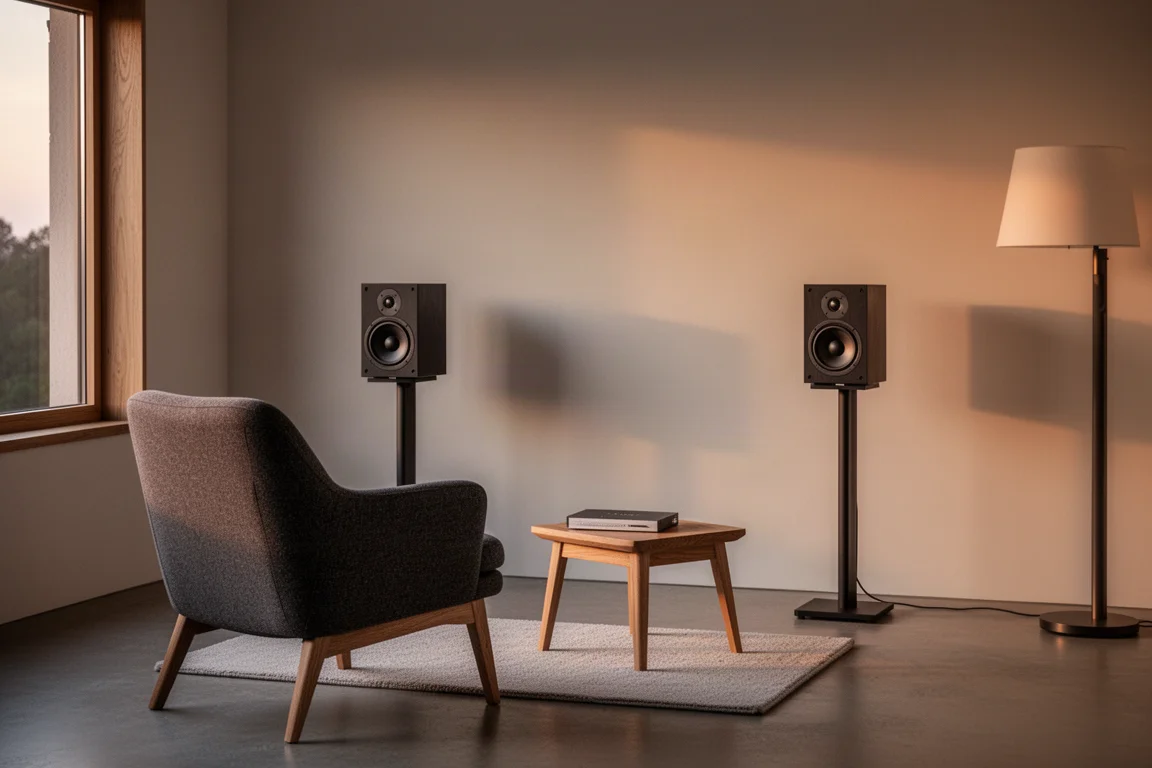
The five-year warranty covering the complete speaker, electronics included, is worth noting. Extended coverage on the amplifier and DSP section is not standard practice for active speakers, where the electronics are often covered for a shorter period than the cabinet. For a self-powered design, that is meaningful reassurance about long-term ownership.
On performance, the A7V delivers deep bass for its size, high output without strain, and a level of transient accuracy that makes recordings feel immediate. Buyers who want a more open soundstage and a softer overall balance may prefer a different approach, but listeners who want the recording presented plainly will find the A7V does exactly what it sets out to do.
Conclusion
The ADAM Audio A7V is a compact active standmount with a distinctly professional character. A hand-built folded ribbon tweeter, a rigid mineral stone fibre woofer, a 90-watt Class D and 15-watt Class AB amplifier pair per cabinet, and a DSP crossover at 2.4 kHz add up to a speaker that prioritises accuracy over sweetness.
At $900 each, or $1,800 per pair, it rewards listeners who want precision, deep bass from a small cabinet, and the simplicity of an active system. The five-year warranty covering the electronics makes the self-powered design easier to commit to, and the front-firing ports make it easier to live with in a real room.
Product link
View more details for ADAM Audio A7V
This product is mentioned in the review. Check the specifications, options, and compatibility before buying.
View more details for ADAM Audio A7VFurther reading
Related Reviews
Hi-Fi Speakers
1723 THX Tower vs 1528 Bookshelf: Which Speaker Fits Your Room?
Two speakers at roughly the same price, built very differently. How the 1723 THX tower and the 1528 bookshelf compare on construction, bass, power needs, and sound.
Hi-Fi Speakers
Acoustic Energy AE 300 Review: Deep Bass From a Compact Standmount
A two-way standmount with real wood veneer, surprising low-end weight, and a warm, easygoing character. Here is what to know before buying.
Hi-Fi Speakers
Acoustic Energy AE1 40th Anniversary Review: A Modern Take on a British Classic
A compact standmount that revives a 1980s favorite with all-new parts, a warm mid-centric balance, and a price of £1,499 per pair.