Astrophotography
Three 80mm Refractors Compared: Which One Makes Sense for Astrophotography?
An achromat, an ED doublet, and a premium quadruplet astrograph go head to head to show what your money actually buys in an imaging refractor.
Introduction
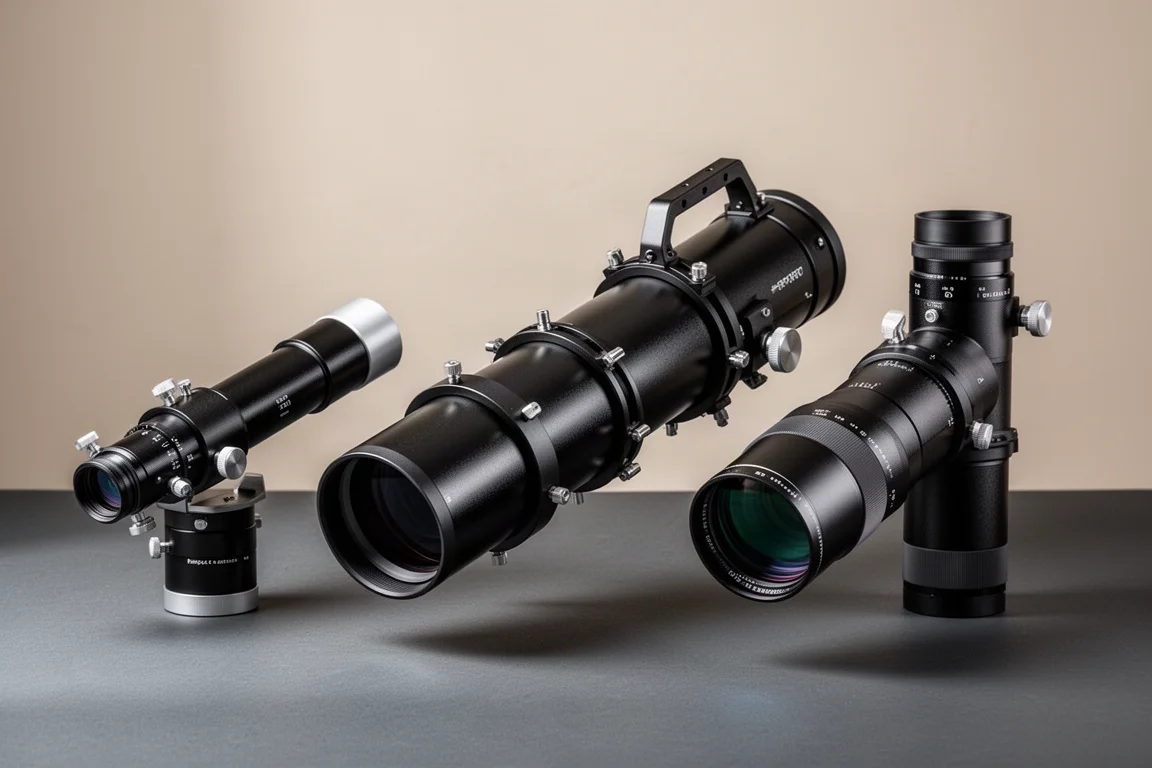
Three telescopes, one aperture. An 80mm achromat at around $130, an 80mm ED doublet at about $600 with a matched flattener, and an 80mm quadruplet astrograph at roughly $1,750. On paper they look almost identical. In practice, they occupy three entirely different tiers of the astrophotography market, and understanding why is the key to spending your budget wisely.
This comparison looks at optical design, build quality, focusing hardware, and real imaging results to help you decide how much correction you actually need for the kind of images you want to take.
What Actually Separates These Telescopes
The single most important factor in an imaging refractor is how many glass elements sit inside the tube, and how many of those are ED (extra low dispersion) glass. Without at least one ED element, stars pick up blue-violet or magenta fringing that is distracting and difficult to remove in post-processing without leaving artifacts. Fringe-killer or minus-violet filters can suppress it optically, but they also pull real color out of your photos, so treating the symptom costs you somewhere else.
In this trio, the Orion ShortTube 80 is a doublet with no ED glass at all. The SVBONY SV503 80ED is a doublet with one FPL51 ED element. The Askar 80PHQ is a quadruplet with two ED elements. More ED glass generally means better color reproduction and tighter stars, and the worst configuration for a one-shot color camera is a plain achromat.
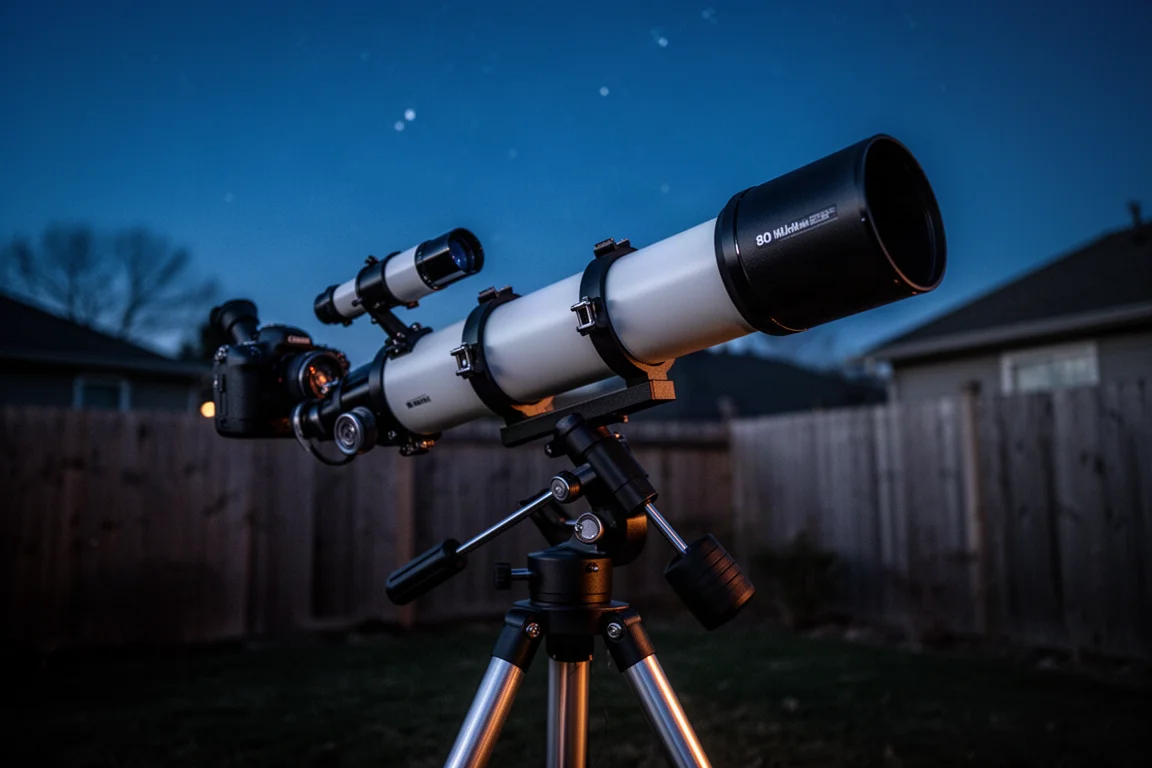
The related vocabulary is apochromatic versus achromatic, which describes how well a telescope brings all visible wavelengths to focus at the same point. Opinions differ on whether an ED doublet technically counts as apochromatic, but the practical test is simple: if your stars show no obvious fringing, it behaves like one.
There is also a field-correction difference. Doublets and triplets typically need a separate field flattener or flattener/reducer. The SVBONY has a matched 0.8x flattener/reducer available, which is included in its $600 price here. No flattener was found for the Orion, and the focuser design makes third-party options impractical. The Askar needs no flattener at all because its corrector element is built into the quad design, and an optional 0.7x reducer brings it from 600mm f/7.5 down to roughly 450mm f/5.7.
Build, Focusers, and Included Accessories
The Orion ShortTube 80 is the most compact of the three at 15 inches (380mm) long, with a non-retracting dew shield that barely matters given its size. It ships with a small Vixen dovetail plate, a plastic front cap, and a Synta-style finder shoe on the focuser. Tube rings are worth adding if you buy it today, since rings let you rotate the whole scope for framing.
The focuser is the weak point. It is single-speed, not a full two-inch drawtube, and it produces a crinkly, less-than-smooth feel. That rules out two-inch eyepieces and 48mm accessories, and it also makes finding a field flattener nearly impossible since third-party flatteners use 48mm threads on the telescope side. The saving grace is a standard 42mm T-thread on the back, so a normal M42 T-adapter attaches a DSLR or mirrorless body without fuss. Because there is no corrector to worry about, you reach focus and start shooting with no back-focus requirement. The scope runs 400mm at f/5.
The SVBONY SV503 80ED is a clear step up in hardware. It measures about 18 inches (450mm) with the dew shield retracted and 24 inches (620mm) extended, and weighs around 6.6 pounds (3kg) with the flattener/reducer installed. You get well-machined tube rings with large knobs, a Vixen dovetail, a metal front cap, a smooth two-speed focuser with full 360-degree rotation and millimeter markings for repeatable focus. It does not include a finder shoe, so budget for one. The 0.8x flattener/reducer slides into the focuser with three compression-ring thumb screws and brings the optical spec from 560mm f/7 down to 448mm f/5.6, a very comfortable range for deep-sky targets.
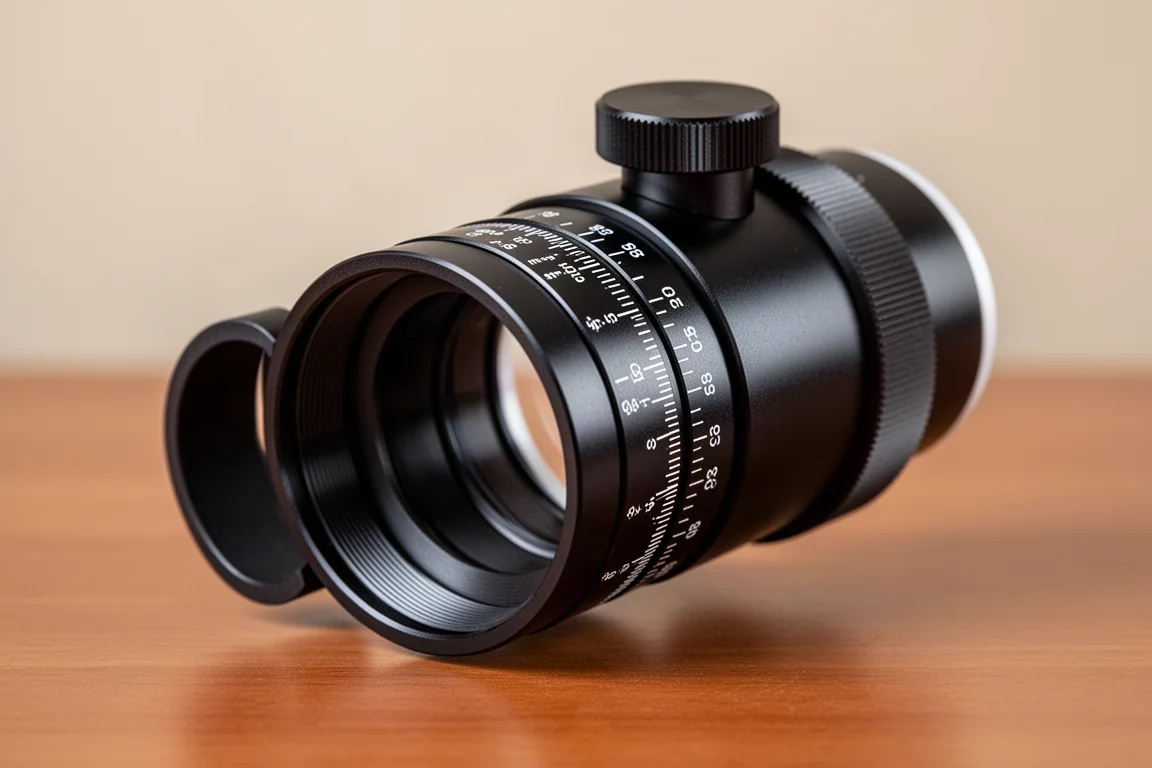
The Askar 80PHQ is the heavyweight, literally. It matches the SVBONY’s 18-inch retracted length but weighs 10.6 pounds (4.8kg) with its reducer, which is expected from four large glass elements plus a three-inch reducer. It comes with excellent rings covered in tapped holes, a long Vixen-style dovetail, a metal top handle, and a metal front cap. The three-inch two-speed focuser feels sturdy and premium, offers 360-degree rotation with every degree marked, and has mounting points ready for an electronic focuser such as a ZWO EAF, plus two Synta-style finder shoe positions.
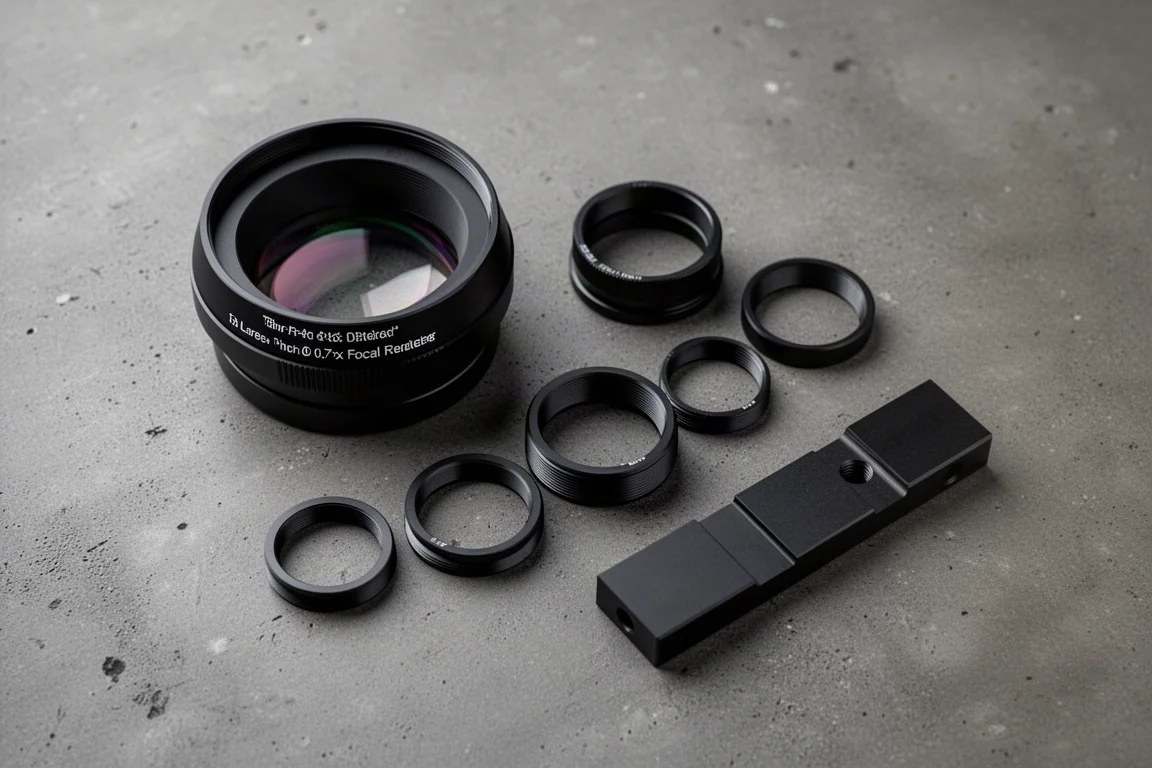
The standout accessory story is the camera connection: the scope ships with four different threaded connections (M48, M54, M68, and M79-class adapters) so unusual camera or spacer threads are covered out of the box, with diagrams included. The reducer threads into this adapter stack and the whole assembly slides into the focuser. Native, you attach the camera and focus with no back-focus requirement; with the reducer installed, you target 55mm of back focus.
Why the Askar 80PHQ Costs More
The price gap comes down to one headline feature: full-frame correction. Both the Askar’s native 600mm f/7.5 configuration and its 0.7x reducer are corrected across a full-frame sensor, which is genuinely rare in a telescope at this price point. That is the core reason a quad astrograph runs about three times the price of a competent ED doublet.
The SVBONY, by contrast, corrects well to roughly APS-C and falls off toward the corners of a full-frame chip. The Orion, with no corrector at all, delivers sharp stars only in the central portion of the frame, degrading quickly outward. If you plan to shoot with a smaller sensor, an ED doublet plus flattener covers that use case well; if full-frame coverage is the goal, that is what the premium tier buys.
Pricing Context and the Mount Rule
As tier benchmarks, achromats like the ShortTube 80 start around $100 and serve mainly as quick grab-and-go or guide scopes. Around $600 with a flattener is a standard entry point for an ED doublet. Premium 80mm-class astrographs like the Askar sit at $1,750 and climb from there, though smaller astrographs can be found cheaper. Value is ultimately subjective and depends on how picky you are about star shape and fringing.
One rule is worth repeating: never skimp on the mount. If you need to save money, save it on the telescope and especially the camera, then put it into tracking quality. For an 80mm refractor, small mounts work, but something in the class of an EQM35, HEQ5, or iOptron CEM26 is a better starting point. All three telescopes in this comparison were tested on a sturdy equatorial mount with guiding, so the optical results reflect the glass rather than tracking errors.
Image Comparison: What the Sensor Actually Records
Test conditions were kept consistent to isolate optical performance: the Iris Nebula, a new Moon, the target high in the sky, a full-frame mirrorless camera without a low-pass filter, ISO 1600, and four 4-minute exposures per telescope, all captured within a single hour. With calibration frames applied, all three scopes vignette noticeably, and dynamic background extraction flattens the field on each; the Askar comes out essentially perfectly flat.
The star shapes tell the real story. The Orion produces sharp stars in the center but badly distorted ones toward the corners, and its finished image shows violet fringing on bright stars along with muted color in the nebula itself. Cropped hard to the center, it still produces a usable photo, which is exactly why it works as a budget or guide scope.
The SVBONY lands in the middle. Corner stars on a full-frame sensor turn into triangles, so a crop to roughly APS-C size is the honest working area. With the flattener/reducer installed, stars improve substantially, dimmer stars appear that the achromat simply cannot show, and fringing drops dramatically. Center sharpness is good, though a step behind the Askar.
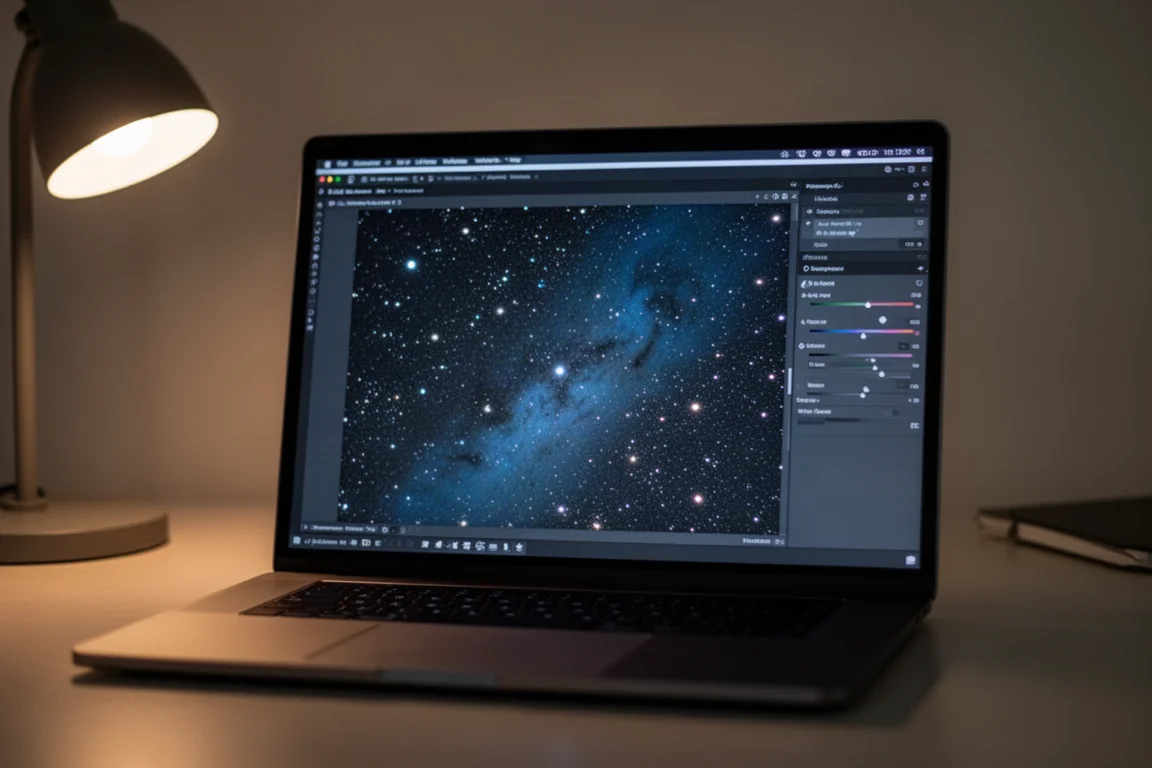
The Askar’s advantage is not so much in the center, where it is only modestly sharper than the SVBONY, but at the edges: corner stars stay round and sharp almost matching the center of frame across the full sensor. That edge-to-edge performance on full frame is precisely what you are paying the premium for, and it means hours of integration would fill the entire frame with usable detail rather than forcing a crop.
Buying Advice
Choose the Orion ShortTube 80 if you want an inexpensive guide scope or a first look at wide-field imaging and accept heavy cropping and some color fringing. Choose the SVBONY SV503 80ED with its matched flattener/reducer if you shoot APS-C or smaller sensors and want genuinely good deep-sky images at a sensible price. Choose the Askar 80PHQ if full-frame coverage, round corner stars, and built-in correction matter enough to justify the premium tier.
Conclusion
The difference between these three 80mm refractors is not aperture, it is optical correction. Each has a clear audience, and knowing which level of star quality you need is what turns one of these into the right purchase rather than an expensive lesson.
Product link
View more details for Askar 80PHQ
This product is mentioned in the review. Check the specifications, options, and compatibility before buying.
View more details for Askar 80PHQFurther reading
Related Reviews
Astrophotography
ASKAR FRA400C Review: A Versatile 400mm Refractor for Astrophotography and More
The ASKAR FRA400C is a compact 72mm refractor that balances reach, versatility, and portability for astrophotographers and visual observers.
Astrophotography
Askar SQA106 Review: A Premium 106mm Astrograph With Exceptional Optics
The Askar SQA106 is a premium 106mm quintuplet astrograph with impressive sharpness across full-frame sensors, though its price and weight demand careful consideration.
Astrophotography
Astro Imaging Gear 2026: Eight New Products Worth Watching
A look at the most interesting new astrophotography and astronomy products announced this year, from fast telescopes to smart cameras and wireless accessories.