Stereo Receivers
Yamaha R-N1000A Review: A Network Stereo Receiver With HDMI ARC and Real Power
Measured performance, HDMI ARC, MusicCast streaming, and a capable moving magnet phono stage: what the Yamaha R-N1000A does well and what to weigh before buying.
Introduction
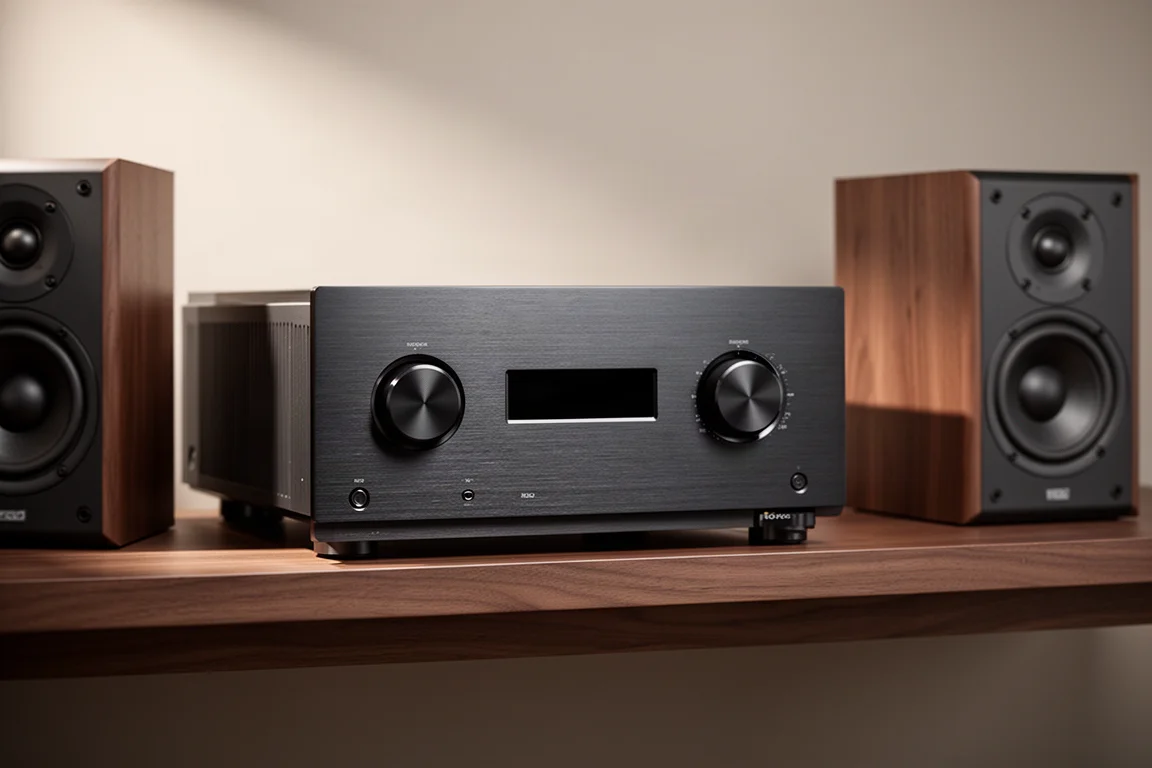
Most stereo receivers ask you to choose between good two-channel sound and practical living-room connectivity. The Yamaha R-N1000A is designed to close that gap. Its defining feature is an HDMI ARC input, which lets you connect a television directly and route audio from the TV’s own apps through the receiver and out to a proper pair of speakers.
That matters if a multi-channel home theater setup is not realistic in your room. With this receiver, a good pair of tower or bookshelf speakers can handle both music and television duty, and the result is a clear step up from a soundbar. The rest of the feature set is equally practical: MusicCast streaming with app control, a moving magnet phono stage for a turntable, and bass management that lets you dial in a subwoofer rather than accept a fixed crossover.
What follows is a closer look at measured performance, the features that matter day to day, and the handful of details worth knowing before you commit.
Who This Receiver Is For
The R-N1000A suits listeners who want one system for everything in a two-channel room. If you already own a decent pair of tower or bookshelf speakers and want your television to sound substantially better without building a surround setup, the HDMI ARC input is the feature that makes this receiver relevant.
It also suits vinyl listeners. The phono stage is built for moving magnet cartridges, so a turntable can plug straight in without an external preamp. And because bass management is adjustable through the companion app, anyone planning to add a subwoofer can integrate it properly instead of working around a fixed crossover point.
It is less suited to anyone who wants a compact desktop amplifier or who needs multi-channel surround processing. This is a full-size two-channel receiver with a specific job.
Main Strengths: Power, Noise, and Measured Performance
Yamaha rates the R-N1000A at 100 watts per channel, and the measurements back that up rather than merely meeting it. With both channels driven, the receiver delivered a clean 100 watts per channel at 0.1% distortion. In the 1 kHz power sweep it produced roughly 119 to 120 watts per channel into 8 ohms at 0.1% distortion, and about 129 to 130 watts at 1%. Into 4 ohms the numbers climb to around 180 watts at 0.1% and 203 watts at 1%, with dynamic power into 4 ohms reaching roughly 260 to 265 watts with both channels driven.
That is meaningful headroom for a two-channel receiver. The hardware behind it looks the part as well: dual heat sinks, 12,000 microfarad power supply capacitors, a large E-core transformer, and four output devices per channel. The amplifier’s frequency response stays linear out to a 3 dB point at 70 kHz.
Noise performance is strong too. At one watt of output, the signal to noise ratio measured 90 dB A-weighted. As a rough guide, 80 dB is acceptable and anything at or above 90 dB is excellent, which means this receiver stays quiet even with high-efficiency speakers. At one watt, the second-order harmonic sat 90 dB below the fundamental.
Against the Arcam A25, the Yamaha is a few decibels noisier at the amplifier outputs and gives up a little in gain matching between preamp and power amplifier. In exchange, it offers more high-current capability for driving 4 ohm speaker loads.
Connectivity, Streaming, and Bass Management
The back panel covers the practical bases. There is the HDMI ARC input for a television, a network connection, coaxial and optical digital inputs for digital sources, and speaker terminals for two pairs of speakers wired in parallel. The moving magnet phono stage handles turntables directly.
MusicCast adds app-based control and streaming, a newer addition to this class of two-channel receiver. Bass management is the more consequential feature. Where earlier designs such as the Yamaha A-S801 offered a subwoofer output with a crossover fixed somewhere around 80 to 90 Hz, the R-N1000A lets you set both the high-pass and low-pass filters from the app, along with delay. That makes subwoofer integration adjustable rather than fixed.
Digital conversion is handled cleanly. At the 44.1 kHz CD sampling rate the filter rolls off gently, and the small residual in the 43 to 44 kHz region sits around 120 dB down. Higher sampling rates push the rolloff further out and stay clean.
The preamp output deserves a mention for anyone planning to add an external power amplifier. It delivers 4 volts RMS, and distortion and noise improve noticeably when Pure Direct is engaged: roughly 82 dB SINAD in normal operation against about 98 dB with Pure Direct. Signal to noise measured 111 dB A-weighted with Pure Direct on, dropping to about 106 dB with it off. Pure Direct bypasses extra processing, and the measurements confirm the benefit. If clean numbers matter to you, it is worth leaving engaged.
Phono and Preamp Performance
Vinyl listeners get a genuinely capable moving magnet stage. With a 5 millivolt input, roughly what an MM cartridge produces, the phono frequency response stayed flat from 10 Hz out to the limit of the test equipment. Some competing designs roll off in the bass region; this one does not, which keeps the low end intact and leaves any filtering decision to you.
Distortion measured 0.07% in normal mode, a figure dominated by noise rather than nonlinearity. Engaging Pure Direct improved the result by roughly 12 dB, to around 75 dB SINAD, which is a strong result for a built-in phono stage. Compared with the Arcam A25, this is the clearer advantage: the Yamaha’s phono section is the better of the two, while the A25’s noise performance at the amplifier outputs is slightly ahead.
The combination of a flat phono response, low noise, and a 4 volt RMS preamp output means the R-N1000A works as a credible front end for a system built around an external amplifier, not just as an all-in-one.
Things to Consider Before Buying
The most noticeable shortcoming is tactile rather than electrical. The volume control lacks ball bearings, which makes it feel less smooth and less substantial than the weighted, gliding controls associated with higher-end hi-fi gear. It does not affect sound quality, but it is the kind of detail that stands out in daily use.
There is also an impedance selector switch on the back. Leave it at its default 8 ohm setting regardless of the speakers you connect, including 4 ohm designs. Switching to the lower setting limits the voltage available to the amplifier rails, which reduces power and makes the amplifier clip sooner. It exists for heat dissipation requirements, not for listening.
Because the receiver has a large heat sink area, ventilation matters. Leave clearance above and to the sides of the chassis. And since the two pairs of speaker terminals are wired in parallel, avoid running two pairs of 4 ohm speakers at high volume, which would present the amplifier with a 2 ohm load.
Finally, this is a full-size component. If your priority is a minimal footprint rather than power and connectivity, a smaller amplifier may suit you better.
Buying Advice
Buy the R-N1000A if you want a two-channel system that does double duty. The HDMI ARC input means a television can feed it directly, MusicCast handles streaming and app control, adjustable bass management makes a subwoofer easy to integrate, and the measured performance supports both efficient and 4 ohm speakers with headroom to spare.

Buy it with confidence if you already own speakers you like and want to improve both music and television sound without a surround system. If you are a vinyl listener, the phono stage is a real strength rather than an afterthought. The main reasons to look elsewhere are ergonomic or spatial: a volume control that lacks the heft of premium designs, and a chassis that needs breathing room. Neither changes how the receiver performs, but both are worth factoring into your decision.
Conclusion
The Yamaha R-N1000A is a well-rounded network stereo receiver. It meets its 100 watts per channel rating with measured results above spec, stays quiet at low output levels, handles 4 ohm loads with genuine current capability, and pairs that amplifier with HDMI ARC, MusicCast streaming, adjustable bass management, and a phono stage that measures as well as it needs to. The complaints are minor and specific. For a two-channel system that also has to serve a television, it is an easy recommendation to consider.
Product link
View more details for Yamaha R-N1000A
This product is mentioned in the review. Check the specifications, options, and compatibility before buying.
View more details for Yamaha R-N1000AFurther reading
Related Reviews
Stereo Receivers
Marantz Stereo 70s Review: A Slim Two-Channel Receiver With Real Home Theater Connectivity
A slim two-channel receiver that pairs natural stereo sound with 8K video switching, HEOS streaming, and a genuinely good phono stage.
Stereo Receivers
Onkyo TX-8470 Review: A Stereo Receiver With AVR DNA
A close look at the Onkyo TX-8470, an $800 stereo receiver with HDMI 2.1 switching, a built-in phono stage and streaming, plus the trade-offs to weigh first.
Stereo Receivers
Outlaw Audio RR 2160 Mark II Review: A Stereo Receiver With Almost Every Input You Need
A feature-dense stereo receiver with a moving magnet and moving coil phono stage, switchable bass management, a built-in streamer, and 110 watts per channel at $999.