Laser Welding
Xlaserlab X1 Pro Dual Wire Feeder Review: Does It Add Real Value?
A hands-on look at the Xlaserlab X1 Pro dual wire feeder, comparing it to the single wire setup on a 700 W laser welder.
Introduction
Running a dual wire feed on a small 700 W laser welder raises an obvious question: does it actually make sense over the standard single wire feed? The Xlaserlab X1 Pro has been used for several months with the standard single wire feed, and it works really well in that configuration. The dual wire feeder is a brand new accessory for this welder, and the real question is how much benefit it brings on a unit that sits on the low end of the wattage range.
The X1 Pro has proven to be a lot more capable than expected, especially on thicker materials. This review compares the dual wire feeder to the single wire feeder across three different joint configurations, all using 1/8 in (3 mm) thick steel with fillet welds. The three configurations are a T-joint, a lap joint, and an outside corner. The outside corner is where the biggest benefit is expected, since outside corners typically show underfill and require multiple passes with the single wire feed.
What Is the Xlaserlab X1 Pro Dual Wire Feeder?
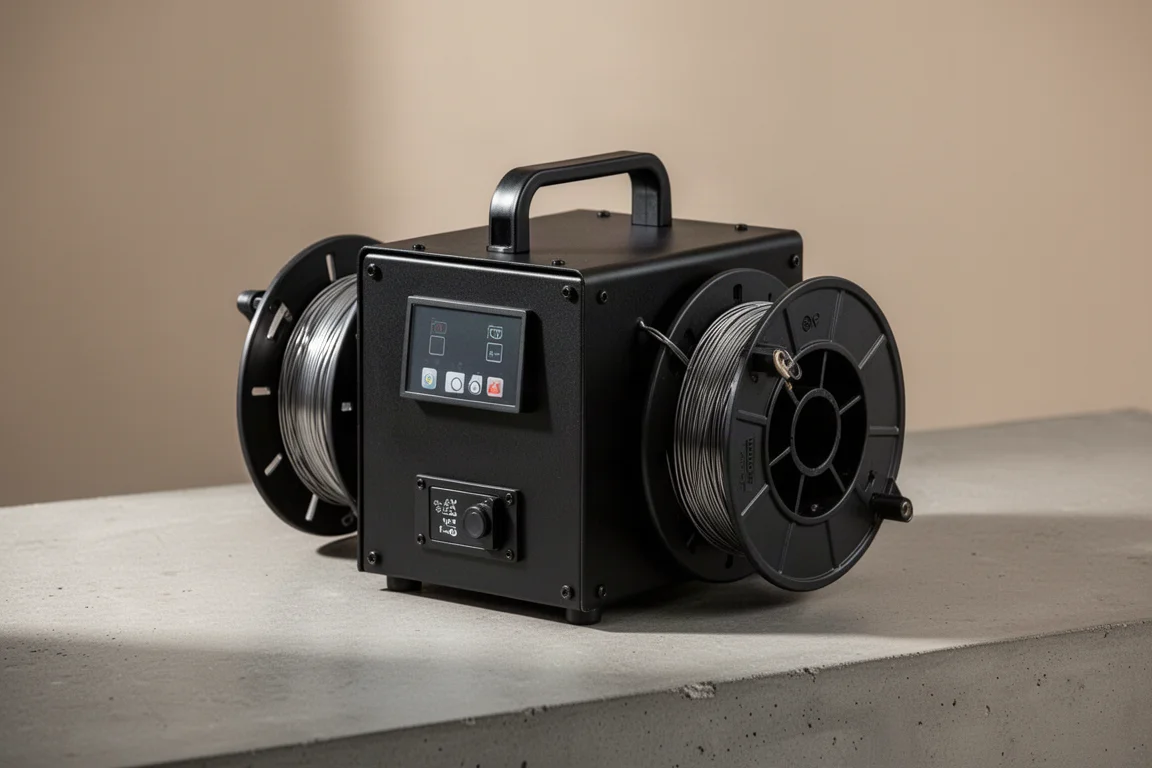
The dual wire feeder is a standalone unit designed to feed two wires simultaneously into the laser welding gun. It comes in a full metal case with a sturdy build. One wire roll goes on one side and another roll goes on the other. The unit has wheels on the bottom with a handle that extends, so it can be rolled around like a suitcase. With two full-size rolls loaded, the unit weighs around 80 lb including the wire, which makes the suitcase-style rolling mechanism less practical. Setting it on a cart is likely the better approach for most users.
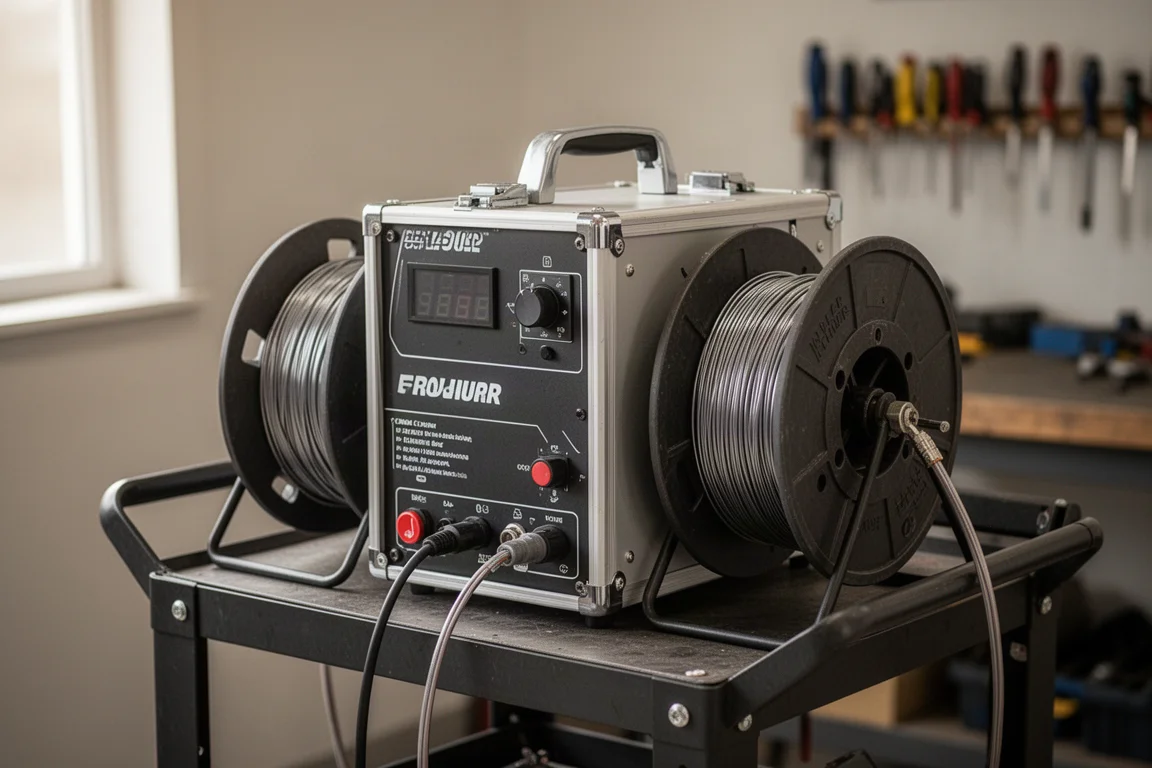
The front panel is similar to the single wire feeder, with a wire feed and retract button directly on the unit. Having these controls on the unit is nice, though having them on the gun would be even better. The unit is sized to fit two full 12-in rolls with 4-in wide rolls, which is a lot of wire for laser welding.
One notable omission is that no adapters are included to bring the unit down for 8-in rolls. Since aluminum and stainless steel rolls can be expensive, users may not want to buy full 12-in rolls for laser welding, which uses wire more slowly than MIG. 3D printing adapters is a workable solution, though the first adapter found online did not fit and a custom design was needed.
Build Quality and Included Accessories
The internal design of the dual wire feeder is solid. It uses dual drive rolls on both sides, and rather than the Swiss feed mechanism found on the single wire feeder, this unit uses an e-power design. This is a Chinese-made wire feeder that looks similar to Swiss feeds but has a few differences. It uses a spur gear to engage the idler with the drive, providing true four-wheel drive all the way through.
A single healthy-size motor drives both sides, connecting into a metallic gear box with a direct geared connection between the two sides. This ensures the two sides stay synced. Overall, the build quality is solid and there is nothing to be disappointed about.
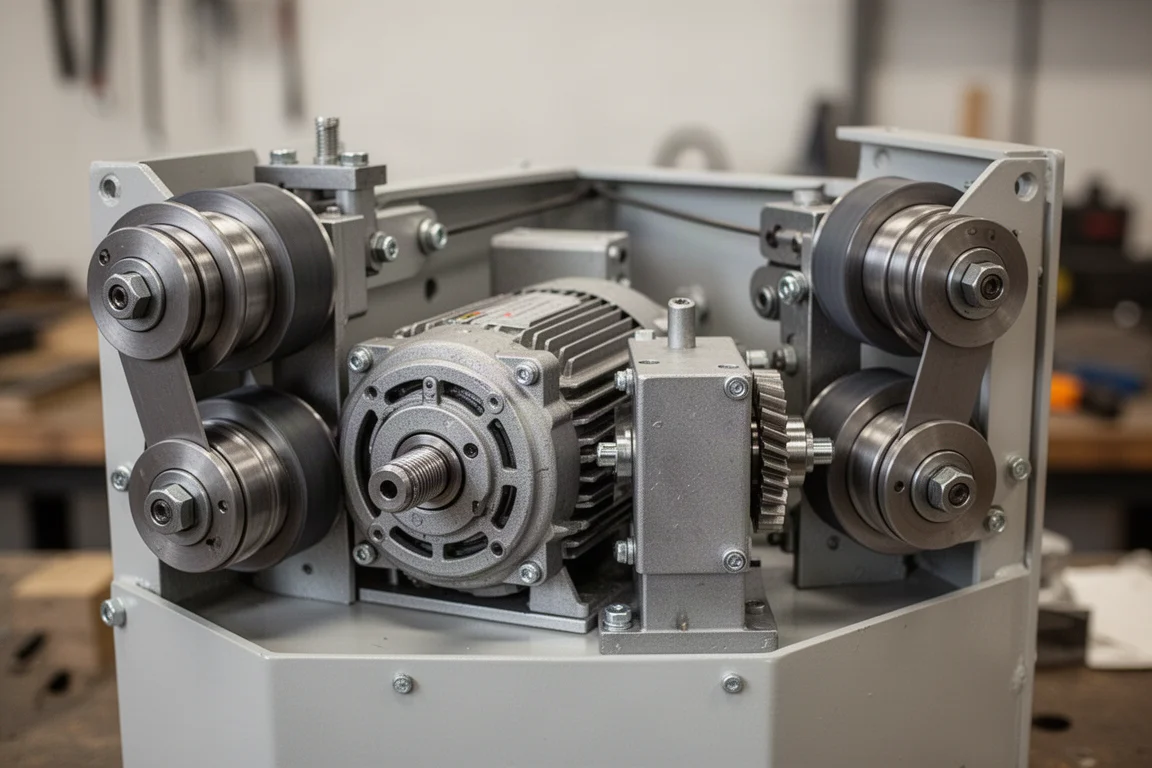
The included accessories are impressive. The unit comes with a set of drive rolls installed, plus three additional sets. There are V-shaped rollers for solid steel wire and U-shaped rollers for aluminum. Having specialty rollers is a big upgrade and is genuinely helpful for users working with different wire materials.
The package also includes the electrical cable and a dual cable with two connections that go into the wire feed ports, feeding out into one connection that attaches to the gun. A variety of welding nozzles are included as well. The feed cables are long, so it takes a little while for wire to feed all the way up through them. Each side slides in and is secured with a screw rather than threads.
Setting Up the Dual Wire Feeder
Assembling the dual wire feeder requires installing the feed cables and the gun assembly. The double cable ferrule fits into the gun, then slides into place, and a contact tip goes into the end. Putting the whole assembly together before sliding it into the gun works best.
The spool brake on this unit is one of the better ones seen, though not the very best. Backing off the idler tensions is recommended, since most people run these too tight on MIG welders and the same applies to wire feeders. There is no need for excessive tension, and it only adds wear on the mechanisms.
The fastest wire speed setting is 50 mm/s, which is fairly slow. A jog feature would be useful, but none is available, so holding the wire feed button is the only option until the wire reaches the tip. The contact tip should be kept close to the nozzle to keep the wires side by side so the cast of the wire does not have an effect.
Welding Performance: T-Joint
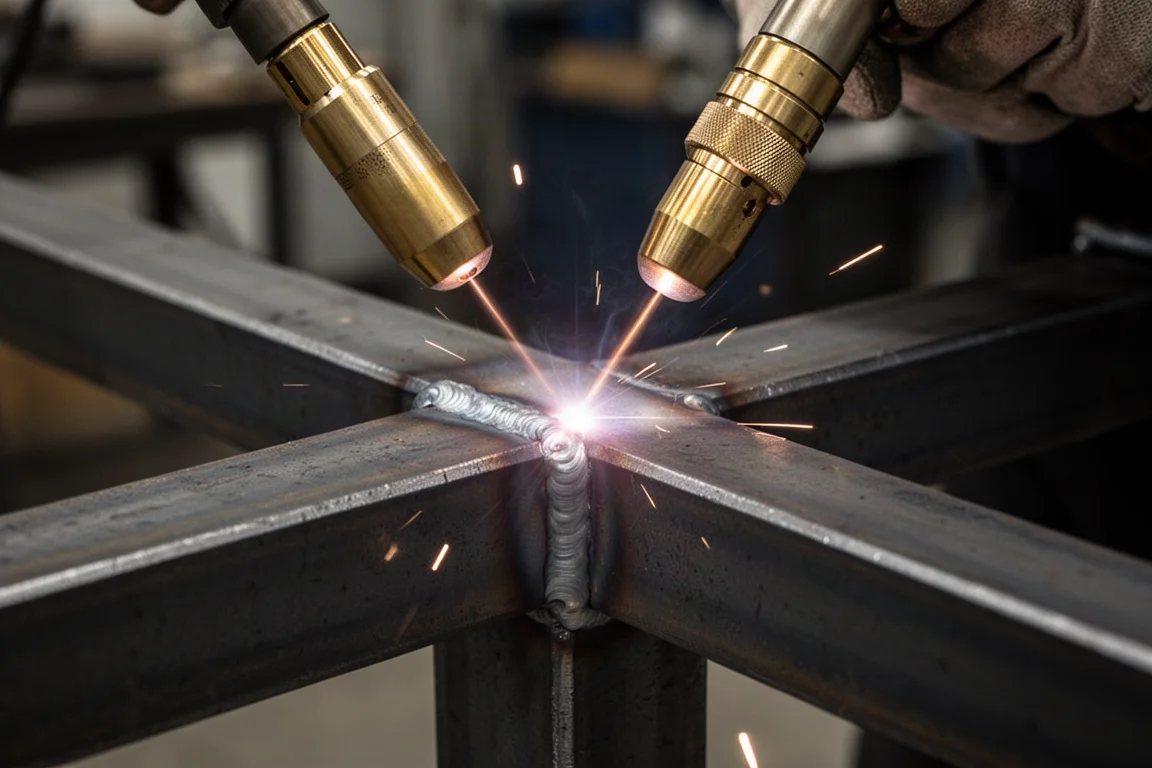
Running the dual wire feeder on a T-joint initially showed a total lack of fusion down in the toe of the weld. The wire appeared to be getting in the way. Increasing the scan width resolved the issue, and the resulting weld looked pretty nice and slightly bigger than the single wire version.
Comparing the two T-joints, the fillet weld size is the most obvious difference. Measured with calipers, the single wire fillet weld was around 80 thousandths of an inch, while the dual wire fillet weld was about 100 thousandths of an inch. That is roughly 25% bigger on the fillet weld size. The dual wire weld was also a bit more consistent and cleaner, with not quite as much oxidation. This could be due to the larger nozzle on the dual wire feeder and increased gas flow, or the additional wire acting as a heat sink.
From a strength perspective, both welds held up well in a fillet weld break test, bending open from the root. The root held up really well with both the single wire and the dual wire. Neither weld broke open, indicating good penetration. Either one works just fine for T-joints, and the dual wire does not provide a huge advantage here, though it does not hurt and may offer a little more durability in cyclically loaded environments.
Welding Performance: Lap Joint
The lap joint showed a more significant difference between the single and dual wire feeders. The single wire fillet weld was much smaller, while the dual wire deposited significantly more material. Both welds looked perfectly acceptable, but the additional fill from the dual wire feeder could be beneficial for aesthetic reasons or strength in lap joint applications.
In the break test, the single wire lap joint opened up fairly easily, showing less penetration into the joint than expected. The sheer cut edge of the material appeared to roll up, leaving not enough material to consume during deposition with the single wire. It might still be strong enough for decorative applications and possibly some structural ones, but more strength would be preferable.
The dual wire lap joint performed much better. There was a big difference, with a whole lot more material covering the joint. The lap joint welded on one side with a 700 W machine held up stoutly in the break test, exceeding what has been seen with the single wire feeder on similar joints.
Welding Performance: Outside Corner
The outside corner joint showed the most dramatic difference between the two setups. With the single wire, there was definitely not enough fill to grind the corner down and have adequate reinforcement. Multiple passes would be needed to build up enough material. With the dual wire feeder, a single pass filled the corner in enough that just a quick touch with a grinder to round things over would leave the joint in really good shape.
The single wire outside corner showed good penetration all the way along, but the joint yielded and closed up like a book under load. The fracture surface was not that big, since the single wire could only deposit so much material. The dual wire outside corner was much fuller, with a whole lot more reinforcement through the joint and good penetration right through to the bottom. It did not bend open because of the much larger weld deposit.
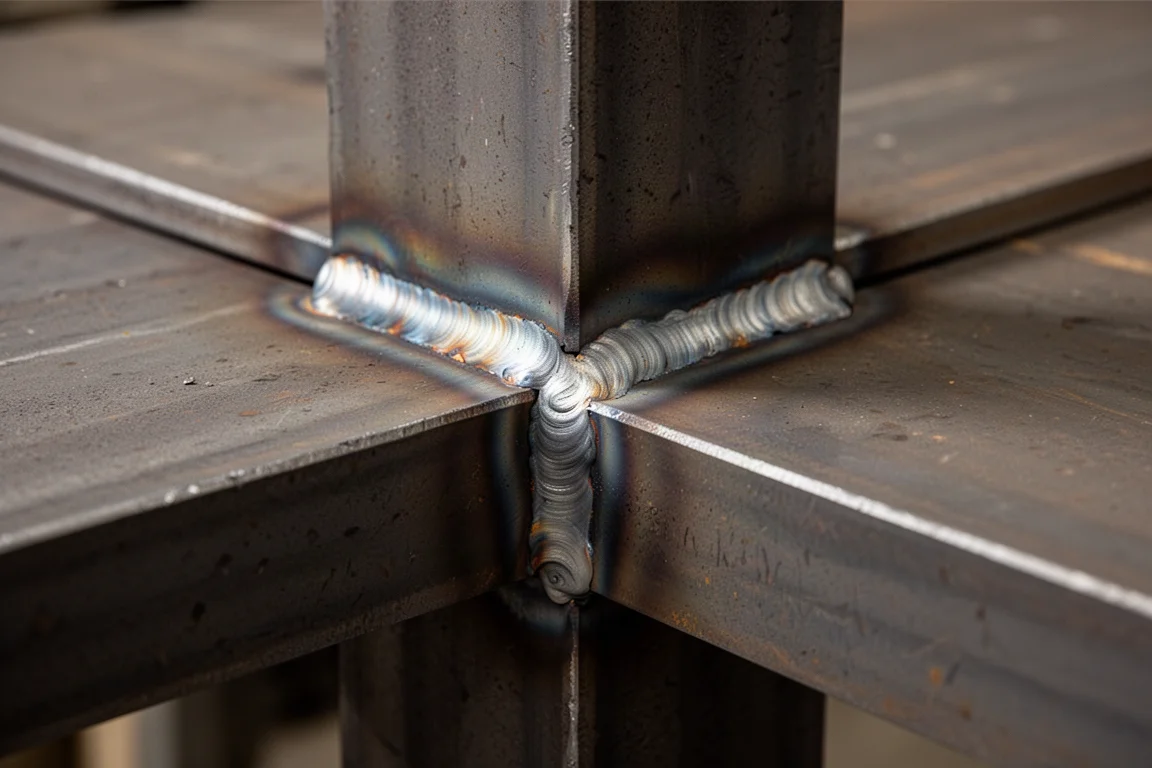
For applications like building a large diesel tank with all outside corners welded using laser, the dual wire feeder offers a clear advantage. Running two or three passes with a single wire feed could achieve the same result, but the dual wire feeder does it in a single pass.
Buying Advice
The Xlaserlab X1 Pro dual wire feeder is a well-constructed wire feeder, especially given the price point. Industrial wire feeding equipment for MIG welders can cost thousands of dollars, while this unit comes in well under $1,000 with dual feeders, a dozen drive rolls, all the necessary hardware, two feed tubes, and nozzles. Factoring all of that in, it is really well made.
There is a genuine benefit to running dual wires, even on a 700 W unit. For fillet welds on T-joints with 1/8 in material, which is near the top end of what this welder is set up to handle, there is not a whole lot of benefit. The results are fairly apples to apples, though the dual wire does provide a little more size and possibly more durability. For most T-joint work, the single wire is fine.
The lap joints and outside corners are where the additional fill makes quite a bit of difference and has a positive impact. For most regular work, the single wire feed remains completely adequate. When working with thick material, an arc process is still the go-to. However, for running a whole bunch of outside corners on larger tanks or similar projects, the dual wire feeder is worth setting up.
The unit can also be used as a single feeder by loading just one roll, with the other side spinning free. This flexibility makes it a practical option for users who are not sure they will always need dual wire feeding.
Conclusion
The Xlaserlab X1 Pro dual wire feeder is a solid, well-built accessory that delivers real benefits in specific applications. It excels at lap joints and outside corners, where the additional fill material makes a meaningful difference in weld strength and appearance. For T-joints, the results are comparable to the single wire feed, with only a modest increase in fillet weld size.
At well under $1,000 with a comprehensive set of included accessories, it represents good value for users who regularly weld lap joints or outside corners. For those who mostly work on T-joints, the single wire feed remains a perfectly adequate choice. The ability to run it as a single feeder adds flexibility, making it a practical investment for shops that want the option without committing to dual wire feeding full time.
Product link
View more details for Xlaserlab X1 Pro Dual Wire Feeder
This product is mentioned in the review. Check the specifications, options, and compatibility before buying.
View more details for Xlaserlab X1 Pro Dual Wire FeederFurther reading
Related Reviews
Welding Safety
Handheld Laser Welding Safety: Managing the Real Hazards
A practical look at the hazards of handheld laser welding and the layered controls that keep the work safe.
Laser Cutting & Welding
xTool MetalFab: Common Questions Answered Before You Buy
A practical look at the xTool MetalFab laser cutting and welding system, covering cutting detail, software ease, welding performance, and real-world trade-offs.