Floorstanding Speakers
Wharfedale Evo 5.3 Review: A Compact Three-Way Floorstander That Gets the Basics Right
A close look at the Wharfedale Evo 5.3, a £1,099 three-way floorstanding speaker with weighty bass, a dedicated dome midrange and an upgraded AMT tweeter.
Introduction
Floorstanding or standmount? It is a debate as old as hi-fi itself, and it is not going to be settled any time soon. Below roughly £3,000, plenty of floorstanders try to buy bass extension by squeezing extra or larger drivers into a cabinet that is not damped well enough, and the result is usually a loss of resolution in a two-channel system. Above £5,000, three-way designs and properly built cabinets become the norm and the pendulum swings back toward the bigger speaker.
Wharfedale’s Evo 5.3 sits in the interesting territory between those two points. It is a compact three-way floorstander priced at £1,099 a pair, part of an Evo line overhauled in 2025 with new cabinets, drivers and crossovers. Wharfedale is part of the International Audio Group, which also counts Quad, Mission and Audiolab among its brands, and the group’s approach has long been about delivering maximum value for the money. The Evo 5.3 sets out to do the things large speakers do well without falling too far behind on the things small speakers do well.
That is a genuinely useful brief. Buyers at this price are usually trying to avoid a subwoofer, or they have a room where a compact tower simply makes more sense than a standmount on a pair of stands. The question is whether the engineering underneath the familiar Evo silhouette has moved on enough to justify the asking price.
Who the Wharfedale Evo 5.3 Is For
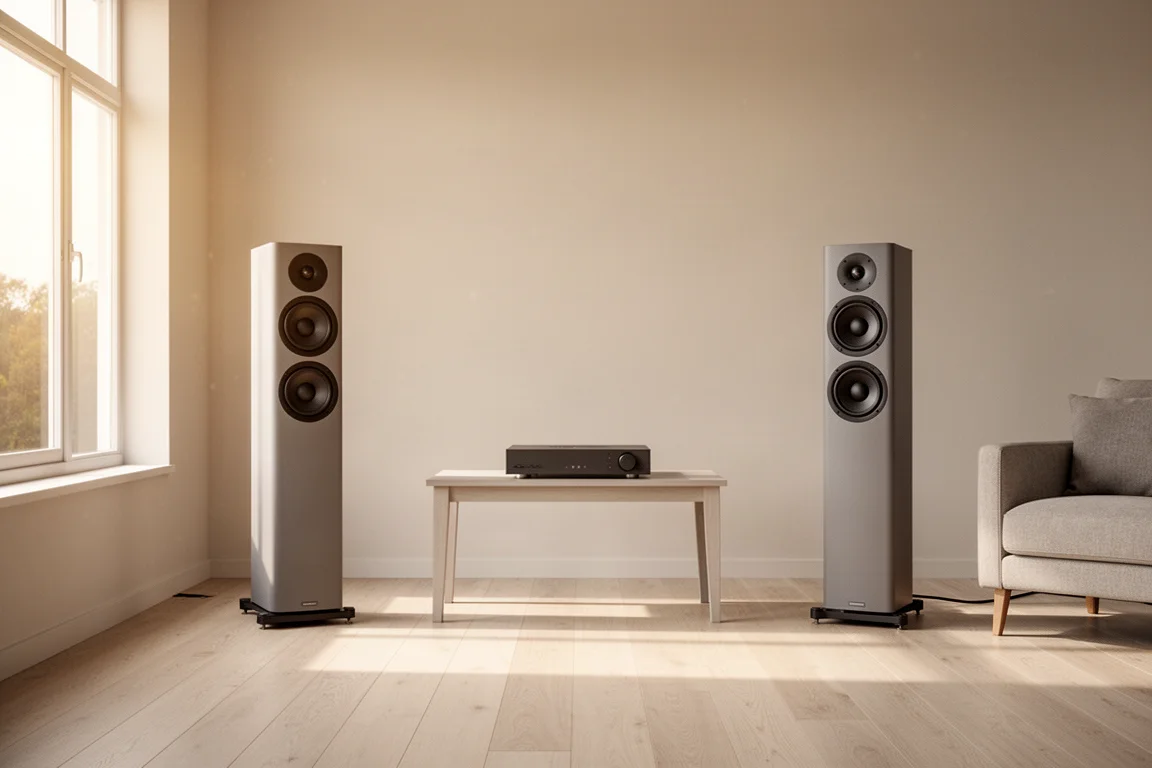
This speaker is aimed at listeners who want floorstander behaviour, meaning deeper bass and the ability to shift cleanly between quiet and loud passages, without accepting the usual penalty in midrange clarity. It suits a medium to large room where a standmount would struggle to fill the space, and it suits anyone who would rather not add a subwoofer to a two-channel setup.
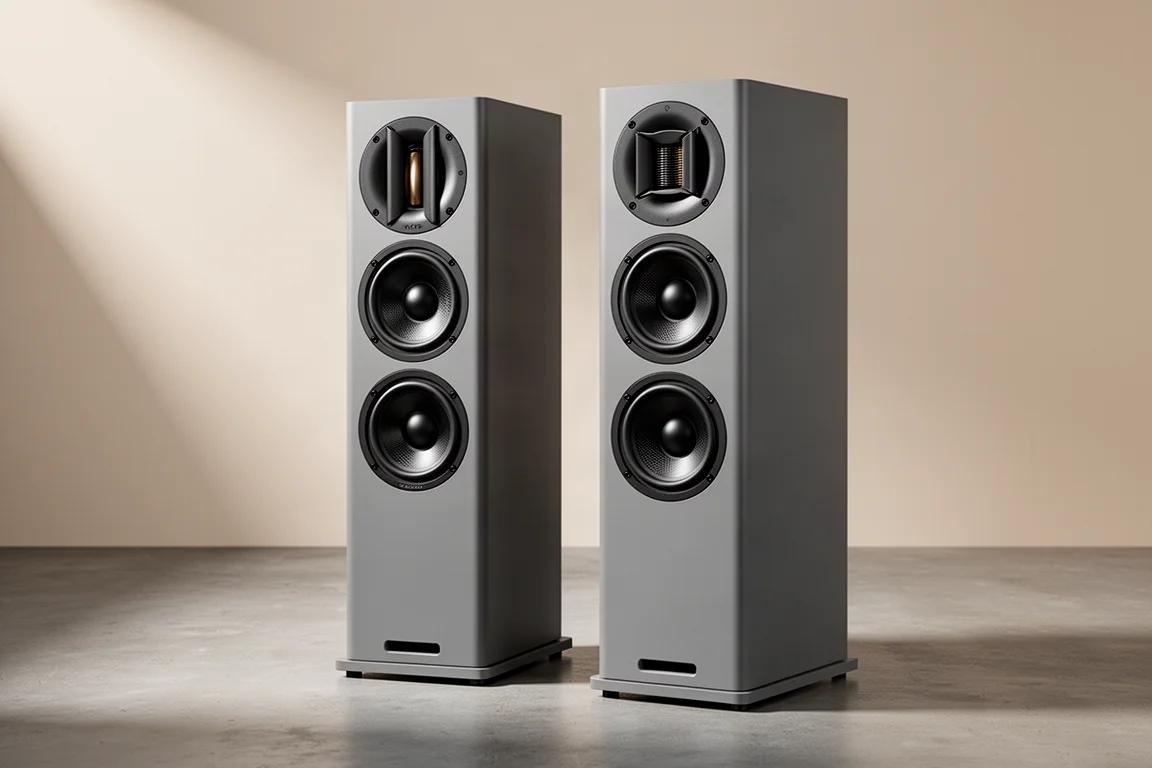
The range also includes two standmounts, a second floorstander and a centre channel, so the Evo 5.3 can anchor a stereo system or form the front pair of a multi-channel one. Finishes matter here too. Earlier Evo models were offered in matte black, matte white and a gloss real walnut veneer, while matte Luna Grey is new to this generation. Real wood veneers are unusual at this price point, and the grey finish gives the cabinet a restrained, industrial character that flatters the predominantly black drivers on the front panel.
Main Strengths
The Evo 5.3 is not simply a reworked Evo 4.3 with a new badge. Cabinet volume has grown in every dimension, the drivers have been revised, and the crossover has been reworked, all of which shows up in the way the speaker behaves in a real room.
Weighty, Well-Defined Bass
Bass and the lower midrange up to 825 Hz are handled by two 130 mm aramid drivers. Aramid, better known as Kevlar, is a material Wharfedale has used for more than 25 years. The larger cabinet drops the quoted bass extension from 42 Hz on the Evo 4.3 to 40 Hz on the 5.3 at the minus 6 dB point. Those figures are not inflated with room gain, which makes them more honest than a lot of published numbers.
What matters more than the specification is the character of that bass. These are not boom boxes. The low end pressurises a room while keeping enough definition to hold on to rhythms, and it does not drown bass definition or significantly pollute the midrange. That combination is rare at this price, where extra punch so often comes with a loss of control. This generation also introduces new damping materials in the bass drivers, including the Reszo frame that sits in front of the cone and the Reszo seal, a low-mass elastomer damping ring positioned where the cone meets the surround.
Midrange Separation and an Articulate AMT Treble
A 50 mm soft dome midrange, recessed into a waveguide to match dispersion, covers 825 Hz to 4 kHz. This is the core benefit of a three-way design: it keeps the crossover away from the region around 2 kHz, where human hearing is most sensitive because of natural resonances in the ear canal. The result is strong separation between performers and a midrange that stays clean as the music gets busy.
The air motion transformer tweeter has grown from 30 x 60 mm on the previous generation to 35 x 70 mm here, which improves efficiency and dispersion. It is articulate, offering delicacy and extension in the highest octaves, and it sits in balance with the rest of the frequency range. The overall tone is warm, but the speaker cannot fairly be described as bright or rolled off. If there is a reservation, it is that a little more midrange resolution would help extract subtle details from recordings, and the placement of individual performers in absolute terms is slightly vague, which is impressive nonetheless for a floorstander with extra cabinet resonances to manage.
Cabinet, Drivers and Crossover Upgrades
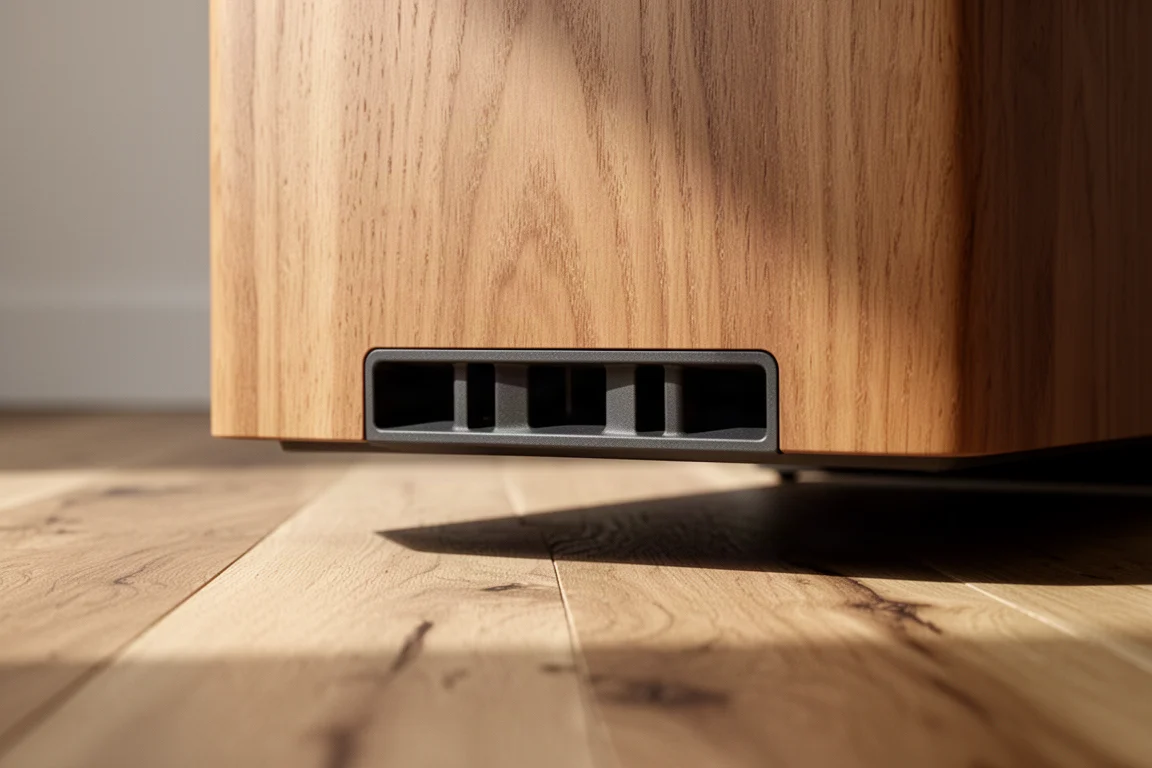
Construction remains MDF with a soft, high-loss chipboard layer sandwiched in the middle, surfaces lined with acoustic foam and three internal braces to reduce resonances. The port is still downward firing, but the plinth now has three slots rather than two to improve airflow, and the low centre of gravity plus the port orientation should make the speaker easier to place near walls than a rear-ported design.
The midrange and tweeter both pick up the Reszo frame damping, and both use Silent Weave, a cotton and felt hybrid added to the cavity behind the diaphragm to reduce unwanted reflections inside the cabinet. The tweeter also gains an elastomer damping gasket behind the diaphragm. The crossover in the three-way models is now split across two boards rather than one, separating the bass filter, shortening signal paths and upgrading components to polypropylene capacitors and air core inductors in the woofer circuit. Taken together, it amounts to a significant facelift.
Things to Consider Before Buying
The Evo 5.3 is a compact floorstander with a downward-firing port, but it still asks for care during setup, and it is more revealing of the electronics in front of it than the price might suggest.
Placement and Room Interaction
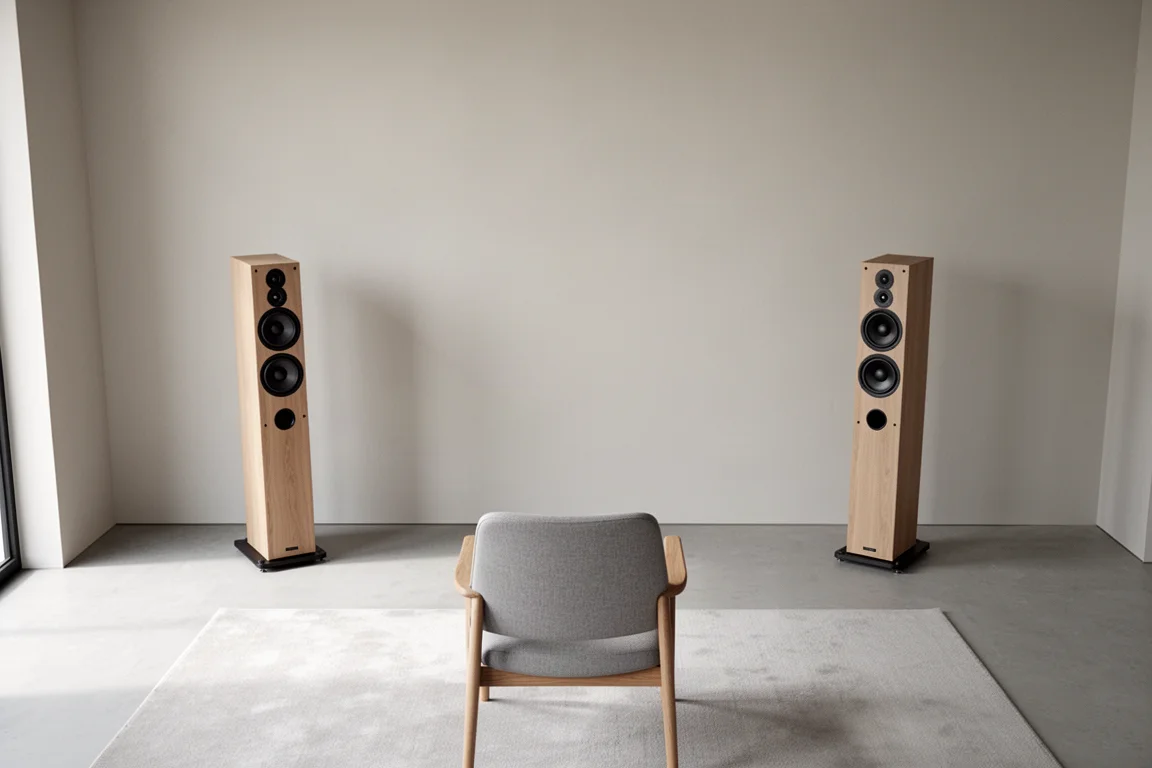
Despite the downward-firing port, this speaker did not get away with being pushed close to a wall. To stop the bass from wallowing, it ended up just under 91 cm, or about 3 ft, into the room, measured from the centre line of the front baffle. A toe angle pointing the speakers at the listener’s shoulders helped with midrange clarity as well. Every room behaves differently, so the exact distance and angle will vary, but budget for some experimentation rather than assuming a corner-friendly placement.
Amplifier Matching
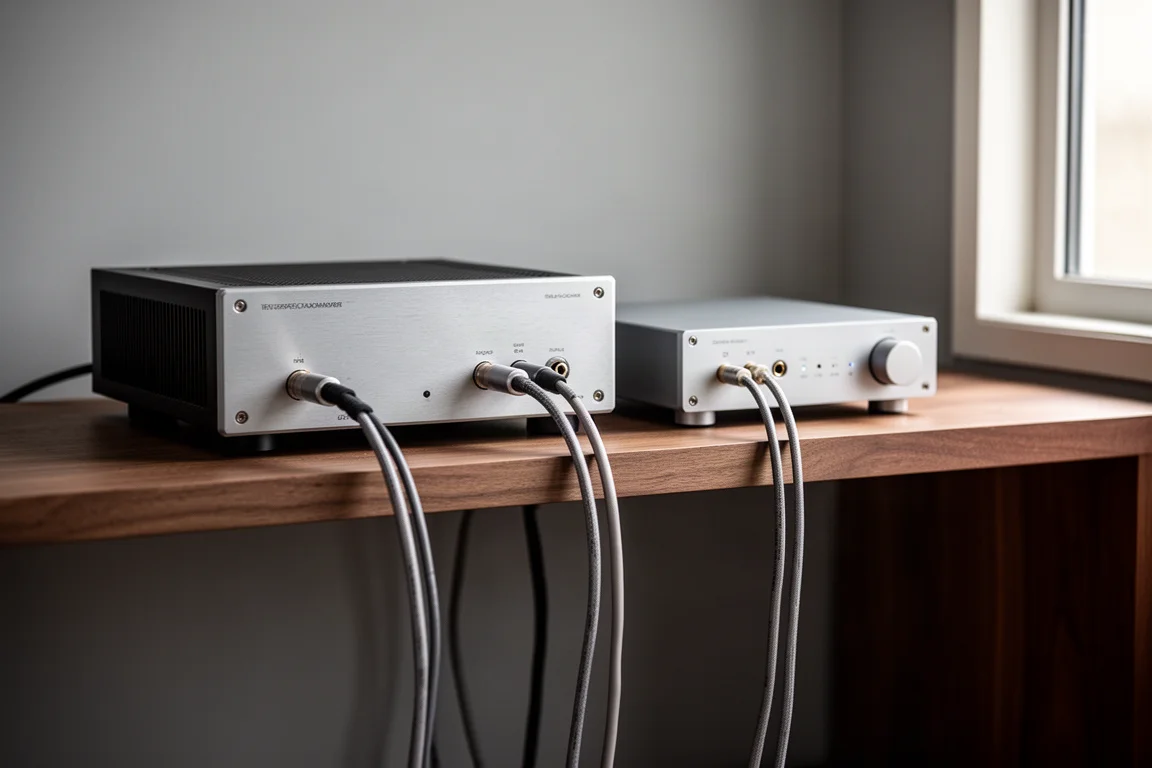
Because the presentation is distinctly on the warm side of neutral, partnering equipment matters. A neutral integrated amplifier lets the speaker’s own personality come through, which means the system as a whole will not sound neutral. An Audiolab 6000A Mk II at £699 drove the speakers with plenty of authority and its internal DAC was handsomely suited to the task, though a separate DAC can lift fidelity further. The similarly priced Musical Fidelity B1Xi offered slightly better fidelity across the board, while a £1,950 Exposure 2510 unearthed limitations in the Evo 5.3’s midrange clarity and did not make an entirely satisfying combination.
If you want to temper the rich and organic presentation, choose amplification with strong bass control and a leaner tone. A Cambridge Audio MXW70, which delivers 70 W per channel into 8 ohms and 125 W into 4 ohms to match the speaker’s 4-ohm rating, paired with the DAC Magic 200M comes in at just under £850 and trades a little authenticity in the rendering of notes for a detailed, controlled and fairly neutral result. One practical note: the rear terminals are good quality, but there is only one pair, and two sets would have been preferable given the three-way design, since bi-amping the woofers would allow better bass control.
Buying Advice
The Evo 5.3 makes most sense when it is judged against what else £1,099 buys. An Acoustic Energy AE109 Mk II at £599 is a rare gem, pulling off real clarity by being ultra compact and using an HDF cabinet, but it cannot match the Wharfedale for bass extension or for shifting gears easily between quiet and loud passages. A Dali Opticon 2 Mk II standmount at £1,000 delivers more tonal shading and texture to notes and images better, yet it does not let you follow each performer as easily.
A larger Monitor Audio Silver 100 7G produces a wider sound stage, more focused imaging, tighter bass and crisper transients with more fine detail in the midrange. The top end of both speakers offers similar resolution, but the two have very distinct personalities. Vocals and many instruments can sound a little cool on the Monitor Audio, while the Wharfedale turns the tonal temperature a couple of clicks above neutral. Someone who loves one is unlikely to love the other, so the decision comes down to tonal preference rather than outright superiority.
That makes the amplifier choice part of the purchase decision rather than an afterthought. If you already own a lean, well-controlled amplifier, the Evo 5.3 will reward it. If your system leans warm already, the combination may end up richer than you want. Buyers who value bass weight and a relaxed tonal balance should find the pairing easy to get right, and the real wood veneer option at this price remains a genuine bonus for anyone who cares about how the room looks.
Conclusion
Wharfedale has successfully updated a popular range, and the Evo 5.3 is a very well put together compact three-way floorstander for £1,099. The Luna Grey finish flatters the predominantly black drivers in a tasteful, modern design, and the sound is rich, with weighty and well-defined bass, excellent midrange separation and open, refined highs. A little more midrange resolution would be welcome, and the warm balance will not suit every listener or every system.
What defines the speaker is that it belongs on a very short list of floorstanders under £2,000 that do the things big speakers do well without falling too far behind on the things small speakers do well. For listeners who want that combination, and who are prepared to give it space and match it with a suitably controlled amplifier, the Evo 5.3 earns a strong recommendation.
Product link
View more details for Wharfedale Evo 5.3
This product is mentioned in the review. Check the specifications, options, and compatibility before buying.
View more details for Wharfedale Evo 5.3Further reading
Related Reviews
Floorstanding Speakers
Acoustic Energy AE109 Mark II Review: A Refined Floorstander at £699
The Acoustic Energy AE109 Mark II is a slim, warm sounding floorstander that delivers clarity, midrange body and strong imaging in small to medium rooms.
Floorstanding Speakers
Acoustic Energy AE509 Review: A Slim Floorstander With Deep, Defined Bass
A practical look at the Acoustic Energy AE509, a slim floorstanding speaker with carbon fibre drivers, deep and well-defined bass, and an easy-going character that rewards careful system matching.
Floorstanding Speakers
Arendal 1528 Tower 8 Review: Reference Neutrality With Real Demands
A close look at the Arendal 1528 Tower 8, a nearly five-foot, 200-pound floorstander that rewards generous space, serious power, and high listening levels with reference-grade neutrality.